
github.com
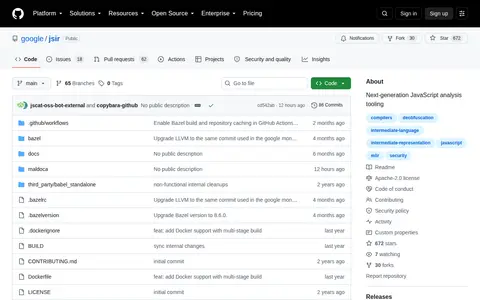
Next-generation JavaScript analysis tooling
Directory
Published directory entries matching your search.
Next-generation JavaScript analysis tooling

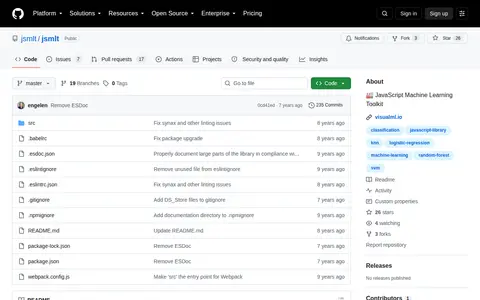
JSMLT is an open source JavaScript library for education in machine learning. It implements supervised learning algorithms, including SVM, random forest, decision tree, perceptron, neural networks, k-nearest neighbors and logistic regression, and provides visualization examples for exploring how the algorithms work.

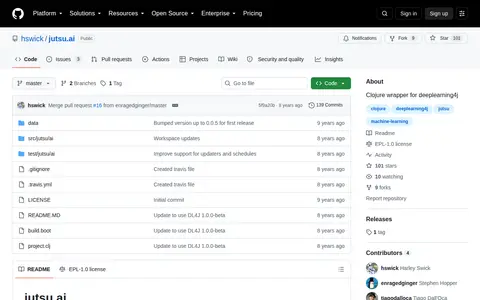
A Clojure wrapper for deeplearning4j with added syntactic sugar, aiming to provide a declarative API for machine learning on the JVM. It translates Clojure keywords into Java method calls, making many deeplearning4j configuration options accessible. The project is a work in progress, and configurations have been tested on basic feedforward nets, RNNs and CNNs.

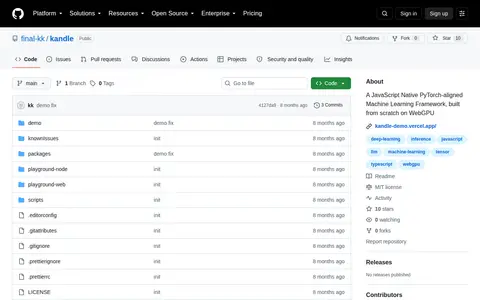
A JavaScript Native PyTorch-aligned Machine Learning Framework, built from scratch on WebGPU.

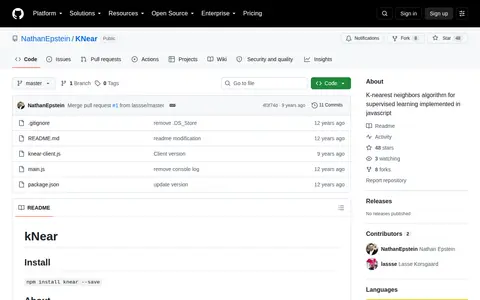
JavaScript implementation of the k nearest neighbors algorithm for supervised learning.

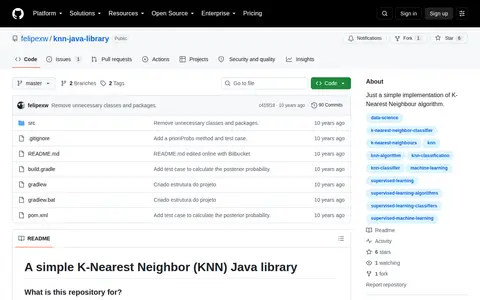
Just a simple implementation of K-Nearest Neighbors algorithm using with a bunch of similarity measures.

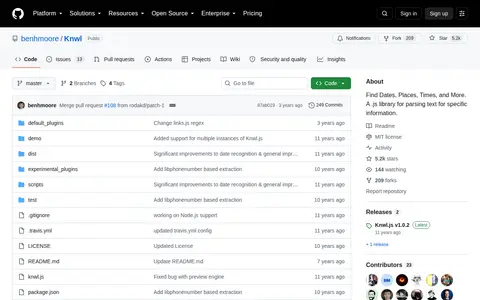
Knwl.js is a JavaScript library that parses text for dates, times, phone numbers, emails, places and more. Parser plugins supply parsing abilities, and the library runs in the browser or on the server with Node.js.

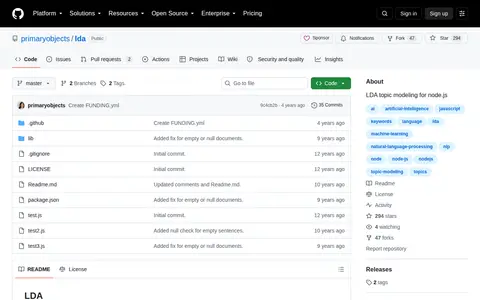
LDA is a JavaScript library for node.js that performs Latent Dirichlet allocation topic modeling, extracting topics and related keywords from a collection of documents. It returns an array of topics, each with an array of terms and probabilities, and uses English stop-words by default.

Supports teaching, studying or skills practice with AI-guided learning tools.

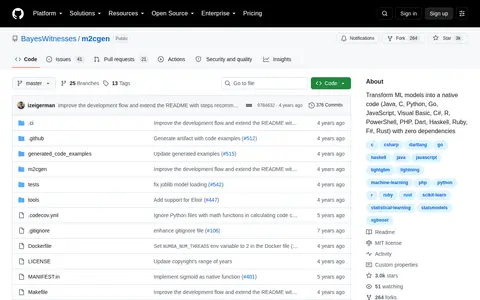
m2cgen is a tool that transforms trained machine learning models into native code across a wide range of programming languages including Java, C, Python, Go, JavaScript, C#, R, PHP, Dart, Haskell, Ruby, F#, and Rust, with zero dependencies. Its codebase is hosted in the BayesWitnesses GitHub repository, which includes navigation for installation, development guidance, supported languages, and supported model types.

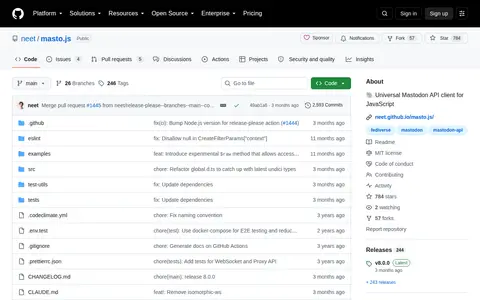
🐘 Universal Mastodon API client for JavaScript

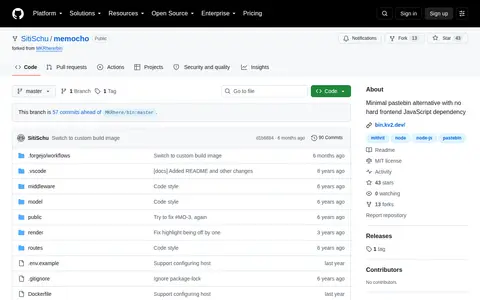
Memochō is a lightweight pastebin and hastebin alternative forked from mkr/bin, with no hard frontend JavaScript dependency. It can run via Node.js with configuration through environment variables, in Docker, or with Docker Compose. Customisation is possible by adding a style.css and addon.js file to a custom directory.

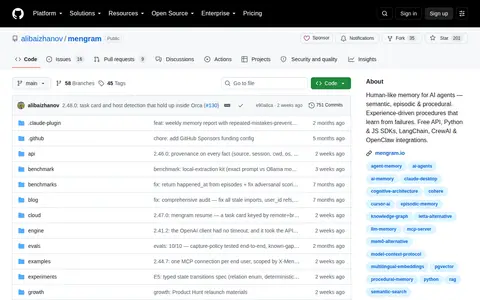
Mengram is an open-source project that provides human-like memory capabilities for AI agents. It supports semantic, episodic, and procedural memory types, with experience-driven procedures designed to learn from failures. The project offers a free API, Python and JavaScript SDKs, and integrations with LangChain, CrewAI, and OpenClaw.
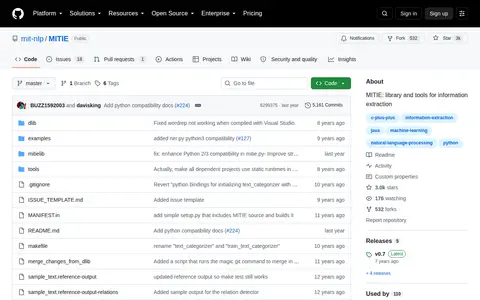
MITIE is a set of tools for information extraction built on dlib. It provides named entity extraction and binary relation detection, along with tools for training custom extractors and relation detectors. Pre-trained models support English, Spanish and German. The core is written in C++, with bindings for Python, R, Java, C and MATLAB.

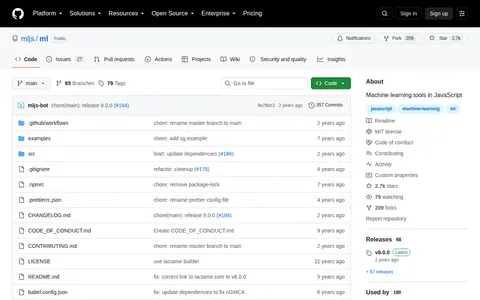
ml.js is an open-source machine learning toolset implemented in JavaScript, hosted in the mljs/ml GitHub repository. It provides libraries for both supervised and unsupervised machine learning tasks, alongside usage resources and standalone example code for users.

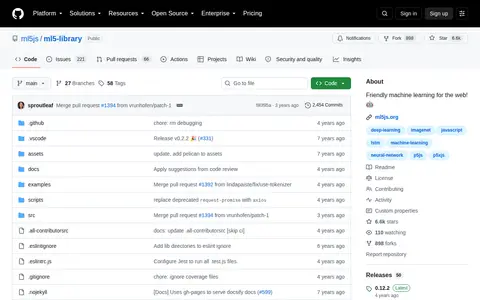
ml5.js is a JavaScript library providing access to machine learning algorithms and models in the browser, building on TensorFlow.js. It aims to make machine learning approachable for artists, creative coders and students, and is supported by code examples, tutorials and sample data sets. The project is described as currently in development.

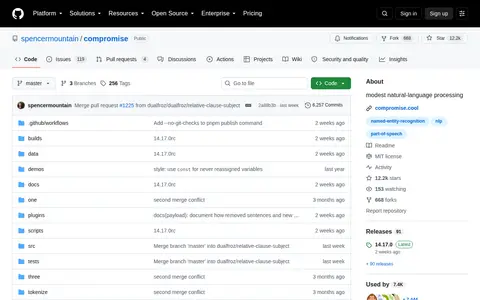
Compromise is a JavaScript natural-language processing library that turns text into data, offering tokenization of words, sentences and punctuation along with part-of-speech tagging, matching, and transformations such as verb conjugation and number handling. It runs on the client side, is about 250kb minified, and includes plugins, with multilingual support listed for French, German, Italian and Spanish.

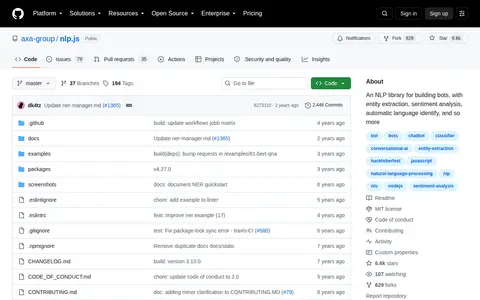
nlp.js is a JavaScript library for building chatbots and bots, developed by AXA Group. It includes features such as entity extraction, sentiment analysis, and automatic language identification. The library is open-source and hosted on GitHub.

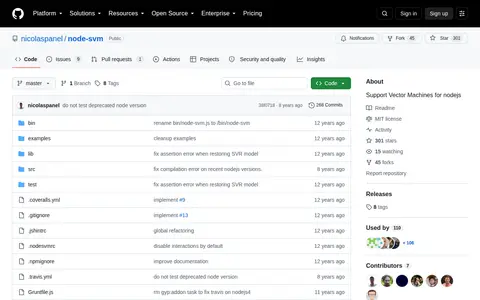
Node-SVM is a GitHub repository that provides support vector machine (SVM) implementations for Node.js. The project enables developers to use SVM algorithms within JavaScript applications. It includes installation instructions, a quick start guide, and an API reference. The repository is open source and contributed to by the community.

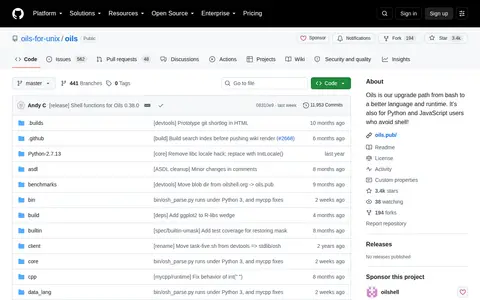
Oils is a project that provides an upgrade path from Bash to a better language and runtime. It is also intended for Python and JavaScript users who avoid shell scripting. The repository includes source code, contribution guidelines, and development build instructions.

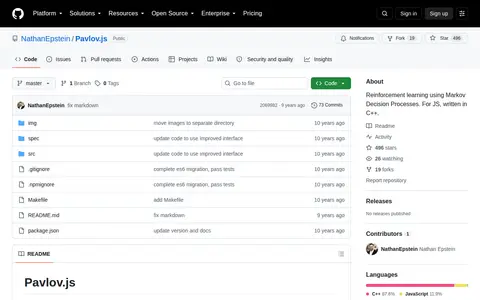
Pavlov.js is a reinforcement learning library that uses Markov Decision Processes. It is written in C++ and compiled to JavaScript. The package is installed through npm. Users define transitions and rewards, then call learn to derive a policy and query actions for states.

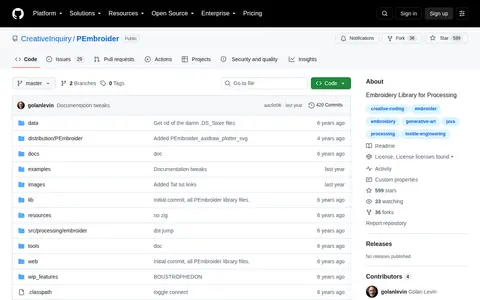
PEmbroider is an open-source, cross-platform lightweight Java library for generative embroidery design that integrates with the Processing creative coding framework. It is intended for artists, craftspersons, educators, makers, and schools, and can generate embroidery files in .DST, .EXP, and .JEF formats. The library was developed at the CMU Frank-Ratchye STUDIO for Creative Inquiry and is released under the GNU General Public Licence (GPLv3) and Anti-Capitalist Software License (ACSL 1.4).

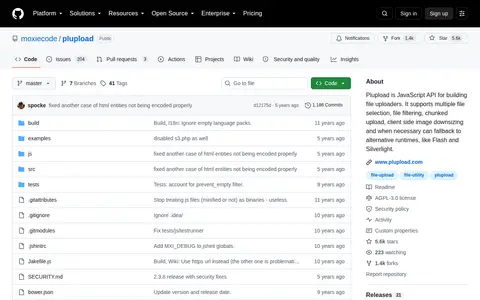
Plupload is a JavaScript API for building file uploaders. It supports multiple file selection, file filtering, chunked upload, client-side image downsizing, and can fall back to alternative runtimes including Flash and Silverlight when necessary.

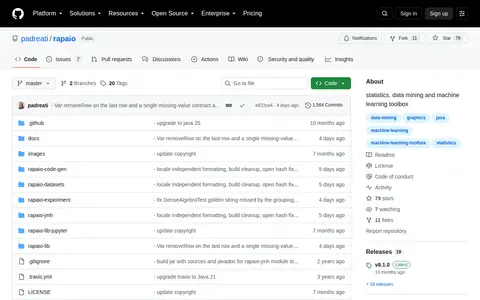
Rapaio is a statistics, data mining, and machine learning toolbox written in Java. It includes distributions, hypothesis testing, Naive Bayes, logistic regression, decision trees, random forests, boosting, SVM, PCA, and KMeans.