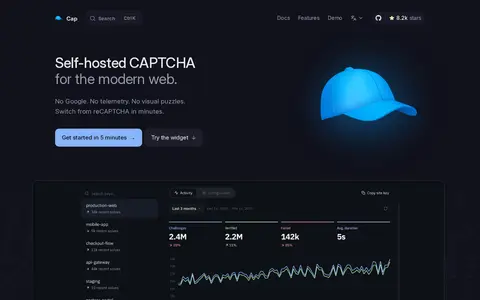

Cap is a free, open-source, self-hosted CAPTCHA alternative. It uses proof-of-work and JavaScript instrumentation challenges instead of visual puzzles, and is licensed under Apache 2.0. It is installed by running a server with Docker and adding a widget to a form.
Directory
Search results
Published directory entries matching your search.

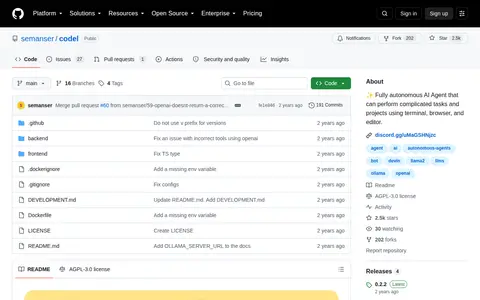
Codel is a self-hosted autonomous AI agent that performs tasks and projects using a terminal, browser and editor. It runs in a sandboxed Docker environment, detects the next step automatically, can fetch web information through a built-in browser, and saves command history and outputs in a PostgreSQL database.
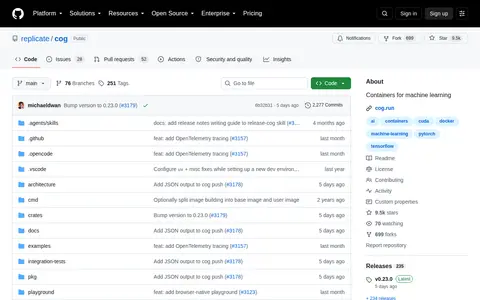
Cog is an open-source tool that packages machine learning models in standard, production-ready containers. Users define the environment in a configuration file, and it generates a Docker image with Nvidia base images and dependency caching. Model inputs and outputs are defined in Python, from which Cog generates an OpenAPI schema and an HTTP inference server. Models can be deployed to own infrastructure or Replicate.
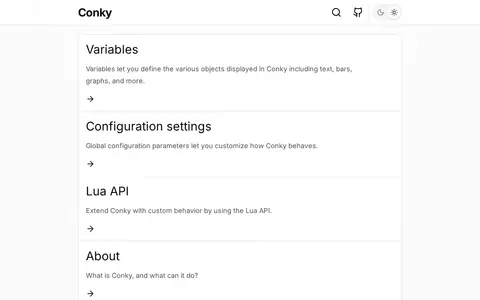
Conky is a documented system monitoring tool for Linux and similar desktop environments. Its documentation covers variables for defining displayed objects such as text, bars and graphs, global configuration settings, a Lua API for extending behavior, compiling from source, contributing, running with Docker, syntax highlighting and a GitHub wiki with user configs and scripts.
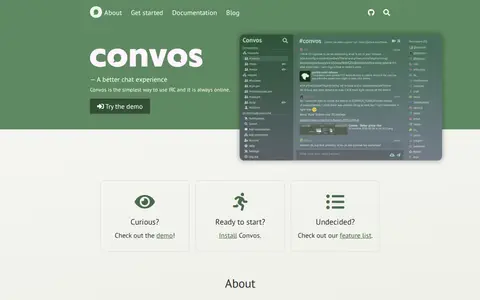
Convos is a multiuser chat web app for IRC that runs in the browser. It features a persistent bouncer on the server side that keeps users online after the browser window is closed, and it logs activity in an archive. It supports video chat with one or multiple participants, custom color themes, rich formatting with emojis and inline media, and installation on a home server, cloud service or Docker.
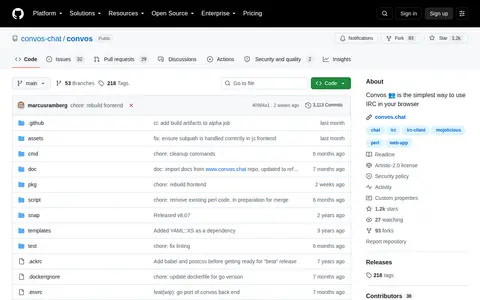
Convos is an open-source multiuser chat application hosted in the convos-chat/convos GitHub repository. It is designed as a simple option for using IRC directly in a web browser. The repository includes documentation for quick start, local installation, Docker deployment, and release creation.
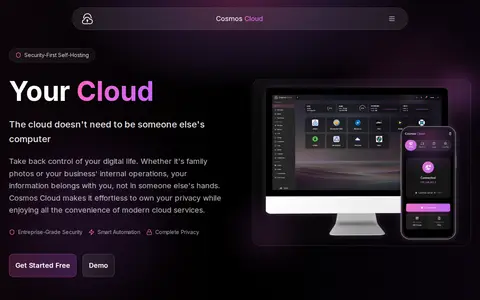
Cosmos Cloud is a self-hosted platform for running apps and services at home or in a business. It includes a reverse proxy, automatic HTTPS, SmartShield, a built-in VPN and backups. It can run as a standalone service or as a Docker container, and documentation covers installation, apps, URLs, users, backups, domains and HTTPS, Constellation VPN and storage.
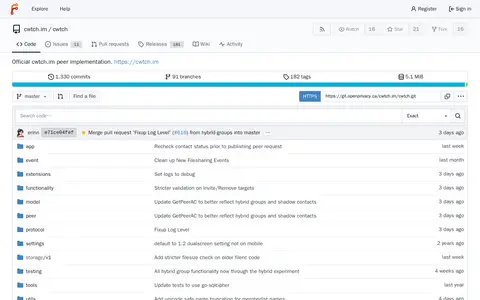
Cwtch is the official cwtch.im peer implementation, written mainly in Go. Its README describes it as privacy-preserving infrastructure for asynchronous, decentralized and metadata-resistant applications, extending the metadata-resistant Ricochet protocol to support asynchronous, multi-peer group communications through discardable, untrusted, anonymous infrastructure. The README notes that a server section is out of date and that no current docker container exists.
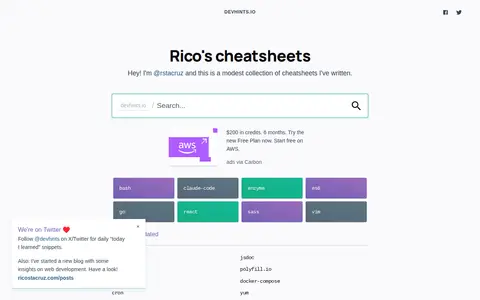
Devhints is a collection of web development cheatsheets covering topics such as JavaScript, CSS, Git, Docker, and various command line tools. Each sheet is a one-page quick reference with usage examples, links, and snippets. The site also includes guidance on writing cheatsheets and on writing Vim help files.
Distrobox is a tool that uses podman, docker or lilipod to create containers running the Linux distribution of the user's choice inside the terminal. The created containers are tightly integrated with the host, sharing the HOME directory, external storage, external USB devices, graphical apps and audio.
Receive notifications when an image is updated on a Docker registry
dizqueTV creates live TV channel streams from media on Plex servers. Channels, programs, commercials and settings are configured in a web UI. The spoofed HDHomeRun tuner can be added to Plex, Jellyfin or Emby, or the M3U URL used with third-party IPTV players. It ships as a Docker image and prebuilt binaries for Windows, Linux and Mac.
🐋 A Dockerfile for nginx-rtmp-module + FFmpeg from source with basic settings for streaming HLS. Built on Alpine Linux.
Ready to use deeplearning docker images.
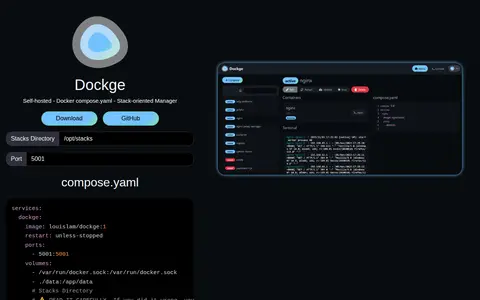
Manage Docker Compose application stacks through a web interface.
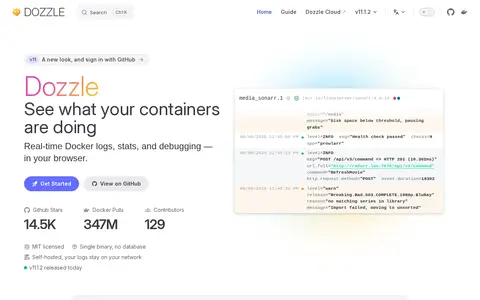
Dozzle is a lightweight, open-source log viewer for Docker, Swarm, and Kubernetes. It streams container logs in real time and allows searching, filtering by level or time range, and querying JSON fields with SQL from the browser.
This GitHub repository hosts the official code for DragGAN, a project presented at the SIGGRAPH 2023 conference under the title 'Drag Your GAN: Interactive Point-based Manipulation on the Generative Image Manifold'. The repository includes links to web demos, requirements documentation, and instructions for running a Gradio visualizer in Docker.
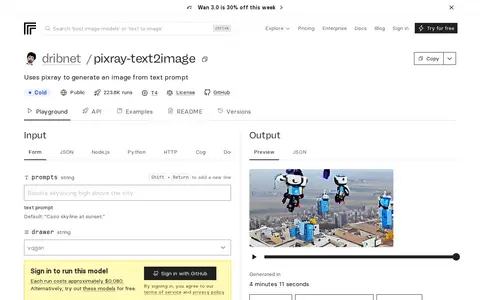
pixray-text2image is a public Replicate model that uses pixray to generate an image from a text prompt. It runs on Nvidia T4 GPU hardware, with predictions typically completing within 6 minutes, and is also open source and runnable on one's own computer with Docker.
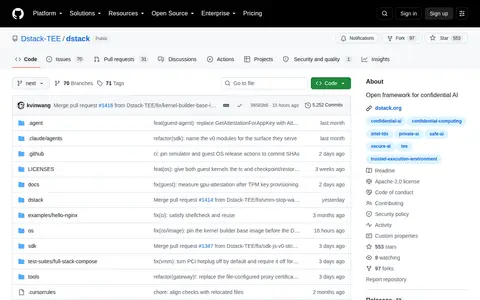
dstack is an open framework for confidential AI that runs containers inside confidential VMs with Intel TDX, using existing Docker Compose files. It supports attested workload identities and native NVIDIA Confidential Computing on H100 and Blackwell GPUs, with options for self-hosted TDX machines or Phala Cloud.
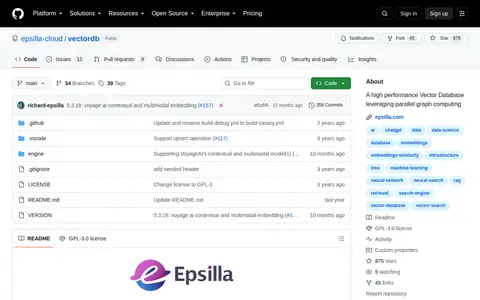
Epsilla is a high-performance vector database hosted on GitHub under the epsilla-cloud organization. It leverages parallel graph computing for its operations, and offers an experimental option to use it as a Python library without requiring a Docker image, alongside Epsilla Cloud as a deployment option.
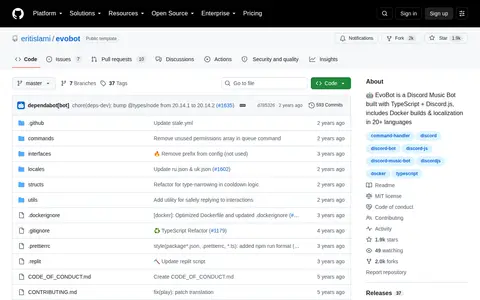
🤖 EvoBot is a Discord Music Bot built with TypeScript + Discord.js, includes Docker builds & localization in 20+ languages
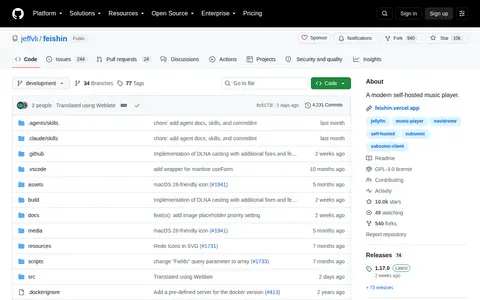
Feishin is a self-hosted music player with a desktop client and a web client. The desktop client supports MPV and web player backends and built-in lyric fetching. It is also distributed as a Docker image.
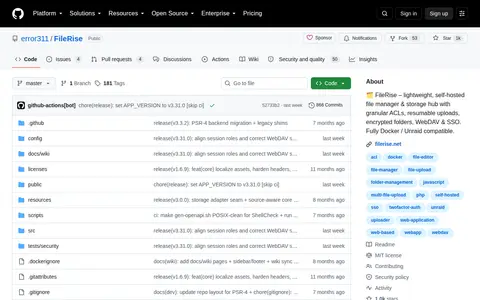
FileRise is a self-hosted web file manager and storage hub written in PHP. It provides per-folder ACLs, drag-and-drop and resumable uploads, file and folder sharing links, tags and search, and in-browser previews. It supports WebDAV access, optional folder-level encryption at rest, and OnlyOffice integration. A no-database setup is described, with Docker or a standard Linux PHP web server as deployment options.
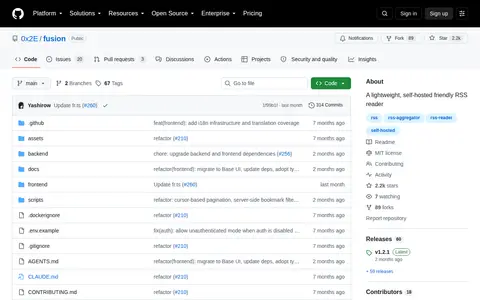
Fusion is a lightweight RSS reader intended to be self-hosted. It parses RSS and Atom feeds, supports feed auto-discovery and group organization, and offers unread tracking, bookmarks, search and keyboard shortcuts. It can run as a single binary or with Docker and includes a PWA web interface plus Fever API compatibility for third-party clients.