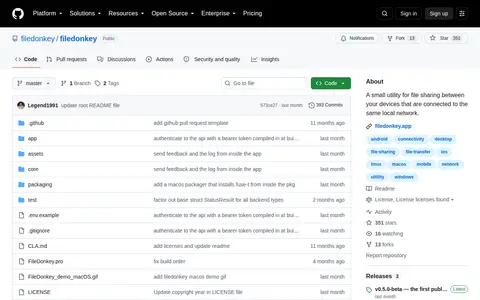

FileDonkey is a utility for file sharing between devices connected to the same local network. It presents another machine in the file manager as a disk that can be opened, browsed and edited, with files staying on the machine they already live on. Each machine shares one chosen folder, and devices find each other without configuration. A free beta is available for macOS, Windows and Linux, with Android and iPhone support planned.
Directory
Search results
Published directory entries matching your search.
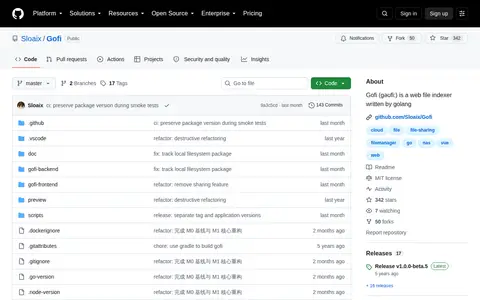
Gofi is a web file indexer and manager written in Go, with a React frontend. It offers file management features such as resumable chunk uploads, folders, rename, copy, move, batch deletion and indexed search. Configuration is done through environment variables.

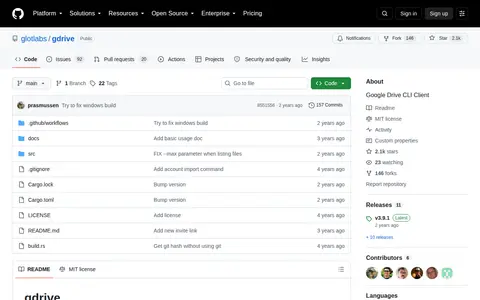
Google Drive CLI is a command line application for interacting with Google Drive, described as the successor of gdrive2 with only the most basic functionality implemented at present. It requires Google OAuth Client credentials and account setup through an add command, and it saves account credentials and tokens under a local configuration directory.
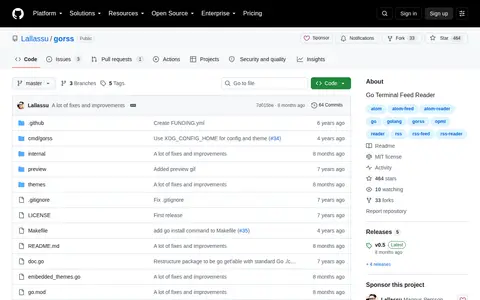
gorss is a simple RSS/Atom feed reader written in Go for the terminal. It reads feeds, stores data in SQLite, and supports OPML feed loading and XDG configuration. It offers keyboard shortcuts, configurable highlights, and built-in themes with runtime switching. Prebuilt binaries are provided for Linux and OSX.
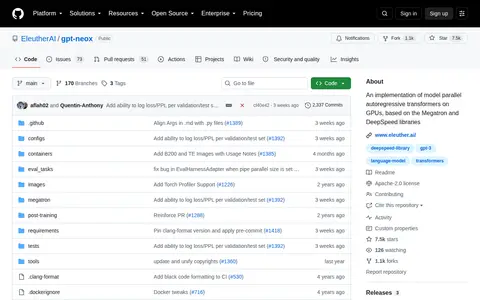
GPT-NeoX is EleutherAI's library for training large-scale language models on GPUs. It builds on NVIDIA's Megatron and adds DeepSpeed techniques plus optimizations. It supports launching via Slurm, MPI and the IBM Job Step Manager, and offers predefined configurations for architectures including Pythia, PaLM, Falcon and LLaMA 1 & 2. The repository states it is likely the wrong library for those not training models with billions of parameters from scratch.
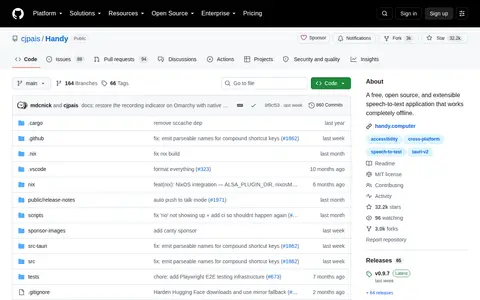
Handy is a free, open source, cross-platform desktop application for speech-to-text transcription. A configurable shortcut records speech, which is transcribed using Whisper or Parakeet V3 models and pasted into the active text field. Processing is local, with no audio sent to the cloud. It is available for Windows, macOS, and Linux.
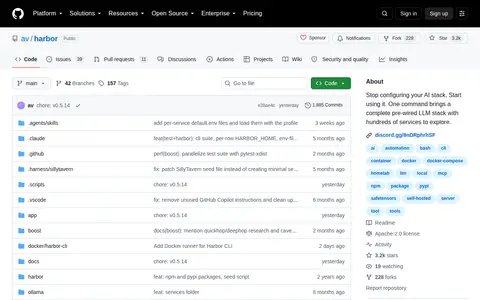
Harbor is a CLI and companion app that starts a pre-wired local LLM stack. Users pick services such as Ollama, llama.cpp, vLLM, Open WebUI, SearXNG, Speaches and ComfyUI, and Harbor handles Docker Compose orchestration, configuration and cross-service connectivity with a single harbor up command.
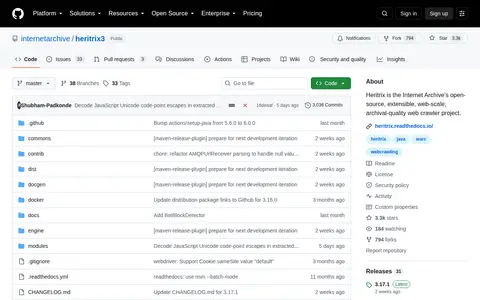
Heritrix is the Internet Archive's open-source web crawler project, described as extensible, web-scale and archival-quality. It is designed to respect robots.txt exclusion directives and META nofollow tags. Documentation covers getting started, operating, configuring crawl jobs and the REST API. It is free software under the Apache License, Version 2.0, with some files under other licenses.
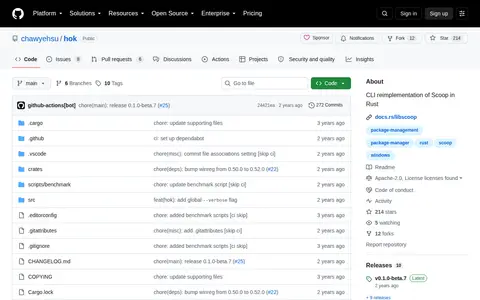
Hok is a command-line implementation of Scoop written in Rust. The project states that it is under heavy development and that its interfaces may change without notice. Its commands cover managing manifest buckets, installing, listing, searching, updating and uninstalling packages, and handling configuration and package caches. The project is described as experimental and as currently available only through the dorado bucket.
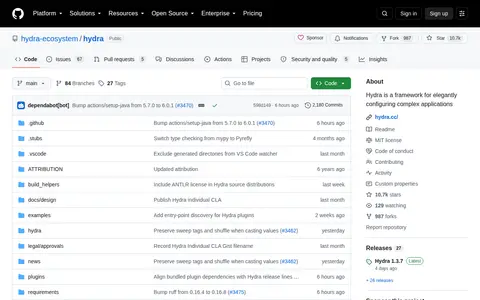
A framework for elegantly configuring complex applications.
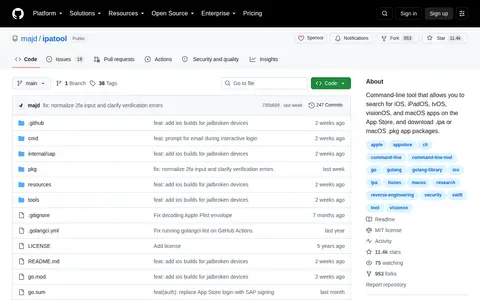
A command-line tool for searching the App Store for iOS, iPadOS, tvOS, watchOS, visionOS and macOS apps and downloading .ipa or macOS .pkg app packages. It requires a supported operating system and an Apple Account already configured to use the App Store, and it runs in interactive mode by default.
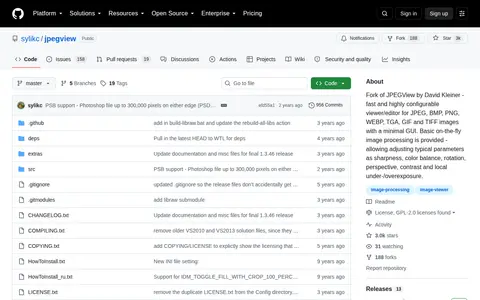
JPEGView is a fork of the original JPEGView by David Kleiner. It is a fast, highly configurable viewer and editor for JPEG, BMP, PNG, WEBP, TGA, GIF and TIFF images with a minimal graphical user interface, and provides basic on-the-fly image processing to adjust sharpness, color balance, rotation, perspective, contrast and local under-/overexposure.
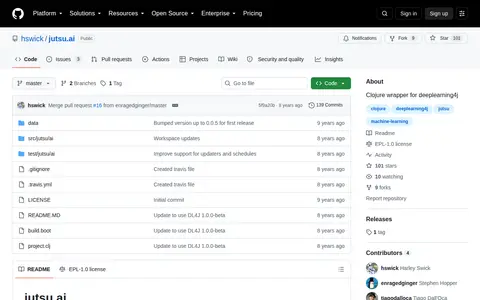
A Clojure wrapper for deeplearning4j with added syntactic sugar, aiming to provide a declarative API for machine learning on the JVM. It translates Clojure keywords into Java method calls, making many deeplearning4j configuration options accessible. The project is a work in progress, and configurations have been tested on basic feedforward nets, RNNs and CNNs.
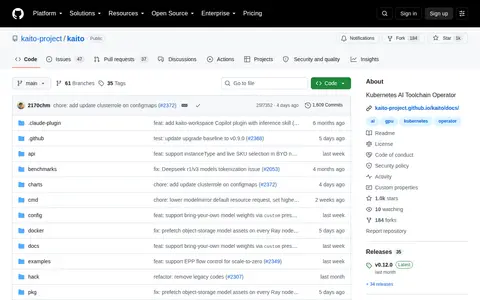
Kaito is the Kubernetes AI Toolchain Operator, an operator suite that automates LLM inference, fine-tuning and RAG engine deployment in a Kubernetes cluster. It simplifies the CRD API and provides optimized preset configurations for inference engine scheduling parameters. Workspaces are the basic CRD for managing inference and tuning workloads, and all vLLM-supported models can be run.
Keras GPT Copilot is a Python package that integrates an LLM copilot within the Keras model development workflow, generating feedback from model configuration, optimizer details and experiment results. It interacts with OpenAI's GPT models and offers a prompt-only mode for compatibility with other large language models.
KerasTuner is a hyperparameter optimization framework for Keras. It provides a define-by-run syntax for configuring search spaces and includes Bayesian Optimization, Hyperband and Random Search algorithms. It requires Python 3.8+ and TensorFlow 2.0+.
KISS Translator is a simple, open-source bilingual translation extension and userscript. It supports bilingual webpage translation, input-field translation, selection word lookup, and mouse-hover translation, and includes YouTube bilingual subtitles with configurable subtitle styles. It lists built-in services such as Google, Microsoft, Baidu, Tencent, DeepL, OpenAI, Gemini, Claude, Ollama, and DeepSeek. The README notes that provider plugins, Local AI, file translation, and automatic clipboard translation are available only in the Chrome/Edge and Firefox extension builds, not in userscripts and other clients.
LightSession is a Firefox and Chrome browser extension that keeps ChatGPT fast by keeping only the last N messages in the DOM during long conversations. It is a local-only extension that trims conversation data before React renders it, with a configurable message limit of 1 to 100 and an experimental Ultra Lean Mode.
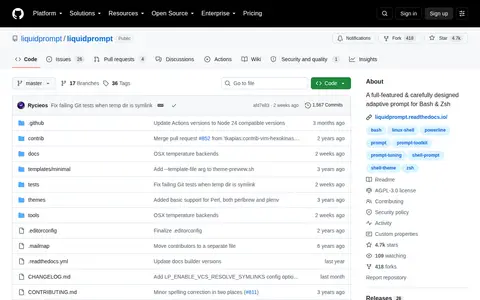
Liquidprompt is an adaptive shell prompt for Bash and Zsh. It displays information based on the current system status and is configured by editing a text file of key/value pairs. Predefined themes are enabled through the shell configuration.
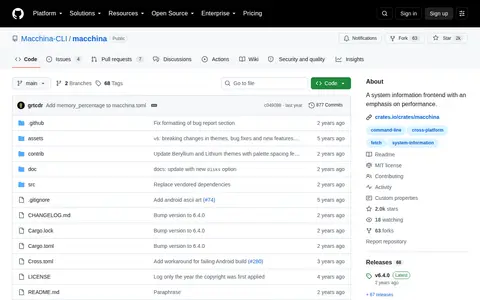
macchina is a system information frontend with an emphasis on performance, available for Linux, macOS, Windows, NetBSD, FreeBSD, OpenWrt and Android. It displays system information such as kernel version, uptime, memory usage and processor load. It is described as basic by default and customizable by design, with a theming system kept outside the configuration file. The project is in maintenance mode, accepting only bug fixes and documentation improvements.
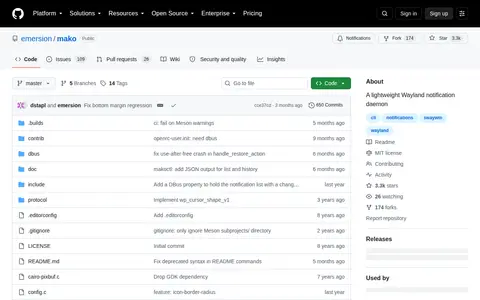
Mako is a lightweight notification daemon for Wayland that works on Sway and implements the FreeDesktop Notifications Specification. It runs automatically when a notification is emitted via D-Bus activation, and can be extensively configured and controlled at runtime with makoctl.
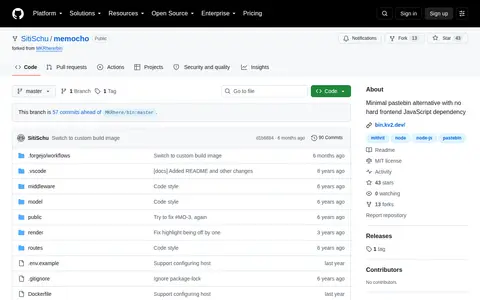
Memochō is a lightweight pastebin and hastebin alternative forked from mkr/bin, with no hard frontend JavaScript dependency. It can run via Node.js with configuration through environment variables, in Docker, or with Docker Compose. Customisation is possible by adding a style.css and addon.js file to a custom directory.
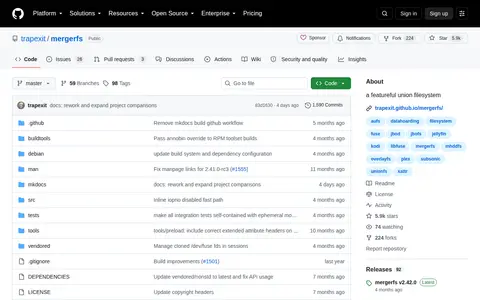
mergerfs is a FUSE-based union filesystem aimed at simplifying storage and management of files across numerous commodity storage devices. It logically combines filesystem paths into a single mount point and acts as a proxy to the underlying paths. Paths can be added or removed without impacting the rest of the data, and file selection and creation placement are configurable. It is similar to mhddfs, unionfs, aufs and DrivePool.
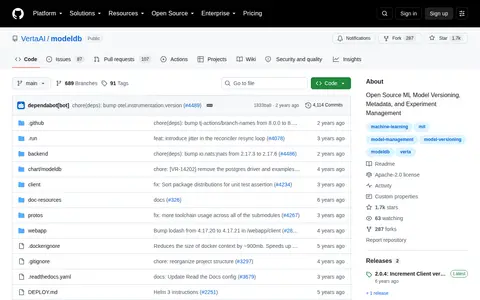
ModelDB is an open-source system for versioning machine learning models, including their code, data, config and environment, and for tracking ML metadata across the model lifecycle. It supports reproducible models, experiment management and lifecycle tracking. It runs on Docker and Kubernetes, offers Python and Scala clients, and is maintained by Verta.ai.