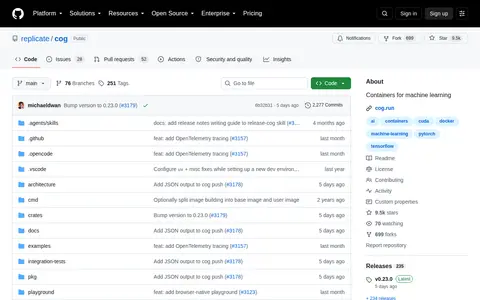

Cog is an open-source tool that packages machine learning models in standard, production-ready containers. Users define the environment in a configuration file, and it generates a Docker image with Nvidia base images and dependency caching. Model inputs and outputs are defined in Python, from which Cog generates an OpenAPI schema and an HTTP inference server. Models can be deployed to own infrastructure or Replicate.
Directory
Search results
Published directory entries matching your search.
Open-source project that provides machine-learning models, research, training resources, or evaluation tools.
Cortex Memory is a production-ready cognitive foundation for autonomous systems such as Embodied-AI and OpenClaw. It provides memory management functionality including extraction, search, and automated optimization, and includes SKILL, CLI, API, MCP, and an insights dashboard out-of-the-box.
Fast inference engine for Transformer models in C++.
Curated list of awesome vector search framework/engine, library, cloud service and research papers to vector similarity search.
Open-source project that supports deploying, serving, monitoring, or operating AI and machine-learning systems.
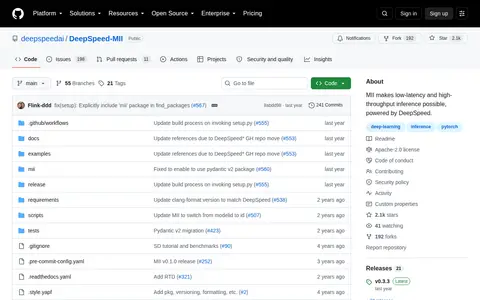
MII makes low-latency and high-throughput inference possible, powered by DeepSpeed.
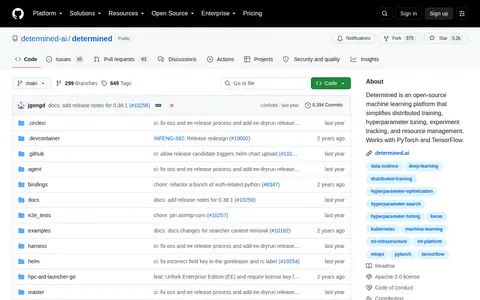
Determined is an open-source machine learning platform that simplifies distributed training, hyperparameter tuning, experiment tracking, and resource management. It works with PyTorch and TensorFlow, offering a Python library, command line interface, and web UI for managing machine learning workflows.
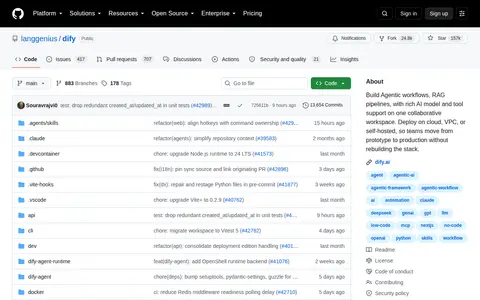
Dify is an open-source LLM app development platform with a visual canvas for AI workflows and RAG pipelines, plus model management and observability. It can be deployed on cloud, VPC, or self-hosted, and integrates with proprietary and open-source LLMs.
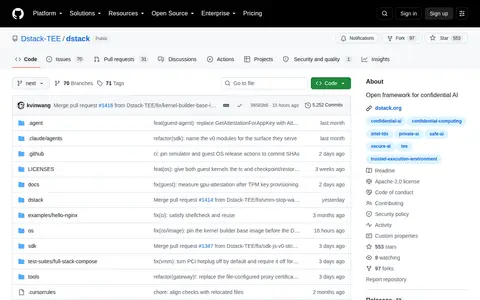
dstack is an open framework for confidential AI that runs containers inside confidential VMs with Intel TDX, using existing Docker Compose files. It supports attested workload identities and native NVIDIA Confidential Computing on H100 and Blackwell GPUs, with options for self-hosted TDX machines or Phala Cloud.
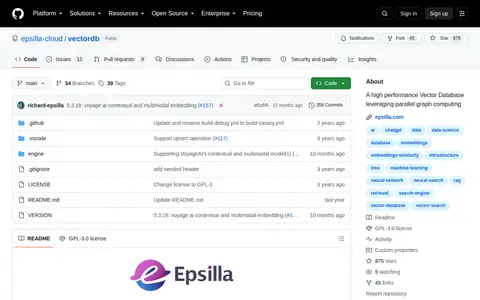
Epsilla is a high-performance vector database hosted on GitHub under the epsilla-cloud organization. It leverages parallel graph computing for its operations, and offers an experimental option to use it as a Python library without requiring a Docker image, alongside Epsilla Cloud as a deployment option.
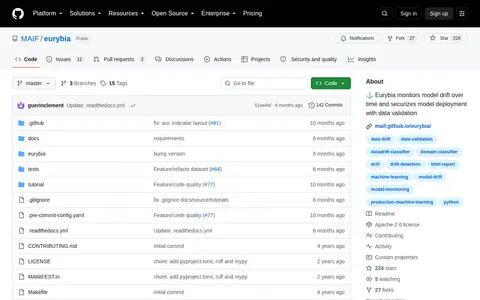
Eurybia is an open-source tool hosted on GitHub under the MAIF organization. It is designed to monitor model drift over time and secure model deployment processes through data validation functionality, with public documentation covering overview, quickstart, installation, features, and project background.
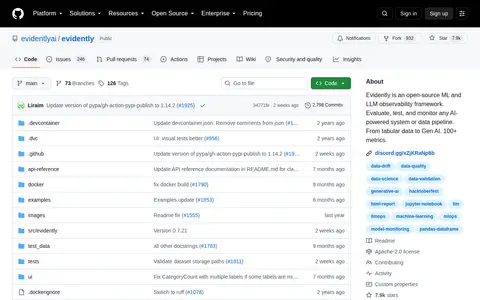
Evidently is an open-source observability framework for machine learning and large language models, hosted on GitHub under the evidentlyai organization. It enables users to evaluate, test, and monitor AI-powered systems and data pipelines, with support for use cases ranging from tabular data processing to generative AI, and includes more than 100 built-in metrics.
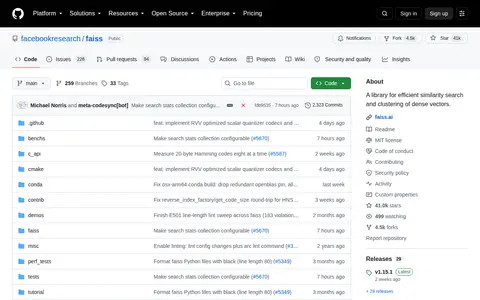
Faiss is a library for efficient similarity search and clustering of dense vectors, containing algorithms that search sets of vectors of any size. It is written in C++ with complete wrappers for Python/numpy, with some algorithms implemented on the GPU, and is developed primarily at Meta's Fundamental AI Research group.


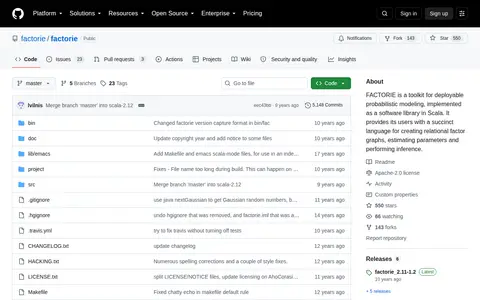
FACTORIE is an open-source toolkit for deployable probabilistic modeling, implemented as a software library in Scala and hosted on GitHub under the factorie organization. It provides users with a succinct language for creating relational factor graphs, estimating model parameters, and performing inference, with documentation for installation, example usage, and pre-built NLP models.
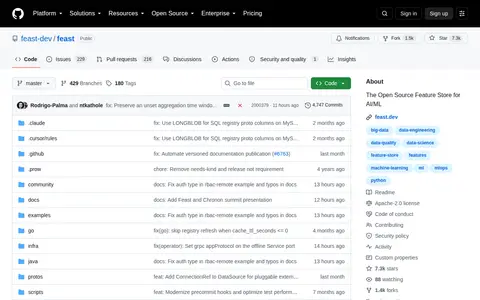
Feast is an open source feature store for machine learning. It manages an offline store for historical data, a low-latency online store, and a feature server. It generates point-in-time correct feature sets to avoid data leakage and provides a single data access layer abstracting feature storage from retrieval. Installable with pip and initialized through a CLI.
Open-source project that provides machine-learning models, research, training resources, or evaluation tools.
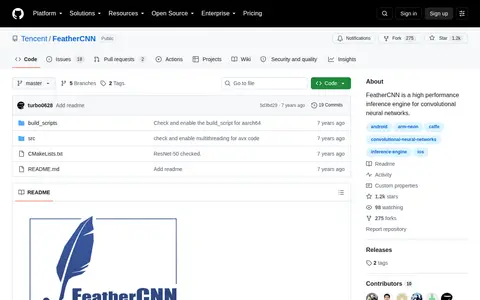
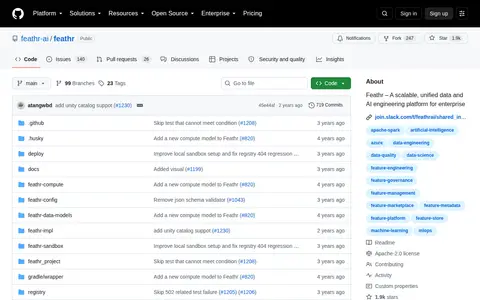
FeatherCNN is a lightweight CNN inference library developed by Tencent AI Platform Department, originating from a game AI project for King of Glory. It targets ARM CPUs and is developed for mobile phones, embedded devices and ARM-based servers. It accepts Caffe models, which are converted into a single binary model.
An enterprise-grade, high performance feature store.
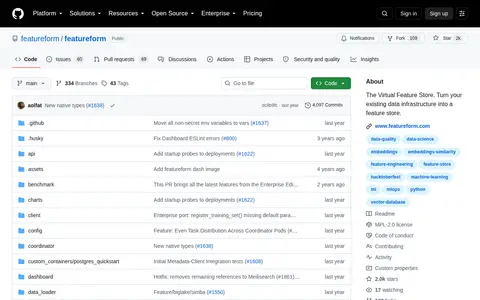
Featureform is an open-source virtual feature store hosted on GitHub under the featureform organization. It is designed to turn users' existing data infrastructure into a feature store, with supporting resources including a public website, documentation, community forum, and explanatory material on its core abstraction and unique value proposition.
Open-source project that provides machine-learning models, research, training resources, or evaluation tools.
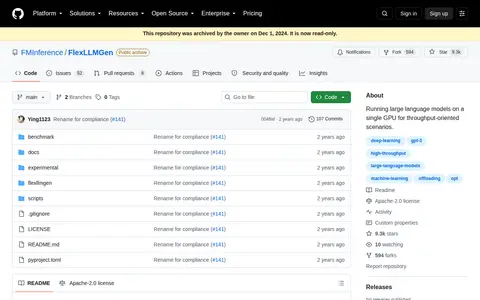
FlexGen is a software project that enables running large language models on a single GPU. It focuses on throughput-oriented scenarios, offering an approach to efficient inference. The project is available on GitHub as FMInference/FlexLLMGen.
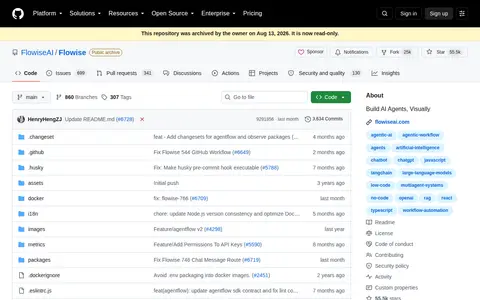
Drag & drop UI to build your customized LLM flow using LangchainJS.
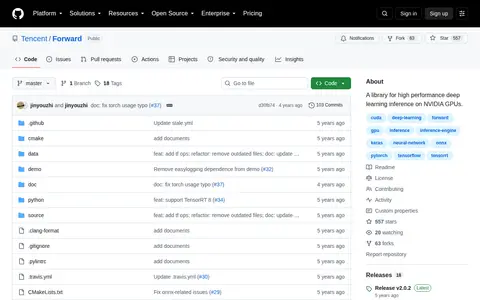
Library for high performance deep learning inference on NVIDIA GPUs.