Southeast Asian Climate Assessment & Dataset presents information on changes in weather and climate extremes and the daily dataset used to monitor them. It receives data from 11 participants for 15 countries, and the SACA dataset holds 11,887 series of observations at 10,066 meteorological stations. Seventeen percent of the series is public and downloadable for non-commercial research.
Directory
Search results
Published directory entries matching your search.
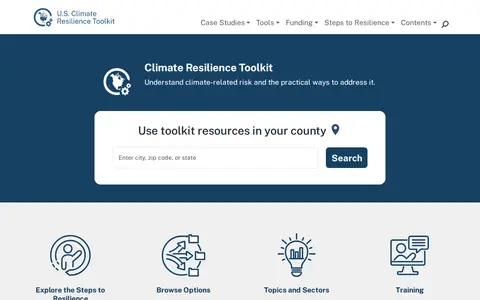
The U.S. Climate Resilience Toolkit is a website offering resources on understanding climate-related risk and practical ways to address it. It includes Steps to Resilience, topics and sectors, training, a registry of experts, and a help desk with FAQs and technical resources.
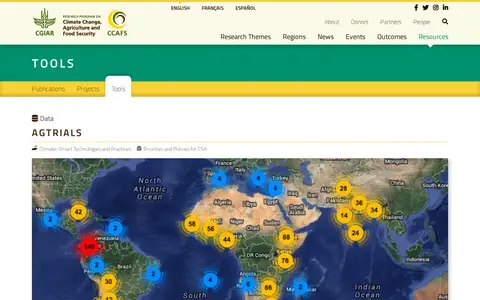
AgTrials is a global agricultural trial repository launched in 2010 by the CGIAR Research Program on Climate Change, Agriculture and Food Security (CCAFS). It collects decades of agricultural field experiment data to support research on climate change impacts and help identify appropriate agricultural adaptation techniques for smallholder farmers, addressing limited public access to scattered trial data.
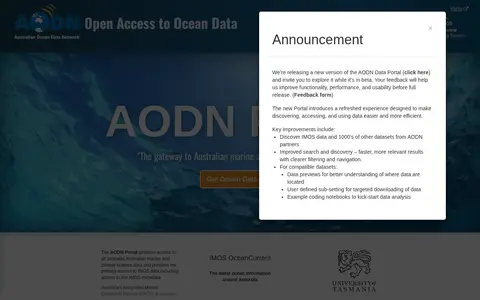
The AODN Portal is a gateway to Australian marine and climate science data. It provides access to all available Australian marine and climate science data and is the primary access point for IMOS data, including IMOS metadata.
Searchable repository for finding atmospheric, oceanography and climate datasets and measurement and test data.
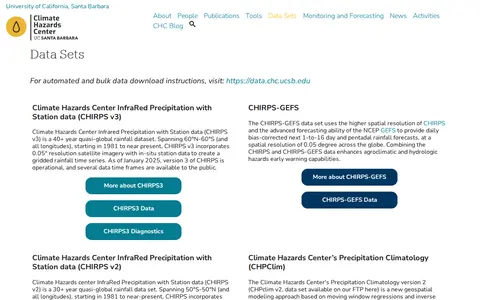
The Climate Hazards Center Data Archive provides access to gridded rainfall and temperature datasets, including CHIRPS, CHIRPS-GEFS, CHPClim, and CHIRTS. CHIRPS combines satellite imagery with station data to create rainfall time series; CHIRPS v3 covers 60°N-60°S from 1981 to near present. Bulk download instructions are available at a separate data site.
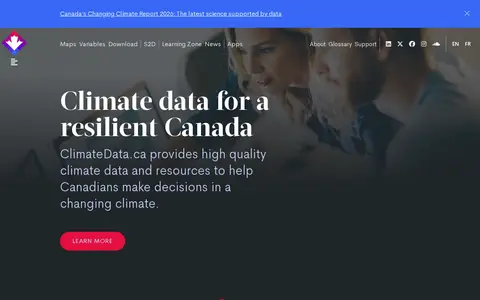
ClimateData.ca provides climate data and resources intended to support decisions in a changing climate. The site offers maps and graphs for creating and downloading data visualizations, a searchable catalogue of 125 datasets, and on-demand processing to tailor datasets using custom thresholds and time periods. It also includes a Learning Zone and newsletters about updates.
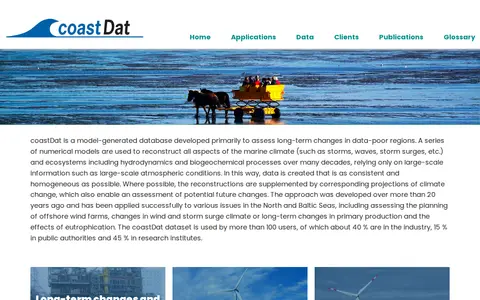
coastDat is a model-generated database used to assess long-term changes in data-poor regions. Numerical models reconstruct marine climate aspects such as storms, waves and storm surges, and ecosystems, relying on large-scale atmospheric information. Where possible, reconstructions are supplemented by climate change projections. The approach has been applied to issues in the North and Baltic Seas.
CMIP5 is the fifth phase of the Coupled Model Intercomparison Project, promoted by the WCRP Working Group on Coupled Modelling with input from IGBP AIMES. It provides a multi-model framework for coordinated climate model experiments, including assessment of carbon cycle and cloud feedbacks, climate predictability on decadal timescales, and differing responses of similarly forced models.
DARECLIMED is a data repository operated by The Cyprus Institute. It hosts three categories of data: climate, water resources, and energy-related data. Climate datasets include atmospheric, terrestrial and oceanic data, proxies, reconstructions, as well as land use, population and economy data.
Independent environmental newsroom covering climate, water, biodiversity and development across Asia and the world.
Indian environmental publication covering climate, pollution, public health, agriculture and development.
Search atmospheric, oceanography and climate data collections and supporting datasets from SWE.
Earth and space science publication covering climate, geology, oceans, research and scientific policy.
Browse research datasets and datasets related to atmospheric, oceanography and climate.
Nonprofit publication covering climate change, environmental justice, energy, food and practical solutions.
The ISIMIP Repository is a searchable archive of climate impact model data. It holds input data such as climate forcing, socioeconomic forcing and static geographic information, plus output data across sectors including agriculture, terrestrial biodiversity, biomes, fire, regional forests, temperature-related mortality, lakes and fisheries. Users search by simulation round, covering ISIMIP2a through ISIMIP4b.
Nonprofit magazine publishing investigations and reporting on politics, inequality, climate and democracy.
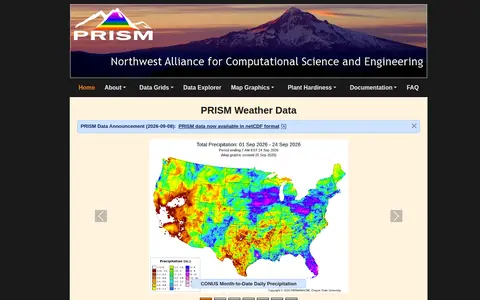
PRISM Climate Data is a project of the PRISM Group at Oregon State University that gathers weather observations, applies quality control and mapping methods, and develops spatial datasets showing short- and long-term weather patterns. Datasets cover 1895 to the present and are offered free of charge, with bulk downloads and single grid cell time series.
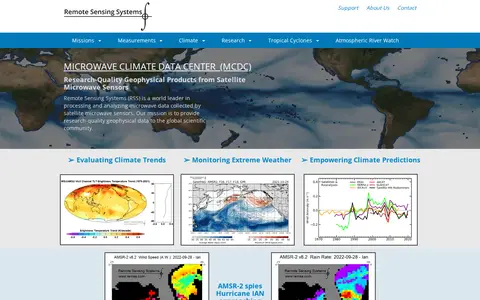
Remote Sensing Systems (RSS) processes and analyzes microwave data collected by satellite microwave sensors. It provides research-quality geophysical data to the global scientific community, supporting work to evaluate climate trends, monitor extreme weather, and empower climate predictions.
Global newsroom covering science, health, agriculture, climate and development across lower-income regions.
News section of the AAAS journal covering research, scientific policy, health, climate and the scientific community.
Scientific American is a science journalism publication covering advances in science and technology and explaining how they change understanding of the world. Its site carries articles on topics such as health, climate, space, neuroscience and physics, alongside magazine issues, games and travel content.
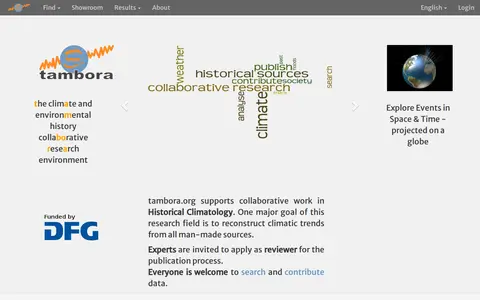
TAMBORA is a collaborative research environment for climate and environmental history. It supports work in historical climatology, with a core goal of reconstructing climatic trends from man-made sources. The platform allows users to search and contribute data, and invites experts to apply as reviewers for its publication process. It hosts resources including reconstructed climate data such as temperature fields and historical flood records. TAMBORA is operated by the Albert-Ludwigs-University Freiburg Library and Department of Physical Geography, and the Leibniz Institute for Regional Geography.