
colab.research.google.com
Google Colab notebook for colorizing old video using DeOldify-style AI processing.
Directory
Published directory entries matching your search.
Google Colab notebook for colorizing old video using DeOldify-style AI processing.

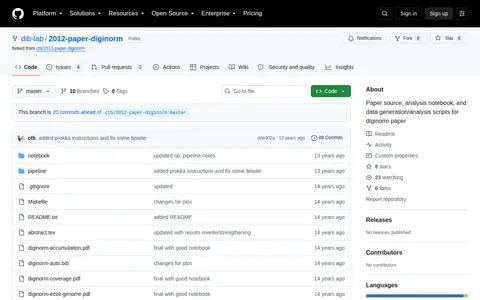
A repository holding the paper source, analysis notebook, and data generation and analysis scripts for the diginorm paper. It is forked from another repository and includes LaTeX sources, bibliography files, figures and a pipeline folder.
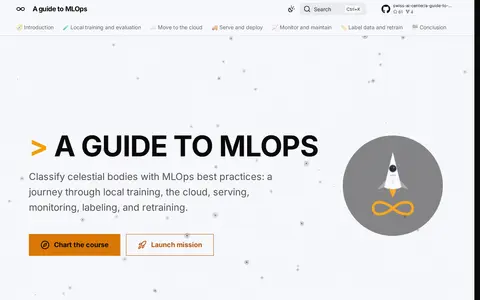
A guide to MLOps is an open-source tutorial from the Swiss AI Center team that walks engineers and small teams from notebook experiments to production. It covers local training and model evaluation, moving the model to the cloud, serving and deploying, monitoring and maintaining, and labeling data and retraining, using tools such as DVC, Git, GitHub Actions, CML, Docker, BentoML, Fluent Bit, Evidently AI, and Label Studio.

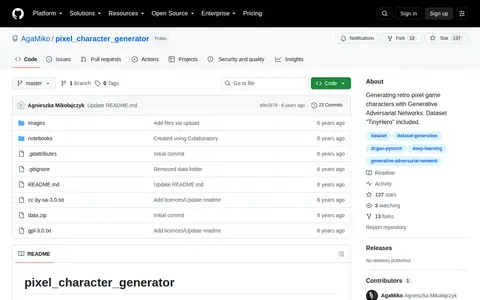
A GitHub repository for generating retro pixel game characters with generative adversarial networks. It includes the TinyHero dataset of 64x64 pixel characters generated from the Universal LPC spritesheet, with 3648 images. Notebooks cover a DCGAN based on the PyTorch tutorial, a conditional DCGAN and a deep convolutional autoencoder. Art is dual licensed under GPL 3.0 and CC-BY-SA 3.0.
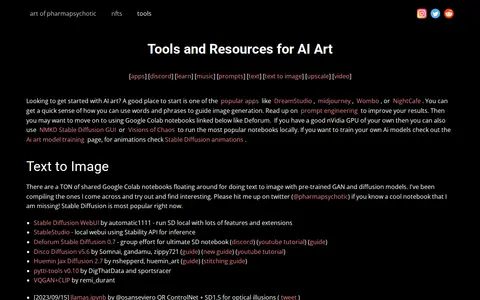
A page by pharmapsychotic collecting tools and resources for AI art, organized into sections such as text to image, upscaling, StyleGAN, text video, prompt engineering and music. It links to shared Google Colab notebooks for text-to-image work with pre-trained GAN and diffusion models, and notes Stable Diffusion WebUI for running SD locally.

Anaconda is a platform for Python, data science, and AI development. Its core is conda, an open-source package and environment manager that installs software, resolves dependencies, and isolates projects. Two installers are offered: Anaconda Distribution, which bundles conda, Python, Anaconda Navigator, and hundreds of packages, and Miniconda, a minimal base environment. Anaconda Notebooks is a cloud-based JupyterLab environment.

Apache Zeppelin is a web-based notebook for data-driven, interactive data analytics and collaborative documents with SQL, Scala, Python, R and more. It uses interpreters to plug in language and data-processing backends, including built-in Apache Spark integration, and includes basic charts, pivot charts, dynamic forms and paragraph publishing to embed results in websites.

autoai is an open-source Python framework for automatic artificial intelligence focused on regression and classification tasks over numerical data. It automates model search, hyper-parameter tuning, and generates high-quality Jupyter Notebook code for resulting models.

Bodywork is a command line tool that deploys machine learning pipelines to Kubernetes, handling containers and orchestration. Any pipeline stage runs either a batch job or a long-running process. It is presented as a lightweight alternative to Kubeflow or building a platform around workflow tools such as Apache Airflow, Argo Workflows or Dagster. Stages are defined as Python modules or Jupyter notebooks and configured in a single bodywork.yaml file.

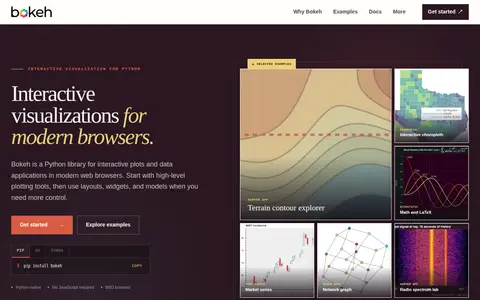
Bokeh is a Python library for creating interactive plots, dashboards, and data applications in modern web browsers. Plots can go in Jupyter notebooks, be saved as standalone HTML, or run with live Python callbacks through the Bokeh server or embedded in an ASGI app. It includes tools for pan, zoom, hover, and selection.

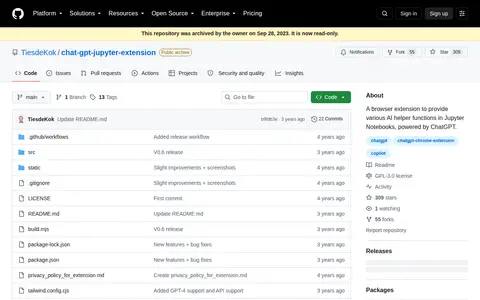
ChatGPT for Jupyter is a browser extension that provides AI-powered helper functions within Jupyter Notebooks, powered by ChatGPT. The extension is compatible with Chrome, Edge, and Firefox browsers, with its code and documentation hosted in a public GitHub repository under the TiesdeKok organization.

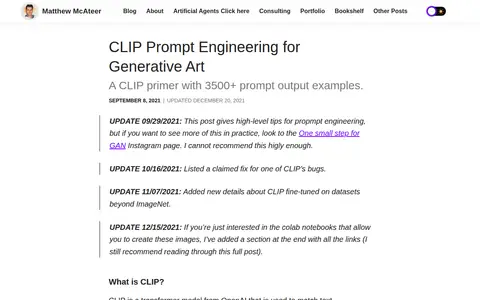
A blog post explaining CLIP, a transformer model from OpenAI that matches text embeddings with image embeddings. It offers high-level prompt engineering tips for generative art and includes over 3500 prompt output examples, along with a section of Colab notebook links.
Web Clipper is an open source browser extension for saving content from the web to a notebook platform. It reduces clutter by clipping only the article, recipe, or product information needed.

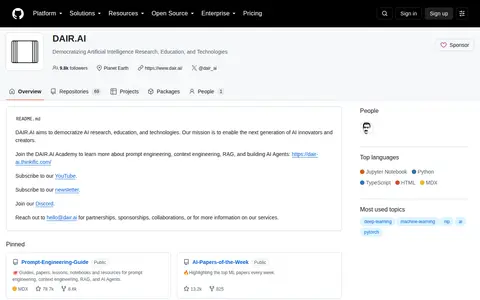
DAIR.AI is a GitHub organization that states it aims to democratize AI research, education, and technologies. Its repositories include a prompt engineering guide covering guides, papers, lessons, notebooks and resources for prompt engineering, context engineering, RAG, and AI Agents, and AI-Papers-of-the-Week, which highlights top machine learning papers each week.

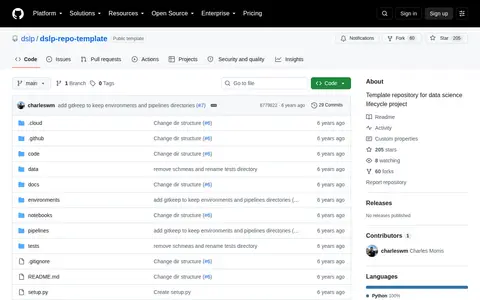
A public GitHub template repository for data science lifecycle projects. It provides a default directory structure including folders for code, data, docs, environments, notebooks, pipelines and tests, plus issue templates and a .github labels file. The source describes it as a launch-off point with minimal opinions. One manual step is creating labels from the labels file.

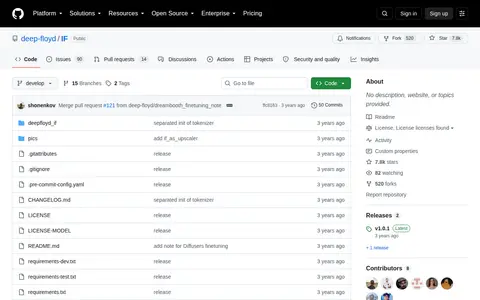
deep-floyd/IF is a GitHub repository for the IF image generation model developed by DeepFloyd Lab at StabilityAI. It provides documentation for minimum model requirements, quick start guides, local notebook support, and integration with the Hugging Face Diffusers library for model use.

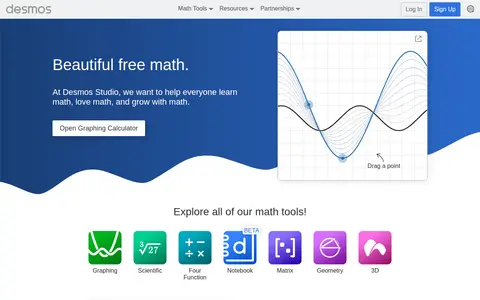
Desmos Studio develops free digital math tools, including Graphing, Scientific, Geometry, and 3D Calculators, as well as Notebook. The tools are available for exploration, with examples provided for user inspiration.

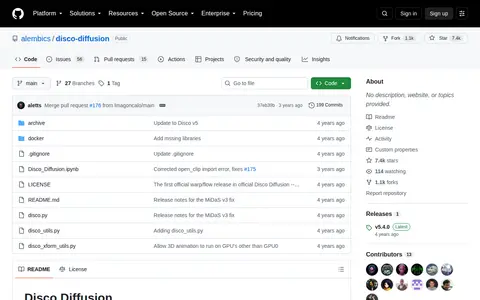
Frankensteinian amalgamation of notebooks, models and techniques for the generation of AI Art and Animations.

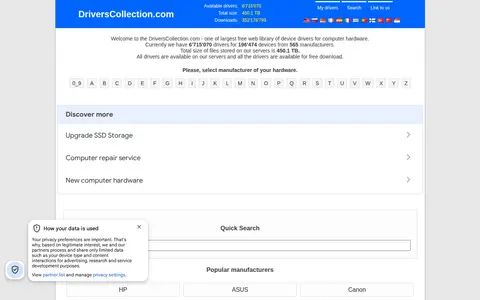
DriversCollection.com is a free web library of device drivers for computer hardware. The site lists drivers for notebooks, video, printers, mainboards and other hardware categories, searchable by manufacturer. It states that drivers are stored on its servers and are available for free download.

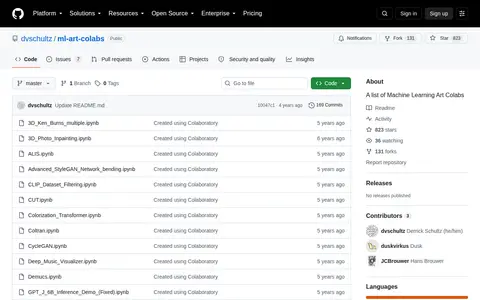
Collection of Google Colab Notebooks for ML Arts.
Emanote creates websites from plain-text notes. It supports Markdown, Wiki-links and directories, and offers HTML templates for theming. The project states it can build personal webpages, blogs, wikis, Zettelkasten, notebooks, knowledge bases and documentation, and includes a live preview that updates in real time.

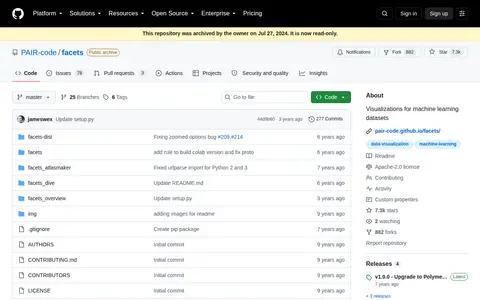
Facets is a project containing two visualizations, Facets Overview and Facets Dive, for understanding and analyzing machine learning datasets. The visualizations are Polymer web components backed by TypeScript that can be embedded in Jupyter notebooks or webpages. Overview produces feature-by-feature statistical analysis and compares statistics across datasets. The repository was archived on Jul 27, 2024 and is now read-only.

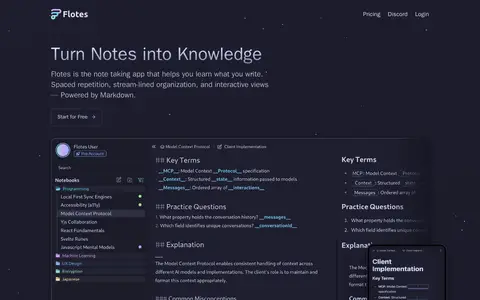
Flotes is a Markdown note-taking application designed for learning. It organizes notes into notebooks and offers study, summary, canvas and wiki views, including fill-in-the-blank study with spaced repetition. Notes are written in plain Markdown and can be imported, exported and shared.

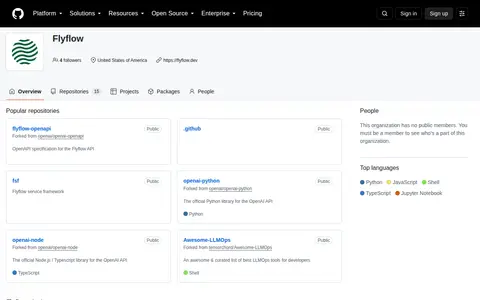
Flyflow is a GitHub organization with public repositories including an OpenAPI specification for the Flyflow API, a service framework, a Python library, and demo applications and notebooks. The organization page lists no public members.