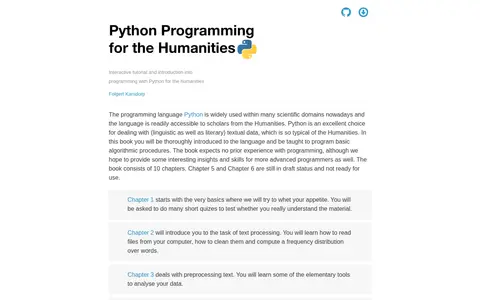
An interactive tutorial and introduction to programming with Python for the humanities by Folgert Karsdorp. The book has 10 chapters covering text processing, preprocessing, programming principles, readability computation, authorship attribution, object-oriented programming, information retrieval, a PDF search web application, classification and hierarchical clustering. It expects no prior programming experience. Chapters 5 and 6 are in draft status.
Directory
Search results
Published directory entries matching your search.
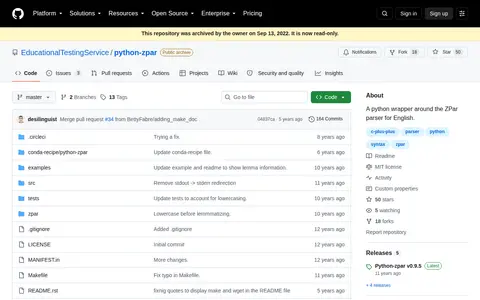
A Python wrapper around the ZPar statistical natural language parser, providing a ctypes-based interface and an XML-RPC ZPar server for batch processing. It works only with English ZPar models and supports 64-bit Linux and OS X. The repository was archived on Sep 13, 2022 and is read-only; the project is no longer under active development.
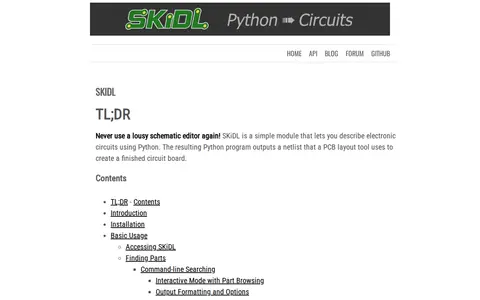
SKiDL is a Python module for describing the interconnections of electronic circuits and components. The resulting Python program performs electrical rules checking and outputs a netlist used as input to a PCB layout tool.

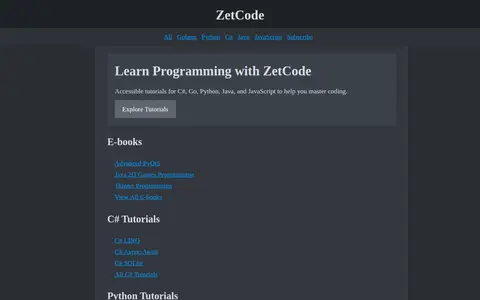
ZetCode is a website offering tutorials on C#, Go, Python, Java, and JavaScript, along with e-books. Its pages include C# and Python tutorial sections and a list of updates, and it notes that Jan Bodnar is the author.
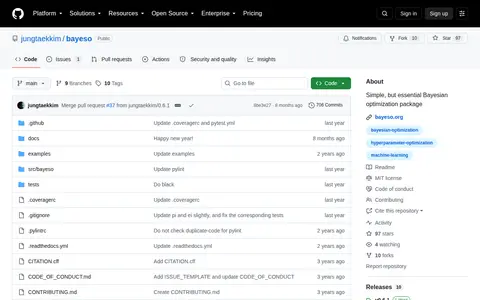
BayesO is a Python framework for Bayesian optimization, described as a simple but essential Bayesian optimization package. It is installed via pip and is tested on Python 3.8 through 3.12. The repository includes documentation, examples and tests, and is released under the MIT License.
DEAP is an evolutionary computation framework for Python aimed at rapid prototyping and testing of ideas. It provides genetic algorithms over representations such as lists, arrays, sets, dictionaries, trees and Numpy arrays, genetic programming with prefix trees, evolution strategies including CMA-ES, multi-objective optimisation, and co-evolution of multiple populations. It supports parallelisation via multiprocessing and SCOOP and works out of the box with Python 3 since version 0.8.
Archived, read-only GitHub repository of free resources for learning machine learning with Python and Jupyter Notebook, including notebooks, courses and other links. It was first posted in 2016 and was archived by the owner on Jun 27, 2022.
Fiber is a Python-based distributed computing library for modern computer clusters. It provides the same API as Python's standard multiprocessing library, uses Nanomsg for communication, and allows dynamic allocation of CPU, memory, and GPU resources. Installation uses pip install fiber.
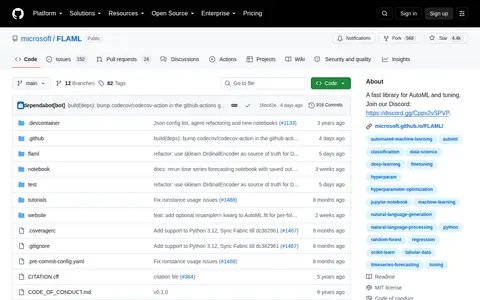
FLAML is a lightweight Python library from Microsoft for automating machine learning and AI operations. It performs model selection and hyperparameter optimization under resource constraints, including tuning foundation model inference hyperparameters. It requires Python 3.10 or later, is installable via pip, and can be used as a scikit-learn style estimator.
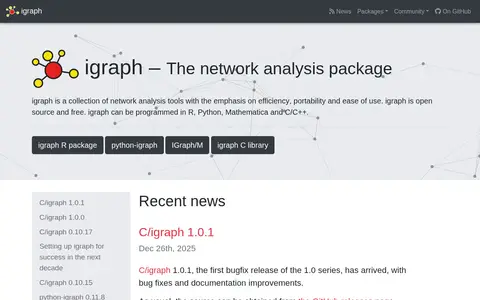
igraph is a collection of network analysis tools emphasizing efficiency, portability and ease of use. It is open source and free, and can be programmed in R, Python, Mathematica and C/C++. Implementations include the igraph R package, python-igraph, IGraph/M and the igraph C library.
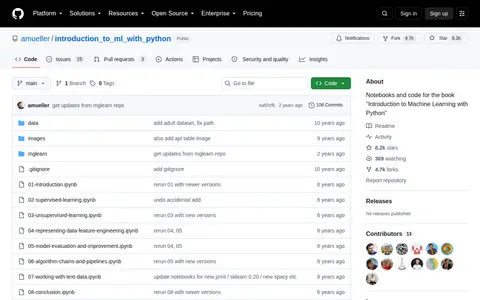
A GitHub repository holding the notebooks and code for the book "Introduction to Machine Learning with Python" by Andreas Mueller and Sarah Guido, together with the mglearn library of helper functions for figures and datasets. The book requires scikit-learn 0.20.0, and the code also needs numpy, scipy, matplotlib, pandas and pillow.
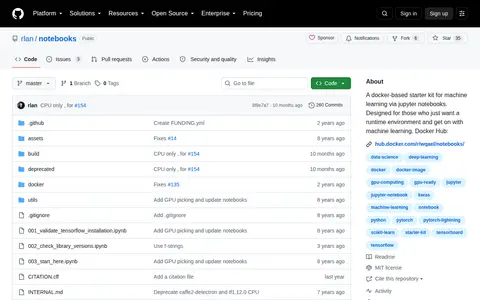
Notebooks is a Docker-based starter kit for machine learning through Jupyter notebooks, intended for users who want a ready runtime environment. Its images cover combinations of Keras, TensorFlow and PyTorch with CUDA v8 through v11, and include JupyterLab, scikit-learn, pandas and visualization, vision and NLP libraries. Python 3 only, as Python 2 is end-of-life.
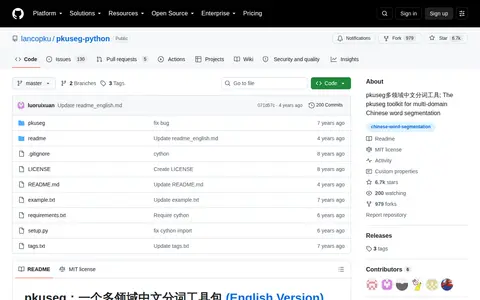
pkuseg is a Python toolkit for multi-domain Chinese word segmentation, based on a 2019 paper. It provides pretrained models for news, web, medicine, tourism, and mixed domains, and supports user-trained models and part-of-speech tagging. It is distributed under the MIT license.
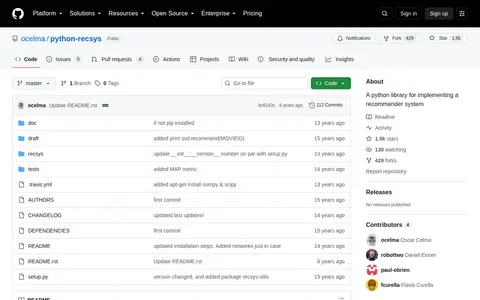
A Python library for implementing a Recommender System.
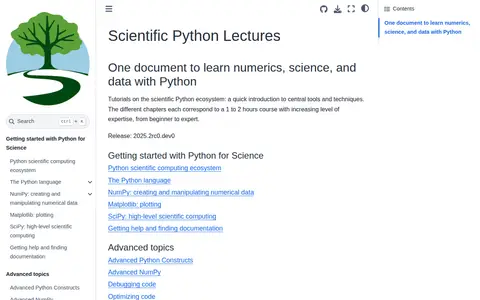
A document for learning numerics, science and data with Python, consisting of tutorials on the scientific Python ecosystem. Chapters correspond to one- to two-hour courses with increasing expertise, from beginner to expert, covering topics such as NumPy, Matplotlib, SciPy, statistics, scikit-image and scikit-learn.
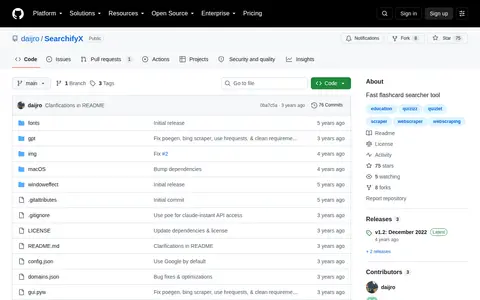
SearchifyX is a fast flashcard searcher tool and the predecessor to Searchify. It acts as a webscraper for Quizlet, Quizizz, and Brainly, letting users query questions from these sites and sort results by similarity to the input query. The tool includes a screen OCR scanner, customizable global hotkeys, and stealth features to prevent websites from detecting window focus changes, and is available as both a GUI application and CLI tool for Linux, Mac OS, and Windows. It was created strictly for educational purposes to demonstrate asynchronous webscraping in Python, requiring Python 3.8 dependencies and Tesseract for OCR functionality.
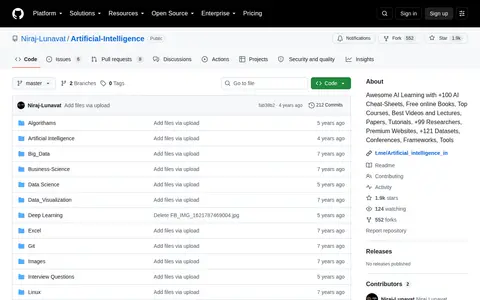
A GitHub repository collecting AI learning resources, including over 100 cheat-sheets, free online books, courses, videos and lectures, papers, tutorials, researchers, websites, datasets, conferences, frameworks and tools. Topics include machine learning, deep learning, big data, data science and Python.
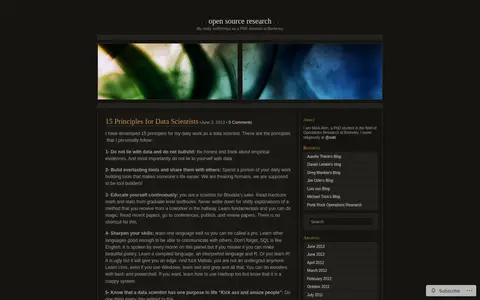
A personal blog by a PhD student at Berkeley that hosts notes and posts on data science, programming and machine learning topics. Entries include 15 principles for data scientists, C++11 learning notes, a Mandelbrot fractal in Python and notes from conference talks.
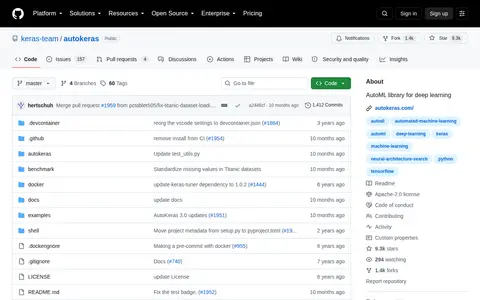
AutoKeras is an AutoML library for deep learning built on Keras, developed by DATA Lab at Texas A&M University. The project describes its goal as making machine learning accessible to everyone. It can be installed with pip, and the documentation states it is currently only compatible with Python 3.7 or later and TensorFlow 2.8.0 or later.
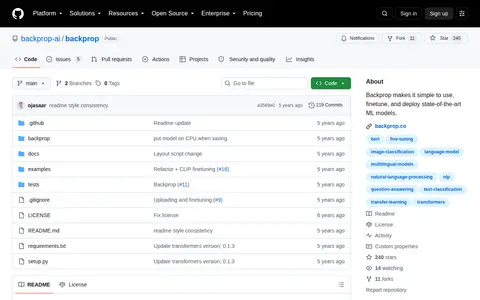
Backprop is a Python library, installable via PyPi, that enables use, finetuning and deployment of machine learning models. It provides task interfaces for conversational question answering, text classification in over 100 languages, image classification, summarisation, emotion detection and text generation, and models can be finetuned with a single line of code.
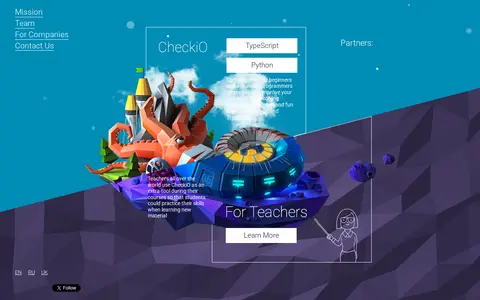
CheckiO is a website with coding games and programming challenges for beginner and advanced programmers. Users improve their coding skills by solving challenges and exercises in Python and TypeScript, and can exchange experience with other users through coding activities. Teachers use it as an extra tool so students can practice skills while learning new material.
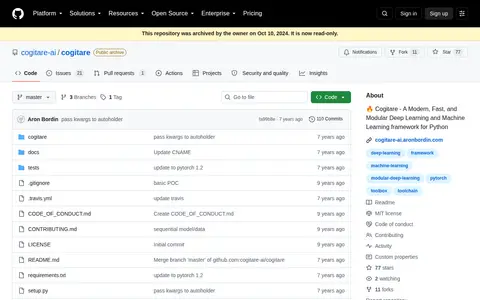
Cogitare is a modern, fast, modular deep learning and machine learning framework for Python built on top of PyTorch, with a user-friendly interface for beginners and advanced toolsets for experts.
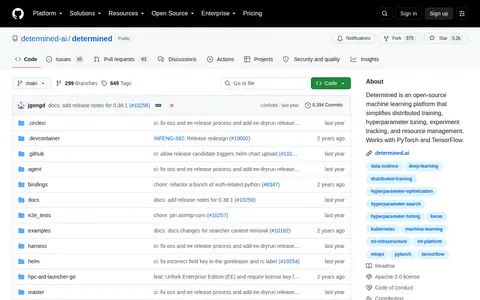
Determined is an open-source machine learning platform that simplifies distributed training, hyperparameter tuning, experiment tracking, and resource management. It works with PyTorch and TensorFlow, offering a Python library, command line interface, and web UI for managing machine learning workflows.
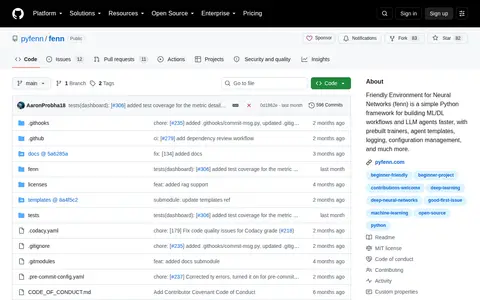
fenn is a Python framework for building machine learning and deep learning workflows and LLM agents. It provides prebuilt trainers, agent templates, logging, and configuration management, with YAML configuration parsed and injected into the entrypoint with CLI override support. It is released under the MIT license.