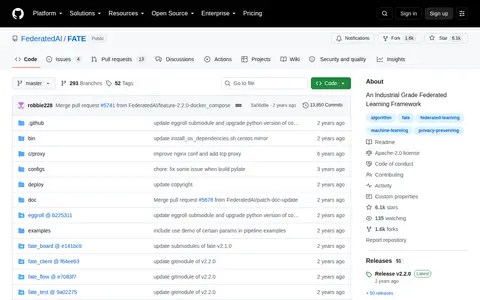

FATE (Federated AI Technology Enabler) is an industrial grade federated learning open source framework that enables enterprises and institutions to collaborate on data while protecting data security and privacy. It implements secure computation protocols based on homomorphic encryption and multi-party computation, and provides federated learning algorithms including logistic regression, tree-based algorithms, deep learning and transfer learning.

Directory
Search results
Published directory entries matching your search.
Gephi is free, open-source software for network visualization and analysis. It is available as a desktop application and as Gephi Lite in the browser. It includes algorithms for community detection, centrality measures and clustering, multiple layout algorithms, appearance customization and image exports. The source code is released under the GPL license.
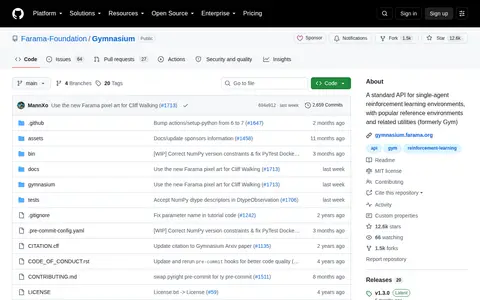
Gymnasium is an open source Python library for developing and comparing reinforcement learning algorithms. It provides a standard API between learning algorithms and environments, plus reference environments including Classic Control, Box2D, Toy Text, MuJoCo and Atari. It is a fork of OpenAI's Gym library maintained by its maintainers.
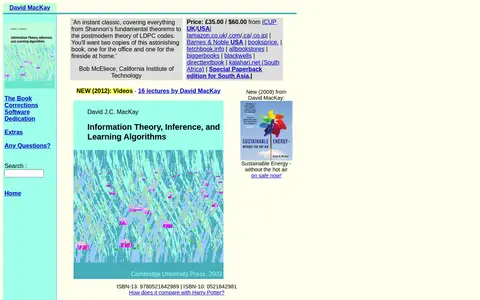
A 2003 book by David J.C. MacKay published by Cambridge University Press, covering information theory, inference, and learning algorithms. The site offers corrections, software, and downloadable figures. It lists a price of £35.00 or $60.00.
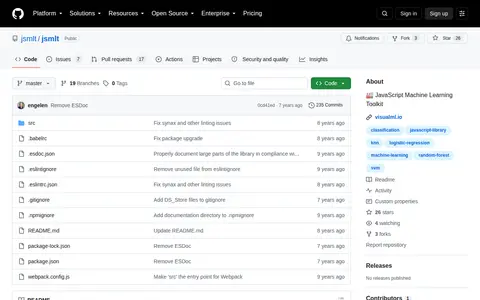
JSMLT is an open source JavaScript library for education in machine learning. It implements supervised learning algorithms, including SVM, random forest, decision tree, perceptron, neural networks, k-nearest neighbors and logistic regression, and provides visualization examples for exploring how the algorithms work.
LightFM is a Python implementation of recommendation algorithms for implicit and explicit feedback. It allows item and user metadata to be incorporated into matrix factorization algorithms, representing users and items as sums of latent feature representations. Installation is available from PyPI, and a Docker setup is provided for running examples and tests.
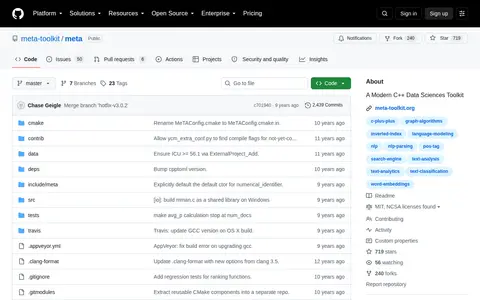
MeTA is a modern C++ data sciences toolkit. It provides text tokenization including deep semantic features like parse trees, inverted and forward indexes with compression and caching strategies, ranking functions for searching indexes, topic models, classification algorithms, graph algorithms, language models, a CRF implementation for POS-tagging and shallow parsing, and wrappers for liblinear and libsvm.
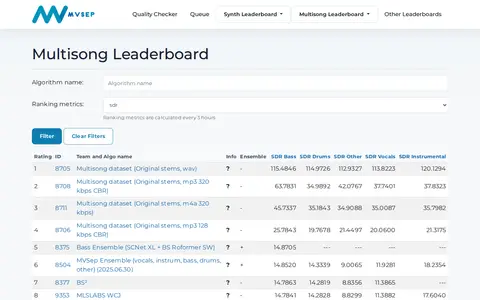
MultiSong Leaderboard is a ranking page on the MVSEP music and voice separation platform. It evaluates multisong audio separation algorithms using metrics including SDR, SI-SDR, L1 frequency, log WMSE, aura STFT, aura MRSTFT, bleedless, and fullness, with rankings updated every three hours. The page lists top-performing algorithms and their scores for separation tasks such as bass, drums, other stems, vocals, and instrumentals.
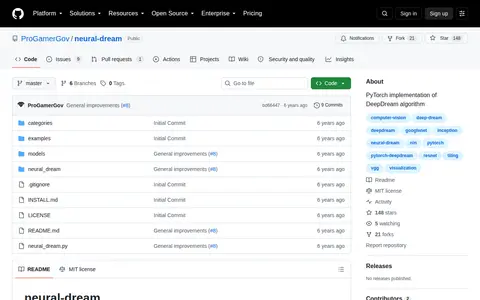
A PyTorch implementation of the DeepDream algorithm hosted on GitHub. The repository provides code for running the DeepDream algorithm using the PyTorch framework, with support for features including specific channel selection and activation strength-based channel selection.
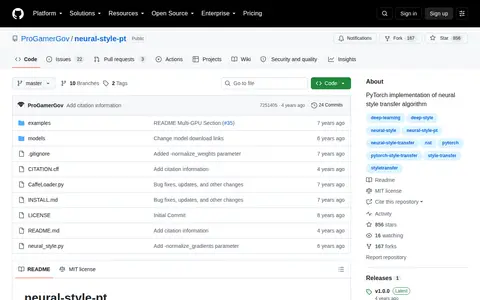
neural-style-pt is a PyTorch implementation of the neural style transfer algorithm from the paper A Neural Algorithm of Artistic Style. It combines the content of one image with the style of another using convolutional neural networks, and is based on Justin Johnson's Neural-Style. Options include content and style weighting, style scale, multiple style images and retaining original colors.
NSynth Super is an open source experimental instrument that lets musicians play sounds generated by the NSynth algorithm. The NSynth algorithm uses a deep neural network to learn sound characteristics and synthesize new sounds from four source sounds. The interface can be played via any MIDI source, such as a DAW, sequencer or keyboard.
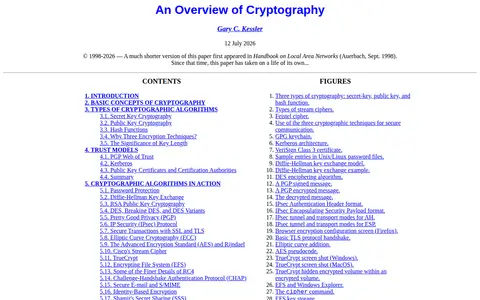
A free, evolving tutorial on cryptography maintained since 1999. It covers basic cryptographic concepts, types of algorithms including secret key, public key and hash functions, trust models, and applied algorithms in action.
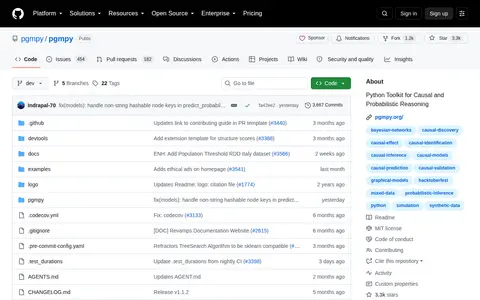
pgmpy is a Python toolkit for causal and probabilistic reasoning using graphical models. It implements data structures for models such as DAGs, PDAGs, MAGs, PAGs, Bayesian Networks, Dynamic Bayesian Networks and Structural Equation Models, with algorithms for tasks including causal discovery, causal identification, inference, model validation, parameter estimation and simulations. Algorithms follow a unified composable API and are scikit-learn compatible when possible. It is available on PyPI and conda.
RubiksTrainer is a site for learning to solve the Rubik's Cube, with practice solutions, algorithms, a solver, formula, timer and speedcubing material. It covers beginner and advanced sections, 3x3 algorithms, recognition practice, OLL, PLL, COLL, a timer, and a scrambler for Cross and F2L practice. The site notes a forthcoming move to another address.
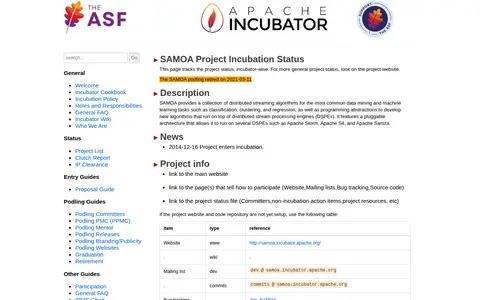
SAMOA was an Apache Incubator podling that provided a collection of distributed streaming algorithms for data mining and machine learning tasks such as classification, clustering and regression, plus programming abstractions for developing new algorithms on distributed stream processing engines. Its pluggable architecture allowed it to run on several engines. The podling retired on 2021-03-11.
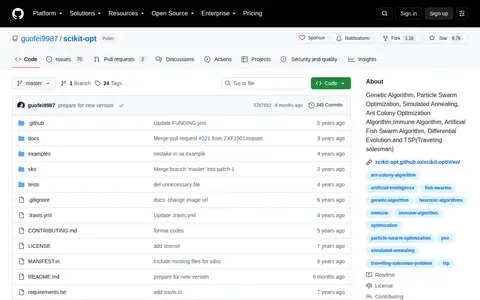
Scikit-Opt is an open-source Python library that implements a range of optimization algorithms. Its features include genetic algorithms, particle swarm optimization, simulated annealing, ant colony optimization, immune algorithm, artificial fish swarm algorithm, differential evolution, and tools for the traveling salesman problem. The project is hosted on GitHub and accepts community contributions.
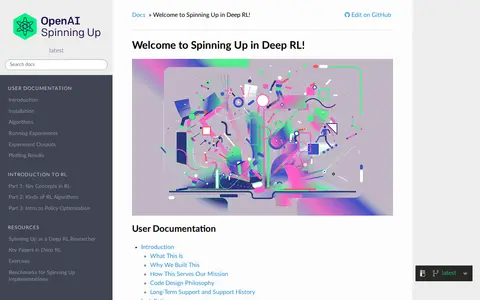
Spinning Up is OpenAI's educational resource on deep reinforcement learning. Its documentation covers installation, included algorithms, running experiments, and an introduction to RL, along with algorithm pages for methods such as DDPG and PPO. The DDPG page describes an algorithm that concurrently learns a Q-function and a policy for continuous action spaces. The PPO page describes on-policy first-order methods, including PPO-Clip.

StepByStepML provides free online machine learning calculators that solve algorithms step-by-step for computer science exams. Users input a dataset and the site shows the full manual calculation for algorithms including K-Means, Minimax, KNN, A* Search, and evaluation metrics. Theory guides accompany the interactive solvers, and the site states it is built for CS students.
Tinyman is a decentralized exchange and automated market maker on the Algorand blockchain. It lets users swap Algorand Standard Assets and provide liquidity to pools to earn fees on swaps. Tinyman v2 is live on Mainnet with new contracts and features, and the site describes automated swaps based on price targets or recurring orders.
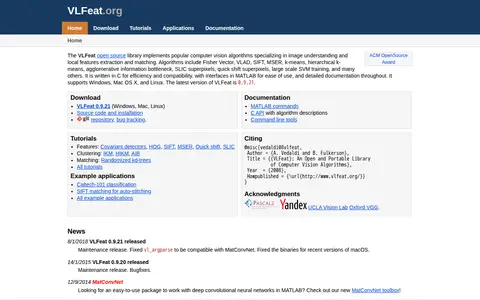
VLFeat is an open-source library of computer vision algorithms focused on image understanding and local feature extraction and matching. Algorithms include SIFT, MSER, Fisher Vector, VLAD, k-means, SLIC superpixels, and SVM training. It is written in C with MATLAB interfaces and supports Windows, Mac OS X, and Linux.
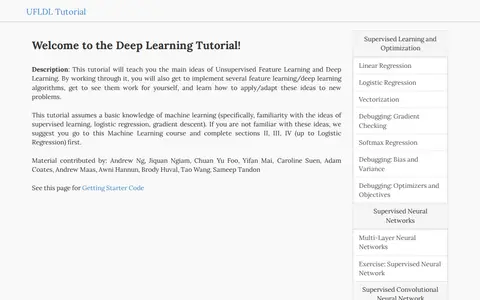
Tutorial teaching the main ideas of unsupervised feature learning and deep learning, with implementation of feature learning and deep learning algorithms. It assumes basic machine learning knowledge, including supervised learning, logistic regression and gradient descent, and suggests completing an earlier machine learning course first.
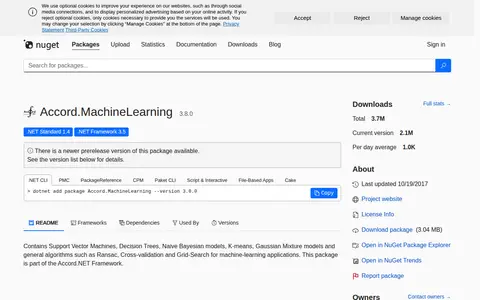
Accord.MachineLearning is a NuGet package, part of the Accord.NET Framework, that contains Support Vector Machines, Decision Trees, Naive Bayesian models, K-means, Gaussian Mixture models, and general algorithms such as Ransac, Cross-validation and Grid-Search for machine-learning applications. Version 3.8.0 targets .NET Standard 1.4 and .NET Framework 3.5.
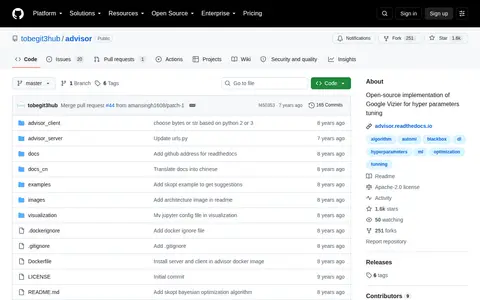
Advisor is an open-source GitHub repository maintained by user tobegit3hub. It provides an open-source implementation of Google Vizier built for hyperparameter tuning tasks. The repository includes documentation for supported algorithms and a quick start guide for users.
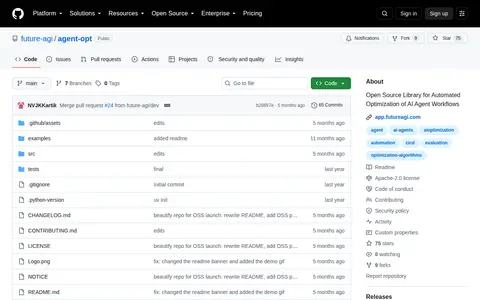
agent-opt is an open-source library hosted on GitHub for automated optimization of AI agent workflows. It includes six implemented optimization algorithms, works with any model and any evaluation metric, and is built to support future AGI development loops.