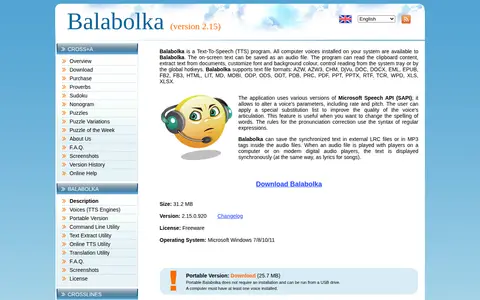

Balabolka is a freeware text-to-speech application that uses computer voices installed on the system. It can save on-screen text as an audio file, read clipboard content, extract text from documents, and save synchronized text in LRC files or MP3 tags.
Directory
Search results
Published directory entries matching your search.
Works with speech, voice, music or other audio using machine-learning models.

Free speech-to-text tool for content creators that accurately transcribes audio & video files up to 2GB.

MMAudio is a Hugging Face Space that generates synchronized audio from video or text. Users can upload a short video and write a prompt, including a negative prompt, to add realistic sound, or create a standalone audio clip from a text description.
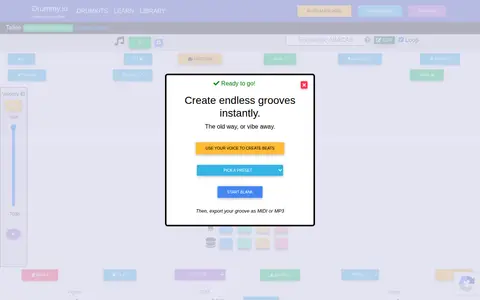
Drummy is a browser-based beat maker and AI drum machine. It composes songs with pattern layers, piano chords, and MIDI or MP3 export. Hector8 converts spoken descriptions into drum patterns. The site offers drum practice challenges and is free for all to compose, play and share.
A Hugging Face Space that turns an ebook file or pasted text into a complete audiobook. The user selects a language, voice and audio format, then generates audio to listen to or download; sections can also be previewed and edited. The page states support for 1107+ languages.
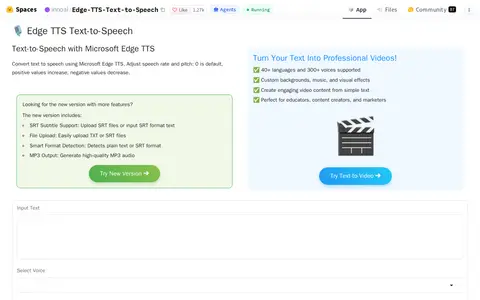
Edge TTS Text To Speech is a Hugging Face Space developed by innoai that converts user-input text to speech. Users can select from dozens of voice options, adjust speech speed and pitch, and generate high-quality MP3 audio files for playback or download. The space is currently running.
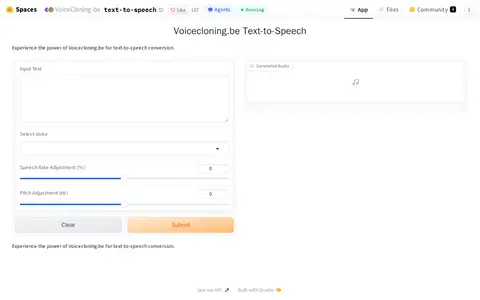
This is a duplicated instance of the Edge TTS Text To Speech Hugging Face Space, created by VoiceCloning-be. It offers the same text-to-speech functionality as the original, allowing users to input text, select voices, adjust speech rate and pitch, and generate customized audio output. The space is currently running.
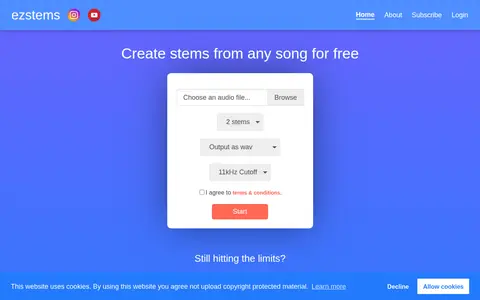
Ezstems is a website that uses Spleeter, a tool that creates stems from any audio file. Users upload an audio file and the resulting stems download in seconds. Free use is subject to limits, with a stated cap of 20 uploads per day and a 20MB file size limit.
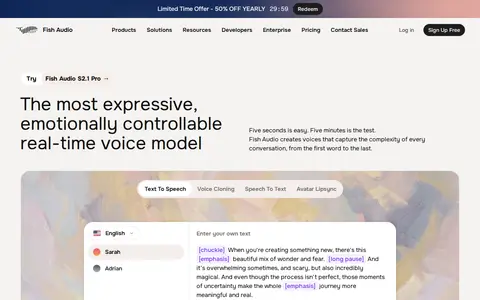
Fish Audio provides AI text-to-speech and voice cloning with emotion control and multilingual support. It offers TTS, speech-to-text, voice agents, and developer APIs with Python and TypeScript SDKs. The site lists a free tier with 8,000 monthly credits and paid Plus, Pro, and Max plans.
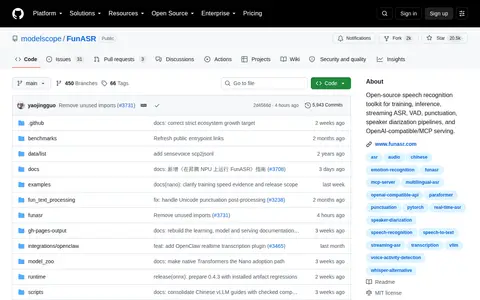
FunASR is an open-source speech recognition toolkit for training, inference, streaming ASR, VAD, punctuation and speaker diarization pipelines, with OpenAI-compatible and MCP serving. An industrial toolkit described for offline, streaming and edge deployment, it also covers emotion and audio-event models and keyword spotting. It is released under an MIT license.
Gnod is the Global Network of Discovery, a project of Marek Gibney offering discovery tools. Its projects include Discover and the Music-Map for music, plus Literature-Map, Movie-Map and a product chart. The site also provides a search engine comparison. It uses AI to suggest bands, art, authors and movies.
Good Tape is an automated transcription tool for video and audio that supports more than 100 languages. It offers speaker labels, AI summaries and a recorder app for iOS and Android. Uploaded recordings are processed and stored on servers inside the EU and are not used to train any model.
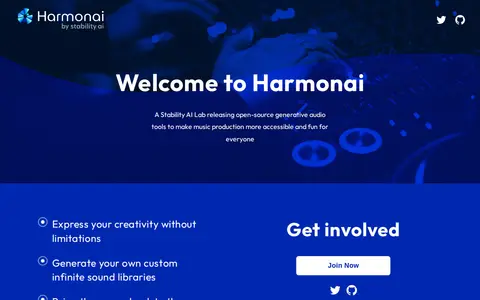
Harmonai is a Stability AI lab that releases open-source generative audio tools for music production. Its stated goal is to make music creation more accessible and enjoyable for all users, with tools that support custom infinite sound library generation to expand creative possibilities for musicians.
Img To Music uses AI for speech, voice, transcription, music, or other audio workflows.
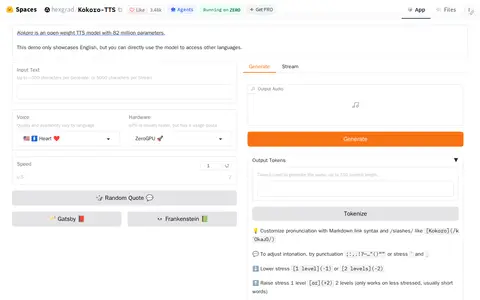
Kokoro TTS is a Hugging Face Space developed by hexgrad that converts input English text to spoken audio. Users can select a voice and speaking speed, and choose to download the generated audio or listen to a live streaming version.
A Hugging Face Space that converts text into speech in various languages, including Lojban and English. Users enter text and choose language and voice settings, then receive audio output. The Space is listed as sleeping due to inactivity.
Lyria by Google DeepMind is a music generation model developed by Google DeepMind, positioned as the organization's most advanced system for AI-powered music creation. It is designed to support creative music production alongside related AI experiments, as part of Google DeepMind's broader portfolio of specialized AI models for generating high-fidelity music and audio.
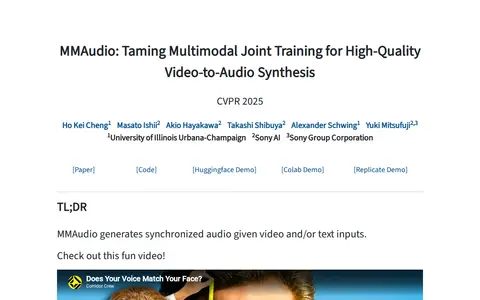
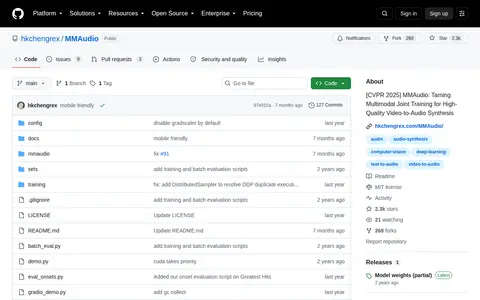
MMAudio is a research project on multimodal joint training for video-to-audio synthesis. It generates synchronized audio given video and/or text inputs. The work is presented at CVPR 2025 by authors from the University of Illinois Urbana-Champaign and Sony.
MMAudio is a CVPR 2025 project for video-to-audio synthesis that generates synchronized audio from video and/or text inputs. It uses multimodal joint training and a synchronization module to align generated audio with video frames. A pretrained large_44k_v2 model is used by default, with inference around 6GB of GPU memory in 16-bit mode.
Moe TTS is a Hugging Face Space created by skytnt that enables users to generate speech from input text and convert existing audio to a different speaker's voice. Users can input text to create speech output, select from available speakers, and adjust the playback speed of generated audio.
Works with speech, voice, music or other audio using machine-learning models.
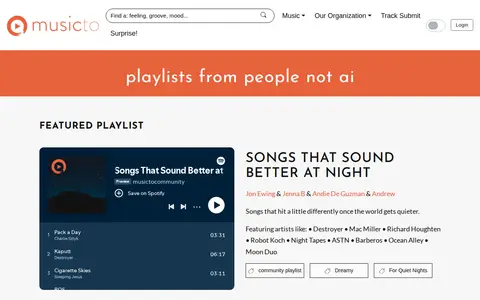
MusicTo is a global creator community that collaborates through music to create playlists for curious listeners. The site states its playlists are made by community members rather than by AI, with themed collections and artist picks.
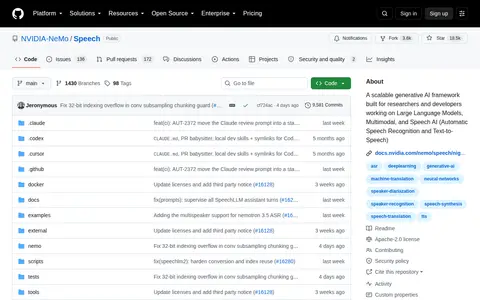
NVIDIA NeMo Speech is a framework built for researchers and developers working on speech AI, including automatic speech recognition and text-to-speech. The repository provides open weight checkpoints and demos through a Hugging Face collection. It is licensed under Apache-2.0 and has pivoted to focus on audio, speech, and multimodal LLMs.