
Greywall is a container-free, deny-by-default sandbox designed for AI coding agents. It provides kernel-enforced filesystem, network, and syscall isolation for Linux and macOS operating systems, and is hosted as a public repository on GitHub.
Directory
Search results
Published directory entries matching your search.
Guild AI is the source repository for an open source toolkit that automates and optimizes machine learning experiments. It runs unmodified training scripts, captures each run result as a unique experiment, and automates trials using grid search, random search and Bayesian optimization.
h5i is a workspace for securing web applications through two approaches: finding vulnerabilities with AI agents and proving correctness with formal verification. It provides AI agents a toolkit for browser automation, HTTP traffic manipulation and reconnaissance, and includes h5i-app, an Axum-based Rust framework for verification with Lean 4.
Open-Source AI Chatbot / Agent builder with support for LLMs as well as social media channels integration.
Jupyter AI is an open source extension that connects AI agents to computational notebooks in JupyterLab. It provides a native chat UI and integrates agents through the Agent Client Protocol, with a permission system requiring approval before files are written or commands executed. It is under incubation in the JupyterLab organization.
Supports software work with AI-assisted coding, testing or application development.
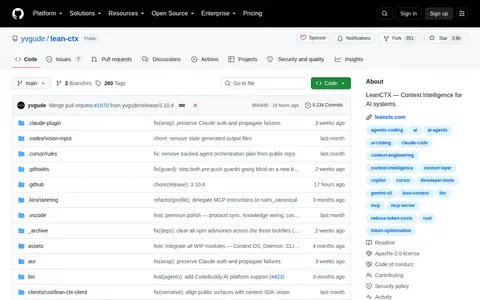
LeanCTX is an open-source context gateway that sits between AI tools and the information they read. It selects task-relevant context, applies supported access and content controls, and records observable context operations and evidence. The engine can run locally through CLI, MCP, hooks and proxy paths, and an SDK embeds supported engine capabilities in applications.
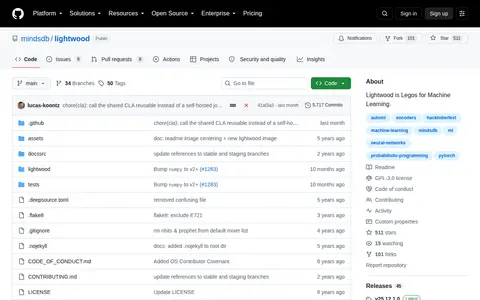
Lightwood is an AutoML framework that generates and customizes machine learning pipelines using a declarative JSON-AI syntax. It handles data types such as numbers, dates, categories, tags, text, arrays and multimedia formats, and includes a time-series mode. Users can override defaults or replace pipeline steps, and the framework generates Python code for the pipeline.
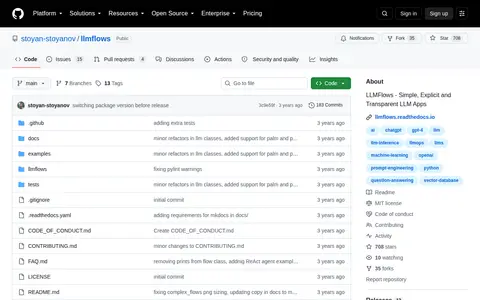
LLMFlows is a Python framework for building LLM applications such as chatbots, question-answering systems and agents. It provides abstractions for using LLMs and vector stores, with explicit classes that avoid hidden prompts or LLM calls, aiming to make monitoring, maintenance and debugging easier.
An alternative to Supabase for AI Code editors and Vibe Coding tools.
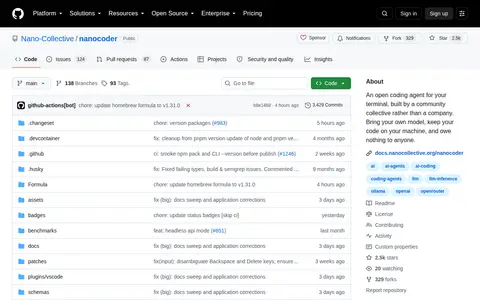
Nanocoder is an open-source coding agent built for terminal use by a community collective rather than a corporate entity. It allows users to bring their own AI model, stores code locally on the user's machine, and does not require users to owe fees or obligations to a company. It is hosted as a public repository on GitHub.

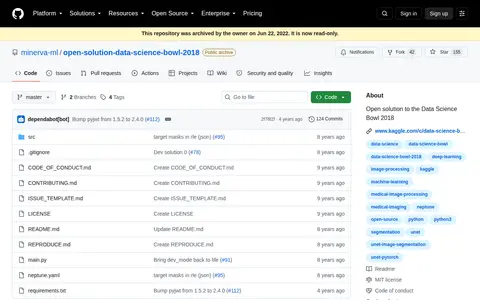
An open solution to the Data Science Bowl 2018, based on the topcoders winning solution from ods.ai. The repository was archived by the owner on Jun 22, 2022 and is now read-only. It uses PyTorch and references neptune.ml, though running it as a plain Python script is possible.
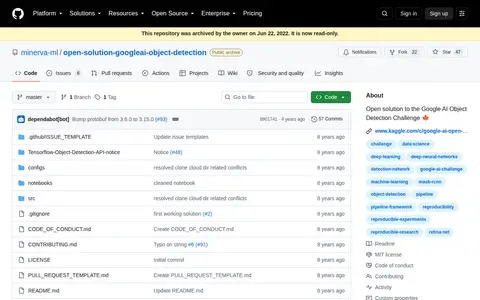
An archived, read-only GitHub repository holding an open solution to the Google AI Open Images Object Detection Track. It offers starter code, configs and notebooks, with RetinaNet training and references to the Neptune experiment platform; Neptune use is optional and the code can run as a plain Python script. The README notes the competition used Open Images Dataset V4.
The AI coding agent built for the terminal.
Model Context Protocol - An open standard for connecting AI models to external tools and data sources. MCP Registry.
Open Source framework for voice and multimodal conversational AI.
Plandex is an open source AI coding agent built for large projects and real-world tasks. It includes smart context management for large codebases, configurable autonomy levels, and tools to support producing production-ready results.
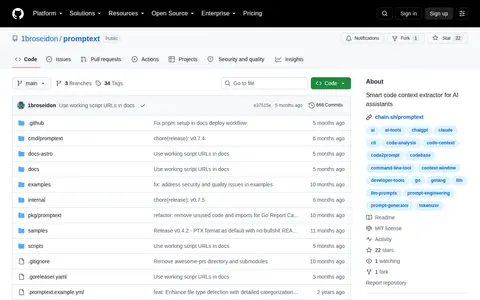
promptext is a smart code context extractor developed for use with AI assistants. The open-source tool is hosted on the GitHub repository belonging to user 1broseidon, and is designed to pull relevant code context to improve the performance of AI coding assistants.
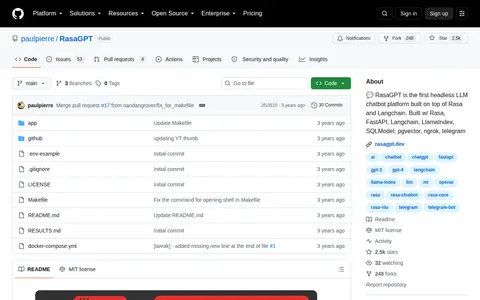
RasaGPT is described as a headless LLM chatbot platform built on top of Rasa and Langchain. It is boilerplate and a reference implementation of Rasa and Telegram utilizing an LLM library like Langchain for indexing, retrieval and context injection.
Supports software work with AI-assisted coding, testing or application development.
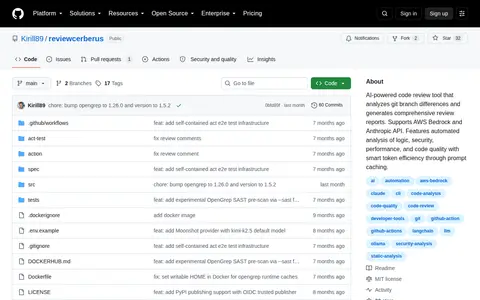
ReviewCerberus is an AI-powered code review tool that analyzes git branch differences and generates review reports. It examines logic, security, performance and code quality, and supports AWS Bedrock and Anthropic API, according to the repository. A GitHub Action posts review comments on pull requests.
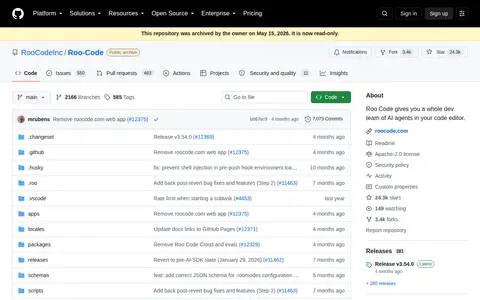
An AI-powered autonomous coding agent integrated directly into VS Code. opensource.
Zero-configuration MCP server that unifies multiple AI coding assistants (Claude Code, Cursor, Codex) through intelligent auto-discovery.