
Microsoft Research publication proposing 18 generally applicable design guidelines for human-AI interaction. The guidelines were validated through evaluation rounds, including a user study with 49 design practitioners who tested them against 20 AI-infused products. The authors state the guidelines can serve as a resource for practitioners designing AI applications and for researchers developing interaction design guidelines.

Directory
Search results
Published directory entries matching your search.
Explore any niche. Discover pain points, content opportunities, and what solutions people are eager to pay for.
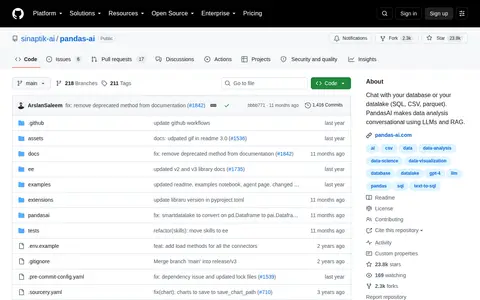
PandasAI is an open-source library that enables conversational data analysis using large language models and retrieval-augmented generation. It allows users to interact with databases or datalakes supporting SQL, CSV, and parquet file formats.
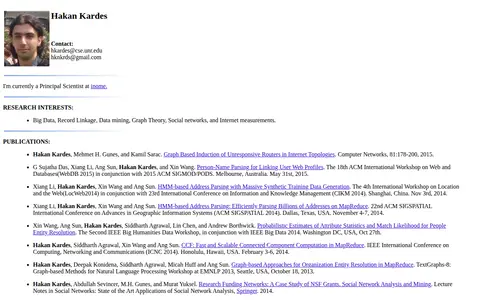
Personal page of Hakan Kardes, a principal scientist whose listed research interests include big data, record linkage, data mining, graph theory, social networks and Internet measurements. The page lists publications on topics such as connected component computation in MapReduce, address parsing and organization entity resolution.
Hammer Aidot Com provides conversational AI for questions, tasks, and general assistance.
HammerAI is presented as a free and private AI chat and roleplay service. According to the site, it allows chatting with role-playing AI characters, generating images as well as writing stories. The source page displays a UK access block citing Online Safety Act regulations.

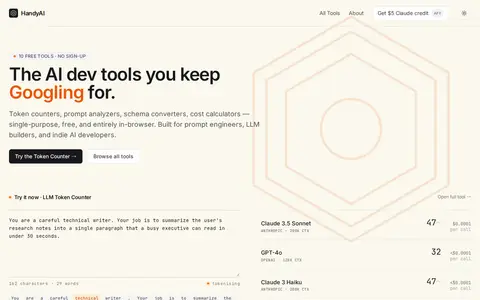
HandyAI is a collection of free browser-based tools for AI and Claude developers, including token counters, prompt analyzers, JSON to tool-use converters and cost calculators. It requires no sign-up and lists the LLM Token Counter and AI Cost Calculator as live tools, with others announced for later release.

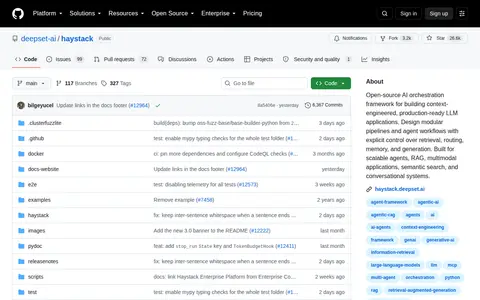
Haystack is an open-source AI orchestration framework for building production-ready LLM applications in Python. It provides modular pipelines and agent workflows with explicit control over retrieval, routing, memory and generation, and is intended for RAG systems, multimodal applications, semantic search, question answering and autonomous agents. Installation is available via pip.
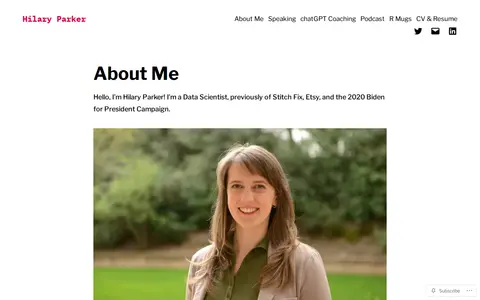
Hilary Mason is co-founder and CEO of Hidden Door, where she works on projects that teach machines to tell stories. She builds projects at the edge of technical possibility, speaks and advises on developing AI products suited for real-world use, and maintains a writing archive covering data and machines dating back to 2006. She has scheduled speaking appearances at events including GDC 2026 and QCon AI New York.
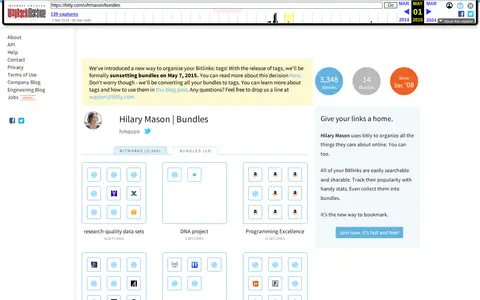
An archived Bitly bundles page belonging to Hilary Mason, listing link collections on topics such as research-quality data sets, programming, data stories and data science blogs. The page notes that Bitly sunset bundles on May 7, 2015 and converted them to tags.
Creates, rewrites or summarizes written content with language models.
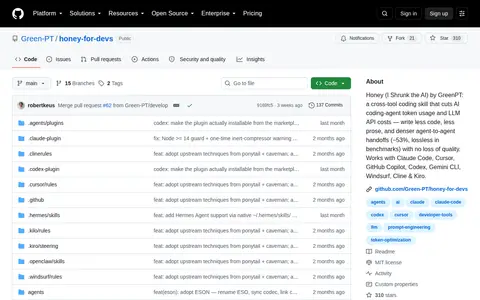
Honey (I Shrunk the AI) by GreenPT is a cross-tool coding skill that reduces AI coding-agent token usage and LLM API costs. It enables writing less code and prose and supports denser agent-to-agent handoffs, with reported 53% cost reduction and no quality loss in benchmarks. It is compatible with Claude Code, Cursor, GitHub Copilot, Codex, Gemini CLI, Windsurf, Cline, and Kiro.
HuggingFace supports AI-assisted research, knowledge retrieval, summarization, or source analysis.
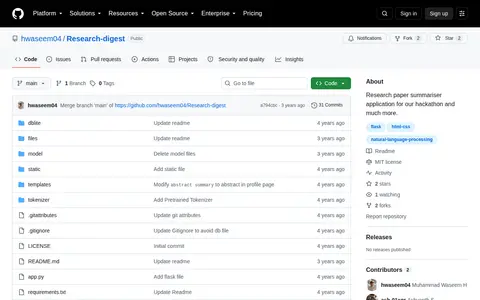
Research-Digest is a Flask application that scrapes arXiv weekly for newly published papers in fields including computer vision and machine learning, then offers a summarization feature so users can grasp key points. Summarization uses a T5 model finetuned on scientific articles, with weights and tokenizers stored locally.
Hyperspace provides conversational AI for questions, tasks, and general assistance.
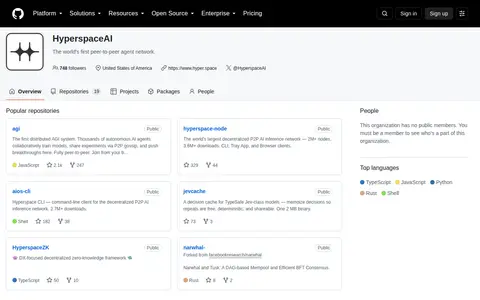
HyperspaceAI describes itself as a peer-to-peer agent network with 19 public repositories on GitHub. Among the repositories is the AGI project, which describes thousands of autonomous AI agents that train models in collaboration and share experiments via P2P gossip. Another repository, hyperspace-node, is described as a decentralized P2P AI inference network with CLI, Tray App and Browser clients.
A first-person essay by former writing and literature teacher Victoria Livingstone describing why she left teaching, citing students' reliance on large language models such as ChatGPT for drafting and revising written work. The piece discusses pedagogical attempts to address AI use and the difficulty of evaluating AI-revised text.
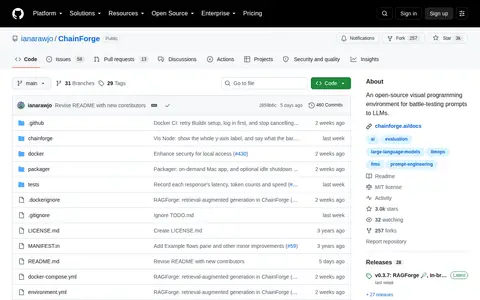
ChainForge is an open-source visual programming environment for battle-testing prompts to large language models. It supports querying multiple models at once, comparing response quality across prompts, models and model settings, and setting evaluation metrics to visualize results. Built on ReactFlow and Flask, it can be installed locally with pip or tried on the web, where features are limited.
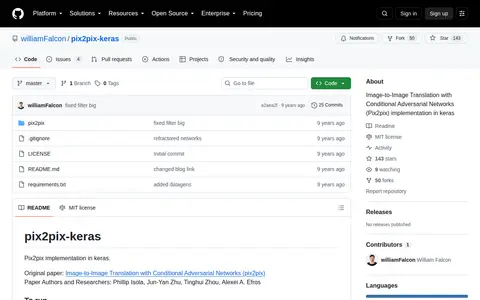
Pix2pix implementation in keras. The repository provides code to download the facades dataset, install requirements, and start training, and it references the original Image-to-Image Translation with Conditional Adversarial Networks paper.
Inception provides conversational AI for questions, tasks, and general assistance.
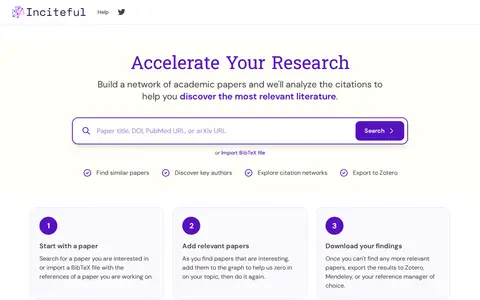
Inciteful supports AI-assisted research, knowledge retrieval, summarization, or source analysis.
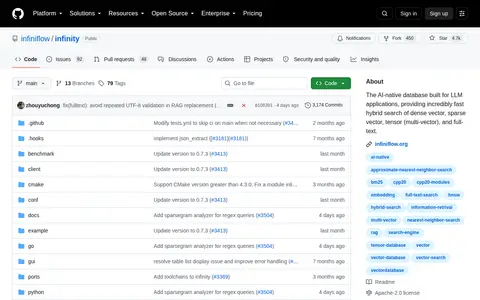
AI-native database built for LLM applications, providing incredibly fast vector and full-text search.
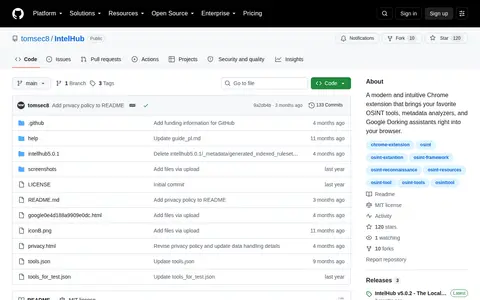
A modern and intuitive Chrome extension that brings your favorite OSINT tools, metadata analyzers, and Google Dorking assistants right into your browser.
Interviews Chat is an AI interview assistant that provides real-time suggestions and live transcription during interviews. It offers AI interview preparation and mock interview practice, and responds to technical and behavioral questions in formats such as STAR answers, bullet points and follow-up questions. A Chrome extension can connect to a browser tab with a task and generate a solution with reasoning.