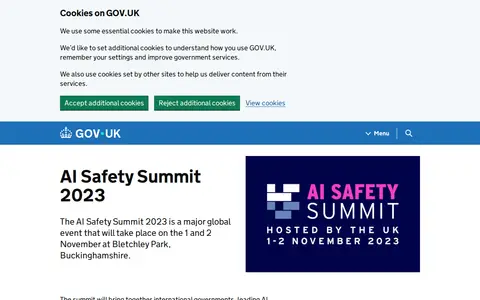

The AI Safety Summit 2023 is a global event held on 1 and 2 November at Bletchley Park, Buckinghamshire. It brings together international governments, AI companies, civil society groups and researchers to consider AI risks, especially at the frontier of development, and discuss mitigation through internationally coordinated action.
Directory
Search results
Published directory entries matching your search.
Filters
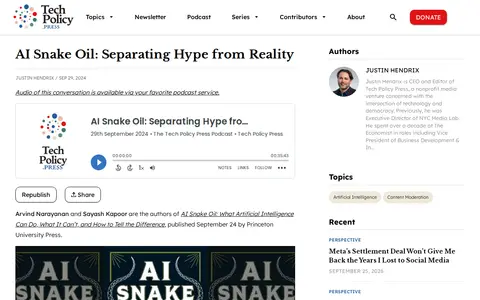

techpolicy.press
A TechPolicy.Press discussion with Arvind Narayanan and Sayash Kapoor, authors of AI Snake Oil: What Artificial Intelligence Can Do, What It Can’t, and How to Tell the Difference, published September 24 by Princeton University Press. The conversation covers AI hype and how to distinguish AI that does not work from real promise.

huggingface.co
Creates, rewrites or summarizes written content with language models.
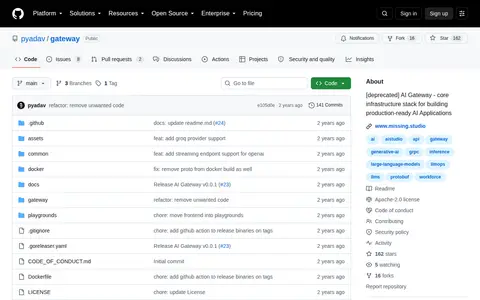

github.com
A deprecated GitHub repository described as an AI Gateway, a core infrastructure stack for building production-ready AI applications. It provides a universal API for inferencing over 100 LLMs and lists supported providers and endpoints such as OpenAI and Groq.
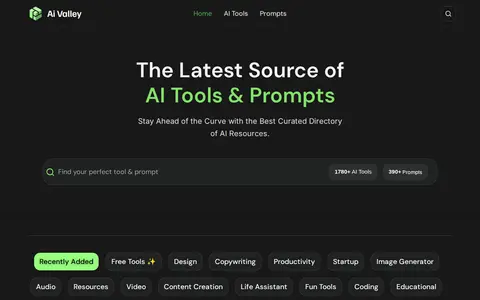

aivalley.ai
AI Valley is a curated directory of AI resources that provides daily updates of useful AI tools and prompts. It hosts over 1,700 AI tools and more than 390 prompts, organized across categories including design, copywriting, productivity, coding, and marketing for various use cases.
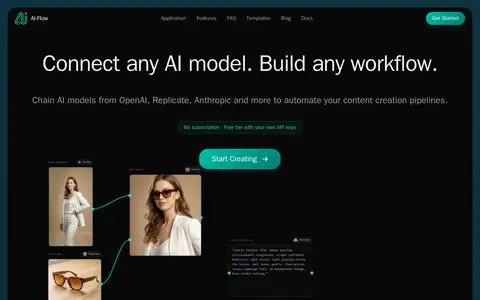

ai-flow.net
AI-Flow is an open source, user-friendly UI application for creating workflows with different AI models. It lets users chain models from OpenAI, Replicate, Anthropic and others to automate content creation pipelines, and workflows can be shared as apps. Users may supply their own API keys or use platform credits.
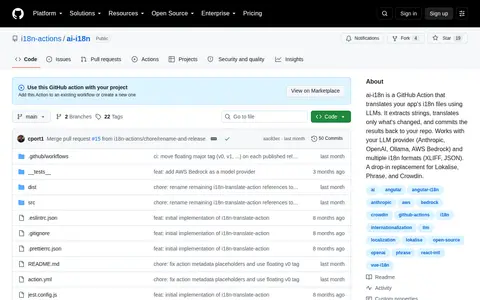

github.com
ai-i18n is a GitHub Action that translates internationalization files using large language models. It extracts strings, translates only changed content, and commits results back to the repository. Supported providers include Anthropic, OpenAI, Ollama, and AWS Bedrock, with compatibility for XLIFF and JSON formats. It serves as a drop-in replacement for services like Lokalise, Phrase, and Crowdin.
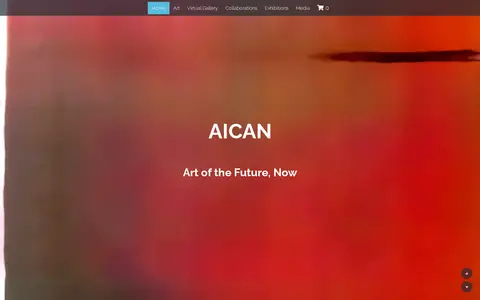
aican.io
AICAN is an artificial intelligence artist and collaborative creative partner. It generates novel images by learning about art and styles without adhering to established categories. The project presents artworks in a virtual gallery and has been featured in media for its visually appealing AI-generated art.
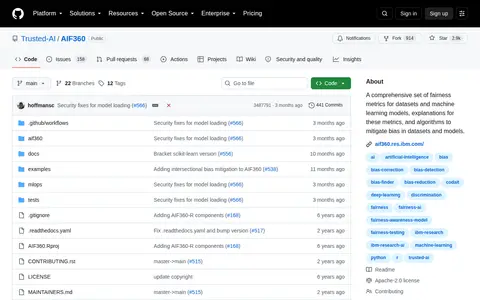

github.com
AIF360, or AI Fairness 360, is a comprehensive toolkit that provides fairness metrics for datasets and machine learning models. It includes explanations for these metrics and algorithms to mitigate bias in data and models. The project is developed by the Trusted-AI community on GitHub.
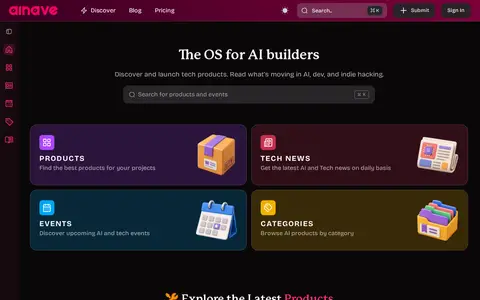

ainave.com
AINave is a platform for discovering new AI tools, launching products, and reading AI news for builders. Approved products get an automatic launch page that people can upvote and comment on, ranked in weekly, monthly and yearly boards.
aispect.io
Turn live audio into stunning visuals.
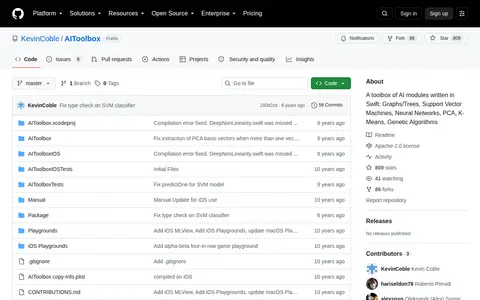

github.com
AIToolbox is a toolbox of AI modules written in Swift, covering graphs and trees, support vector machines, neural networks, PCA, K-Means and genetic algorithms. The framework uses the Accelerate library to speed up computations, except the Linux package versions. A Swift Package is available for Mac and Linux, described as a sub-set of the full framework.
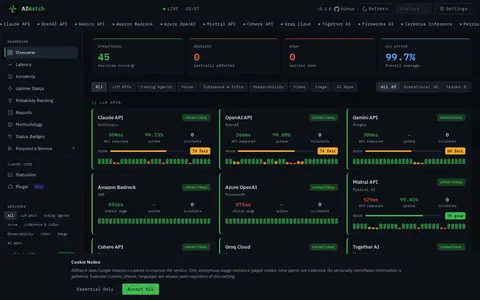

ai-watch.dev
AIWatch is a real-time status monitoring site for 47 AI services, including Claude, ChatGPT, Gemini, Cursor and Codex. It lets users check whether AI services are down and track uptime and incidents, showing service status at a glance and flagging outages for immediate confirmation.
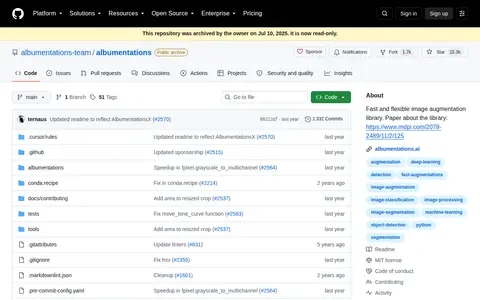

github.com
albumentations is a fast, flexible open-source image augmentation library. An academic paper describing the library is available. The project is no longer maintained, and AlbumentationsX is presented as its successor.
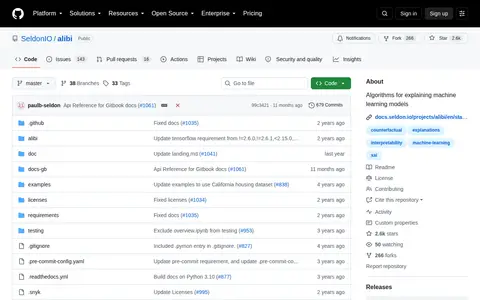

github.com
Alibi is an open-source project that provides algorithms for explaining machine learning models. Developed by SeldonIO and hosted on GitHub, it includes installation and usage documentation for pip and conda.
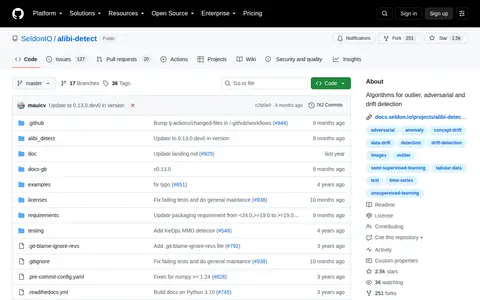

github.com
Alibi Detect is an open-source project that provides algorithms for outlier, adversarial, and drift detection. Developed by SeldonIO and hosted on GitHub, it includes installation and usage documentation for pip and conda.
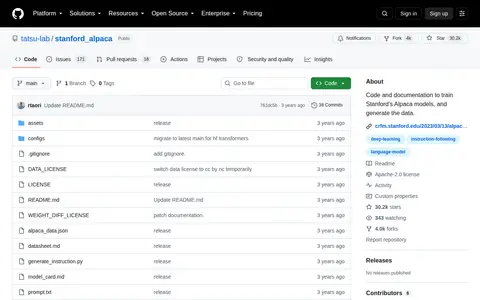

github.com
Alpaca is a project that provides code and documentation to train Stanford's Alpaca instruction-following LLaMA models and generate associated training data. It includes details on the data release, data generation process, and fine-tuning procedures.
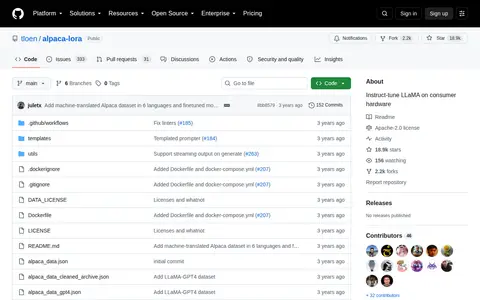

github.com
alpaca-lora is a repository with code for reproducing the Stanford Alpaca results using low-rank adaptation (LoRA). It provides an Instruct model and training code that can be easily extended to the 13b, 30b and 65b models, along with a script for downloading and inference.
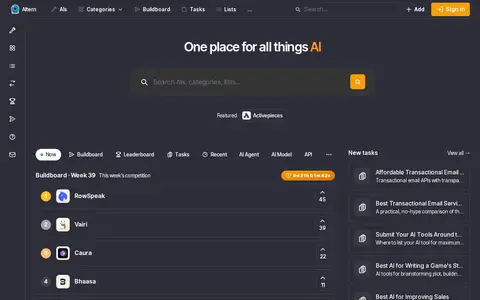

altern.ai
Altern is a directory for finding AI tools, curated lists and categories, with a searchable index of AIs, a weekly leaderboard, tasks and alternatives. Its help center covers user accounts, saving tools, and suggesting alternatives.
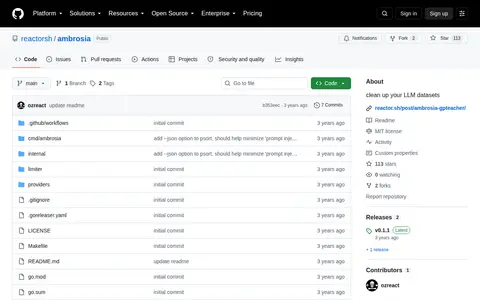

github.com
Ambrosia is a cross-platform command line tool written in Go for improving text datasets used in machine learning. It offers fast deduplication, filtering, length checking and whitespace trimming, plus an LLM-based filtering option called psort. It ships as a single binary with no dependencies and is pre-1.0 software.

amidsttoolbox.com
A Java Toolbox for Scalable Probabilistic Machine Learning.
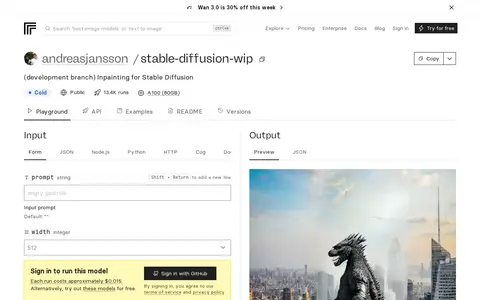

A work-in-progress inpainting branch of Stable Diffusion, published as a public Replicate model. The model runs on Nvidia A100 (80GB) GPU hardware and predictions typically complete within 11 seconds. It costs approximately $0.015 to run on Replicate, or 66 runs per $1. It is open source and can be run on a computer with Docker.
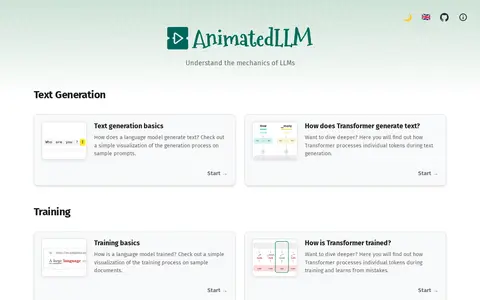

animatedllm.github.io
Understand how large language models work under the hood.
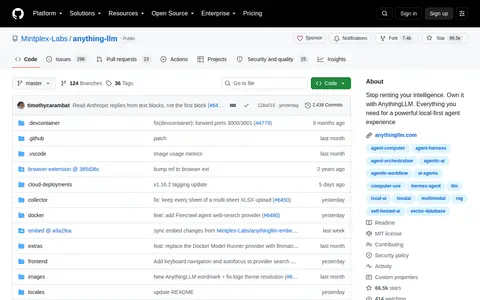

github.com
AnythingLLM is an all-in-one AI application for chatting with documents, using AI agents, and connecting local or cloud LLMs. It includes a built-in local LLM engine, vector databases, document pipelines, multi-user support, and a no-code agent builder. It is distributed under an MIT license.