
donnees.banquemondiale.org
Browse public datasets, metadata and downloadable records in an open catalog.
Directory
Published directory entries matching your search.
Browse public datasets, metadata and downloadable records in an open catalog.
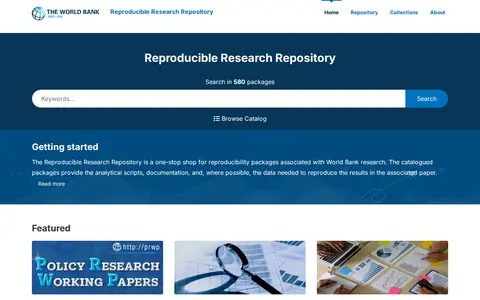
Searchable repository for finding economics datasets and software.

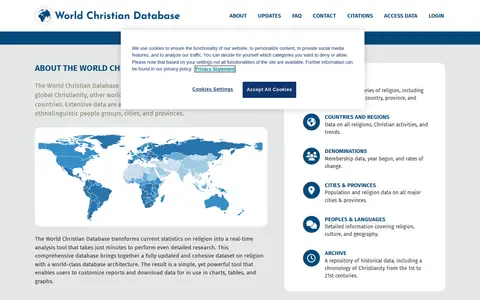
The World Christian Database provides statistical information on world religions, Christian denominations and people groups, with data for all 237 countries. It covers thousands of denominations, ethnolinguistic people groups, cities and provinces, and allows users to customize reports and download data for charts, tables and graphs.

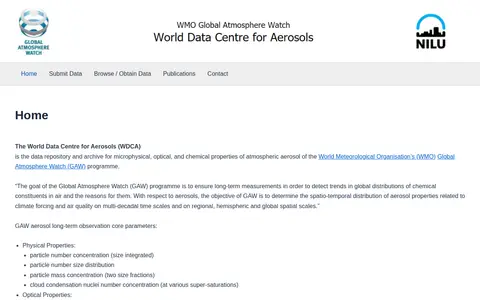
The World Data Center for Aerosols is the data repository and archive for atmospheric aerosol microphysical, optical, and chemical property data, operated as part of the World Meteorological Organisation’s Global Atmosphere Watch programme. The centre supports long-term aerosol measurements to detect trends in global air chemical constituent distributions, with a focus on characterising the spatio-temporal distribution of aerosol properties related to climate forcing and air quality across regional, hemispheric, and global scales over multi-decadal time periods. It curates core long-term aerosol observation parameters including particle number concentration, size distribution, mass concentration, and cloud condensation nuclei concentration.

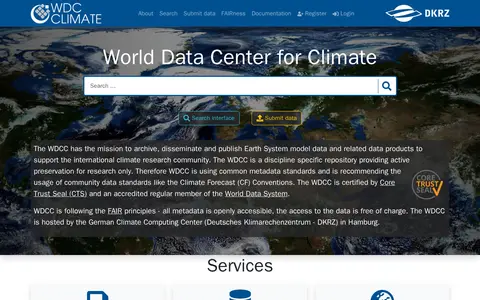
The World Data Center for Climate archives, disseminates and publishes Earth System model data and related data products for the international climate research community. It is hosted by the German Climate Computing Center in Hamburg and offers a search interface and data download free of charge for registered users.
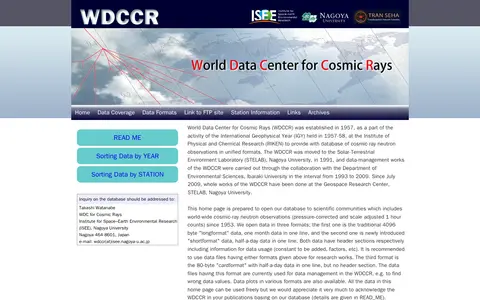
World Data Center for Cosmic Rays is a data center established in 1957 that provides a database of worldwide cosmic-ray neutron observations in unified formats. It offers pressure-corrected and scale-adjusted hourly counts since 1953, with data available in longformat, shortformat and cardformat files, along with data plots. It is based at Nagoya University's Geospace Research Center.
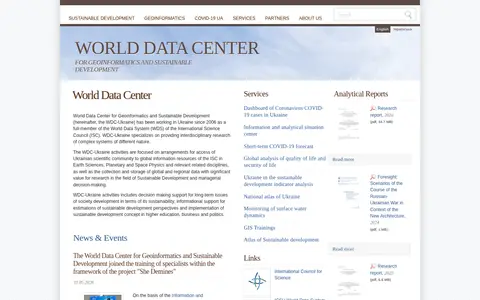
The World Data Center for Geoinformatics and Sustainable Development has operated in Ukraine since 2006 as a full member of the World Data System (WDS) of the International Science Council (ISC). It specializes in interdisciplinary research of complex systems, provides the Ukrainian scientific community with access to ISC global information resources in Earth Sciences, Planetary and Space Physics and related disciplines, and collects and stores global and regional data for sustainable development research and managerial decision-making. It supports long-term societal sustainability decision-making and sustainable development perspective estimation.

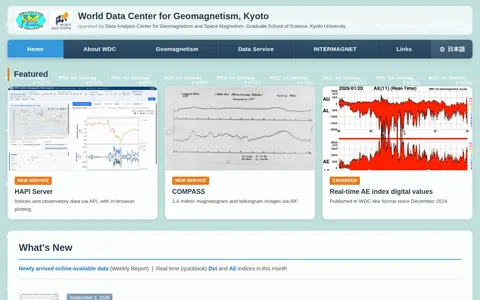
The World Data Center for Geomagnetism, Kyoto provides geomagnetic field data from observatories worldwide along with the AE, ASY/SYM and Dst indices. It offers a HAPI server for indices and observatory data via API with in-browser plotting, and COMPASS image access via IIIF.
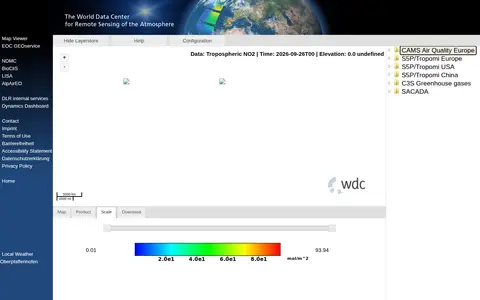
The World Data Center for Remote Sensing of the Atmosphere operates the WDC-RSAT Map Viewer tool. Its website links to related services including EOC GEOservice, NDMC, BioCliS, LISA, AlpAirEO, DLR internal services and Dynamics Dashboard, provides local weather data for Oberpfaffenhofen, and includes pages for contact, imprint, terms of use, accessibility statement and privacy policy.

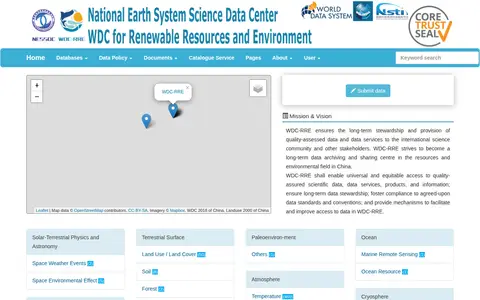
The World Data Center for Renewable Resources and Environment is a data center based in Beijing, China, that archives and shares data in the resources and environmental field. Its catalog covers categories such as agricultural resources, land use and land cover, vegetation, temperature, precipitation, water quality and ocean resources. The site also provides a data service user manual and data documentation.
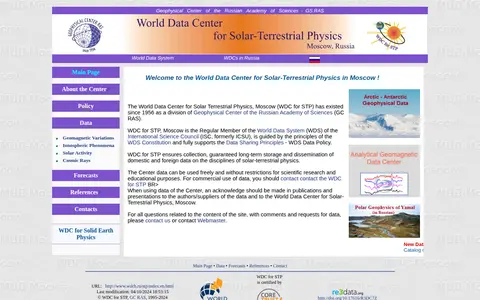
The World Data Center for Solar-Terrestrial Physics, Moscow, a division of the Geophysical Center of the Russian Academy of Sciences, has existed since 1956. It collects, stores and disseminates data on solar-terrestrial physics disciplines, with online data and data search. Its data can be used freely for scientific research and educational purposes.
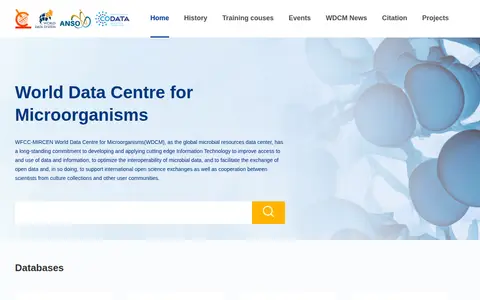
The World Data Centre for Microorganisms is a global microbial resources data center. It applies information technology to improve access to and use of data and information and to optimize the interoperability of microbial data. It facilitates the exchange of open data and supports international open science exchanges and cooperation between scientists from culture collections and other user communities.

The World Data Centre for Geomagnetism, Copenhagen, distributes the definitive PCN index derived from the geomagnetic observatory Qaanaaq and Kp-index data products derived at the geomagnetic observatory Niemegk via an FTP server. It also holds extensive archives of magnetograms and other geomagnetic observatory data products that predate digital data recording, in analogue form such as film or microfiche. It was established in 1957.

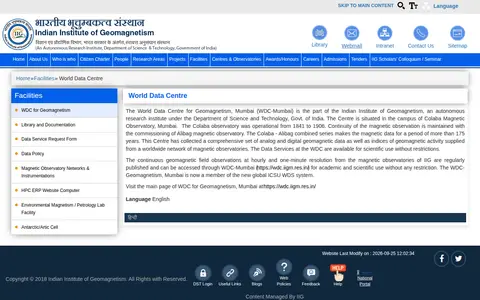
The World Data Centre for Geomagnetism, Mumbai, is part of the Indian Institute of Geomagnetism and is situated at the Colaba Magnetic Observatory campus. It holds analog and digital geomagnetic data and geomagnetic activity indices from observatories worldwide. Data services are available for scientific use without restrictions, and hourly and one-minute observations are published for academic and scientific use.

Search atmospheric, oceanography and climate data collections and supporting datasets from GBR.

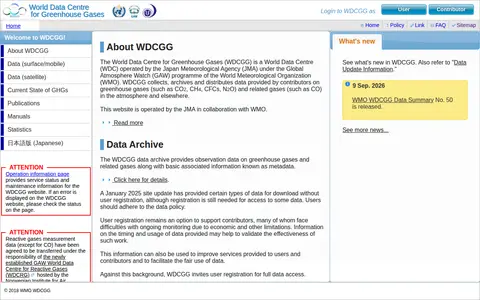
WDCGG is a World Data Centre operated by the Japan Meteorological Agency under the Global Atmosphere Watch programme of the World Meteorological Organization. It collects, archives and distributes contributor-provided data on greenhouse gases such as CO2, CH4, CFCs and N2O and related gases such as CO in the atmosphere and elsewhere. A January 2025 site update provided certain data for download without user registration.

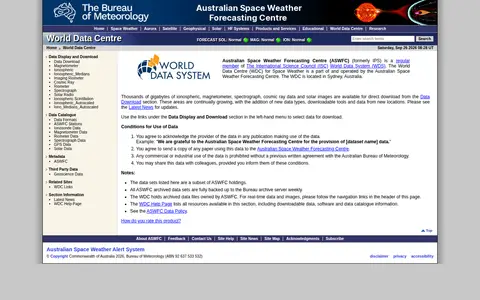
The World Data Centre for Space Weather is part of and operated by the Australian Space Weather Forecasting Centre and is located in Sydney, Australia. It offers ionospheric, magnetometer, spectrograph, cosmic ray data and solar images for direct download, and provides software and data catalogue information. Commercial or industrial use of the data is prohibited without a previous written agreement.
Find and access engineering research data, with indexed datasets.

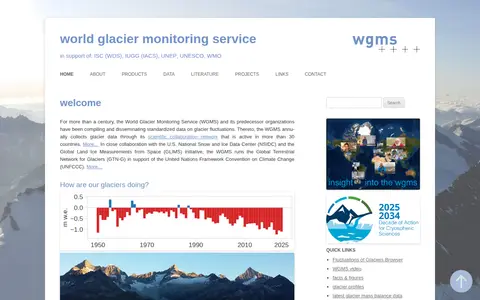
The World Glacier Monitoring Service compiles and disseminates standardized data on glacier fluctuations, collecting glacier data annually through a scientific collaboration network active in more than 30 countries. With NSIDC and GLIMS, it runs the Global Terrestrial Network for Glaciers in support of the UNFCCC.
Find and access atmospheric research data, with indexed measurement and test data.
Research data portal for exploring atmospheric records, including observational data.

The World Register of Marine Species is an authoritative classification and catalogue of marine names. It is continuously updated to reflect current published scientific knowledge without making new taxonomic decisions. The site reports accepted marine species and marine species names, including synonyms, and offers tools such as taxon matching and web services.

The World Stress Map is a global compilation of information on the crustal present-day stress field, maintained since 2009 at the GFZ Helmholtz Centre for Geosciences. It is an open-access database with stress information compiled in a standardized, quality-ranked format. The 2025 database release contains 100,842 data records in the Earth's crust.

The World Values Survey is a cross-national survey data archive and analysis platform run by the World Values Survey Association. The association conducts multi-wave surveys on values and political culture, including its eighth survey wave, and provides public access to survey data, documentation, publications, and webinar content. It also administers the annual Ronald F. Inglehart Best Book Award on Political Culture and Values.