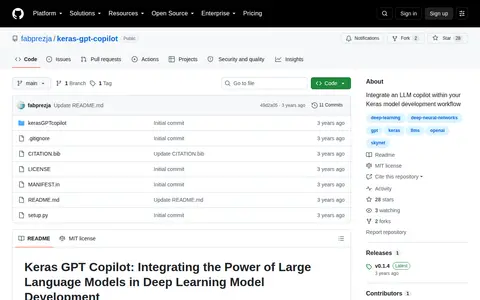

Keras GPT Copilot is a Python package that integrates an LLM copilot within the Keras model development workflow, generating feedback from model configuration, optimizer details and experiment results. It interacts with OpenAI's GPT models and offers a prompt-only mode for compatibility with other large language models.
Directory
Search results
Published directory entries matching your search.
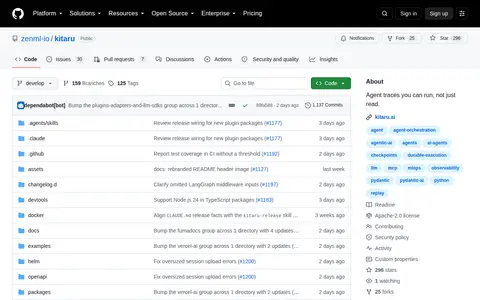
Kitaru is an open-source, self-hosted tool providing replay-based evaluations for AI agents. It records or imports production runs as sessions and replays them against a changed model, prompt, or code, with tool calls answered from the recording. It is available for Python and TypeScript and comes from the team behind ZenML.
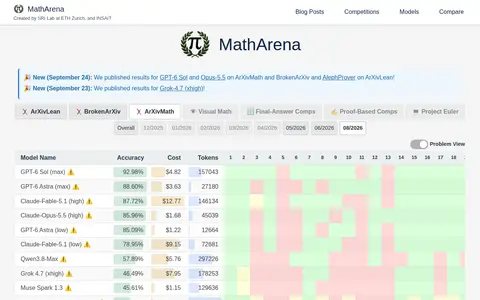
MathArena evaluates large language models on uncontaminated math benchmarks. It presents model analysis across competitions such as ArXivLean, BrokenArXiv, ArXivMath, Visual Math, Final-Answer Comps, Proof-Based Comps and Project Euler. A competition is selected to load tables and a leaderboard, and clicking a cell shows the raw model output.
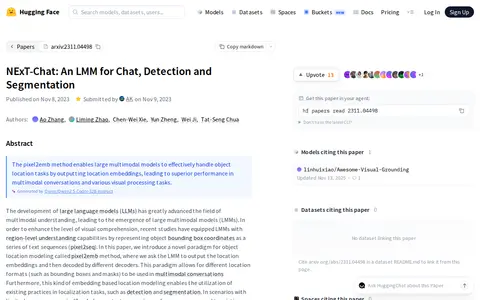
NExT-Chat is a large multimodal model trained using the pixel2emb method, in which the model outputs location embeddings decoded by different decoders. This allows bounding boxes and masks in multimodal conversations and supports tasks such as visual grounding, region caption and grounded reasoning.
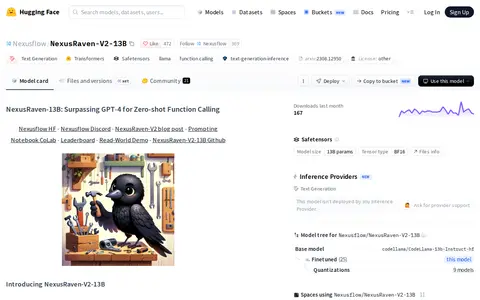
Nexusflow/NexusRaven-V2-13B is a 13-billion parameter language model available on Hugging Face. It is designed for zero-shot function calling and text generation, aiming to advance open-source artificial intelligence. The model can be used with libraries such as Transformers and provides instructions for deployment via inference providers, notebooks, and local applications.
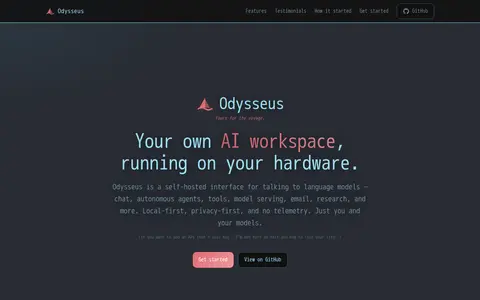
Odysseus is a self-hosted AI workspace for running language models on one's own hardware. It offers chat, autonomous agents, tools and MCP connections, model serving, an email assistant, deep research, model comparison and persistent memory. The project is described as local-first and privacy-first, with no telemetry.
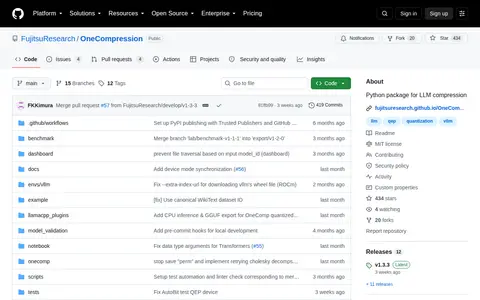
OneComp is a Python package for large language model (LLM) compression, hosted as a public repository under the FujitsuResearch GitHub organization. The project is designed for LLM compression tasks and accepts community contributions to its codebase.
Pipeline Conversations is a podcast from ZenML featuring interviews with platform engineers, ML practitioners and technical leaders building production AI systems. Episodes cover MLOps and LLMOps topics including Kubernetes workflows, model fine-tuning and evaluation, LLM security, cost optimization, prompt engineering and agents in production.
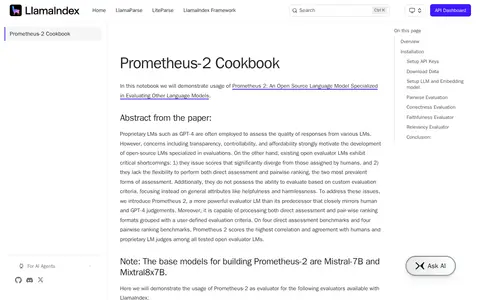
This is a LlamaIndex developer documentation cookbook demonstrating the usage of Prometheus 2, an open-source language model specialized in evaluating other language models. Prometheus 2 was developed to address transparency, controllability, and affordability limitations of proprietary language model evaluators.
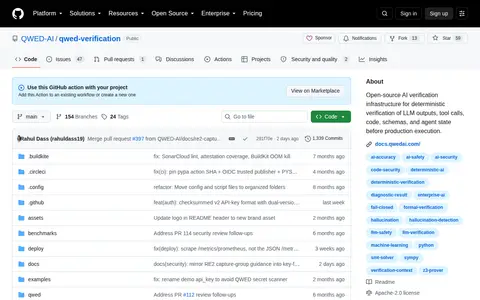
QWED is an open-source AI verification infrastructure hosted on GitHub. It provides deterministic verification for large language model outputs, tool calls, code, schemas, and agent state prior to production execution.
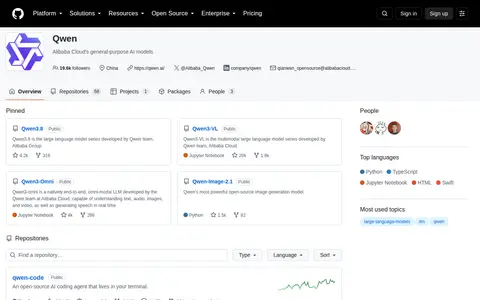
Qwen is a GitHub organization presenting Alibaba Cloud's general-purpose AI models, with 60 repositories. Public projects include Qwen3.8, a large language model series, Qwen3-VL, a multimodal large language model series, and qwen-code, an open-source AI coding agent that lives in a terminal.
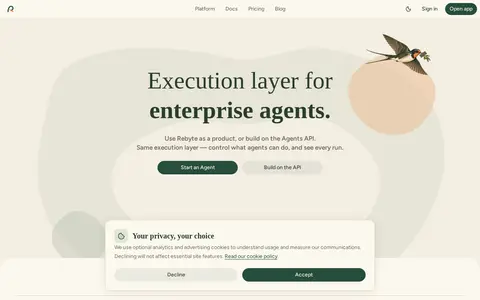
Rebyte is an execution layer for enterprise agents. It runs agents in the cloud with durable execution, tools such as browsers, files, and compute, and policy controls over models, skills, MCP servers, and network access. Execution traces record model steps, tool calls, errors, tokens, and cost. The Agent API is compatible with the official OpenAI client and is described as model agnostic.
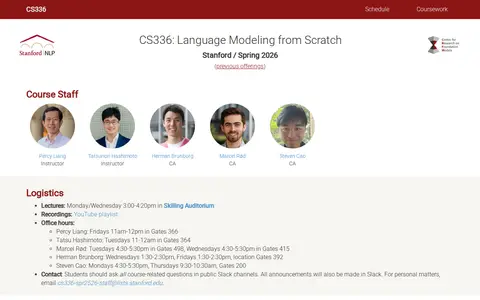
Stanford CS336: Language Modeling from Scratch is the official course website for a Stanford class offered in Spring 2026. The course walks students through the process of developing a language model, including data collection and cleaning for pre-training, transformer model construction, model training, and evaluation before deployment. The site provides logistics, schedule, assignments, and course materials.

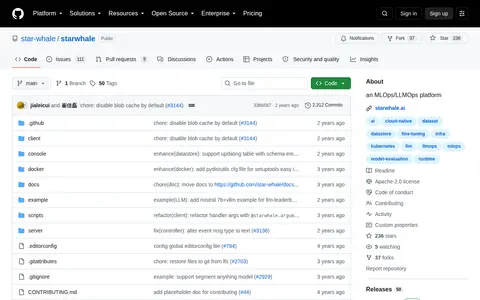
An MLOps/LLMOps platform for model building, evaluation, and fine-tuning.
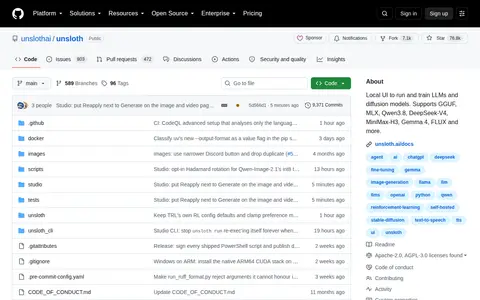
Unsloth is a desktop application for running and training LLMs and diffusion models locally. It supports model formats including GGUF and MLX, and offers fine-tuning methods such as LoRA, QLoRA, full fine tuning and reinforcement learning, along with dataset building and model export. Native builds are offered for Windows, macOS and Linux, with additional installation options.
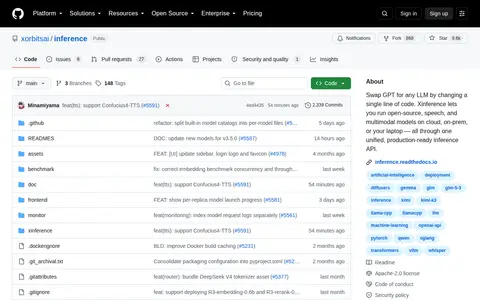
Xinference is a model serving tool that provides a unified production-ready inference API. It allows users to run open-source, speech and multimodal models on cloud infrastructure, on-premises systems or personal laptops by modifying a single line of code.

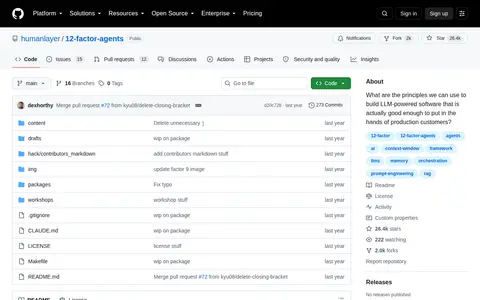
12-Factor Agents is a GitHub repository that outlines principles for building large language model (LLM) powered software that is reliable enough for production customer use. It documents a set of 12 core factors for developing such applications, and contributions to the project are accepted from the public.
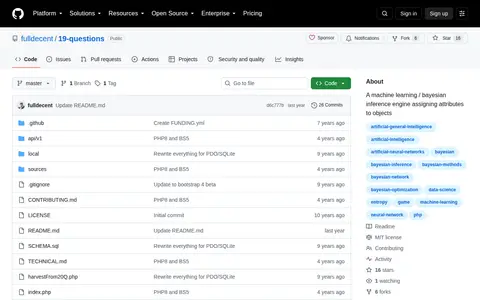
19 Questions is an open source machine learning and Bayesian inference engine designed to assign attributes to objects. Its source code is hosted in a public GitHub repository under the fulldecent organization, and contributions to the project are accepted from the public.
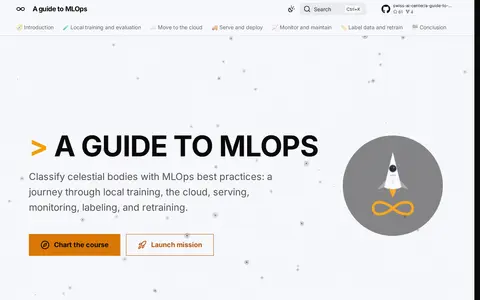
A guide to MLOps is an open-source tutorial from the Swiss AI Center team that walks engineers and small teams from notebook experiments to production. It covers local training and model evaluation, moving the model to the cloud, serving and deploying, monitoring and maintaining, and labeling data and retraining, using tools such as DVC, Git, GitHub Actions, CML, Docker, BentoML, Fluent Bit, Evidently AI, and Label Studio.
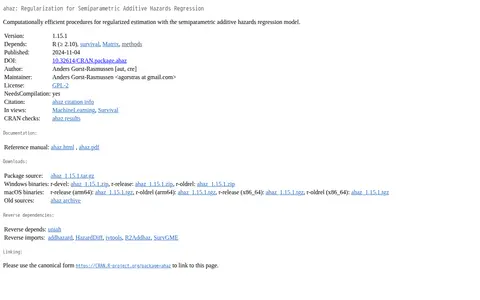
ahaz is an R package providing computationally efficient procedures for regularized estimation with the semiparametric additive hazards regression model. It depends on R version 2.10 or later, along with survival, Matrix and methods, and requires compilation. The package is authored and maintained by Anders Gorst-Rasmussen under GPL-2 and appears in the MachineLearning and Survival views.
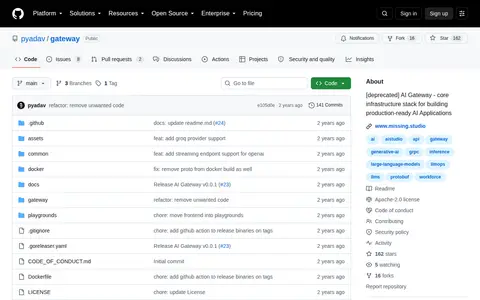
A deprecated GitHub repository described as an AI Gateway, a core infrastructure stack for building production-ready AI applications. It provides a universal API for inferencing over 100 LLMs and lists supported providers and endpoints such as OpenAI and Groq.
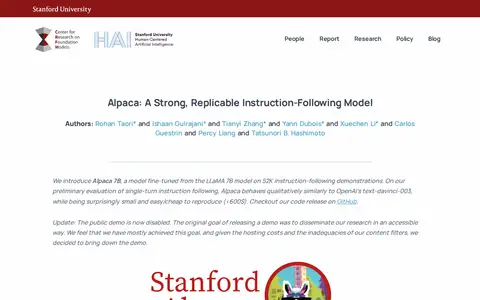
Alpaca 7B is a model fine-tuned from the LLaMA 7B model on 52K instruction-following demonstrations. In a preliminary evaluation of single-turn instruction following, it behaved qualitatively similarly to OpenAI's text-davinci-003 while being small and cheap to reproduce.
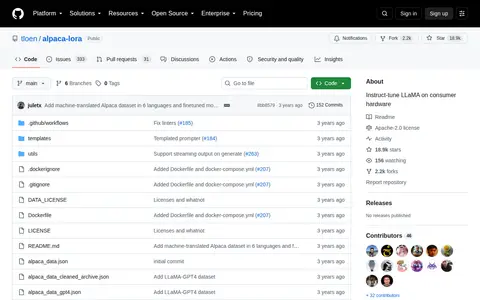
alpaca-lora is a repository with code for reproducing the Stanford Alpaca results using low-rank adaptation (LoRA). It provides an Instruct model and training code that can be easily extended to the 13b, 30b and 65b models, along with a script for downloading and inference.
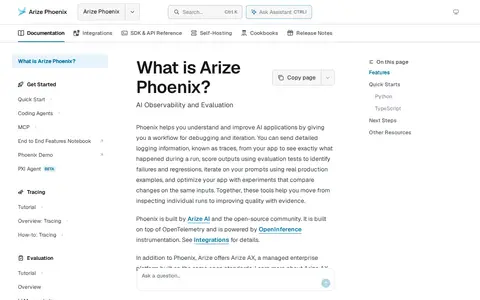
Arize Phoenix is an AI observability and evaluation tool built by Arize AI and the open-source community on OpenTelemetry and OpenInference. It provides tracing for debugging individual runs, evaluations to score output quality, a prompt playground, and datasets and experiments for comparing changes on the same inputs.