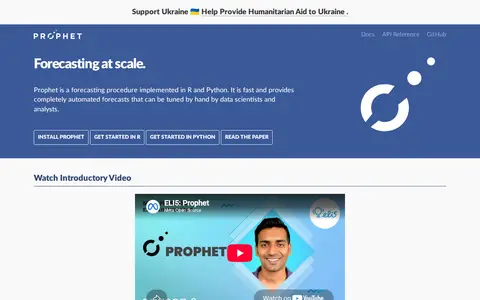

Prophet is a forecasting procedure implemented in R and Python. It provides automated forecasts that can be tuned by hand, and is based on an additive model with non-linear trends and yearly, weekly and daily seasonality plus holiday effects. Facebook released it as open source, available on CRAN and PyPI.
Directory
Search results
Published directory entries matching your search.
PyCUDA is a software project associated with Andreas Klöckner, who teaches and conducts research in scientific computing at the University of Illinois at Urbana-Champaign. The project has a dedicated documentation site.
A hands-on, project-based introduction to programming with Python by Eric Matthes, published in its third edition in December 2022. The book covers basic concepts such as variables, lists, classes, and loops, and guides readers through projects including a Space Invaders-inspired arcade game, data visualizations, and a simple web application.
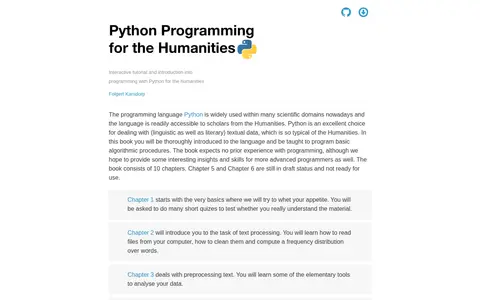
An interactive tutorial and introduction to programming with Python for the humanities by Folgert Karsdorp. The book has 10 chapters covering text processing, preprocessing, programming principles, readability computation, authorship attribution, object-oriented programming, information retrieval, a PDF search web application, classification and hierarchical clustering. It expects no prior programming experience. Chapters 5 and 6 are in draft status.
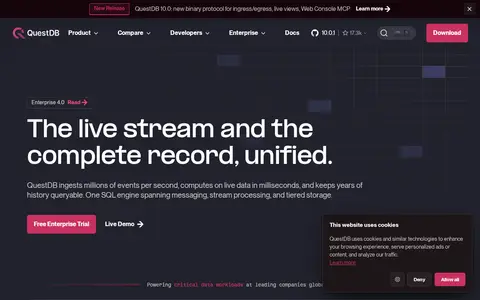
QuestDB is an open-source time-series database engineered for low latency. It uses a column-oriented, time-partitioned storage engine with memory-mapped files and vectorized execution for high-throughput ingestion and millisecond-level analytical queries. SQL is extended with time-series operators such as SAMPLE BY, LATEST ON, ASOF JOIN, WINDOW JOIN and HORIZON JOIN.
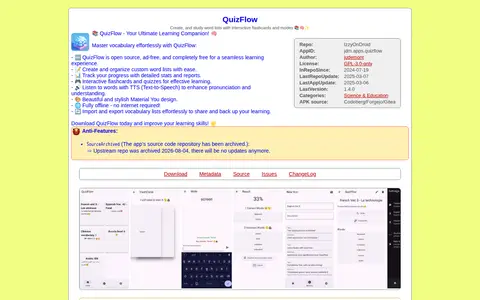
QuizFlow is an open-source, ad-free Android app for creating and studying custom word lists with interactive flashcards and quizzes. It includes progress stats, text-to-speech pronunciation, import and export of lists, and works fully offline. The upstream source repository was archived, so no further updates are planned.
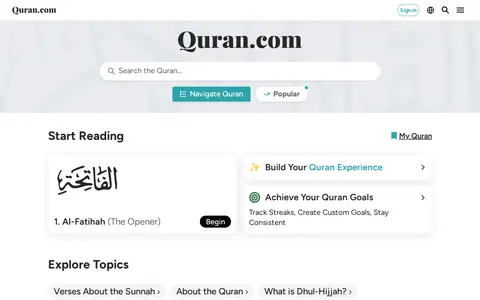
A site for reading the Quran in Arabic with translations, tafsir, word-by-word study, recitations and search in many languages. It also offers learning plans, topics and mobile apps for iOS and Android.
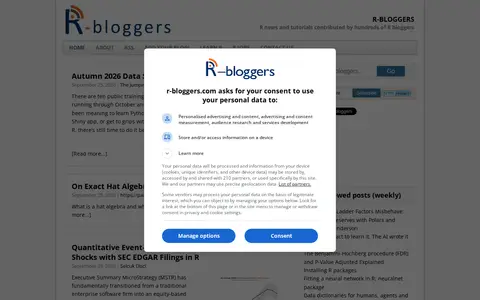
R-bloggers is a platform that aggregates and publishes R-related news and tutorials contributed by hundreds of R bloggers. Its content includes conference recaps, Shiny app development tips, new CRAN package roundups, community spotlights, and R job listings, and it allows bloggers to submit their R-related content for publication.
Rainbow Hunt is an online generator of relaxing rain sounds for background listening, described for sleeping, studying or working. The page provides a day and night display and a minimalist version. A notice indicates that WebGL is required for the main version.
Rainy Mood offers rain sounds used while sleeping, studying and relaxing, with a free web version and iOS/Android apps with additional features. The audio is also available on Spotify and Apple Music. The page notes that the browser does not support the audio element.
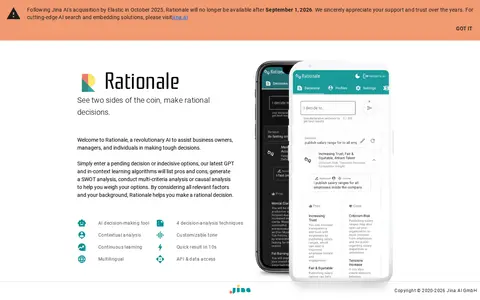
Decision-making tool powered by the latest GPT and in-context learning.
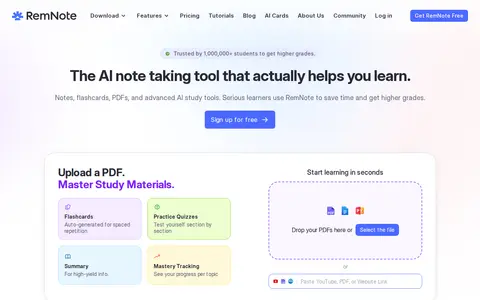
RemNote is an AI-powered study tool for students. It lets users upload PDFs, videos, or notes to instantly generate AI flashcards, quizzes, summaries, and explanations, and includes note-taking, spaced repetition, an exam scheduler, PDF annotation, and an AI tutor.
Remusic is a free AI music generator that creates full-length songs up to 4 minutes long in seconds. It also offers an AI cover generator supporting over 1,000 voices, an AI vocal remover for sound separation, an AI karaoke maker, an AI sheet music generator and a free AI music analyzer.
Supports teaching, studying or skills practice with AI-guided learning tools.
SAS Viya is a cloud native AI, analytic and data management platform supporting teams across the analytics life cycle. It unifies data, analytics and governance, and supports building, validating and deploying AI with governance, fairness and transparency. Deployment options cover cloud, hybrid and on-premises environments.
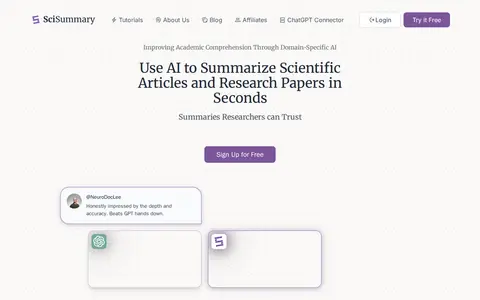
SciSummary is an AI tool for researchers and students that summarizes and helps users understand scientific articles and research papers, and acts as an AI-powered reference and document manager. It supports bulk paper summarization, comparing papers, organizing a library with folders and tags, and chat messages. A free trial, a student plan and a pro plan are listed.
Scribd is a document library offering access to over 300 million human-sourced documents and specialty resources across categories such as business, science, law and study aids. Users can explore and find answers on the go through the Scribd app on web, Android and iOS. The site also allows uploading documents for free to reach a global audience.
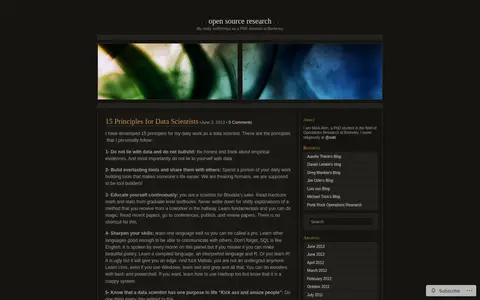
A personal blog by a PhD student at Berkeley that hosts notes and posts on data science, programming and machine learning topics. Entries include 15 principles for data scientists, C++11 learning notes, a Mandelbrot fractal in Python and notes from conference talks.
Sirah is a platform for reading source-attributed hadith texts from established collections, with Arabic text, translations and source grading. It also offers study guides connecting Quran references and narrations, plus an AI assistant that provides source-linked answers. Readers are advised to check quotations and references against the cited sources.
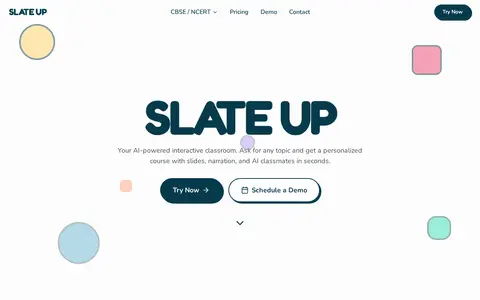
Slate is an AI-powered interactive classroom in which students learn with AI classmates rather than a chatbot. It offers personalised explanations, instant doubt resolution and adaptive courses, with content aligned to NCERT for Indian students. Pricing plans start free with paid upgrades.
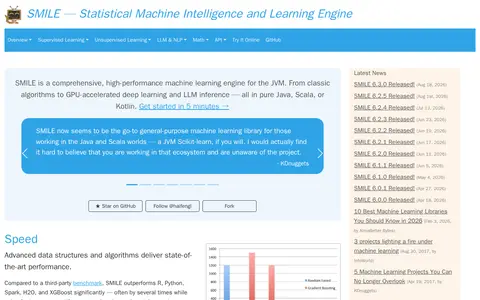
Statistical Machine Intelligence and Learning Engine.
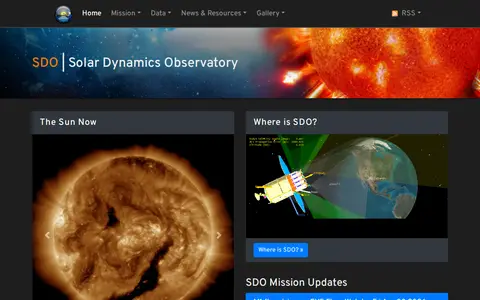
Solar Dynamics Observatory (SDO) is a NASA mission designed to study the solar atmosphere at fine space and time scales across multiple wavelengths to understand the Sun’s influence on Earth and near-Earth space. Its associated portal provides access to mission data, spacecraft specifications, instrument details, scientific publications, observation event information, and outreach resources.
Supports teaching, studying or skills practice with AI-guided learning tools.
Spinning Up is OpenAI's educational resource on deep reinforcement learning. Its documentation covers installation, included algorithms, running experiments, and an introduction to RL, along with algorithm pages for methods such as DDPG and PPO. The DDPG page describes an algorithm that concurrently learns a Q-function and a policy for continuous action spaces. The PPO page describes on-policy first-order methods, including PPO-Clip.