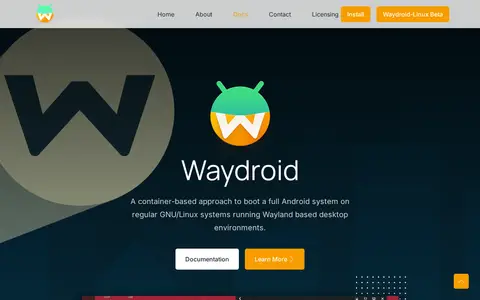

Waydroid is a free and open-source tool that runs a full Android system in a container on GNU/Linux systems with Wayland-based desktop environments. It uses Linux namespaces and provides Android applications, with multi-window and full UI modes. The Android image is based on LineageOS and is currently based on Android 13.
Directory
Search results
Published directory entries matching your search.

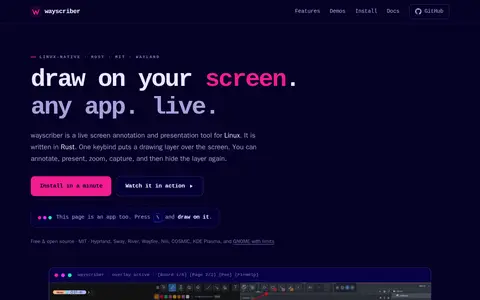
wayscriber is a free and open source, ZoomIt-style real-time screen annotation and presentation tool for Linux/Wayland, written in Rust. A single keybind activates a drawing layer over any application to support annotation, presentation, zoom, capture, and related functions. It is licensed under the MIT license and compatible with Hyprland, Sway, River, Wayfire, Niri, COSMIC, KDE Plasma, and GNOME with limits.
Wazuh is a free and open source security platform that unifies XDR and SIEM protection for endpoints and cloud workloads. It collects, aggregates, indexes and analyzes security data to detect intrusions, threats and behavioral anomalies. Capabilities include file integrity monitoring, vulnerability detection, configuration assessment and log data analysis. A managed Wazuh Cloud service is also offered.
WBO is a free, open-source online collaborative whiteboard that enables multiple users to draw simultaneously on a large virtual board, with real-time state updates for all connected users and persistent board storage. It is suitable for use cases including art, entertainment, design and teaching. Public boards are accessible to all users and are ephemeral, while users can also create private boards with random or custom names shared via link.
CAMEL-AI is an open-source community focused on finding scaling laws of agents for data generation, world simulation, and task automation. It builds multi-agent systems such as CAMEL, OWL, OASIS, and Loong, and conducts foundational research on multi-agent systems to improve reliability, interpretability, and robustness.
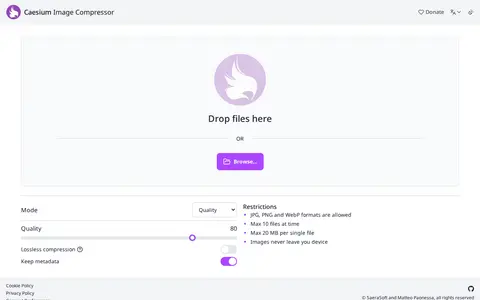
Caesium is a free, open source online compression tool for photos and images. It supports JPG, PNG and WebP formats, with batch processing and preview. Files are limited to 10 at a time and 20 MB per file. The tool offers quality settings and optional lossless compression that preserves image quality, with an option to keep metadata.
ImHex Web is a free and open source hex editor for reverse engineers, developers and data analysts. It runs directly in the web browser with the help of Emscripten and WebAssembly. A native version is also available.
A simple web scraper powered by Cloudflare Workers, built by Adam Schwartz. Users provide a URL and CSS selector, and the tool returns JSON containing the text contents of matching webpage elements. The project is open-source and available on GitHub.
WebExtension.ORG offers free web-hosting space for browser-based open-source applications, with product pages that update release notes and fetch bug reports from github.com. It also provides anonymous bug reporting, RSS feeds for products connected to addons.mozilla.org, and technical support for hosted developers. The site states it is in transition as add0n.com migrates to webextension.org.
webgbcam is a browser-based application that provides a Game Boy Camera-style photo experience, with an explicit stance against NFTs. It generates GIF previews of captured images, uses the gif.js library, and has its source code publicly available on GitHub. Created by maple and inspired by Christine Love's Interstellar Selfie Station, a blank app interface indicates the user must connect a camera and grant browser camera permissions. The project has been featured in coverage from Mashable, Nerdist, and Hackaday, and its creator accepts donations via Ko-fi.
is the Web's freshest and fastest growing backlink index, and the primary source of backlink data for SEO PowerSuite.
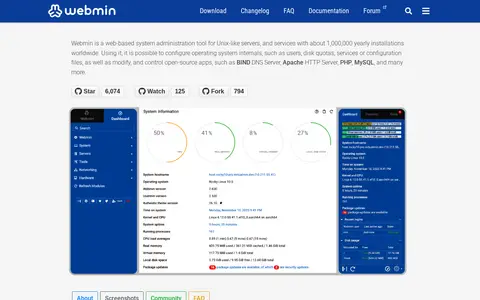
Webmin is a web-based system administration tool for Unix-like servers. It can configure operating system internals such as users, disk quotas, services and configuration files, and control open-source applications including BIND DNS Server, Apache HTTP Server, PHP and MySQL.
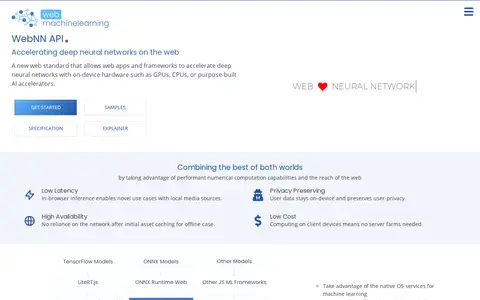
WebNN is a web standard that lets web apps and frameworks accelerate deep neural networks using on-device hardware such as GPUs, CPUs, or purpose-built AI accelerators. The introduction states that in-browser inference supports local media sources, keeps user data on-device, and needs no network after initial asset caching.
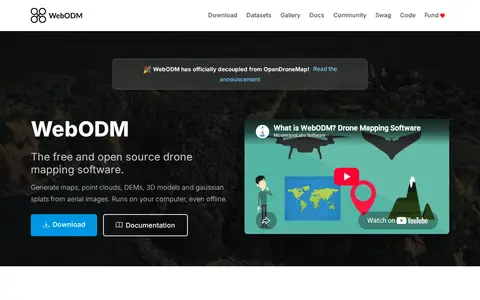
WebODM is free and open source drone mapping software that runs on a computer, including offline. It generates georeferenced orthomosaics, point clouds, digital elevation models, textured 3D models and gaussian splats from aerial images, with support for volume and area measurements and NDVI indexes.
Webrecorder provides open source solutions for archiving the complex, interactive web. Its tools include a free Chrome extension and desktop app for archiving while browsing, and ReplayWeb.page for viewing and embedding WARC or WACZ files. It also offers Browsertrix, a cloud-native archiving platform with a 7-day free trial of the Starter plan.
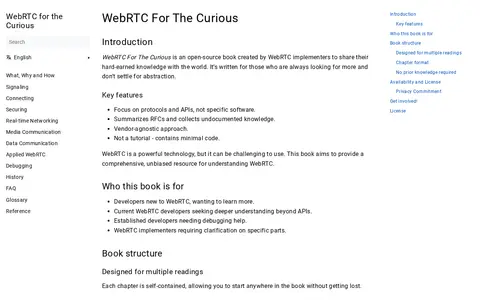
WebRTC For The Curious is an open-source book created by WebRTC implementers. It focuses on protocols and APIs rather than specific software, summarizes RFCs and collects undocumented knowledge, and is vendor-agnostic. It is not a tutorial and contains minimal code.
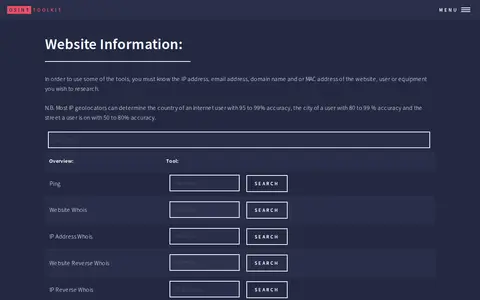
OSINT Toolkit Website Information is a collection of tools for researching websites, IP addresses, domains, emails and MAC addresses. It lists lookups including Ping Website, Whois, reverse Whois, network and TLD lookup, IP history and geolocation, MAC vendor lookup, DNS report and header and source code search. The page states that some tools require the IP address, email address, domain name or MAC address of the target.
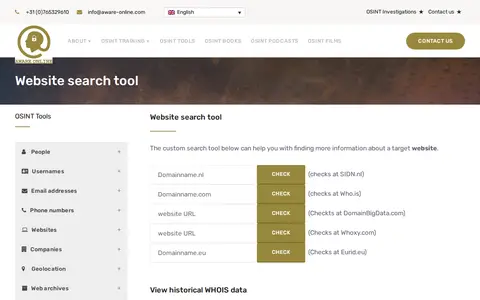
A custom OSINT tool from Aware Online Academy for investigating a target website. It provides scripts to view historical WHOIS data, check website text and source code on third-party sites, visualise links, map web pages, check Reddit presence, find open FTP ports and find other top level domains.
Webstudio is an open source website builder for creating websites with modern web standards. It exposes all CSS properties and HTML attributes, supports reusable styles without classes, custom breakpoints and scroll-driven animations, and can be self-hosted or published to Webstudio Cloud.
Webtor.io is a browser-based torrent tool for streaming and downloading torrents without installing a client. Users paste a magnet link or upload a .torrent file, select a file, then stream it in the built-in player or get a direct HTTP download link. The site states it is open-source and supports magnet links and .torrent files.
A single-page site about mitigating side effects of weight loss, currently covering loose skin, stretch marks and gynecomastia. The author states no credentials and describes the page as covering both scientifically backed and less scientific methods, with sources linked where possible. It notes the issues probably are not completely preventable or reversible.
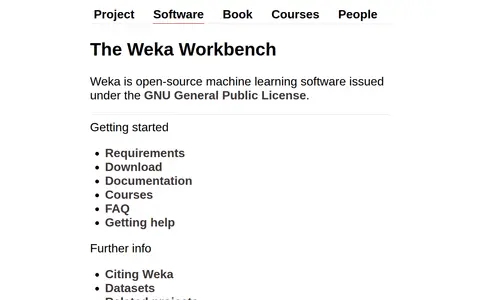
Weka is open-source machine learning software issued under the GNU General Public License. It runs in Java and is presented as a workbench for data mining, with download, documentation, courses and FAQ resources and datasets available on the project site.
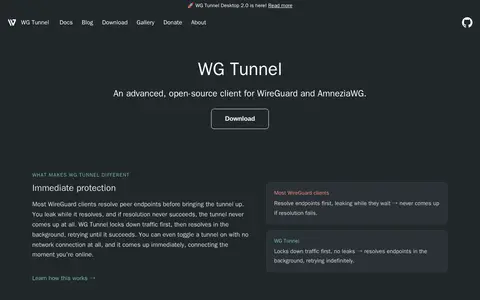
WG Tunnel is an open-source client for WireGuard and AmneziaWG. It locks down traffic before resolving endpoints, so protection is immediate, and includes features such as a kill switch, auto-tunneling, multihop, split and encrypted DNS, and a local proxy mode. Native apps are available for Android and desktop. A separate optional kill switch blocks traffic outside the tunnel.
The What Works Clearinghouse is an initiative of the U.S. Department of Education's Institute of Education Sciences, created in 2002 as a source of scientific evidence on what works in education. It offers practice guides, intervention reports, reviews of individual studies and downloadable data from study reviews, and provides resources for educators such as videos and webinars on evidence-based practices.