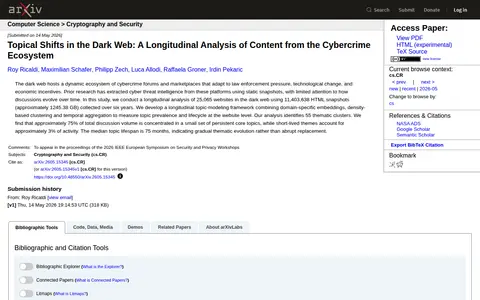

An arXiv paper presenting a longitudinal analysis of the dark web cybercrime ecosystem. The authors analyze 25,065 websites using 11,403,638 HTML snapshots collected over six years, applying a topic-modeling framework with domain-specific embeddings, density-based clustering and temporal aggregation. The analysis identifies 55 thematic clusters and measures topic prevalence and lifecycle at the website level.
Directory
Search results
Published directory entries matching your search.
Dark-web intelligence company publishing monitoring, ransomware and underground-ecosystem analysis.
Intelligence analysis covering illicit communities, ransomware groups and underground online activity.
An arXiv paper on digging deeper into hidden web databases limited by the top-k output constraint. It presents the GetNext meta-algorithm, which retrieves the next ranked tuple through a restrictive interface without prior knowledge of the ranking function, and algorithms that generate and execute multiple reformulated queries. Theoretical analysis and experiments over synthetic and real-world databases are reported.
Analyst posts on deep- and dark-web activity, threat actors and underground communities.
Dizzy is an open-source crawling and analysis system for onion services. It implements techniques to explore, update, check, and classify onion services at scale without overwhelming the Tor network. It was deployed in April 2021 and used to analyze more than 63.3 million crawled onion webpages, focusing on domain operations, web content, cryptocurrency usage, and web graph.
CRATOR is a proposed dark web crawler described in an arXiv paper. It is designed to extract pages that handle security protocols such as captchas, using seed URL lists, link analysis and scanning to discover content, with user-agent rotation and proxy usage for anonymity. The authors report evaluation using coverage, performance and robustness metrics, and suggest threat intelligence, cybersecurity and online investigation applications.
This arXiv paper proposes an end-to-end scalable architecture for early identification of new Tor sites and daily analysis of their content. It is built on an open source big data stack including Kubernetes, Kafka, Kubeflow and MinIO, discovering onion addresses across several sources, downloading HTML from Tor, deduplicating with MinHash LSH and categorizing with BERTopic modeling. In 93 days it identified 80,049 onion services and characterized 90% of them.
Analyst reporting on cybercrime marketplaces, underground actors, ransomware and stolen-data trends.
Research and explainers on dark-web investigations, criminal forums and threat-intelligence methods.
Intelligence reporting on cybercriminal groups, underground forums and ransomware operations.
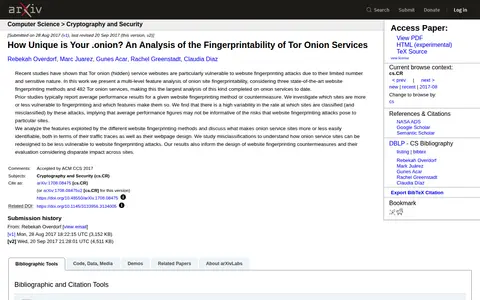
Study of whether website fingerprinting can distinguish and identify Tor onion-service traffic.
Research article cataloging ransomware leak sites and explaining how their status is tracked.
Insikt Group is the research unit of Recorded Future. It conducts research on cybercrime, state-sponsored threats and global issues, and supplies analyst-validated data, analytics and cyber and geopolitical intelligence to the Recorded Future Platform. Its resources include intelligence reports, threat briefings and information on threat actors.