i2pforum.net
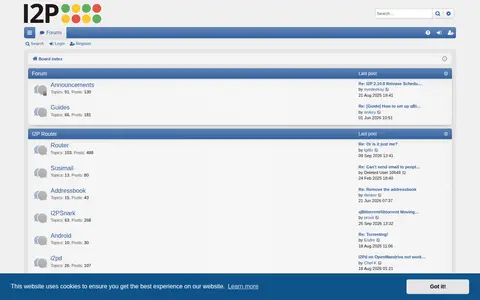
Public community forum discussing I2P software, services, development and network operations.
Directory
Search published websites, apps and repositories.
Public community forum discussing I2P software, services, development and network operations.

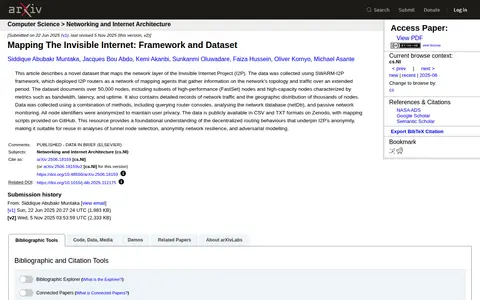
This dataset maps the network layer of the Invisible Internet Project (I2P), collected using the SWARM-I2P framework, which deployed I2P routers as mapping agents. It documents over 50,000 nodes with metrics such as bandwidth, latency, and uptime, plus network traffic records and geographic distribution. Node identifiers were anonymized. Data is available in CSV and TXT formats on Zenodo, with mapping scripts on GitHub.

Intelligence reporting on cybercriminal groups, underground forums and ransomware operations.

Identity Theft Resource Center database documenting publicly reported US data compromises.

Analyst reporting on cybercrime marketplaces, underground actors, ransomware and stolen-data trends.

Kenneth R. Rosen instructions for submitting documents securely through its verified SecureDrop service.

A tag archive on Krebs on Security collecting posts about dark web topics. Entries cover the 2019 takedown of the Wall Street Market dark web bazaar, the disappearance of the Evolution Market in 2015, and stolen credit card shops. Each entry carries a publication date and reader comments.
Leak-awareness search page for checking whether identifiers appear in exposed datasets.

Leakedpassword.com searches across multiple data breaches to check whether a password has been compromised. It also provides an API for use in signup processes to validate users' passwords, drawing its data from Have I Been Pwned and requiring no authentication.

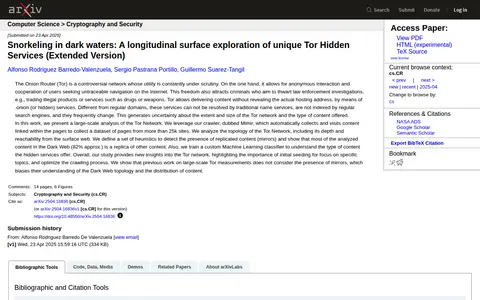
An arXiv paper presenting a large-scale analysis of the Tor network using a crawler called Mimir, which collects and visits linked content. The authors report a dataset of pages from more than 25k sites and examine network topology, replicated content and content types.

A working paper by John Schriner that focuses on how researchers monitor the Dark Web. It defines onion services and Tor and discusses tools for monitoring and securing onion services.

Mozilla service that checks email addresses against known breaches and explains protective steps.

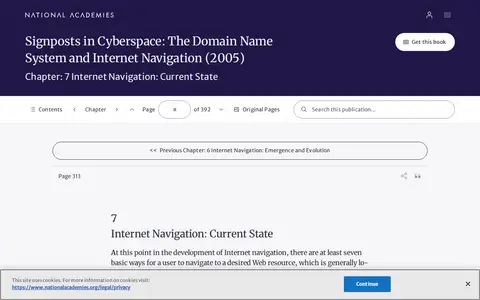
National Academies chapter explaining deep-web content, discovery limits and information retrieval.

The New York Times offers ways to share materials with its journalists confidentially, including a submission form, Signal, postal mail and SecureDrop. The page describes what makes a good tip and notes that no communication system is completely secure.

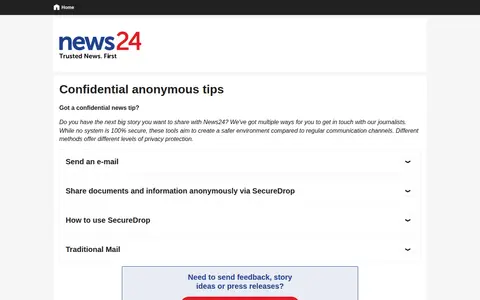
News24 offers ways to send confidential news tips to its journalists, including email and SecureDrop, which encrypts submissions and stores them on a physically secured computer with decryption on an offline machine. The page gives instructions for using SecureDrop through the Tor browser and lists traditional mail addresses.

NRK instructions for submitting documents securely through its verified SecureDrop service.

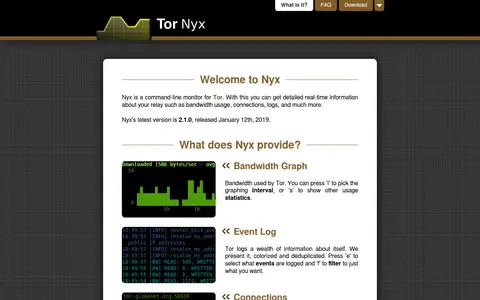
Nyx is a command-line monitor for Tor, providing real-time information about a relay such as bandwidth usage, connections and logs. It is a curses interface suited to ssh connections and tty terminals. It requires Stem 1.5.4 or later and works with Python 2.7 and greater, including Python 3.x.

Guide to search tools and databases that surface information outside conventional web indexes.

Study of whether website fingerprinting can distinguish and identify Tor onion-service traffic.

An arXiv paper measuring onion website discovery and Tor users' interests with honeypots. The authors deployed honeypot onion websites in March–April 2025 and seeded links via three channels to observe interaction events. They report that human users almost without exception originated from Ahmia.fi, and that the CSAM-themed honeypot drew markedly higher engagement than the others.

Official guides for understanding, deploying and maintaining Tor onion services.

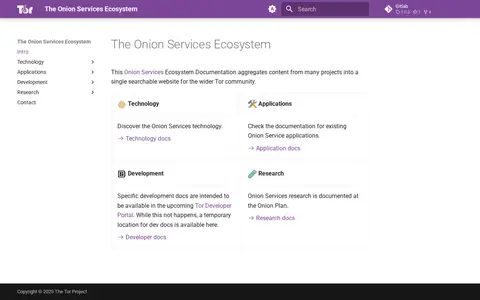
Tor Project documentation portal for onion-service applications, standards and operator tools.

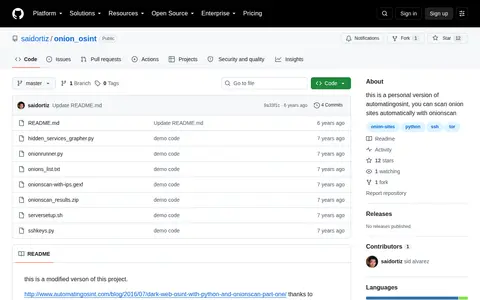
Open-source utility for gathering public metadata about onion services during authorized research.

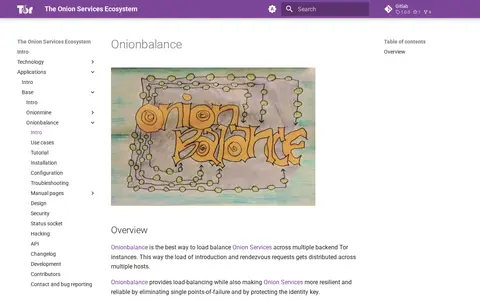
Load-balancing system for resilient Tor onion services, documented by the Tor onion-services team.