
A Towards Data Science article by Hui Wen Goh evaluating popular hallucination detectors, including G-eval, Ragas and the Trustworthy Language Model, across four public RAG datasets. Using AUROC and precision/recall, it reports how well the methods automatically flag incorrect LLM responses in retrieval-augmented generation systems.
Directory
Search results
Published directory entries matching your search.
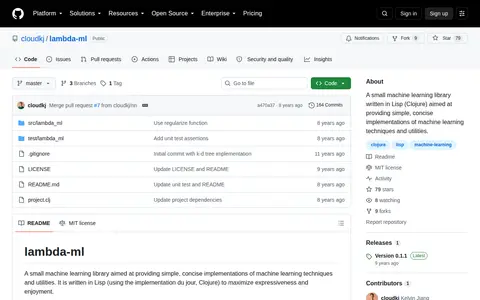
lambda-ml is a small machine learning library written in Lisp, specifically Clojure, aimed at simple, concise implementations of machine learning techniques and utilities. It covers supervised algorithms such as neural networks, decision trees, ensemble methods, k-nearest neighbors, linear and logistic regression, naive Bayes and random forest, plus unsupervised methods including DBSCAN, hierarchical clustering, k-means and non-negative matrix factorization.

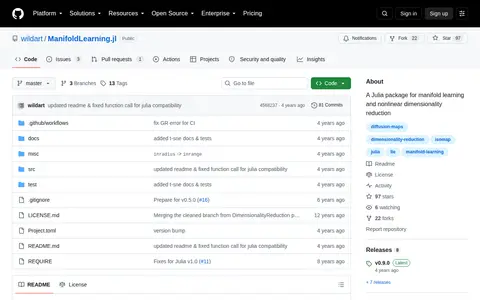
ManifoldLearning.jl is a Julia package for manifold learning and nonlinear dimensionality reduction. It provides methods including Isomap, diffusion maps, locally linear embedding, Hessian eigenmaps, Laplacian eigenmaps, local tangent space alignment and t-SNE. Most methods use k-nearest neighbors to construct local subspace representation, and a custom k-nearest neighbors function is suggested for large datasets.
The case against AI-generated users is an IDEO journal article that explores the use of AI-generated synthetic users for design research. It discusses alternative methods to meet research goals, compares the value of traditional design research to outputs from large language models, and offers forward-looking perspectives on design research practices.
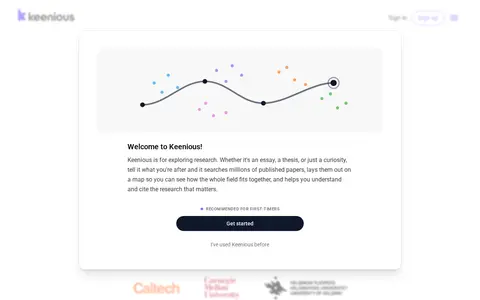
Keenious is an AI-assisted tool for exploring published academic research. It searches about 177M publications, groups results into research areas on a map, and explains unfamiliar terms, methods, and statistics beside the paper. It also translates studies published in other languages. The source states it does not write essays, paragraphs, or assignment outlines.
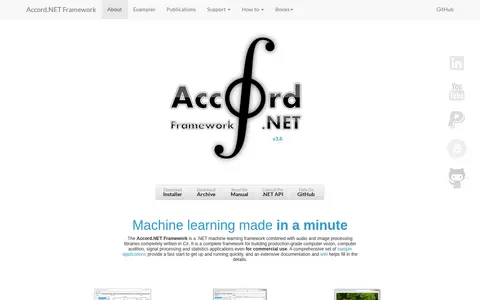
Accord.NET is a .NET machine learning framework combined with audio and image processing libraries written in C#. It covers classification, regression, clustering, distributions, hypothesis tests and kernel methods, with imaging and signal processing components. The framework is intended for building computer vision, audition, signal processing and statistics applications, including commercial use. It offers sample applications, documentation and a wiki.
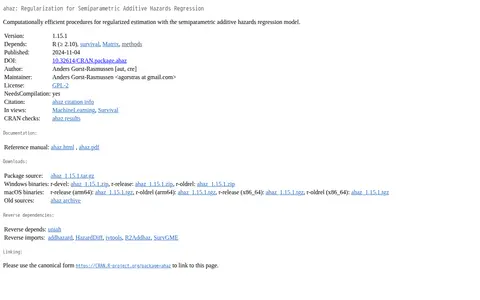
ahaz is an R package providing computationally efficient procedures for regularized estimation with the semiparametric additive hazards regression model. It depends on R version 2.10 or later, along with survival, Matrix and methods, and requires compilation. The package is authored and maintained by Anders Gorst-Rasmussen under GPL-2 and appears in the MachineLearning and Survival views.
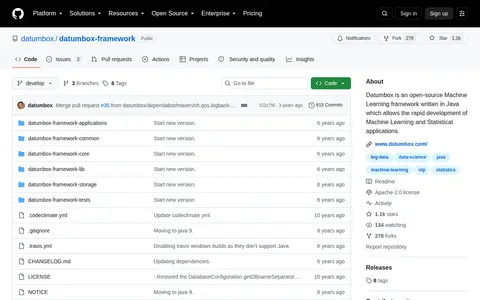
Datumbox is an open-source machine learning framework written in Java for rapid development of machine learning and statistical applications. It focuses on including many machine learning algorithms and statistical methods and on handling large datasets. The code is licensed under the Apache License, Version 2.0, and releases are available on Maven Central, including version 0.8.2.
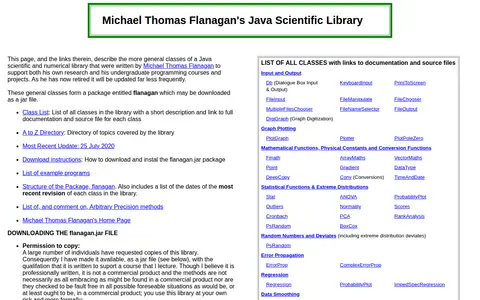
A Java scientific and numerical library written by Michael Thomas Flanagan to support his research and undergraduate programming courses. It is distributed as the flanagan.jar package and includes general classes, example programs and arbitrary precision methods. The author has retired and states it will be updated less frequently. Commercial use, public listing of source codes and redistribution are not permitted.
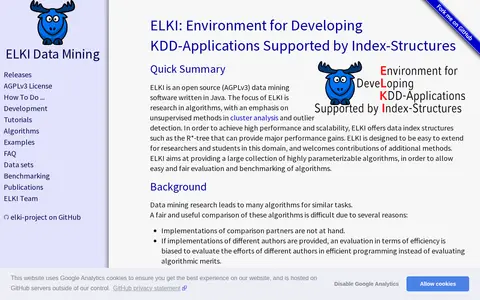
ELKI is an open source data mining software written in Java. It focuses on research in algorithms, emphasizing unsupervised methods in cluster analysis and outlier detection, and offers data index structures for performance and scalability. It is designed for researchers and students to extend.
Uncover LLM evaluation's importance and explore methods for assessing its performance and impact across industries.
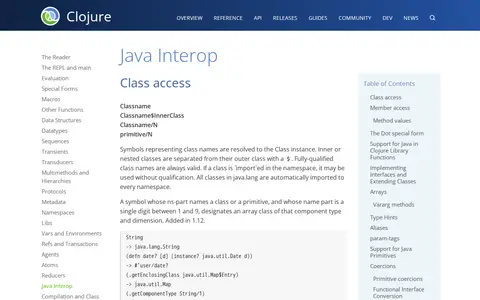
A reference page in the Clojure documentation covering Java interop, including class access, member access, the dot special form, implementing interfaces and extending classes, arrays, vararg methods and type hints.
A curated GitHub list of resources on audio-driven talking face generation. It organizes research papers and projects, including encoder-decoder and StyleGAN-based methods, pose-controllable and lip-sync work, and 3D model-based approaches.
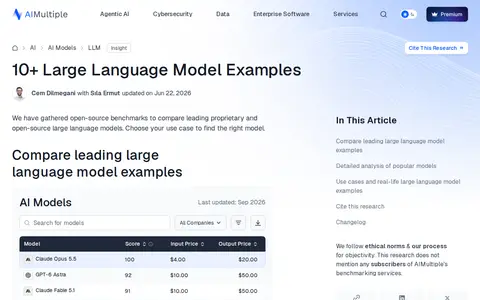
This webpage provides a curated list of large language model examples, alongside insights on business adoption, language model training, and influential models. It includes comparative analysis of leading LLMs such as OpenAI’s GPT-5, Claude 4.6, Gemini, DeepSeek-R1, Qwen, Llama 4, and xAI Grok-4 and Grok-4.1.
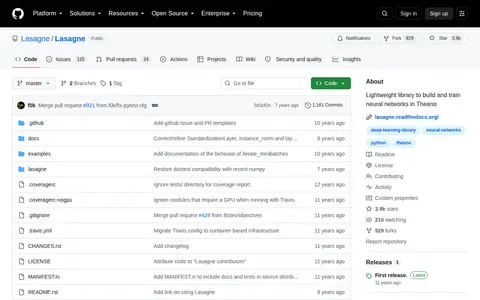
Lasagne is a lightweight library for building and training neural networks in Theano. It supports feed-forward networks such as convolutional neural networks, recurrent networks including LSTM, multiple inputs and outputs, and optimization methods including Nesterov momentum, RMSprop and ADAM. Cost functions are freely definable and gradients derive from Theano's symbolic differentiation.
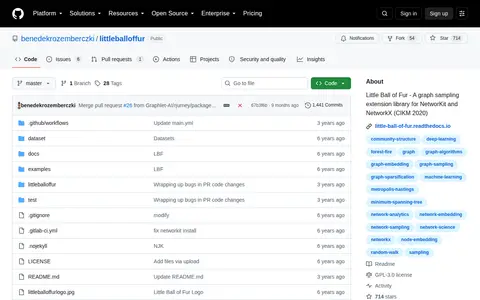
Little Ball of Fur is a graph sampling extension library for Python and a graph sampling extension library for NetworKit and NetworkX. It consists of methods that can sample from graph structured data, covering vertex, edge, and exploration sampling techniques with a unified application public interface.
MIT 6.S191 is MIT's introductory program on deep learning methods, with applications in vision, robotics, medicine, language, game play, art and more. It is described as a high-intensity bootcamp teaching deep learning fundamentals, with lectures, software labs and a final project proposal competition. Prerequisites assume calculus and linear algebra.
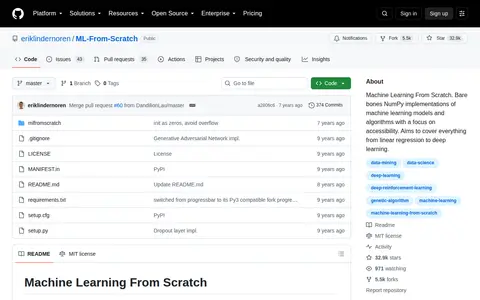
ML-From-Scratch is a GitHub repository that provides bare bones NumPy implementations of machine learning models and algorithms with a focus on accessibility, aiming to cover methods from linear regression to deep learning.
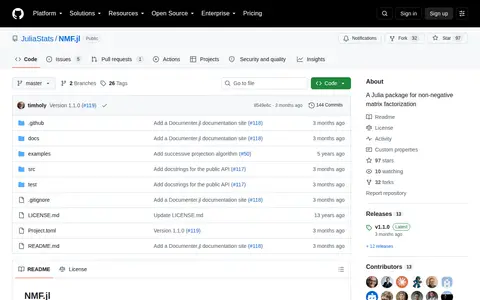
NMF.jl is a Julia package for non-negative matrix factorization, which factorizes a non-negative matrix into two lower-rank non-negative matrices. The nnmf function runs initialization and optimization in one call. Implemented methods include multiplicative update, projected alternating least squares, projected gradient and coordinate descent, with random and NNDSVD initialization.
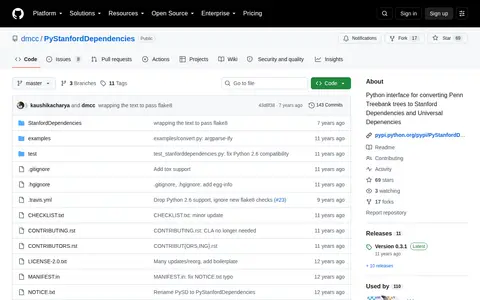
PyStanfordDependencies is a Python interface for converting Penn Treebank trees to Stanford Dependencies and Universal Dependencies. It offers a get_instance() function with subprocess or jpype backends, and convert_tree() or convert_trees() methods returning Token objects. Visualization options include asciitree, Graphviz dotgraphs, and interactive xdot windows. A Stanford CoreNLP or Parser jar file can be supplied, or downloaded automatically.
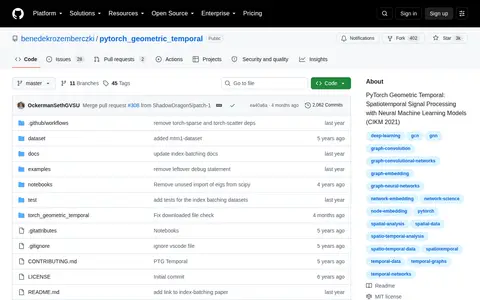
PyTorch Geometric Temporal is a temporal extension library for PyTorch Geometric. It contains dynamic and temporal geometric deep learning, embedding and spatio-temporal regression methods from published research papers. It includes a dataset loader, train-test splitter and temporal snapshot iterator for dynamic and temporal graphs, with GPU support and benchmark datasets.
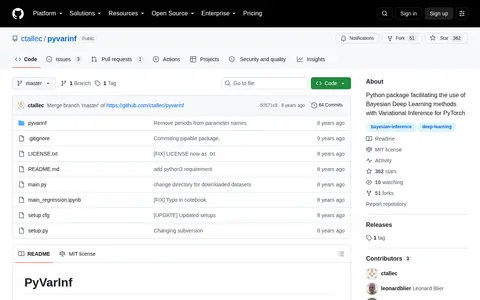
PyVarInf is a Python package that facilitates the use of Bayesian deep learning methods with variational inference for PyTorch, providing facilities to train PyTorch neural network models using variational inference. It approximates the posterior distribution over network weights with a parametric distribution.
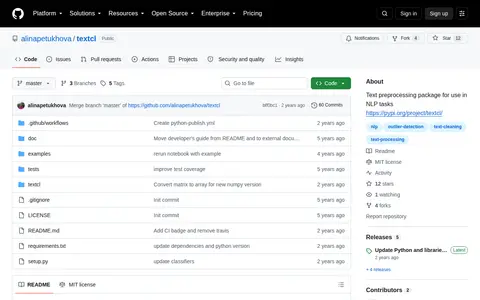
TextCL is a text preprocessing package intended for cleaning text data before use in natural language processing tasks. It can be an initial step in text analysis and in predictive, classification, or text generation models. Documented preprocessing tasks include splitting texts into sentences, filtering by language, perplexity filtering, duplicate sentence filtering using Jaccard similarity, and unsupervised outlier detection with methods such as TONMF, RPCA, and SVD.
Your daily dose of AI research from AK.