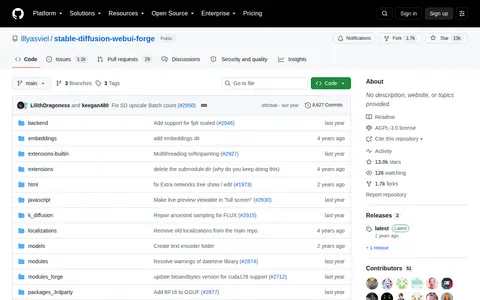

Stable Diffusion WebUI Forge is a platform built on top of Stable Diffusion WebUI (based on Gradio) that aims to ease development, optimize resource management, speed up inference and study experimental features. It is based on SD-WebUI 1.10.1 and syncs with the original WebUI periodically.
Directory
Search results
Published directory entries matching your search.
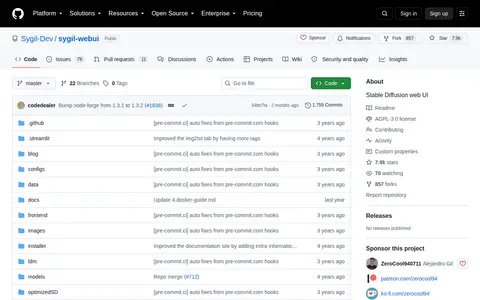
Sygil WebUI is a web-based UI for Stable Diffusion. Installation instructions cover Windows and Linux, using install.bat or install.sh copied from the installer folder; after installation, webui.cmd on Windows or webui.sh on Linux/Mac starts the WebUI.
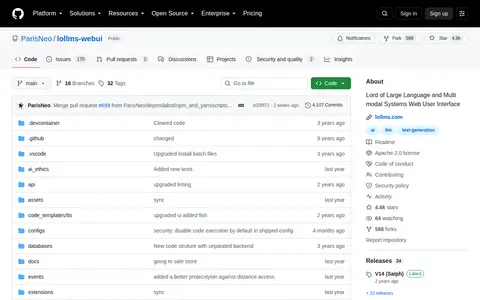
LoLLMs WebUI is a web user interface for large language and multimodal systems. The repository describes it as a local, single-user webui with multi models and modal support, providing an interface to access and utilize various LLM and other AI models.
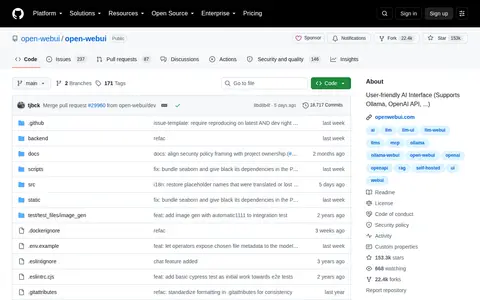
Open Webui is a GitHub repository or organization with source code, releases, documentation, or project resources.
Sygil Webui is a web-based user interface for Stable Diffusion, developed by the Sygil.Dev team. Its GitHub repository provides installation instructions for the tool and links to the development team's Discord community server.
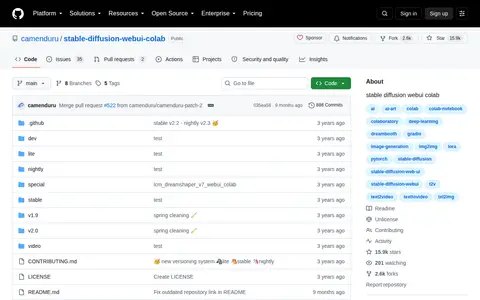
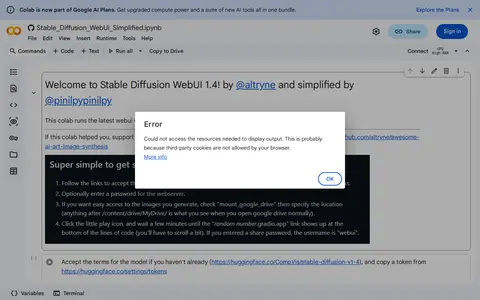
Collection of stable diffusion webui colab for different checkpoints.
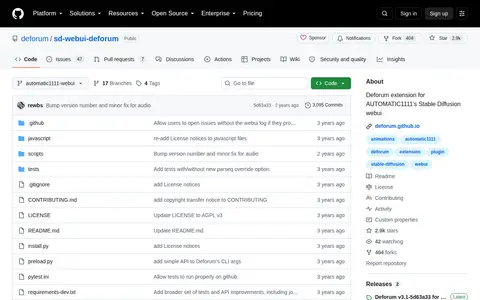
This GitHub repository hosts the official Deforum extension for AUTOMATIC1111's Stable Diffusion web user interface. The extension integrates Deforum functionality into the Stable Diffusion webui, and the repository includes resources such as a FAQ, getting started guide, and known issues list for users.
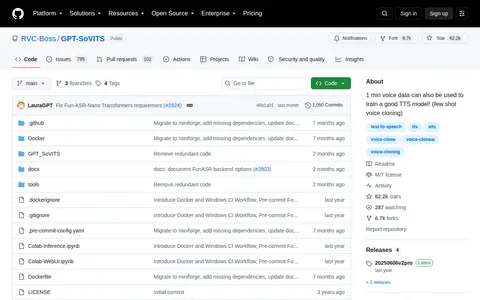
GPT-SoVITS is a few-shot voice conversion and text-to-speech WebUI. It supports zero-shot TTS from a five-second vocal sample and fine-tuning with one minute of training data. Cross-lingual inference covers English, Japanese, Korean, Cantonese and Chinese. Integrated WebUI tools include voice accompaniment separation, training set segmentation, Chinese ASR and text labeling.
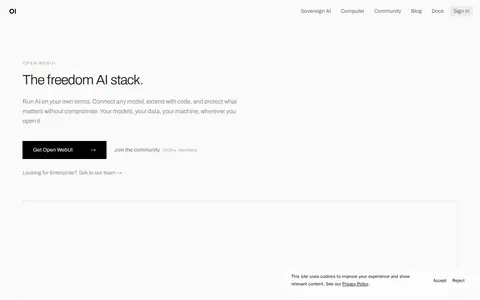
Open WebUI is a self-hosted AI interface for running AI on the user's own hardware. It connects to local or cloud models including Ollama, OpenAI, Anthropic, or compatible services, and can be extended with Python. The project offers community-shared prompts, models, tools, and functions, and lists deployment options including on-premises or air-gapped setups. Installation can be done with a pip command.
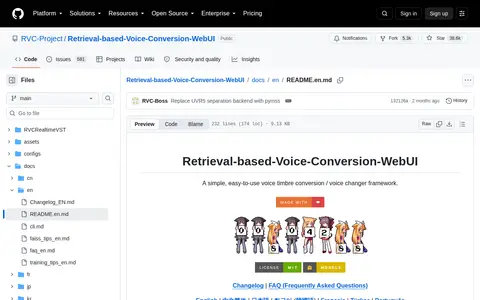
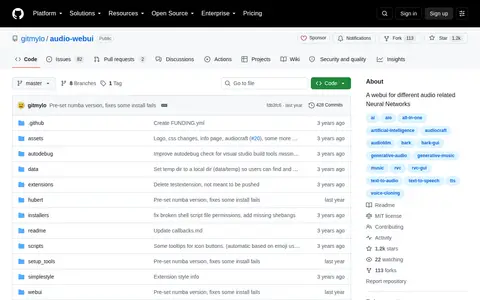
Retrieval-based-Voice-Conversion-WebUI is a project for training voice conversion models from voice data, with an easy-to-use WebUI. It includes a pymss/MSST model to separate vocals and instruments and a high-pitch voice extraction algorithm to prevent a muted sound problem. Dependencies differ by hardware, including CPU, AMD, Intel and NVIDIA GPU setups.
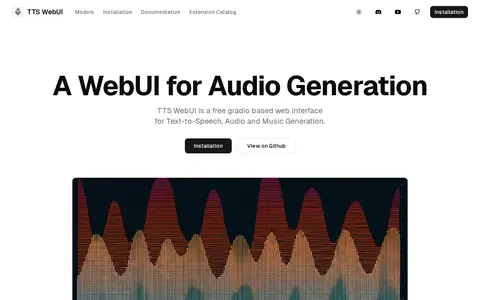
TTS WebUI is a free Gradio-based web interface for text-to-speech, audio and music generation. It can generate audio from text using over 30 AI models, including Bark, MusicGen, Tortoise and Vocos, and offers voices from the Bark Speaker Directory. Installation is available through one-click installers or manual setup.
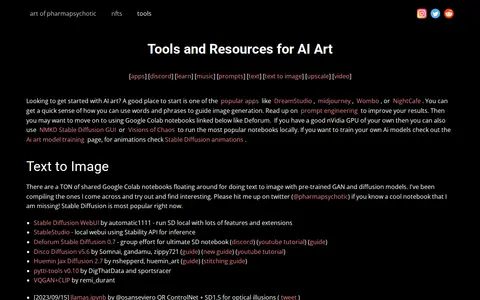
A page by pharmapsychotic collecting tools and resources for AI art, organized into sections such as text to image, upscaling, StyleGAN, text video, prompt engineering and music. It links to shared Google Colab notebooks for text-to-image work with pre-trained GAN and diffusion models, and notes Stable Diffusion WebUI for running SD locally.
Applio is an open-source AI voice conversion suite. It provides voice conversion, real-time voice changing, speech synthesis, model training, voice blending and audio analysis. The project states it is MIT licensed and runs on Windows, macOS and Linux, with a desktop app or Gradio WebUI, and no accounts or telemetry.
Open-source project that uses AI for speech, voice, transcription, music, or other audio workflows.

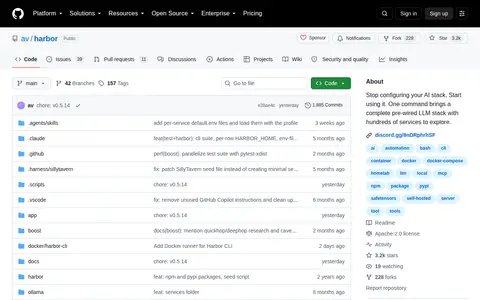
Harbor is a CLI and companion app that starts a pre-wired local LLM stack. Users pick services such as Ollama, llama.cpp, vLLM, Open WebUI, SearXNG, Speaches and ComfyUI, and Harbor handles Docker Compose orchestration, configuration and cross-service connectivity with a single harbor up command.
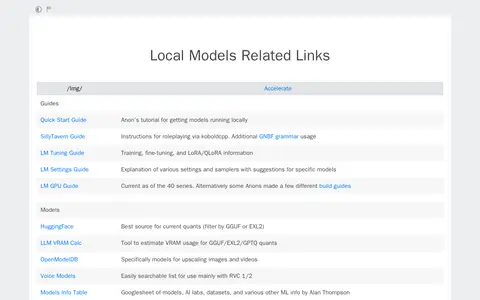
A links page listing resources related to running local language models. It gathers guides, including a quick start guide for running models locally, model sources such as HuggingFace for current quants, and inferencing frontends including Text Gen WebUI.
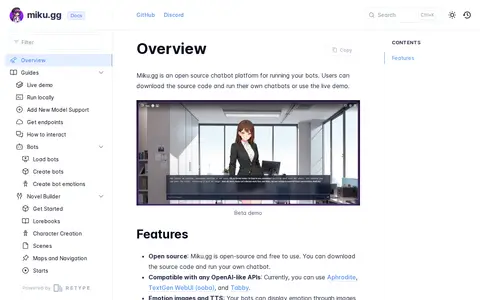
Miku.gg is an open source chatbot platform for running bots. Users can download the source code and run their own chatbots or use the live demo. It works with any OpenAI-like APIs and currently supports Aphrodite, TextGen WebUI and Tabby. Bots can show emotion through images and use TTS, with Azure TTS, NovelAI and ElevenLabs supported. A bot directory allows sharing, downloading or trying bots without local installation.
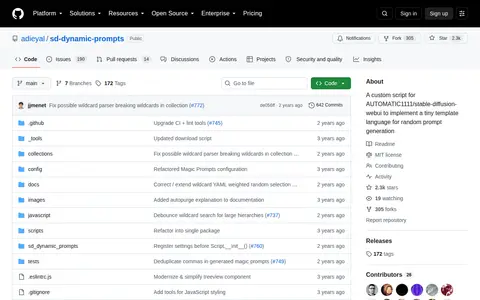
SD Dynamic Prompts is a custom script built for the AUTOMATIC1111 stable-diffusion-webui. It implements a small template language that enables random generation of prompts for use with Stable Diffusion image generation workflows.
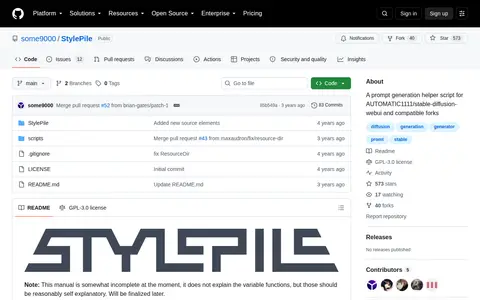
StylePile is a prompt generation helper script and extension for AUTOMATIC1111/stable-diffusion-webui and compatible forks. It mixes and matches elements that affect the style of generated results, with elements placed in a specific order and given strength values. It appears under the Scripts dropdown in txt2img and img2img.
Creates or edits images with generative models and visual controls.
Versão em português do notebook para rodar a Web UI do Stable Diffusion no Google Colab de graça.
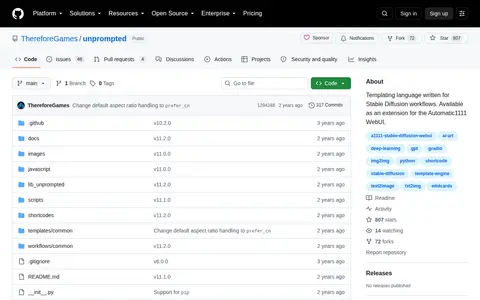
Unprompted is a templating language for Stable Diffusion workflows, distributed as an extension for the Automatic1111 WebUI. It is built around shortcodes and includes more than 70 shortcodes, such as conditionals, file imports and choose blocks for wildcards. Templates can be organized into folders and subfolders, and the language supports nested shortcodes and recursion.