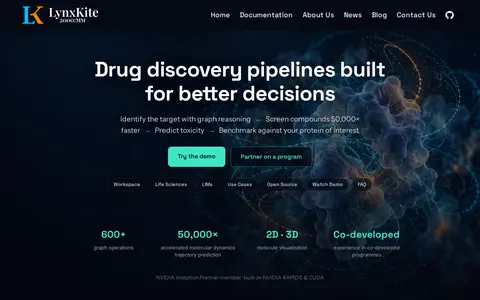

LynxKite is a GPU-accelerated platform for graph analytics and drug discovery. It combines graph reasoning, machine learning and molecule analysis in one workflow, and offers 600+ graph operations with 2D and 3D molecule visualization. It is free and open source with a commercial tier for production teams.
Directory
Search results
Published directory entries matching your search.
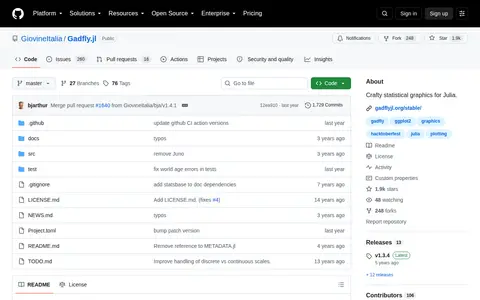
Gadfly is a Julia package for creating statistical graphics. Developed by GiovineItalia, it provides a grammar of graphics for generating visualizations in Julia. The repository includes documentation, examples, and installation instructions, and is open source.

nngraph is an open source GitHub repository that provides graph computation capabilities for Torch's nn neural network package. It enables users to define and work with neural network graph structures for their machine learning projects.
ONNX-MLIR provides compiler technology that transforms a valid Open Neural Network Exchange (ONNX) graph into code implementing the graph with minimum runtime support. It is based on LLVM/MLIR compiler technology and contributes an ONNX Dialect and a driver that lower ONNX graphs into MLIR files or LLVM bytecodes.
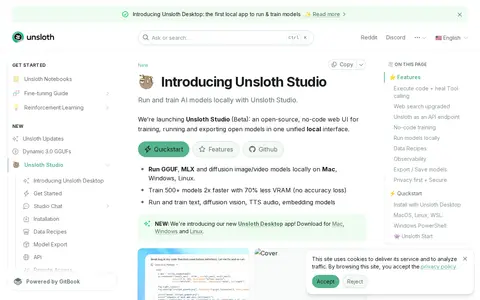
Unsloth Studio is an open-source, no-code web UI for training, running and exporting open models in one local interface. It supports GGUF, MLX and diffusion image/video models on Mac, Windows and Linux, and runs AI models offline without a GPU. A graphical Data Recipes workflow creates synthetic datasets from uploaded files.
Agents is an open-source framework for data-centric, self-evolving autonomous language agents. It introduces agent symbolic learning, which treats an agent pipeline like a computational graph and uses prompt-based loss, back-propagation and weight updates to train agents. The project also supports optimizing multi-agent systems and was updated to Agents 2.0 with agent learning and evaluation support.
A curated GitHub list of TensorFlow experiments, libraries and projects, with sections for tutorials, models, tools, videos, papers and books. It describes TensorFlow as an open source software library for numerical computation using data flow graphs.
Every ChatGPT GUI is a repository list tracking graphical user interface alternatives for accessing the API for ChatGPT, Claude and other LLMs. It groups open source web AI chats, browser extensions, Obsidian plugins, self-hosted tools and desktop apps, with demo and source links. The repository is MIT licensed and accepts pull requests to add or remove apps.
FACTORIE is an open-source toolkit for deployable probabilistic modeling, implemented as a software library in Scala and hosted on GitHub under the factorie organization. It provides users with a succinct language for creating relational factor graphs, estimating model parameters, and performing inference, with documentation for installation, example usage, and pre-built NLP models.
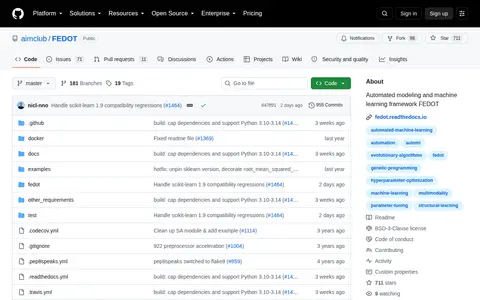
FEDOT is an open-source framework for automated modeling and machine learning. It provides automatic generative design of machine learning pipelines, with an evolutionary approach supporting classification, regression, clustering and time series prediction. Pipelines are represented as graphs defining connections between data preprocessing and model blocks. It is distributed under the 3-Clause BSD license.
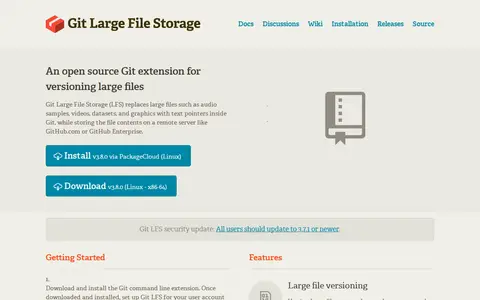
Git Large File Storage (Git LFS) is an open source Git extension for versioning large files. It replaces large files such as audio samples, videos, datasets, and graphics with text pointers inside Git while storing the file contents on a remote server like GitHub.com or GitHub Enterprise. Installation is available for Windows, Mac, and Linux. Tracking file types does not convert pre-existing files, which requires the git lfs migrate command.
Google Agent Development Kit (ADK) is an open toolkit for building powerful multi-agent systems and production-grade agents. It supports multiple programming languages including Python, JavaScript, Go, Java, and Kotlin, and offers features such as graph workflows, multi-agent collaboration, and integration with various AI models including Gemini, Claude, and OpenAI.
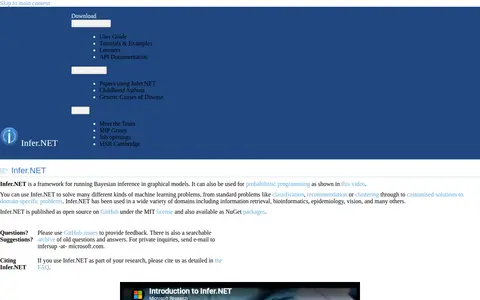
Infer.NET is a framework for running Bayesian inference in graphical models. It can be used for machine learning problems such as classification, recommendation or clustering, and for probabilistic programming. It is published as open source on GitHub under the MIT license and available as NuGet packages.
Kompas is a tool for capturing ideas, connecting them and developing them into writing. Sessions build a graph that becomes writing. A free desktop version is local-first and open source, and a Pro Cloud version offers cross-device sync and built-in AI.
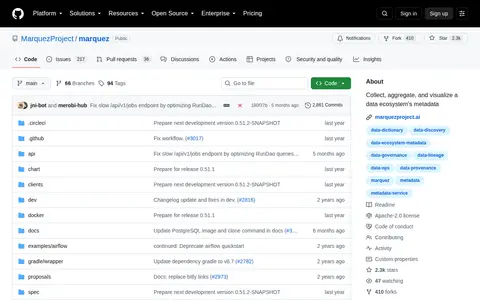
Marquez is an open source metadata service for collecting, aggregating and visualizing a data ecosystem's metadata. It maintains provenance of how datasets are consumed and produced and provides visibility into job runtime and dataset access. Metadata is collected via OpenLineage, and a web UI shows job and dataset dependencies through a lineage graph.
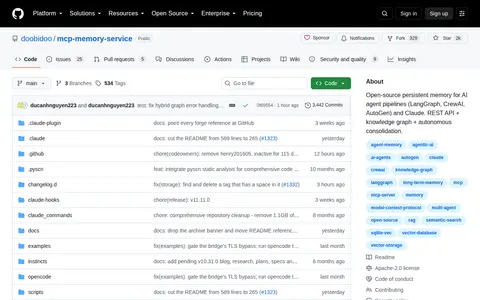
MCP Memory Service is an open-source tool that provides persistent memory for AI agent pipelines including LangGraph, CrewAI, AutoGen and Claude, with a REST API, knowledge graph and autonomous consolidation functionality.
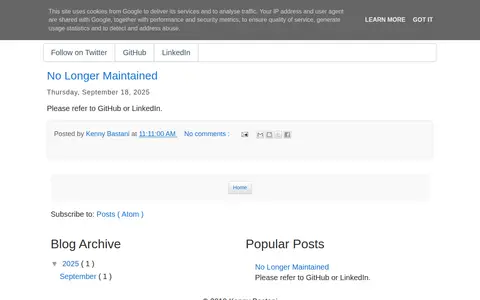
Meaning of is the personal blog of Kenny Bastani, covering open source software, graph databases, cloud native architectures, information theory, artificial intelligence, and machine learning. As of September 18, 2025, the blog is no longer maintained, with readers directed to the author's GitHub or LinkedIn profiles.
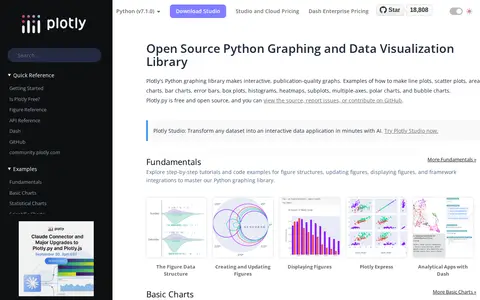
Plotly's Python graphing library is a free, open-source library for building interactive, publication-quality charts and graphs. It supports chart types including line plots, scatter plots, bar charts, error bars, box plots, histograms, heatmaps, subplots, multiple-axes, polar charts, and bubble charts. The source is available on GitHub.
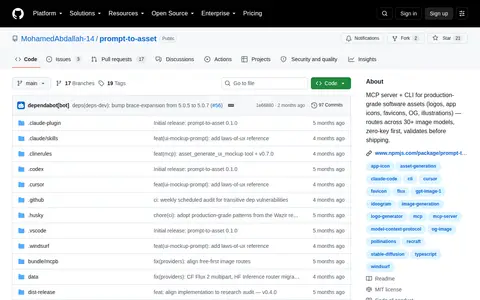
prompt-to-asset is a GitHub repository containing an MCP server and command-line interface tool for generating production-grade software assets including logos, app icons, favicons, Open Graph images and illustrations. The tool routes requests across more than 30 image models, supports zero-key initial usage, and includes validation functionality to review assets before they are shipped.
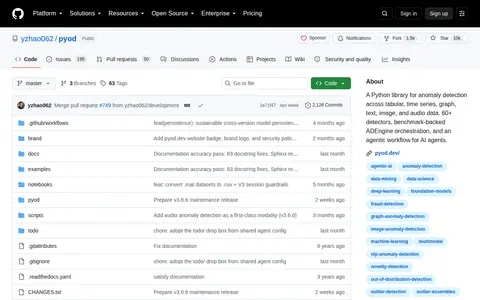
PyOD is an open-source Python library hosted on GitHub for anomaly detection across tabular, time series, graph, text, image and audio data. It includes over 60 anomaly detectors, an ADEngine orchestration tool, and supports agentic workflows for use with AI agents.
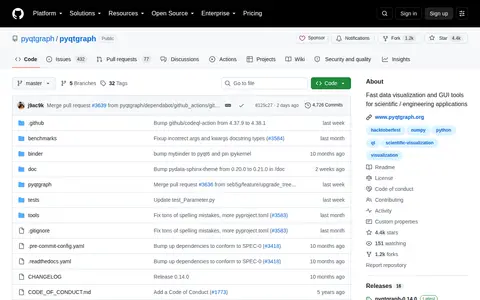
PyQtGraph is a pure-Python graphics library that uses the Qt framework. It is intended for mathematics, scientific and engineering applications, and relies on numpy for number crunching, Qt's GraphicsView for 2D display and OpenGL for 3D display. It supports Python 3.12+, Qt 5.15 or 6.8+, and numpy 2.2+.
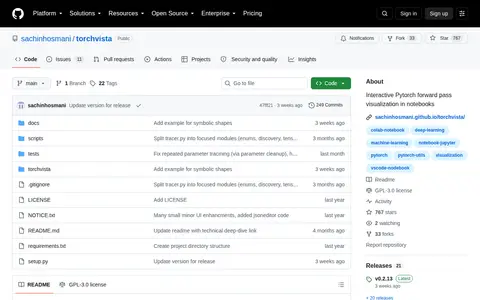
torchvista is an open-source tool that enables interactive visualization of PyTorch forward passes in Jupyter notebooks, maintained as a public GitHub repository under the sachinhosmani organization. It supports interactive drag-and-zoom graphs, collapsible nodes for hierarchical modules, and error-tolerant partial visualization when errors arise.
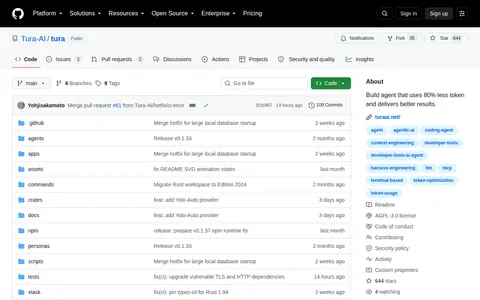
Tura is an open-source agent runtime harness that turns a task into a runtime-managed command graph, avoiding repeated model round trips in a ReAct session. The documentation describes it as a terminal-native developer tool that turns intent into verified code changes, emphasizing reading the repository first, keeping an audit trail, and proving results.
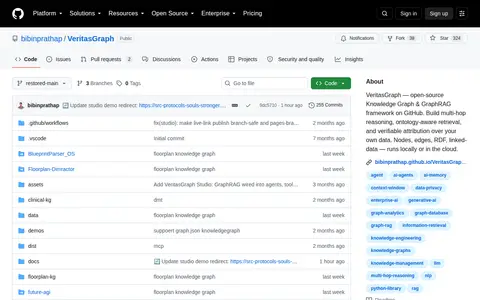
VeritasGraph is an open-source knowledge graph and GraphRAG framework. It supports multi-hop reasoning, ontology-aware retrieval, and verifiable attribution over user data, using nodes, edges, RDF, and linked data. The project runs locally or in the cloud.