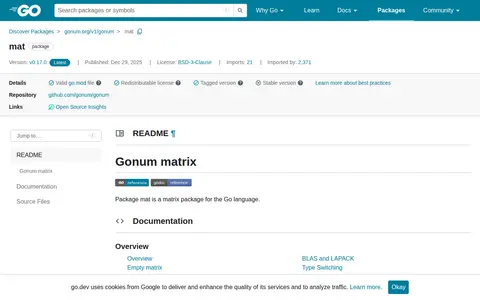
The mat package from Gonum provides implementations of float64 and complex128 matrix structures and linear algebra operations on them in Go. It offers interfaces for matrix classes, concrete implementations such as Dense and SymDense, methods for using matrix data, and types for matrix factorizations such as QR and LU.
Directory
Search results
Published directory entries matching your search.
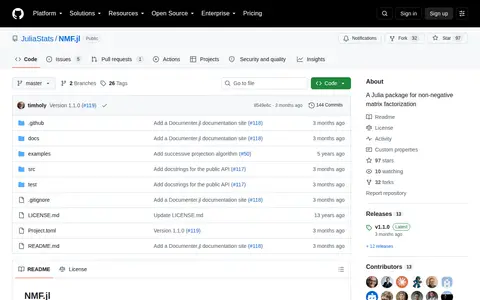
NMF.jl is a Julia package for non-negative matrix factorization, which factorizes a non-negative matrix into two lower-rank non-negative matrices. The nnmf function runs initialization and optimization in one call. Implemented methods include multiplicative update, projected alternating least squares, projected gradient and coordinate descent, with random and NNDSVD initialization.
Stability Matrix creates or edits images with generative AI and text-based controls.
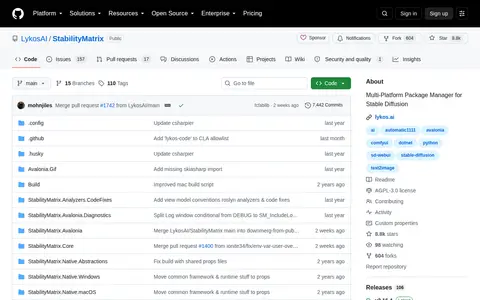
Stability Matrix is a multi-platform package manager designed for Stable Diffusion. It offers one-click installation and updates for Stable Diffusion Web UI packages, a built-in inference interface for the system, and a launcher with a syntax-highlighted terminal emulator and routed GUI input prompts.
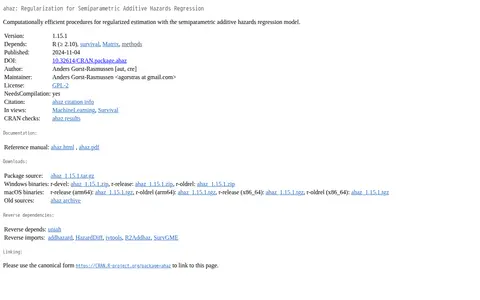
ahaz is an R package providing computationally efficient procedures for regularized estimation with the semiparametric additive hazards regression model. It depends on R version 2.10 or later, along with survival, Matrix and methods, and requires compilation. The package is authored and maintained by Anders Gorst-Rasmussen under GPL-2 and appears in the MachineLearning and Survival views.
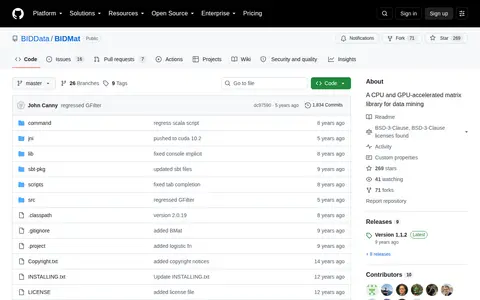
CPU and GPU-accelerated matrix library intended to support large-scale exploratory data analysis.
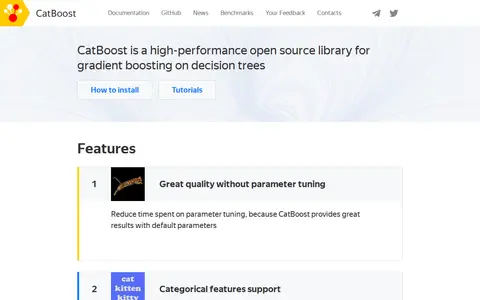
CatBoost is an open-source gradient boosting library on decision trees, developed by Yandex as the successor to its MatrixNet algorithm. It natively supports categorical features without preprocessing, offers a fast GPU implementation for large datasets, and reduces overfitting via a proprietary gradient boosting scheme. The library is used for tasks including search, recommendation systems, and weather prediction at Yandex.
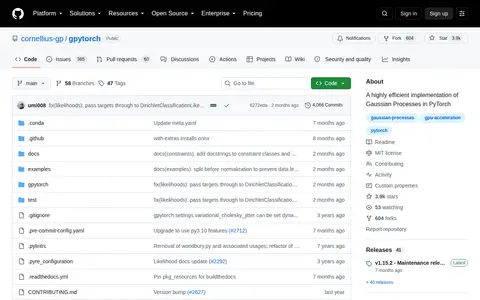
GPyTorch is a Gaussian process library implemented using PyTorch, designed for creating scalable, flexible, and modular Gaussian process models. It performs most inference operations using numerical linear algebra techniques such as preconditioned conjugate gradients, and provides GPU acceleration through matrix-vector-multiplication-based inference. Installation requires Python 3.10 or later, PyTorch 2.4.1 or later, and NumPy 2.0 or later.
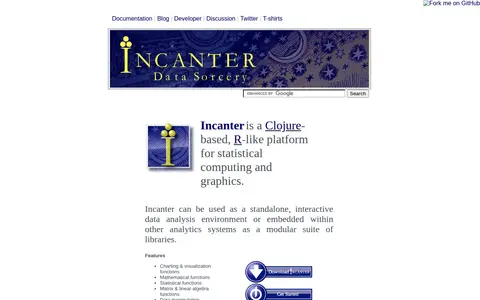
Incanter is a Clojure-based, R-like platform for statistical computing and graphics. It provides charting and visualization, mathematical, statistical, matrix and linear algebra, and data manipulation functions. It can be used as a standalone interactive data analysis environment or embedded within other analytics systems as a modular suite of libraries.
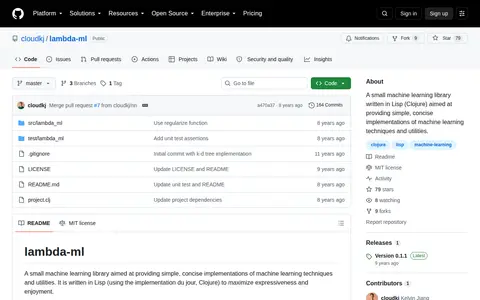
lambda-ml is a small machine learning library written in Lisp, specifically Clojure, aimed at simple, concise implementations of machine learning techniques and utilities. It covers supervised algorithms such as neural networks, decision trees, ensemble methods, k-nearest neighbors, linear and logistic regression, naive Bayes and random forest, plus unsupervised methods including DBSCAN, hierarchical clustering, k-means and non-negative matrix factorization.
LightFM is a Python implementation of recommendation algorithms for implicit and explicit feedback. It allows item and user metadata to be incorporated into matrix factorization algorithms, representing users and items as sums of latent feature representations. Installation is available from PyPI, and a Docker setup is provided for running examples and tests.
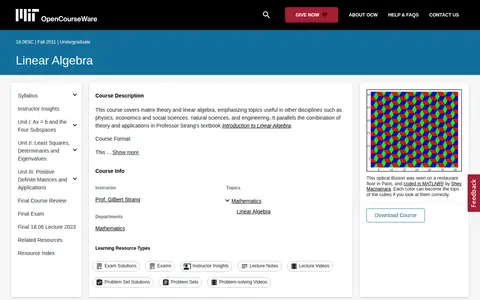
An MIT OpenCourseWare course covering matrix theory and linear algebra, emphasizing topics useful in physics, economics, social sciences, natural sciences and engineering. It is designed for independent study and includes lecture videos by Gilbert Strang, summary notes, problem solving videos, and problem sets with solutions.
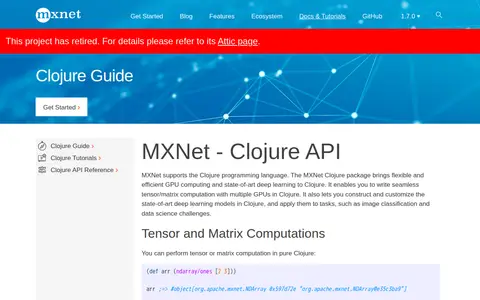
The MXNet Clojure package brings GPU computing and deep learning to the Clojure programming language. It enables tensor and matrix computation with multiple GPUs in Clojure, and allows constructing and customizing deep learning models for tasks such as image classification and data science challenges.
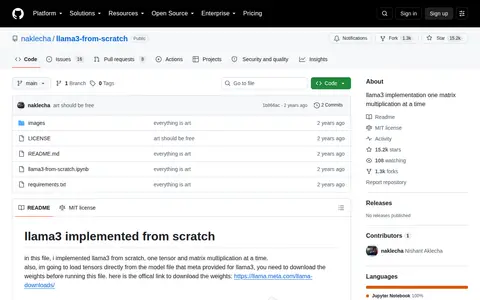
A notebook project that implements llama3 from scratch, one tensor and matrix multiplication at a time. It loads tensors directly from the model file Meta provided for llama3, and the weights must be downloaded before running the file. The author does not implement a BPE tokenizer and instead uses tiktoken.
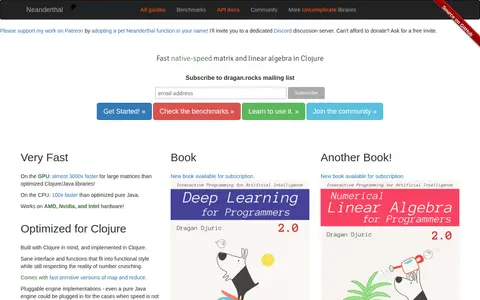
Neanderthal is a Clojure library for fast native matrix and linear algebra, built with native BLAS and LAPACK for number crunching and wrapped in a small Clojure layer. It offers pluggable engine implementations, including a pure Java engine, plus primitive versions of map and reduce.
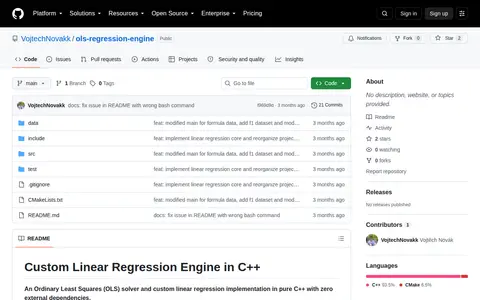
A C++ implementation of an Ordinary Least Squares solver and linear regression engine with zero external dependencies. It uses a custom matrix library, modified Gram-Schmidt orthogonalization and QR decomposition. It includes a CSV test dataset from the Czech film market and computes error metrics such as RSS and MAE.
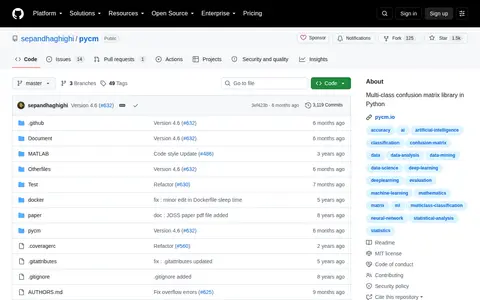
PyCM is a multi-class confusion matrix library written in Python. It supports input data vectors and direct matrices and offers post-classification model evaluation statistics. It is aimed at data scientists needing metrics for predictive models and classifiers. A MATLAB setup is also documented.
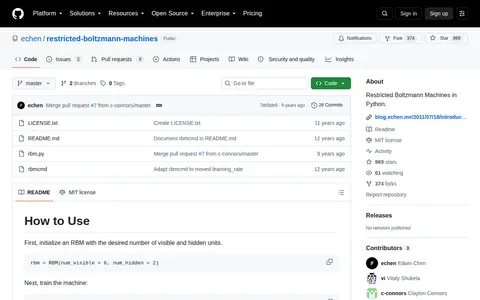
A Python implementation of Restricted Boltzmann Machines. It lets users initialize an RBM with a chosen number of visible and hidden units, train it on a matrix of training examples, run visible or hidden data, and let the network run freely. It is released under an MIT license.
SciRuby is a project providing tools for scientific computing and data visualization in Ruby. Its releases include NMatrix, a linear algebra library with dense and sparse matrix storage and tensor support, alongside visualization and statistics gems. The project describes itself as currently alpha, and it notes its gems are tested but not battle-hardened. SciRuby and NMatrix are available under the BSD three-clause license.
SOMPY is a Python library for self-organizing maps structured similarly to somtoolbox in Matlab. It offers only batch training, PCA or RandomPCA initialization, component plane visualization, hitmap and U-Matrix visualization, and 1-d or 2-d SOM with rectangular, planar grid. It supports function approximation and predictions, mostly using Sklearn.
ZeroClaw is an agent runtime distributed as a single Rust binary that users configure and run. It connects to LLM providers such as Anthropic, OpenAI and Ollama, reaches users through channels including Discord, Telegram, Matrix, email, voice and webhooks, and acts through tools including shell, browser, HTTP, hardware and custom MCP servers. A quickstart command performs one-shot setup to pick a provider and write a working config.