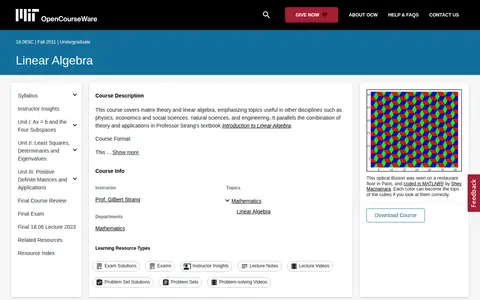
An MIT OpenCourseWare course covering matrix theory and linear algebra, emphasizing topics useful in physics, economics, social sciences, natural sciences and engineering. It is designed for independent study and includes lecture videos by Gilbert Strang, summary notes, problem solving videos, and problem sets with solutions.
Directory
Search results
Published directory entries matching your search.
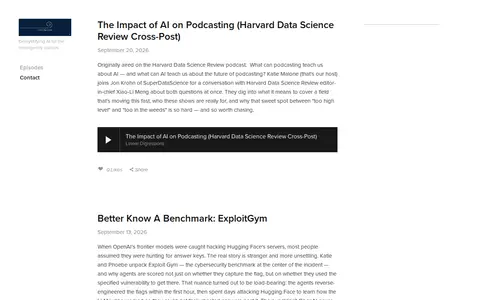
Linear Digressions is a podcast series covering machine learning and AI topics, with episodes such as "LLM as a Judge," a cross-post on AI and podcasting from the Harvard Data Science Review, and a benchmark installment on ExploitGym. One episode examines mechanistic interpretability, described as an approach that opens the model itself to trace why it behaves as it does.
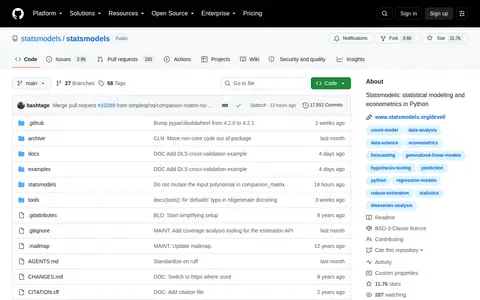
Statsmodels is a Python package that complements scipy for statistical computations, including descriptive statistics and estimation and inference for statistical models. It provides linear regression models, generalized linear models, discrete models, time series analysis, survival analysis, multivariate methods and a range of statistical tests.
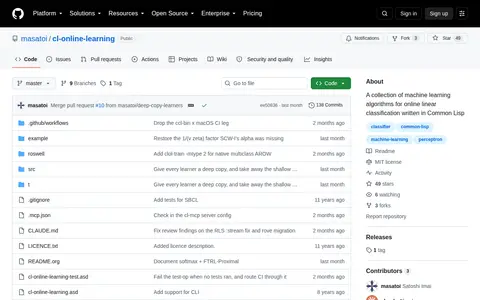
cl-online-learning is a Common Lisp library collecting machine learning algorithms for online linear classification. It implements binary classifiers including Perceptron, AROW, SCW-I, logistic regression with SGD or ADAM, and FTRL-Proximal, plus multiclass approaches such as one-vs-rest, one-vs-one, multiclass AROW and softmax with FTRL-Proximal. Command line tools are provided as a roswell script, and the package is available from Quicklisp.
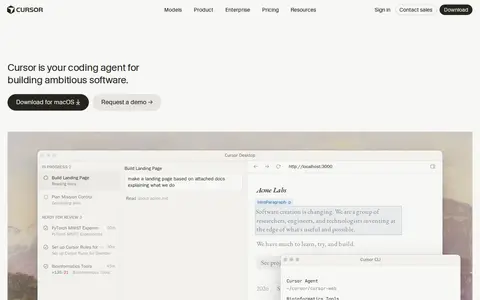
Cursor is a coding agent for building software. It can be used to understand a codebase, plan and build features, fix bugs and review changes. Cloud agents run in isolated VMs for parallel work, and it integrates with tools including GitHub, GitLab, Slack and Linear.
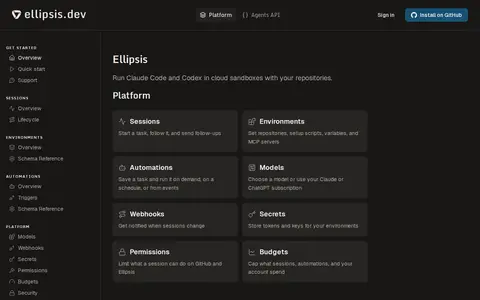
This is the documentation for Ellipsis, a platform that enables running internal agents in the cloud via Claude Code or Codex, with support for custom tools, secrets, and MCP servers. Users define agents as YAML configuration files in their repositories, and Ellipsis executes the agents to build features, fix bugs, and investigate production issues. The platform also includes integrations with GitHub, Slack, Linear, and Sentry, plus support for sessions, environments, secrets, permissions, and usage budgets.
emel is a simple and functional machine learning library built for the Erlang ecosystem and implemented in Gleam. It turns data into functions and supports installing through rebar.config, mix.exs or gleam add. Implemented algorithms include linear regression, k nearest neighbors, decision tree, naive Bayes, k means, perceptron, logistic regression and neural network, along with mathematics, algebra, geometry and statistics.
Generalized linear models in Julia.
The mat package from Gonum provides implementations of float64 and complex128 matrix structures and linear algebra operations on them in Go. It offers interfaces for matrix classes, concrete implementations such as Dense and SymDense, methods for using matrix data, and types for matrix factorizations such as QR and LU.
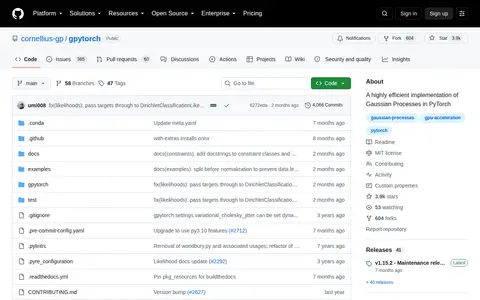
GPyTorch is a Gaussian process library implemented using PyTorch, designed for creating scalable, flexible, and modular Gaussian process models. It performs most inference operations using numerical linear algebra techniques such as preconditioned conjugate gradients, and provides GPU acceleration through matrix-vector-multiplication-based inference. Installation requires Python 3.10 or later, PyTorch 2.4.1 or later, and NumPy 2.0 or later.
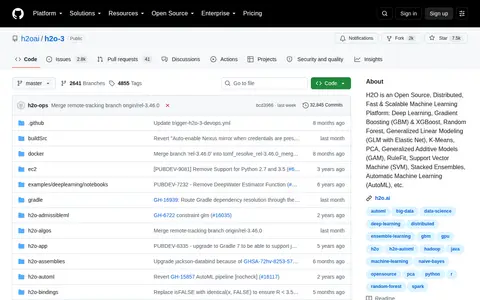
H2O is an open-source, distributed, fast, and scalable machine learning platform hosted on GitHub by the h2oai organization. It supports a wide range of machine learning methods including deep learning, gradient boosting, random forest, generalized linear modeling, clustering, dimensionality reduction, rule fitting, support vector machines, stacked ensembles, and automated machine learning.
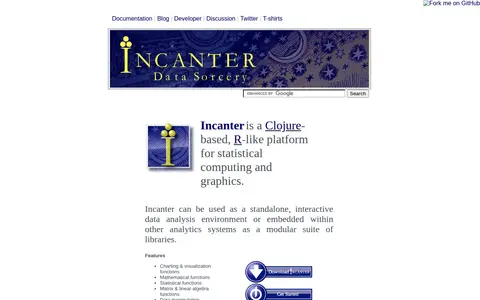
Incanter is a Clojure-based, R-like platform for statistical computing and graphics. It provides charting and visualization, mathematical, statistical, matrix and linear algebra, and data manipulation functions. It can be used as a standalone interactive data analysis environment or embedded within other analytics systems as a modular suite of libraries.

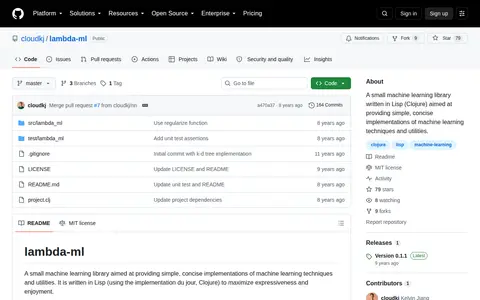
lambda-ml is a small machine learning library written in Lisp, specifically Clojure, aimed at simple, concise implementations of machine learning techniques and utilities. It covers supervised algorithms such as neural networks, decision trees, ensemble methods, k-nearest neighbors, linear and logistic regression, naive Bayes and random forest, plus unsupervised methods including DBSCAN, hierarchical clustering, k-means and non-negative matrix factorization.

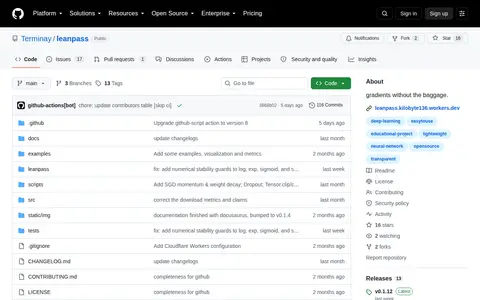
Leanpass is a NumPy-based autodiff library for small neural network experiments, designed to be readable and simple to inspect for learning how automatic differentiation works. It provides tensors with reverse-mode autodiff, activation functions, linear layers, multilayer perceptrons, loss utilities, and SGD and Adam optimizers. Its only dependency is NumPy.
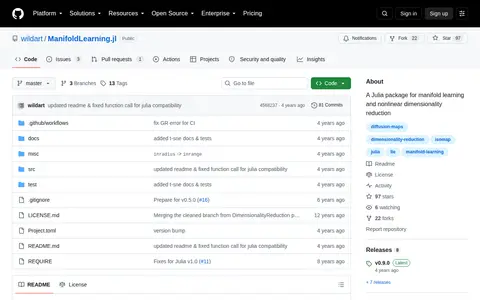
ManifoldLearning.jl is a Julia package for manifold learning and nonlinear dimensionality reduction. It provides methods including Isomap, diffusion maps, locally linear embedding, Hessian eigenmaps, Laplacian eigenmaps, local tangent space alignment and t-SNE. Most methods use k-nearest neighbors to construct local subspace representation, and a custom k-nearest neighbors function is suggested for large datasets.
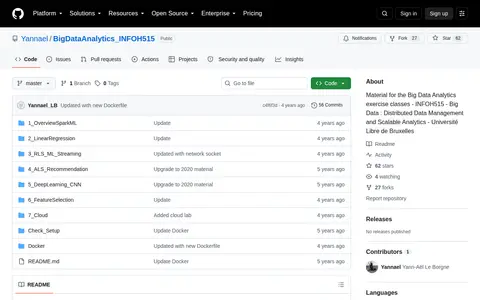
A repository of material for the exercise classes of a Big Data Analytics master course. Hands-on sessions cover Spark and its machine learning library, Map/Reduce implementations of linear regression and alternating least squares, streaming analytics with Recursive Least Squares, and image classification with convolutional neural networks. Material is provided as Jupyter notebooks.
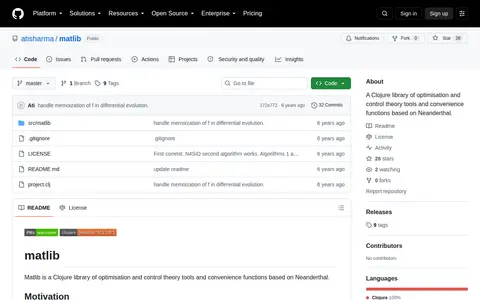
matlib is a Clojure library of optimisation and control theory tools and convenience functions based on the Neanderthal linear algebra library. It is available as a public repository on GitHub.
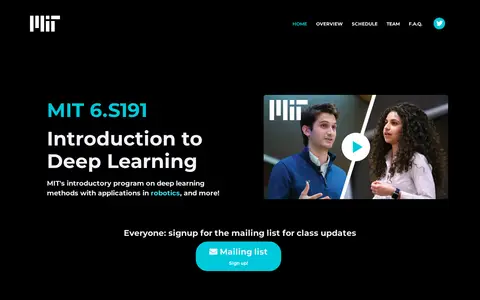
MIT 6.S191 is MIT's introductory program on deep learning methods, with applications in vision, robotics, medicine, language, game play, art and more. It is described as a high-intensity bootcamp teaching deep learning fundamentals, with lectures, software labs and a final project proposal competition. Prerequisites assume calculus and linear algebra.
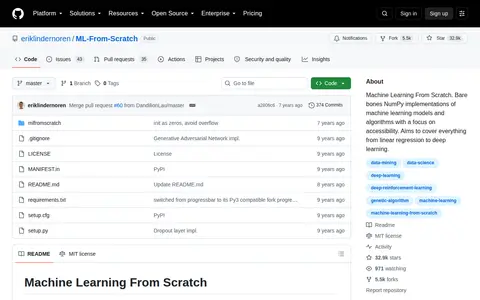
ML-From-Scratch is a GitHub repository that provides bare bones NumPy implementations of machine learning models and algorithms with a focus on accessibility, aiming to cover methods from linear regression to deep learning.
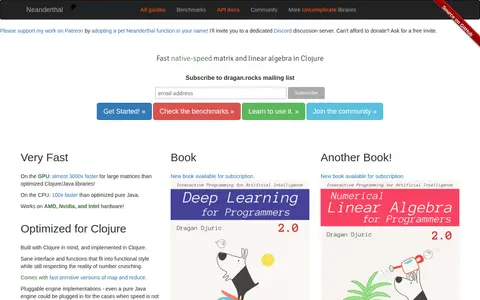
Neanderthal is a Clojure library for fast native matrix and linear algebra, built with native BLAS and LAPACK for number crunching and wrapped in a small Clojure layer. It offers pluggable engine implementations, including a pure Java engine, plus primitive versions of map and reduce.
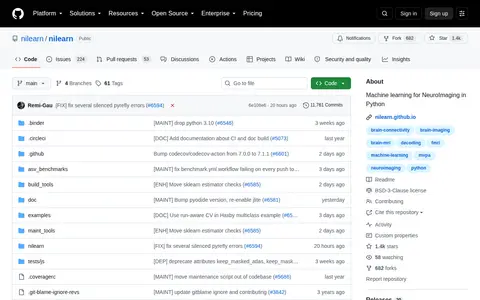
Nilearn provides statistical and machine-learning tools for analyses of brain volumes and surfaces, with documentation and a community. It supports general linear model based analysis and uses the scikit-learn toolbox for multivariate statistics, with applications such as predictive modeling, classification, decoding and connectivity analysis. It is written in Python and installable with pip.
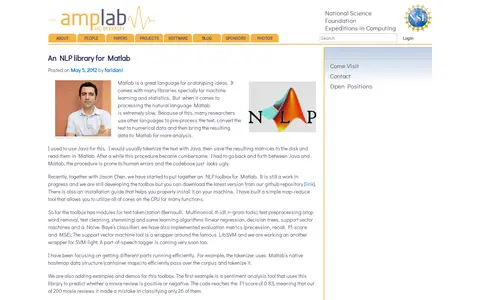
An NLP toolbox for Matlab under development by researchers at UC Berkeley's AMPLab, intended to process natural language within Matlab rather than switching to other languages. It includes modules for text tokenization, text preprocessing such as stop word removal and stemming, and learning algorithms including linear regression, decision trees, support vector machines and a Naive Bayes classifier.
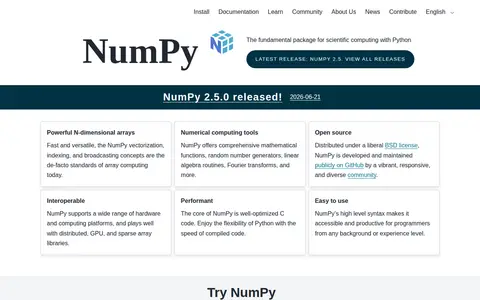
NumPy is a Python library providing a multidimensional array object and routines for fast operations on arrays, including mathematical, logical, sorting, Fourier transforms, linear algebra and random simulation. It is open source under a BSD license and is described as the fundamental package for scientific computing in Python, with core code written in optimized C.
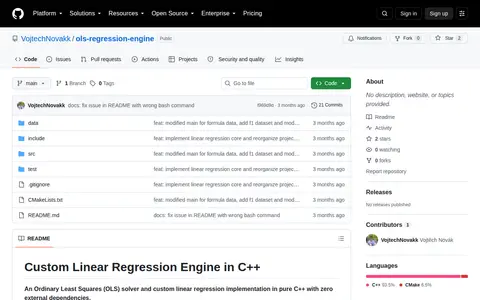
A C++ implementation of an Ordinary Least Squares solver and linear regression engine with zero external dependencies. It uses a custom matrix library, modified Gram-Schmidt orthogonalization and QR decomposition. It includes a CSV test dataset from the Czech film market and computes error metrics such as RSS and MAE.