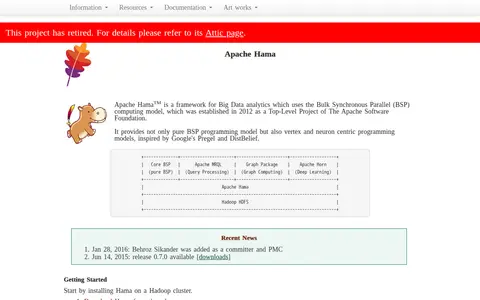
Apache Hama is a retired Apache Software Foundation Top-Level Project established in 2012. It is a framework for Big Data analytics that uses the Bulk Synchronous Parallel (BSP) computing model. It also provides vertex-centric and neuron-centric programming models inspired by Google's Pregel and DistBelief. Its components include core BSP, Apache MRQL for query processing, a graph computing package, and Apache Horn for deep learning, and it integrates with Hadoop HDFS.
Directory
Search results
Published directory entries matching your search.
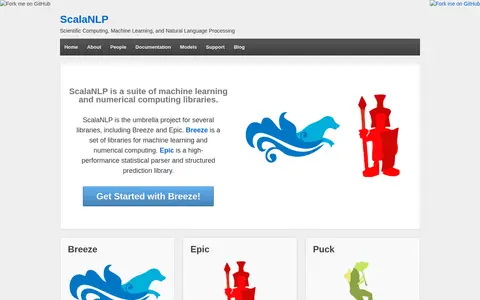
ScalaNLP is an umbrella project for machine learning and numerical computing libraries, including Breeze and Epic. Breeze covers linear algebra, numerical computing and optimization. Epic is a statistical parser and structured prediction library. The site also lists Puck, a GPU-powered parser built on grammars produced by the Berkeley Parser.
AI Horde is a community-run, open source project where volunteers share their computers so anyone can make images and text for free. The site invites visitors to generate content and contribute computing power, and it shows a gallery of images made on the horde with their prompts.
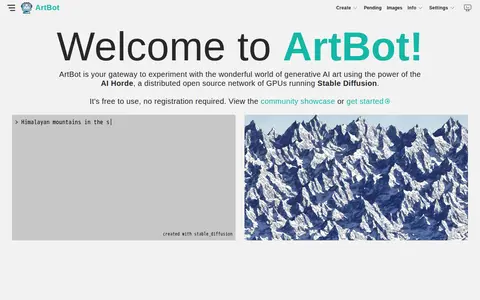
ArtBot is a tool for generating AI-created images and photos with Stable Diffusion, using a distributed computing cluster powered by the AI Horde. It is free to use and requires no login. The page lists creation tools such as ControlNet, drawing, image-to-image, inpainting and live paint, along with an image gallery and model details.
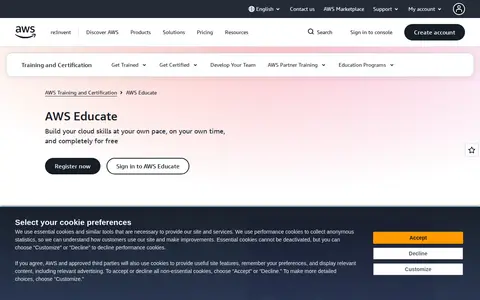
An AWS program offering students and educators no-cost access to cloud computing skills training developed by AWS experts, plus career pathways for students. It provides a library of free, self-paced online training and hands-on labs covering storage, compute, networking, databases and cloud operations. Learners as young as 13 can register with an email address, and learners 18 and older can access a job board.
Cognitive Class AI by IBM is a free online learning platform. It offers over 100 courses, 300 hands-on projects and 20 learning paths covering AI, cloud computing, full-stack development, cybersecurity, data science and other technology fields. Learners can earn certificates and badges, and the platform serves over 3 million learners.
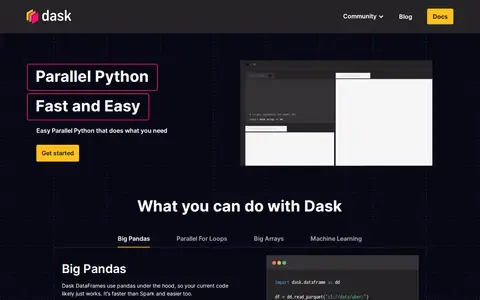
Dask is an open-source Python library for parallel computing maintained by contributors across dozens of companies. The site describes uses including Dask DataFrames for pandas, parallel for loops, large arrays with NumPy and Xarray, and machine learning. It can run on a laptop or be deployed on resource managers such as Kubernetes or cloud.
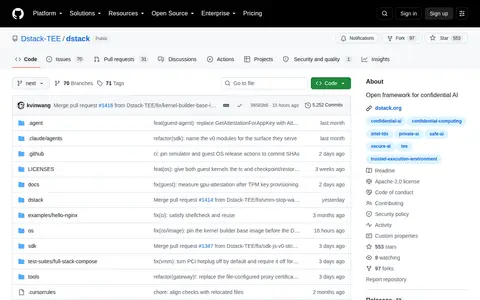
dstack is an open framework for confidential AI that runs containers inside confidential VMs with Intel TDX, using existing Docker Compose files. It supports attested workload identities and native NVIDIA Confidential Computing on H100 and Blackwell GPUs, with options for self-hosted TDX machines or Phala Cloud.
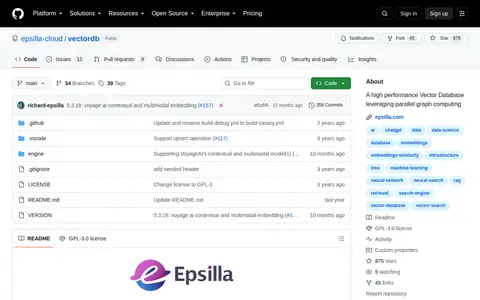
Epsilla is a high-performance vector database hosted on GitHub under the epsilla-cloud organization. It leverages parallel graph computing for its operations, and offers an experimental option to use it as a Python library without requiring a Docker image, alongside Epsilla Cloud as a deployment option.
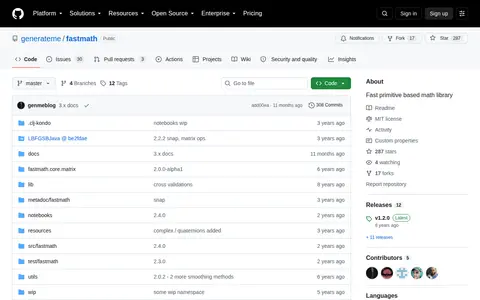
A collection of functions for mathematical and statistical computing, macine learning, etc., wrapping several JVM libraries.
Fiber is a Python-based distributed computing library for modern computer clusters. It provides the same API as Python's standard multiprocessing library, uses Nanomsg for communication, and allows dynamic allocation of CPU, memory, and GPU resources. Installation uses pip install fiber.
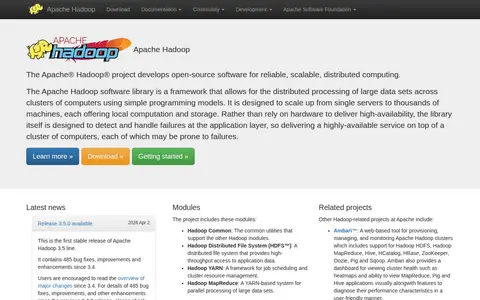
Apache Hadoop is an open-source project that develops software for reliable, scalable, distributed computing. Its library is a framework for distributed processing of large data sets across clusters of computers using simple programming models, scaling from single servers to thousands of machines with local computation and storage, and detecting failures at the application layer.
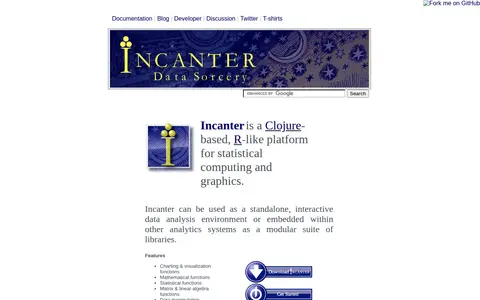
Incanter is a Clojure-based, R-like platform for statistical computing and graphics. It provides charting and visualization, mathematical, statistical, matrix and linear algebra, and data manipulation functions. It can be used as a standalone interactive data analysis environment or embedded within other analytics systems as a modular suite of libraries.
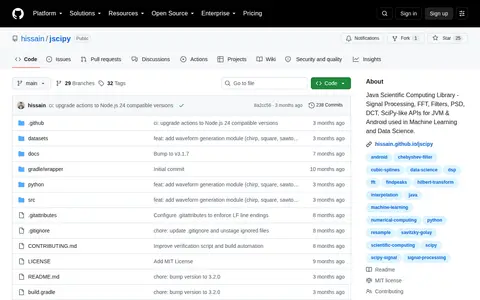
Open-source Java scientific computing library for JVM and Android platforms, with SciPy-like APIs for use in machine learning and data science workflows. It provides functionality for signal processing, FFT, filters, PSD, and DCT operations.
Jupyter Notebook is a web-based interactive computing platform combining live code, equations, narrative text, visualizations, and dashboards. It supports over 40 programming languages, including Python, R, Julia, and Scala, and notebooks can be shared via email, Dropbox, GitHub, and the Jupyter Notebook Viewer.
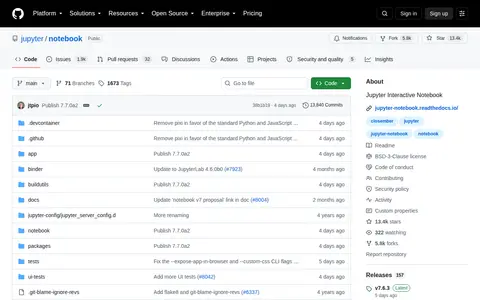
Jupyter notebook is a web-based notebook environment for interactive computing.
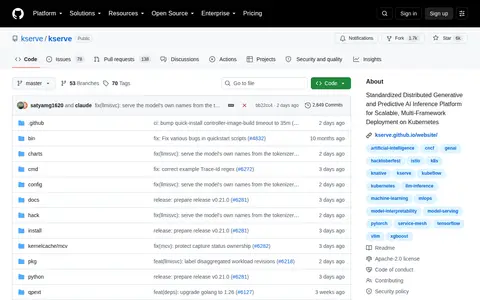
KServe is a standardized distributed generative and predictive AI inference platform for scalable, multi-framework deployment on Kubernetes. It is a Cloud Native Computing Foundation incubating project. The platform supports backends such as vLLM and llm-d for serving LLMs, and multi-framework predictive serving. Standalone installation on standard Kubernetes is described as more lightweight but without canary deployment or request-based autoscaling with scale-to-zero.
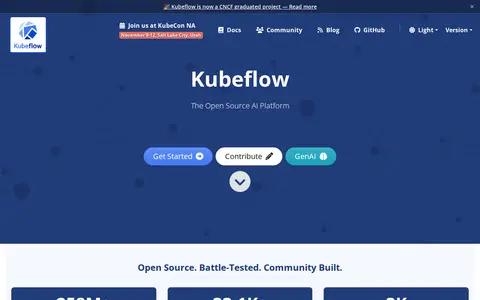
Kubeflow is described as the cloud native AI platform, composed of modular open source projects forming a Kubernetes-native stack for data and AI workloads. Its subprojects include Kubeflow Pipelines for building and deploying portable machine learning workflows, Kubeflow Trainer for distributed AI training and LLM fine-tuning, Kubeflow Katib for automated machine learning, Kubeflow Notebooks for interactive development environments, and Kubeflow Hub for indexing models and metadata. It is a Cloud Native Computing Foundation project.
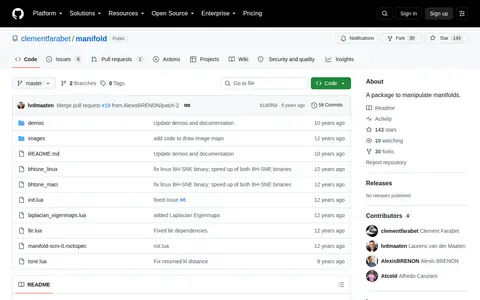
Manifold is a package for manipulating manifolds, built for Torch7. It is installed via luarocks and depends on the libatlas3-base package. The package offers basic functions such as computing neighbors and distances, and embeddings using random projections, LLE and tSNE. Demos are included, such as a t-SNE map produced on 5,000 MNIST digits.
The Master of Data Science (M.A.S.) at Illinois Institute of Technology is a master's program in the School of Computing. It covers machine learning, deep learning, big data analytics and data visualization, with courses available online, on campus or hybrid and full-time, part-time or self-paced schedules.
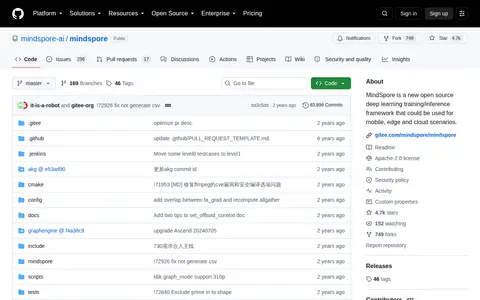
MindSpore is an open source deep learning training and inference framework that could be used for mobile, edge, and cloud computing scenarios. Its source code is hosted in the mindspore-ai/mindspore repository on GitHub.
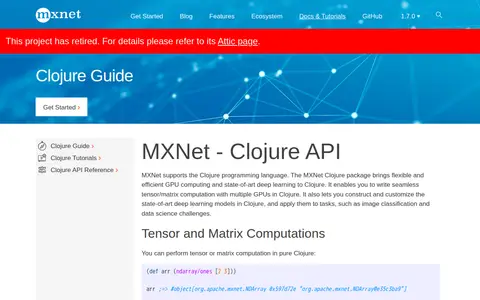
The MXNet Clojure package brings GPU computing and deep learning to the Clojure programming language. It enables tensor and matrix computation with multiple GPUs in Clojure, and allows constructing and customizing deep learning models for tasks such as image classification and data science challenges.
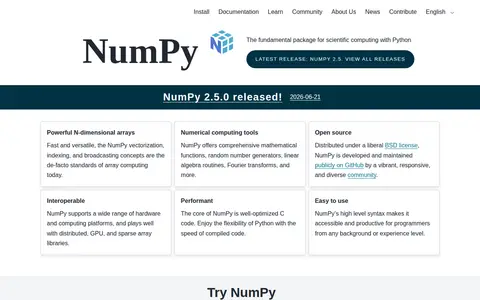
NumPy is a Python library providing a multidimensional array object and routines for fast operations on arrays, including mathematical, logical, sorting, Fourier transforms, linear algebra and random simulation. It is open source under a BSD license and is described as the fundamental package for scientific computing in Python, with core code written in optimized C.
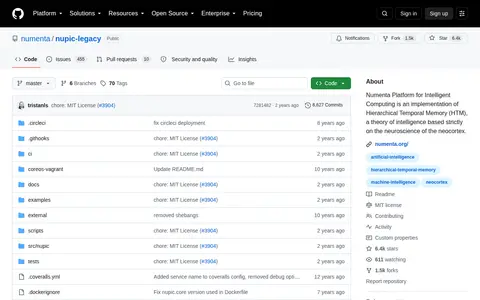
Numenta Platform for Intelligent Computing.