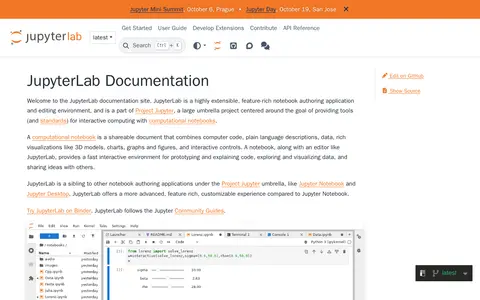

JupyterLab is an extensible notebook authoring application and editing environment within Project Jupyter. A notebook combines code, text descriptions, data and visualizations. JupyterLab provides an environment for prototyping and explaining code, exploring and visualizing data, and sharing ideas. It is a sibling to Jupyter Notebook and Jupyter Desktop and is described as offering a more advanced, customizable experience than Jupyter Notebook.
Directory
Search results
Published directory entries matching your search.

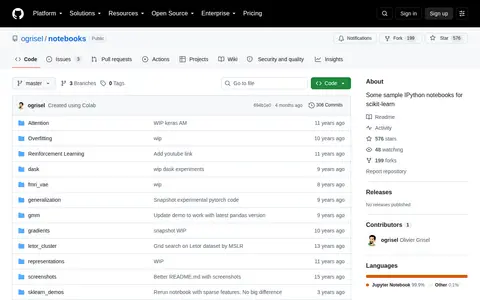
The ipython-notebooks repository, hosted on GitHub under the user ogrisel, contains sample IPython notebooks for use with the scikit-learn machine learning library. It is an open-source project that accepts contributions from GitHub users.
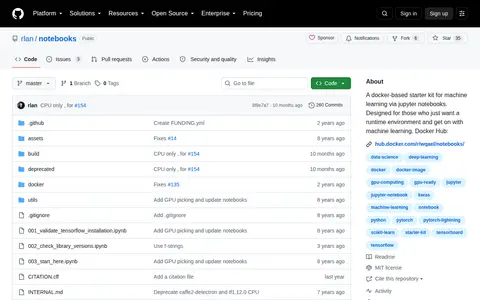
Notebooks is a Docker-based starter kit for machine learning through Jupyter notebooks, intended for users who want a ready runtime environment. Its images cover combinations of Keras, TensorFlow and PyTorch with CUDA v8 through v11, and include JupyterLab, scikit-learn, pandas and visualization, vision and NLP libraries. Python 3 only, as Python 2 is end-of-life.
Gemini Notebook supports AI-assisted research, knowledge retrieval, summarization, or source analysis.
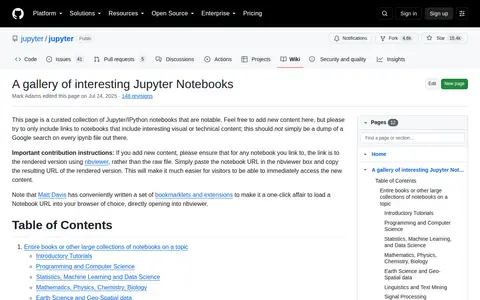
This is a curated gallery of interesting Jupyter Notebooks, organized by topic categories including introductory tutorials, programming and computer science, statistics and machine learning, data science, mathematics, physics, chemistry, biology, earth science, geo-spatial data, linguistics, and text mining.
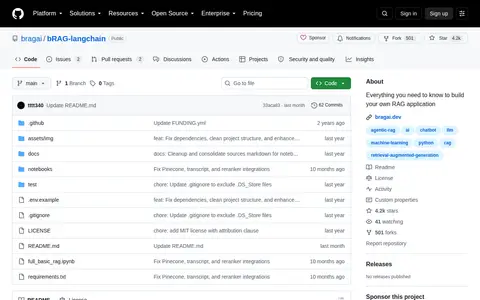
This repository collects notebooks that explore Retrieval-Augmented Generation (RAG) for various applications, from introductory to advanced implementations. It includes a full_basic_rag.ipynb starter and notebooks on multi-querying, routing, query construction, indexing, and advanced retrieval. The materials cover environment setup, data loading, embedding generation, and vector store configuration with ChromaDB or Pinecone.
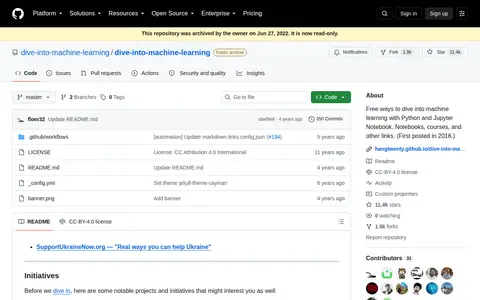
Archived, read-only GitHub repository of free resources for learning machine learning with Python and Jupyter Notebook, including notebooks, courses and other links. It was first posted in 2016 and was archived by the owner on Jun 27, 2022.
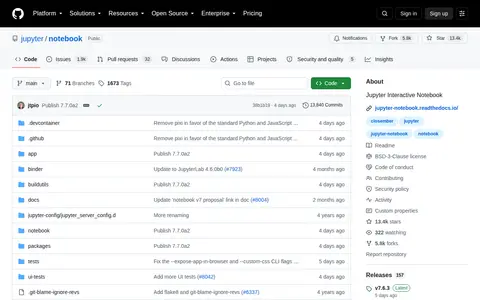
Jupyter Notebook is a web-based interactive computing platform combining live code, equations, narrative text, visualizations, and dashboards. It supports over 40 programming languages, including Python, R, Julia, and Scala, and notebooks can be shared via email, Dropbox, GitHub, and the Jupyter Notebook Viewer.
Jupyter notebook is a web-based notebook environment for interactive computing.
NotebookLM supports AI-assisted research, knowledge retrieval, summarization, or source analysis.
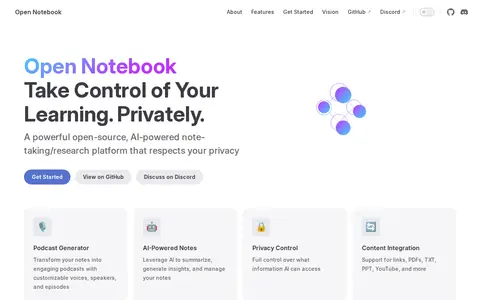
Open Notebook is an open-source, AI-powered note-taking and research platform focused on user privacy. It includes a podcast generator that transforms notes into customizable audio content, AI tools for summarizing notes and generating insights, granular privacy controls for AI data access, and support for integrating links, PDFs, text files, presentations, YouTube videos and other content types. The platform is designed for researchers, students, and learning enthusiasts.
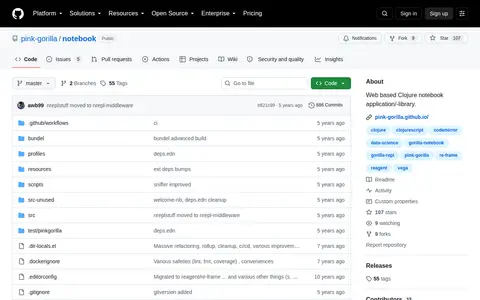
A Clojure/Clojurescript notebook application/-library based on Gorilla-REPL.
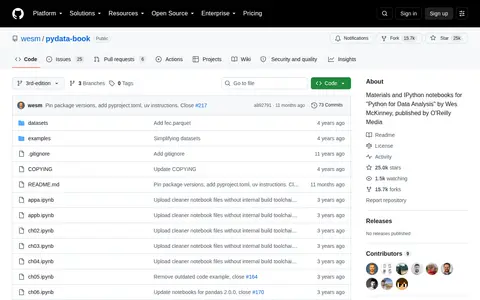
The repository holds materials and IPython notebooks for "Python for Data Analysis, 3rd Edition" by Wes McKinney, published by O'Reilly Media. Notebooks cover chapters on Python basics, NumPy, pandas, data loading, cleaning, visualization, time series and modeling libraries, plus appendices. The code is released under the MIT license.
r/notebooklm points to a Reddit community or thread with discussion, updates, troubleshooting, or shared resources.
this VQGAN+CLIP Animations notebook creates or edits images with generative AI and text-based controls.
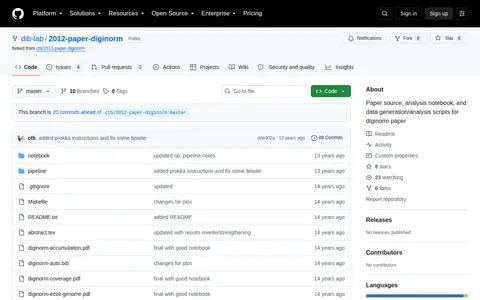
A repository holding the paper source, analysis notebook, and data generation and analysis scripts for the diginorm paper. It is forked from another repository and includes LaTeX sources, bibliography files, figures and a pipeline folder.
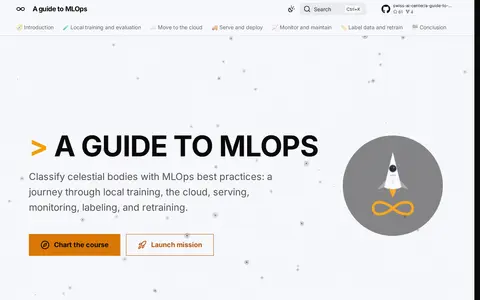
A guide to MLOps is an open-source tutorial from the Swiss AI Center team that walks engineers and small teams from notebook experiments to production. It covers local training and model evaluation, moving the model to the cloud, serving and deploying, monitoring and maintaining, and labeling data and retraining, using tools such as DVC, Git, GitHub Actions, CML, Docker, BentoML, Fluent Bit, Evidently AI, and Label Studio.
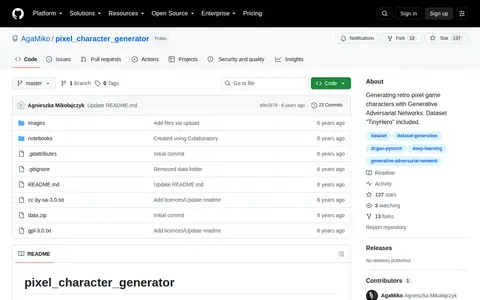
A GitHub repository for generating retro pixel game characters with generative adversarial networks. It includes the TinyHero dataset of 64x64 pixel characters generated from the Universal LPC spritesheet, with 3648 images. Notebooks cover a DCGAN based on the PyTorch tutorial, a conditional DCGAN and a deep convolutional autoencoder. Art is dual licensed under GPL 3.0 and CC-BY-SA 3.0.
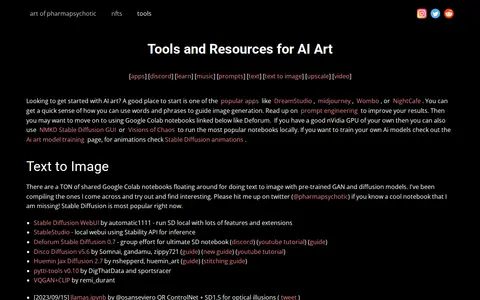
A page by pharmapsychotic collecting tools and resources for AI art, organized into sections such as text to image, upscaling, StyleGAN, text video, prompt engineering and music. It links to shared Google Colab notebooks for text-to-image work with pre-trained GAN and diffusion models, and notes Stable Diffusion WebUI for running SD locally.
Anaconda is a platform for Python, data science, and AI development. Its core is conda, an open-source package and environment manager that installs software, resolves dependencies, and isolates projects. Two installers are offered: Anaconda Distribution, which bundles conda, Python, Anaconda Navigator, and hundreds of packages, and Miniconda, a minimal base environment. Anaconda Notebooks is a cloud-based JupyterLab environment.
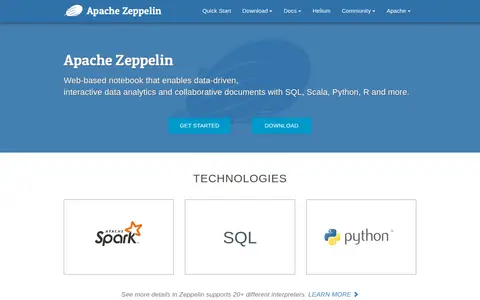
Apache Zeppelin is a web-based notebook for data-driven, interactive data analytics and collaborative documents with SQL, Scala, Python, R and more. It uses interpreters to plug in language and data-processing backends, including built-in Apache Spark integration, and includes basic charts, pivot charts, dynamic forms and paragraph publishing to embed results in websites.
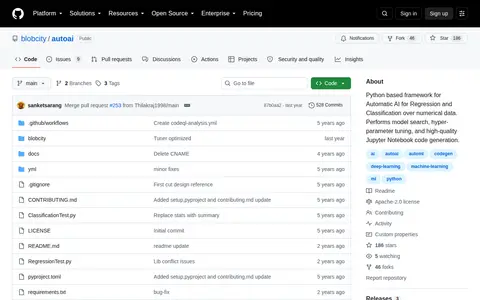
autoai is an open-source Python framework for automatic artificial intelligence focused on regression and classification tasks over numerical data. It automates model search, hyper-parameter tuning, and generates high-quality Jupyter Notebook code for resulting models.
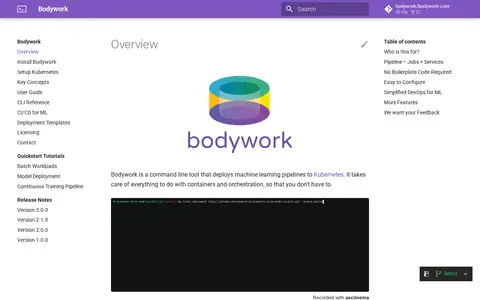
Bodywork is a command line tool that deploys machine learning pipelines to Kubernetes, handling containers and orchestration. Any pipeline stage runs either a batch job or a long-running process. It is presented as a lightweight alternative to Kubeflow or building a platform around workflow tools such as Apache Airflow, Argo Workflows or Dagster. Stages are defined as Python modules or Jupyter notebooks and configured in a single bodywork.yaml file.
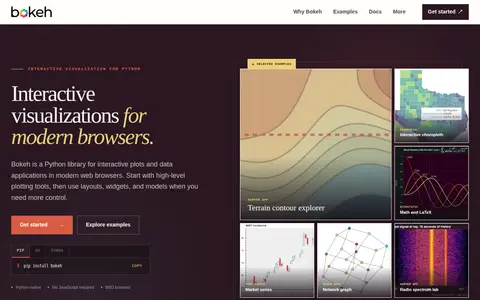
Bokeh is a Python library for creating interactive plots, dashboards, and data applications in modern web browsers. Plots can go in Jupyter notebooks, be saved as standalone HTML, or run with live Python callbacks through the Bokeh server or embedded in an ASGI app. It includes tools for pan, zoom, hover, and selection.