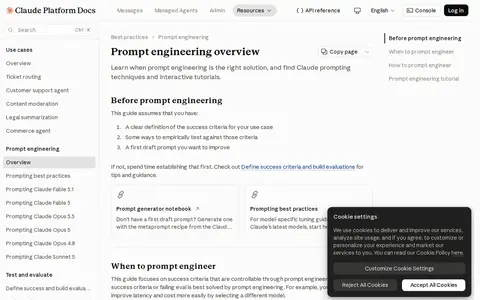

Anthropic Prompt Engineering documentation on the Claude Platform provides an overview of prompt engineering. It explains when prompt engineering is appropriate, presents Claude prompting techniques, and includes interactive tutorials for developers.
Directory
Search results
Published directory entries matching your search.
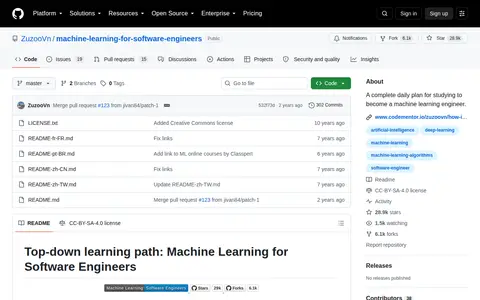
Machine Learning for Software Engineers is a study resource that provides a complete daily study plan for software engineers seeking to become machine learning engineers, structured as a top-down learning path.
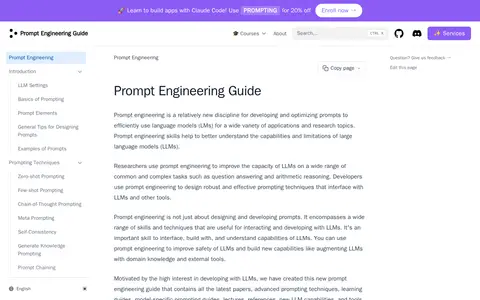
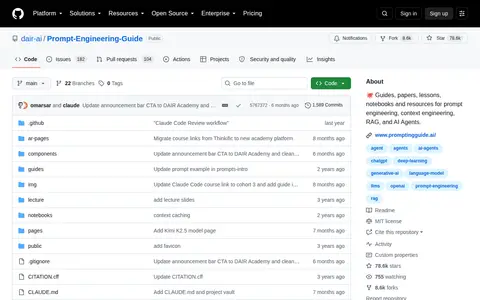
A guide to prompt engineering that collects papers, advanced prompting techniques, learning guides, model-specific guides, lectures, references, new LLM capabilities, and tools related to prompt engineering. It describes prompt engineering as a discipline for developing and optimizing prompts to use language models across applications and research topics, and offers courses on prompting and building AI agents.
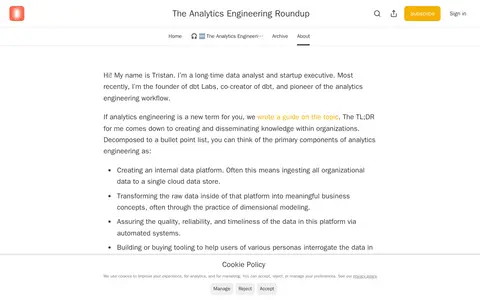
The Analytics Engineering Roundup is a Substack newsletter curating articles on analytics engineering and its adjacent ecosystem, curated by Tristan Handy. He describes analytics engineering as creating and disseminating knowledge within organizations, covering cloud data platforms, dimensional modeling and data quality.
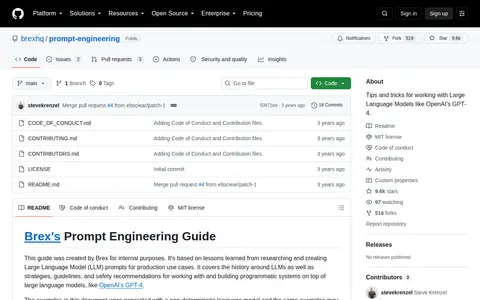
brexhq/prompt-engineering is a GitHub repository containing Brex's Prompt Engineering Guide. It provides tips and tricks for working with Large Language Models such as OpenAI's GPT-4, with content covering the definition of large language models, an incomplete history of language models, and the concept of prompts.
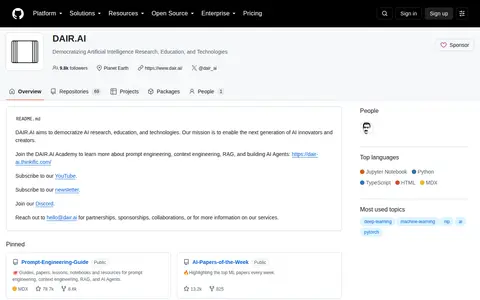
DAIR.AI is a GitHub organization that states it aims to democratize AI research, education, and technologies. Its repositories include a prompt engineering guide covering guides, papers, lessons, notebooks and resources for prompt engineering, context engineering, RAG, and AI Agents, and AI-Papers-of-the-Week, which highlights top machine learning papers each week.
Data Engineering Podcast is a show that covers the tools, techniques, and challenges of the data engineering discipline. Its episodes address topics including databases, workflows, automation, and data manipulation, and it is available for listening on a range of podcast platforms.
Prompt Engineering Guide is a GitHub repository or organization with source code, releases, documentation, or project resources.
Prompt Engineering Lil'Log is a blog post focused on prompt engineering for autoregressive language models. It covers methods to steer large language model behavior without updating model weights, including zero-shot prompting, few-shot prompting, and chain-of-thought prompting.
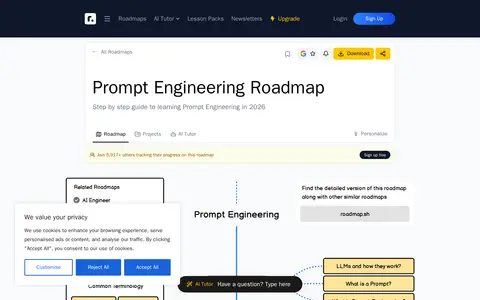
The Prompt Engineering Roadmap on roadmap.sh is a community-created step-by-step guide for learning prompt engineering in 2026. Roadmap.sh is an open-source platform that provides developer career roadmaps, learning resources, best practices, and projects, and is the 6th most starred project on GitHub with hundreds of thousands of monthly visitors.
The Data Engineering Show is a podcast for data engineering and BI practitioners. It features discussions with tech influencers about practical day-to-day data challenges and solutions. Episodes are available on platforms including Apple Podcasts, Spotify and Pocket Casts.

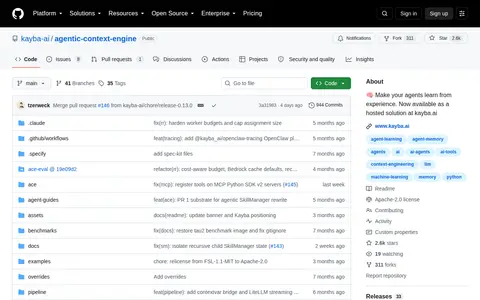
Agentic Context Engine (ACE) is an open source tool designed to enable AI agents to learn from experience. It is also offered as a hosted solution at kayba.ai, with supporting resources including proven results documentation, a quick start guide, and runners.
Agentic Engineering Jobs supports AI agents, automated workflows, orchestration, or delegated tasks.

AI Engineer Pack provides AI-assisted learning, courses, tutorials, or study support.
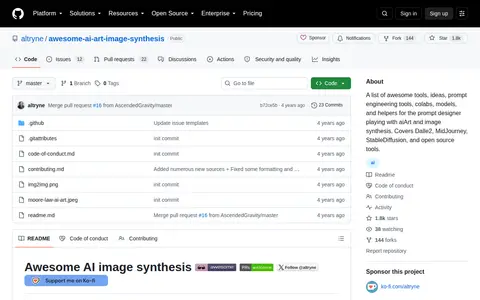
A GitHub repository compiling tools, ideas, prompt engineering resources, Colabs, models and helpers for prompt designers working with AI art and image synthesis. The list covers Dalle2, MidJourney, StableDiffusion and open source tools, and includes sections on commercial and free hosted tools, prompt engineering, post-processing and communities.
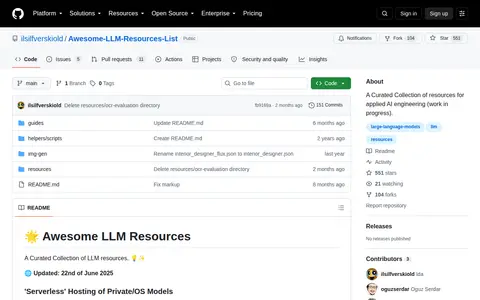
Awesome LLM Resources is a GitHub-hosted curated list of resources for applied AI engineering. The collection is marked as a work in progress and aggregates relevant materials for applied AI engineering work.
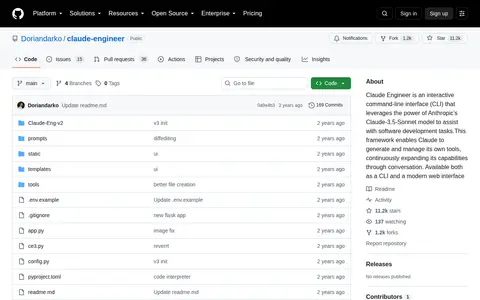
Claude Engineer is an interactive command-line interface that uses Anthropic's Claude-3.5-Sonnet model to assist with software development tasks. The framework lets Claude generate and manage its own tools, expanding its capabilities through conversation. It is available both as a CLI and a modern web interface.
A blog post explaining CLIP, a transformer model from OpenAI that matches text embeddings with image embeddings. It offers high-level prompt engineering tips for generative art and includes over 3500 prompt output examples, along with a section of Colab notebook links.
An article presenting initial impressions of DSPy, a framework developed by the Stanford NLP group for algorithmically optimizing language model prompts. The author describes DSPy as closing the loop of prompt engineering by turning a manual process into a structured machine learning workflow. The piece notes it is not a substitute for the official documentation and covers topics such as teleprompter, optimization, compile, bootstrapping and metric functions.
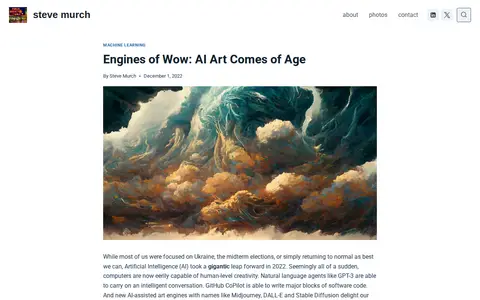
Engines of Wow: AI Art Comes of Age is a three-part blog series by Steve Murch that discusses recent advances in AI-generated art, including tools like Midjourney, DALL-E, and Stable Diffusion, and explores issues of creativity, ownership, and derivative work.
GPT Engineer provides machine-learning models, research, training resources, or evaluation tools.
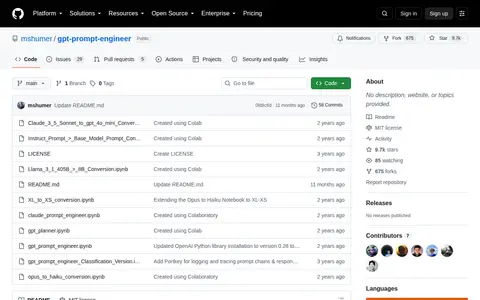
GPT Prompt Engineer is an open-source tool hosted on the mshumer GitHub repository. It includes versions optimized for different language models such as Claude 3 Opus and a Claude 3 Opus to Haiku conversion version, and offers features for prompt engineering tasks.
Kaito is the Kubernetes AI Toolchain Operator, an operator suite that automates LLM inference, fine-tuning and RAG engine deployment in a Kubernetes cluster. It simplifies the CRD API and provides optimized preset configurations for inference engine scheduling parameters. Workspaces are the basic CRD for managing inference and tuning workloads, and all vLLM-supported models can be run.
An article comparing the roles of data scientist and data engineer. It states that the positions are sometimes confused for each other and are often treated as the same, though the two roles work together. It notes that companies can encounter problems with team efficiency and system performance when the roles are conflated, and that the average company needs far more data engineers.