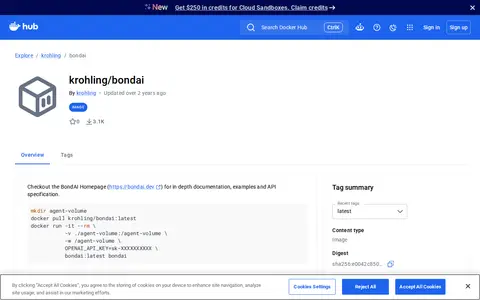

This Docker Hub listing provides the krohling/bondai Docker image for the BondAI agent tool. The 258.4 MB image was last updated almost 3 years ago. Users can run the image via a Docker command that mounts a local volume and configures an OpenAI API key, and can refer to the BondAI homepage for full documentation, examples, and API specifications.
Directory
Search results
Published directory entries matching your search.
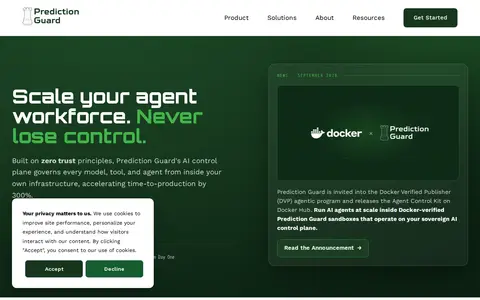
Prediction Guard is a self-hosted AI control plane described as enforcing NIST and OWASP-aligned runtime controls inside an organization's security boundary. It offers Agent Forge for creating interactive and autonomous agents, and an OpenAI, Anthropic and MCP compatible API. The site lists a Docker Verified Publisher agentic program entry and a verified Agent Control Kit on Docker Hub.
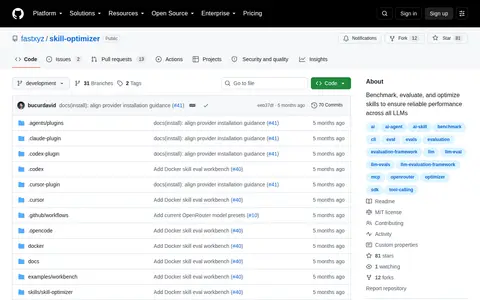
A repository offering a Docker workbench and an agent skill for running deterministic evals against agent skills. The local CLI executes cases and suites in Docker against OpenRouter models, and the repository includes an MIT license. Only openrouter/... model references are supported.
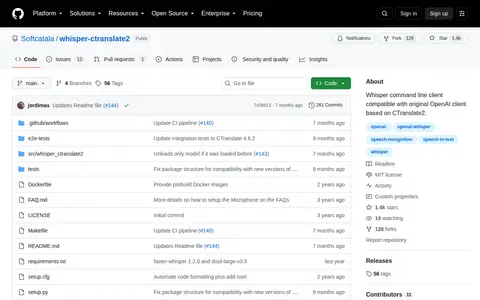
Whisper command line client compatible with the original OpenAI client and based on CTranslate2. It uses CTranslate2 and the Faster-whisper implementation. The project lists Docker images with pre-loaded models, speaker diarization, voice activity detection and live transcription from a microphone. It is installed as a Python package or run from a Docker image.
A guide to MLOps is an open-source tutorial from the Swiss AI Center team that walks engineers and small teams from notebook experiments to production. It covers local training and model evaluation, moving the model to the cloud, serving and deploying, monitoring and maintaining, and labeling data and retraining, using tools such as DVC, Git, GitHub Actions, CML, Docker, BentoML, Fluent Bit, Evidently AI, and Label Studio.
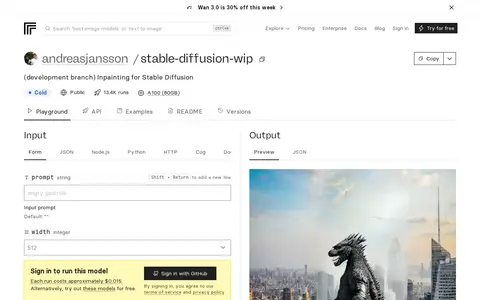
A work-in-progress inpainting branch of Stable Diffusion, published as a public Replicate model. The model runs on Nvidia A100 (80GB) GPU hardware and predictions typically complete within 11 seconds. It costs approximately $0.015 to run on Replicate, or 66 runs per $1. It is open source and can be run on a computer with Docker.
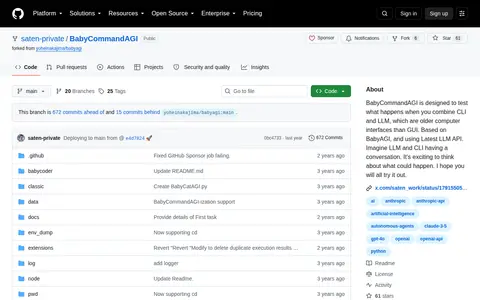
BabyCommandAGI is a Python script system based on BabyAGI that is designed to test combining CLI and LLM interfaces, with the thinking part of BabyAGI greatly simplified to execute commands efficiently. The README warns that it may unintentionally destroy the environment, recommends running it in a virtual environment such as Docker, and recommends Claude 3.7 Sonnet or higher.
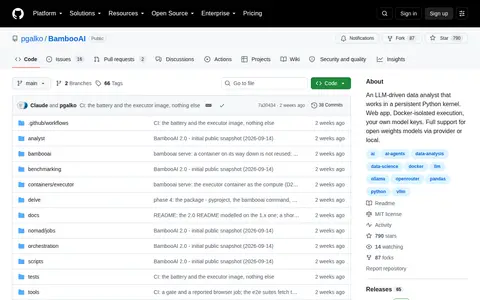
BambooAI is an LLM-driven data analyst tool that operates in a persistent Python kernel. It is available as a web app with Docker-isolated execution, supports user-provided model keys, and is compatible with open weights models via provider or local deployment.
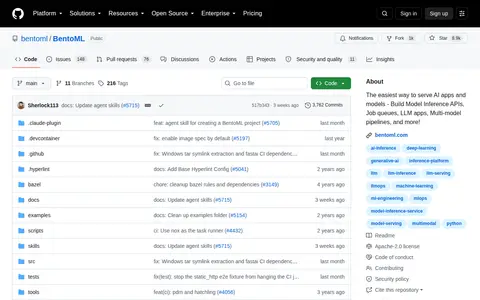
BentoML is a unified model serving framework. It enables users to build model inference APIs, job queues, LLM applications, and multi-model pipelines. The framework supports local execution and deployment via Docker.
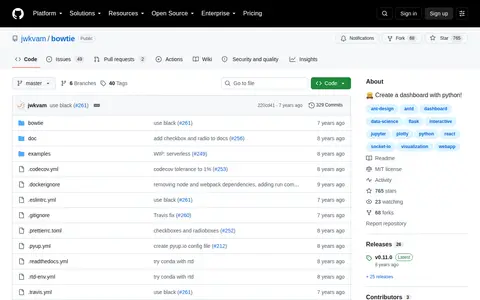
Bowtie is a library for writing dashboards in Python. It wraps the code needed for interactive data exploration and visualization, so users can build functionality without knowing web frameworks or JavaScript. It can be installed with conda or pip, and Docker images are provided.
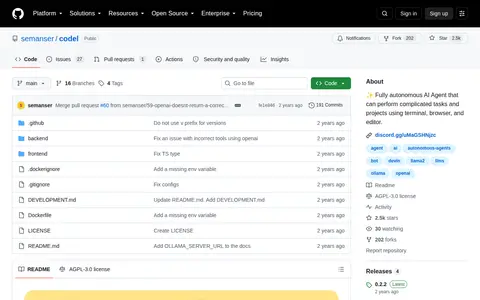
Codel is a self-hosted autonomous AI agent that performs tasks and projects using a terminal, browser and editor. It runs in a sandboxed Docker environment, detects the next step automatically, can fetch web information through a built-in browser, and saves command history and outputs in a PostgreSQL database.
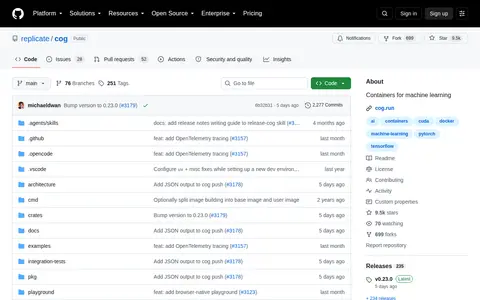
Cog is an open-source tool that packages machine learning models in standard, production-ready containers. Users define the environment in a configuration file, and it generates a Docker image with Nvidia base images and dependency caching. Model inputs and outputs are defined in Python, from which Cog generates an OpenAPI schema and an HTTP inference server. Models can be deployed to own infrastructure or Replicate.
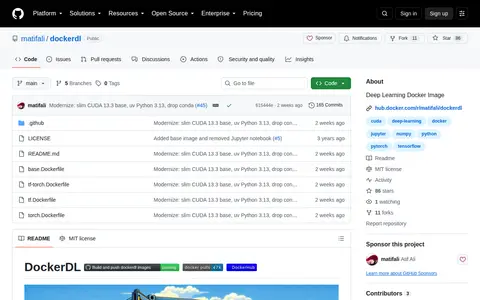
Ready to use deeplearning docker images.
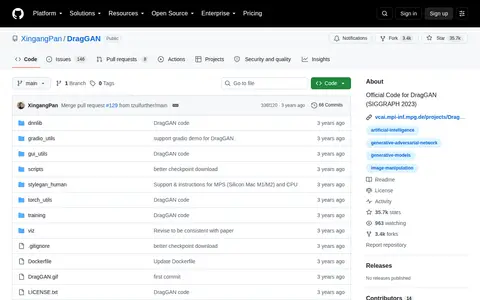
This GitHub repository hosts the official code for DragGAN, a project presented at the SIGGRAPH 2023 conference under the title 'Drag Your GAN: Interactive Point-based Manipulation on the Generative Image Manifold'. The repository includes links to web demos, requirements documentation, and instructions for running a Gradio visualizer in Docker.
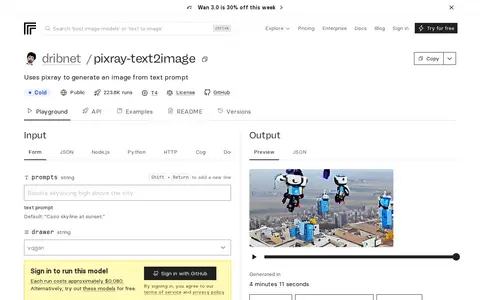
pixray-text2image is a public Replicate model that uses pixray to generate an image from a text prompt. It runs on Nvidia T4 GPU hardware, with predictions typically completing within 6 minutes, and is also open source and runnable on one's own computer with Docker.
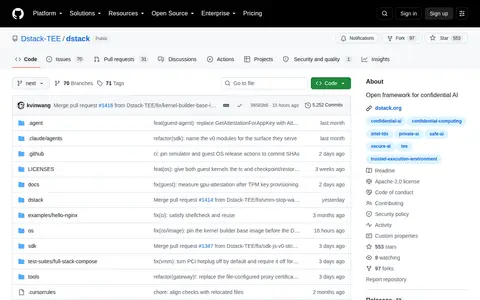
dstack is an open framework for confidential AI that runs containers inside confidential VMs with Intel TDX, using existing Docker Compose files. It supports attested workload identities and native NVIDIA Confidential Computing on H100 and Blackwell GPUs, with options for self-hosted TDX machines or Phala Cloud.
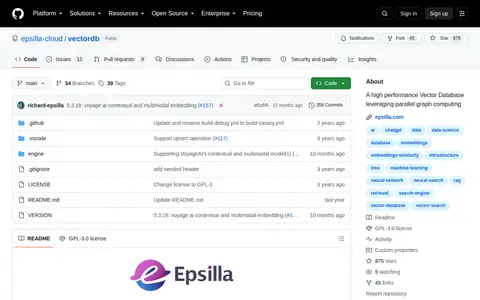
Epsilla is a high-performance vector database hosted on GitHub under the epsilla-cloud organization. It leverages parallel graph computing for its operations, and offers an experimental option to use it as a Python library without requiring a Docker image, alongside Epsilla Cloud as a deployment option.
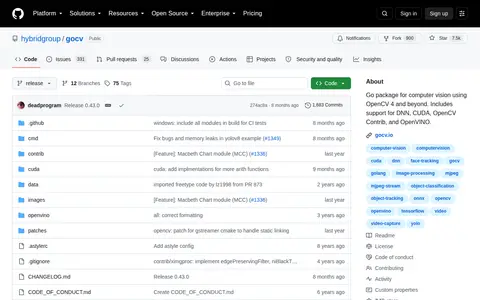
GoCV is a Go package providing language bindings for the OpenCV 4 computer vision library. It supports recent Go and OpenCV releases (v4.12.0) on Linux, Docker, macOS, and Windows, and includes support for DNN, CUDA, OpenCV Contrib, and OpenVINO.
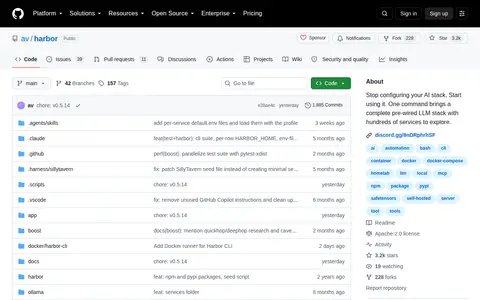
Harbor is a CLI and companion app that starts a pre-wired local LLM stack. Users pick services such as Ollama, llama.cpp, vLLM, Open WebUI, SearXNG, Speaches and ComfyUI, and Harbor handles Docker Compose orchestration, configuration and cross-service connectivity with a single harbor up command.
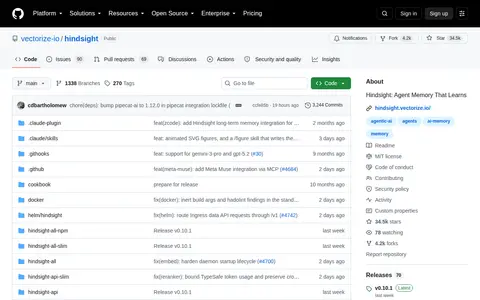
Hindsight is an agent memory system from Vectorize, intended to help agents learn over time rather than only recall conversation history. It is published under the MIT licence and can be run via Docker, working with multiple LLM providers.
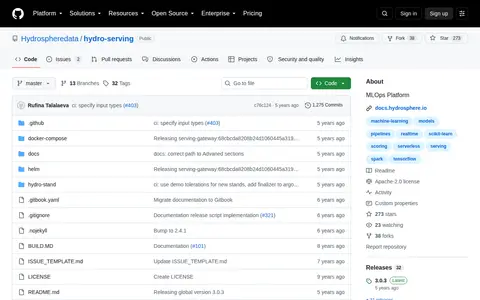
Hydrosphere is a GitHub repository for an MLOps platform. The repository provides documentation for getting started with the platform, including installation instructions and guidance for deployment using Docker and Kubernetes.
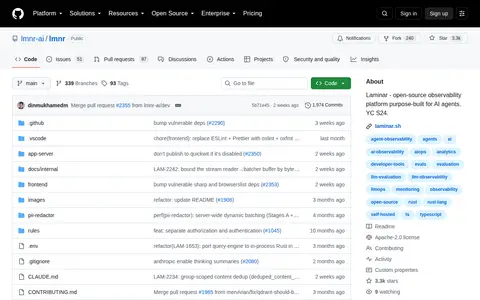
Laminar is an open-source observability platform purpose-built for AI agents. It provides OpenTelemetry-native tracing with a one-line SDK setup, plain-English signals that alert in Slack, and an SDK and CLI for running evals. It is written in Rust with 20x trace compression, and can be used via a managed platform or self-hosted with Docker Compose.
LightFM is a Python implementation of recommendation algorithms for implicit and explicit feedback. It allows item and user metadata to be incorporated into matrix factorization algorithms, representing users and items as sums of latent feature representations. Installation is available from PyPI, and a Docker setup is provided for running examples and tests.

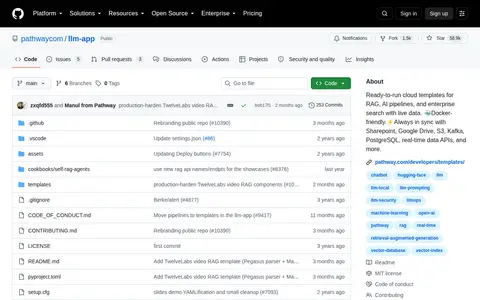
LLM App is an open-source project providing ready-to-run cloud templates for retrieval-augmented generation (RAG), AI pipelines and enterprise search with live data. It is Docker-friendly and designed to stay synchronized with data sources including Sharepoint, Google Drive, S3, Kafka, PostgreSQL and real-time data APIs, hosted by pathwaycom on GitHub.