
AI Models Catalog is a structured YAML catalog of AI model providers and their models, sourced from first-party APIs and official documentation. It includes TypeScript type definitions and Zod runtime validation schemas, plus scripts to sync data from providers and validate YAML files against schemas.
Directory
Search results
Published directory entries matching your search.
Apache Airflow is a platform created by the community to programmatically author, schedule and monitor workflows. Pipelines are defined in Python, and workflows can be monitored, scheduled and managed through a web application. Operators allow tasks to run on services such as Google Cloud Platform, Amazon Web Services and Microsoft Azure.
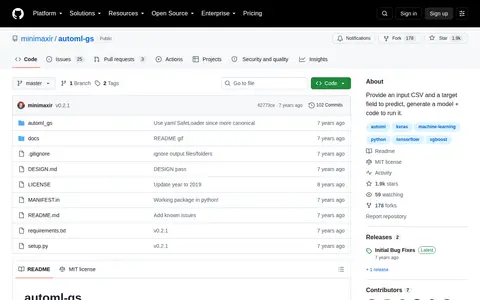
automl-gs is a Python 3 AutoML module that takes an input CSV and a target field and generates a trained machine learning or deep learning model plus native Python code pipelines. It provides a zero code/model definition interface and performs random hyperparameter searches, reporting metrics for each trial in a CSV.
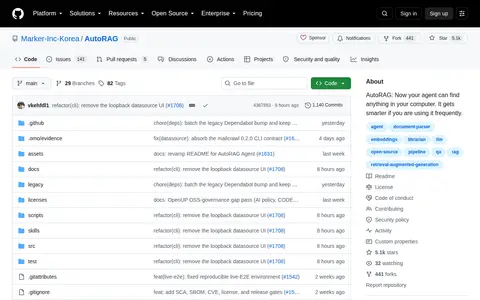
AutoRAG is a project developed by Marker-Inc-Korea that enables an agent to locate content on a user's computer. Its functionality improves with frequent use, and it includes an agent component with defined core values, architecture and operational details.
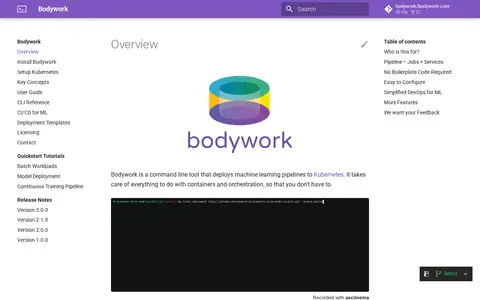
Bodywork is a command line tool that deploys machine learning pipelines to Kubernetes, handling containers and orchestration. Any pipeline stage runs either a batch job or a long-running process. It is presented as a lightweight alternative to Kubeflow or building a platform around workflow tools such as Apache Airflow, Argo Workflows or Dagster. Stages are defined as Python modules or Jupyter notebooks and configured in a single bodywork.yaml file.
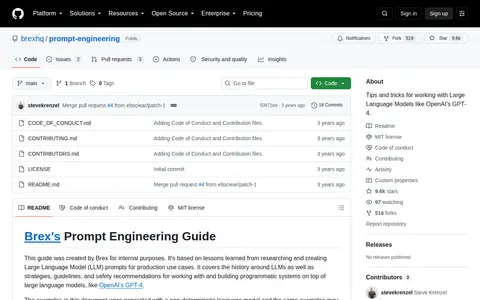
brexhq/prompt-engineering is a GitHub repository containing Brex's Prompt Engineering Guide. It provides tips and tricks for working with Large Language Models such as OpenAI's GPT-4, with content covering the definition of large language models, an incomplete history of language models, and the concept of prompts.
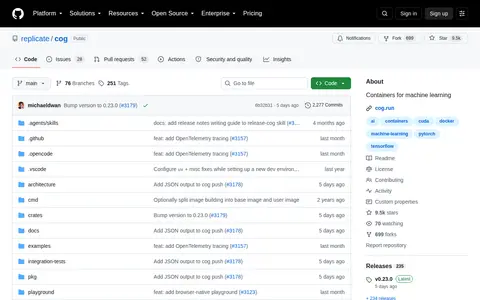
Cog is an open-source tool that packages machine learning models in standard, production-ready containers. Users define the environment in a configuration file, and it generates a Docker image with Nvidia base images and dependency caching. Model inputs and outputs are defined in Python, from which Cog generates an OpenAPI schema and an HTTP inference server. Models can be deployed to own infrastructure or Replicate.
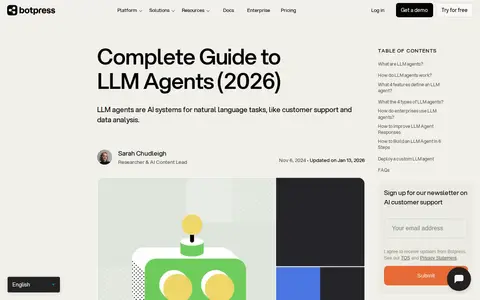
A Botpress-published guide that explains large language model (LLM) agents, including their definition, core features, common types, and improvement techniques, and notes that LLM agents are AI systems for natural language tasks such as customer support and data analysis.
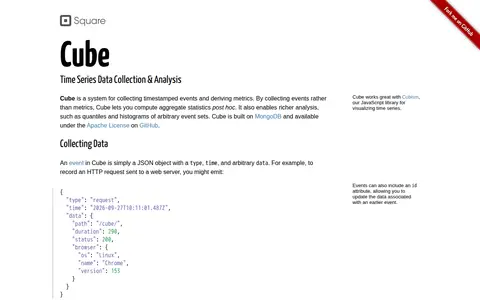
Cube is a system for collecting timestamped events and deriving metrics, built on MongoDB and released under the Apache License on GitHub. It accepts events via UDP, HTTP POST, and WebSockets, defines a query language for retrieving events, and groups events by time to compute aggregate metrics.
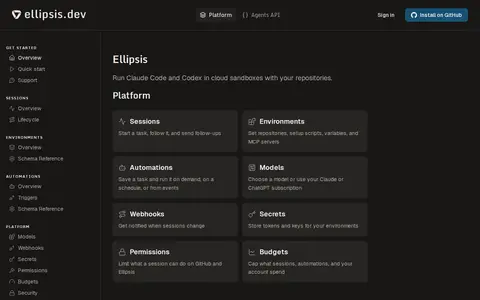
This is the documentation for Ellipsis, a platform that enables running internal agents in the cloud via Claude Code or Codex, with support for custom tools, secrets, and MCP servers. Users define agents as YAML configuration files in their repositories, and Ellipsis executes the agents to build features, fix bugs, and investigate production issues. The platform also includes integrations with GitHub, Slack, Linear, and Sentry, plus support for sessions, environments, secrets, permissions, and usage budgets.
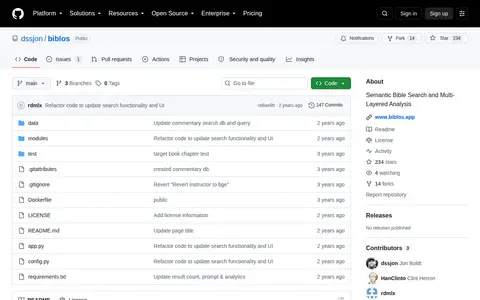
Biblos is a tool for semantic search and multi-layered analysis of Biblical texts, using Chroma and instructor-large embeddings for retrieval. Search results are summarized with Anthropic's Claude, and the tool includes Greek New Testament text, Dodson Greek Lexicon definitions and Church Fathers' commentaries. The web UI is built with Streamlit.
Eidolon is an open source framework and agent server for building and deploying generative AI agent applications. It offers a pluggable SDK, declarative YAML agent definitions, and pre-built agents, and it supports adding RAG storage to applications. The server is described as a deployment server for agentic applications, and agents can be deployed to Kubernetes.
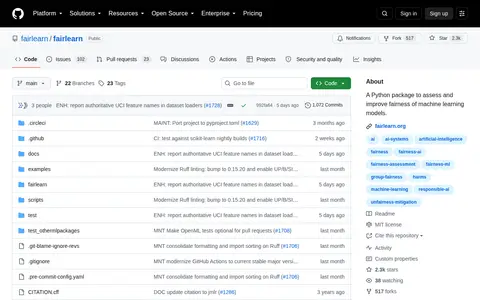
Fairlearn is a Python package hosted on a GitHub repository maintained by the Fairlearn project, designed to assess and improve the fairness of machine learning models. The repository includes documentation covering fairness definitions and a getting started guide for the tool.
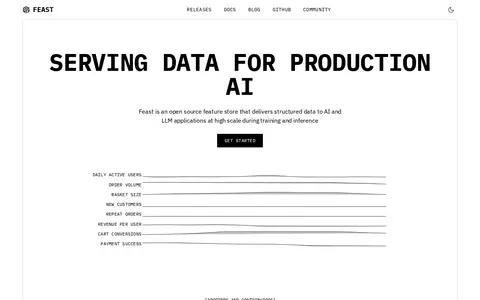
Feast is an end-to-end open source feature store for machine learning. It allows teams to define, manage, discover, and serve features, delivering structured data to AI and LLM applications during training and inference. Documented use cases include real-time recommendations, fraud detection, risk scoring, and customer segmentation.
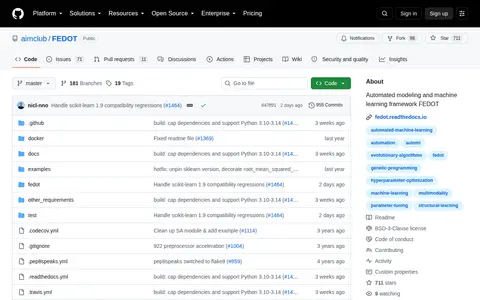
FEDOT is an open-source framework for automated modeling and machine learning. It provides automatic generative design of machine learning pipelines, with an evolutionary approach supporting classification, regression, clustering and time series prediction. Pipelines are represented as graphs defining connections between data preprocessing and model blocks. It is distributed under the 3-Clause BSD license.
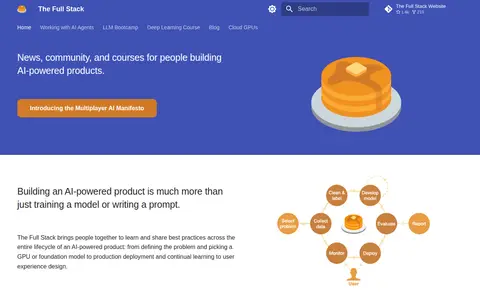
Full Stack Deep Learning offers news, community, and courses for people building AI-powered products. It covers the lifecycle of an AI-powered product, from defining the problem and picking a GPU or foundation model to production deployment and continual learning.
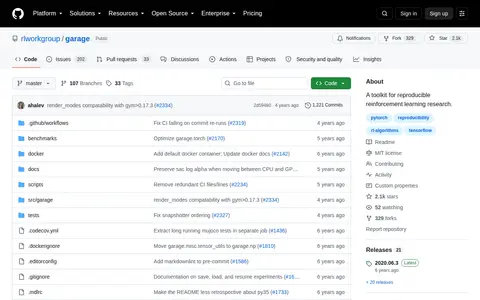
Garage is a toolkit for developing and evaluating reinforcement learning algorithms, with an accompanying library of implementations built using it. The toolkit offers modular tools including composable neural network models, replay buffers, high-performance samplers, an experiment definition interface, reproducibility tools, logging including TensorBoard, checkpointing and resuming, and environment interfaces.
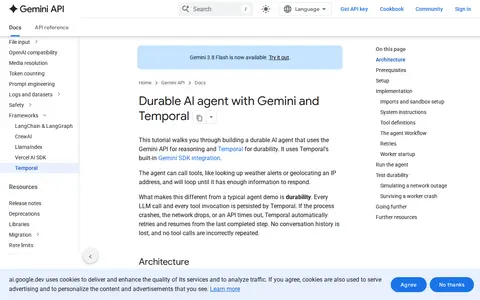
Gemini and Temporal Durable Agent is a Google AI for Developers resource providing guidance on building durable AI agents using the Gemini API and Temporal. It includes documentation covering architecture, prerequisites, setup, implementation steps, system instructions, tool definitions, agent workflow configuration and retry handling.
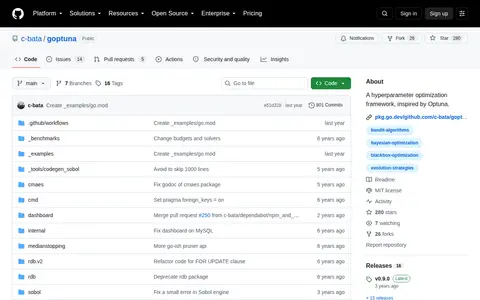
Goptuna is a hyperparameter optimization framework inspired by Optuna, written in pure Go. It provides Bayesian optimization, evolution strategies and multi-armed bandit algorithms, including random search, TPE, CMA-ES variants, ASHA and Sobol sampling. It supports a Define-by-Run style API for dynamically constructing search spaces and offers RDB storage for continuing optimizations and scaling studies across workers.
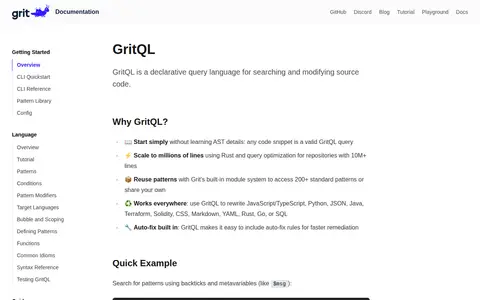
GritQL is a declarative query language from Grit for searching and modifying source code. It lets users search with code snippets and metavariables, define custom lints, and apply auto-fix rules, and it supports rewriting JavaScript/TypeScript, Python, JSON, Java, Terraform, Solidity, CSS, Markdown, YAML, Rust, Go and SQL.
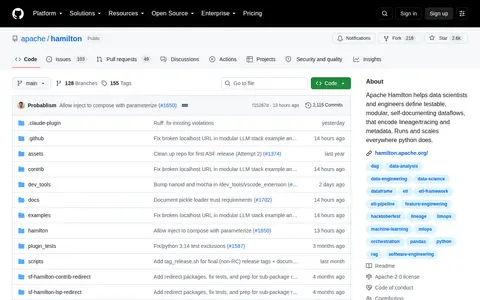
A scalable general purpose micro-framework for defining dataflows.
A freeCodeCamp handbook for developers on organizing AI agents for real business cases. It covers prerequisites, large language models, definitions of AI agents, and a decision algorithm for creating optimal agents, including checking budget, starting with one agent, and measuring performance. It uses a Google Research, Google DeepMind, and MIT paper as its primary source and code examples in a Google Colab notebook.
Hyperas is a wrapper that combines Keras model definition with Hyperopt hyperparameter optimization. Users define models as usual and wrap parameters in double curly brackets with a chosen distribution. It is installed via pip and runs optimization using algorithms such as TPE with a set number of evaluation runs.
KerasTuner is a hyperparameter optimization framework for Keras. It provides a define-by-run syntax for configuring search spaces and includes Bayesian Optimization, Hyperband and Random Search algorithms. It requires Python 3.8+ and TensorFlow 2.0+.