
Directory

Search results

Published directory entries matching your search.

Search results

194 listings

PyStanfordDependencies is a Python interface for converting Penn Treebank trees to Stanford Dependencies and Universal Dependencies. It offers a get_instance() function with subprocess or jpype backends, and convert_tree() or convert_trees() methods returning Token objects. Visualization options include asciitree, Graphviz dotgraphs, and interactive xdot windows. A Stanford CoreNLP or Parser jar file can be supplied, or downloaded automatically.

Models & Machine Learning 0
github.com

Ray is an AI compute engine consisting of a core distributed runtime and AI libraries for scaling AI and Python applications. It runs on any machine, cluster, cloud provider, and Kubernetes, and is installed with pip install ray.

Models & Machine Learning 0

A Python implementation of Restricted Boltzmann Machines. It lets users initialize an RBM with a chosen number of visible and hidden units, train it on a matrix of training examples, run visible or hidden data, and let the network run freely. It is released under an MIT license.

Models & Machine Learning 0
github.com

Rockpool is a Python package for developing signal processing applications with spiking neural networks. It allows users to build networks, simulate, train and test them, and deploy them in simulation or on event-driven neuromorphic compute hardware. It provides layers with simulation backends including Brian2, Torch, JAX, Numba and raw numpy.

Models & Machine Learning 0
github.com

Scalene is a Python profiler that measures CPU, GPU and memory usage. It identifies inefficiencies and can request optimization suggestions from AI providers, including Amazon Bedrock, Microsoft Azure, OpenAI and local models via Ollama. It can be used at the command line or as a Visual Studio Code extension, and installs via pip or conda.
Models & Machine Learning 0
scikit-learn.org

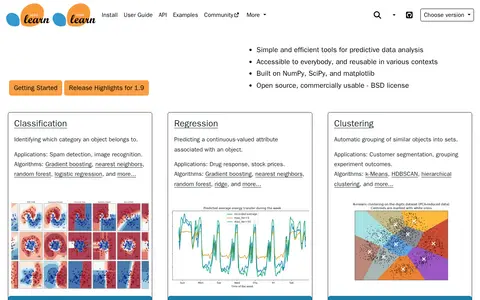
A Python module for machine learning built on top of SciPy.

Models & Machine Learning 0
github.com

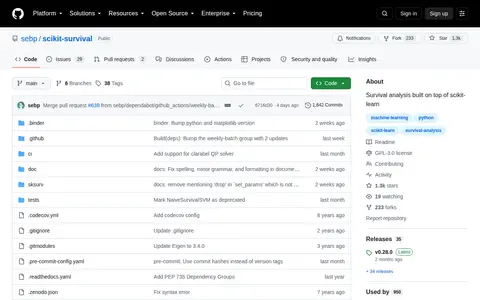
Scikit-Survival is a Python library that implements survival analysis functionality built on top of the scikit-learn framework. It is hosted as a public open source repository on GitHub for community contributions.

Models & Machine Learning 0
github.com

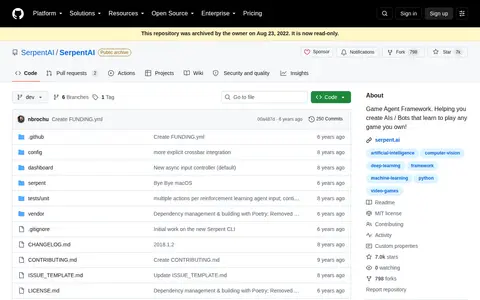
Serpent.AI is a Python-based Game Agent Framework intended to help users create artificial intelligences and bots that learn to play video games. The project was marked as end of life in November 2018, with a revival update released in May 2020.

Models & Machine Learning 0
github.com

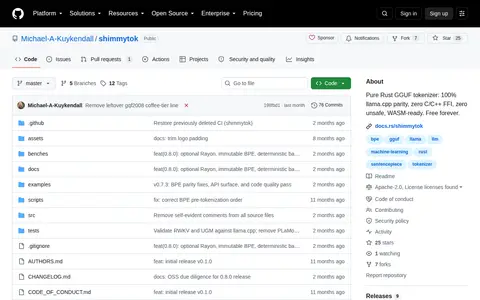
A pure Rust tokenizer library that reads tokenizers directly from GGUF model files, requiring no Python, C++ or separate tokenizer files. It supports SPM, BPE, WPM, RWKV and UGM tokenizers tested token-for-token against llama.cpp, and offers batch encoding with optional Rayon parallelism. MIT licensed.

Models & Machine Learning 0
simplecv.org

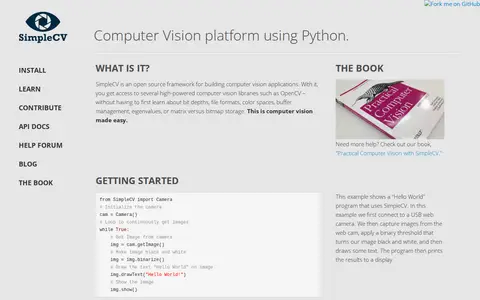
SimpleCV is an open source framework for building computer vision applications, providing access to libraries such as OpenCV without requiring knowledge of bit depths, file formats, color spaces or buffer management. The platform uses Python, and examples include connecting to a camera, binarizing images and drawing text.

Models & Machine Learning 0
github.com

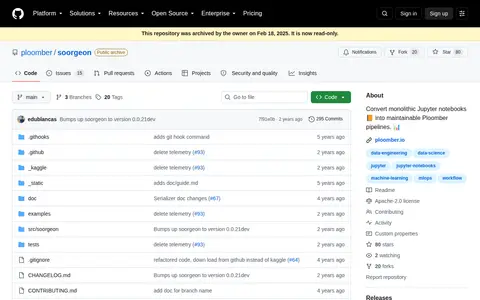
Soorgeon is a tool that converts monolithic Jupyter notebooks into Ploomber pipelines. It is compatible with Python 3.7 and higher and installs via pip. The repository was archived by its owner on Feb 18, 2025, and is now read-only. The project describes itself as being in alpha.

Models & Machine Learning 0
spacy.io

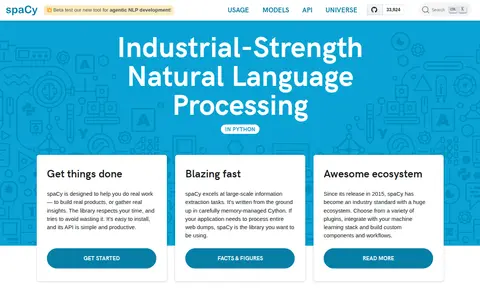
spaCy is a free open-source library for Natural Language Processing in Python. It features named entity recognition, part-of-speech tagging, dependency parsing and word vectors, supports over 75 languages and provides 84 trained pipelines for 25 languages.

Models & Machine Learning 0
github.com

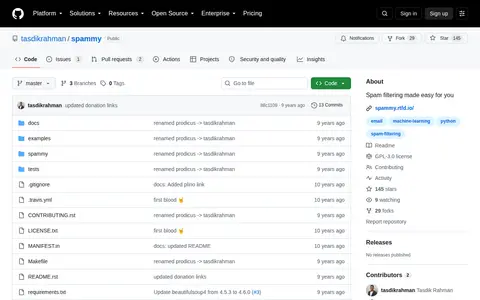
spammy is a Python spam filtering library built on nltk that powers the plino web app. Users can train the classifier on their own dataset to classify emails into spam or ham.

Models & Machine Learning 0
statsmodels.org

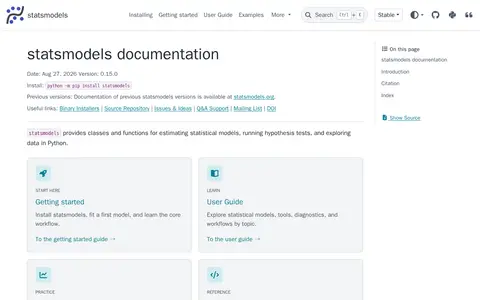
Statsmodels is a Python module providing classes and functions for estimating statistical models, conducting statistical tests, and statistical data exploration. It supports model specification using R-style formulas and pandas DataFrames, and is released under the open source Modified BSD (3-clause) license.

Models & Machine Learning 0

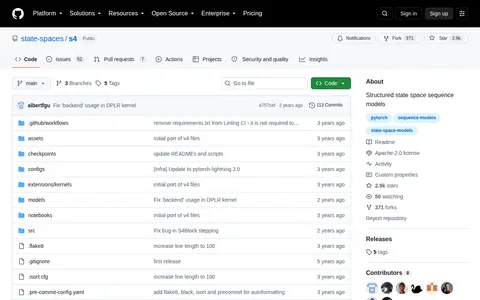
Structured State Spaces for Sequence Modeling is a GitHub repository providing official implementations and experiments for models related to S4, including HiPPO, LSSL, SaShiMi, DSS, S4D and S4ND. It states requirements of Python 3.9+ and Pytorch 1.10+, and is released under an Apache-2.0 license.

Models & Machine Learning 0
surpriselib.com

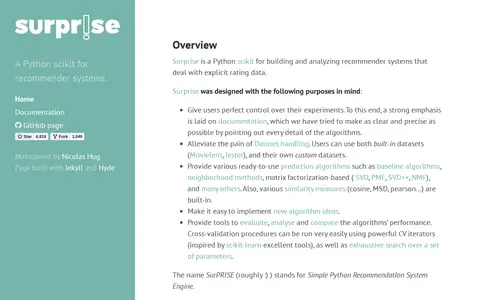
Surprise is a Python scikit for building and analyzing recommender systems that deal with explicit rating data. It includes built-in datasets, prediction algorithms such as SVD and NMF, similarity measures, and cross-validation tools. The documentation states that Surprise does not support implicit ratings or content-based information.

Models & Machine Learning 0
github.com

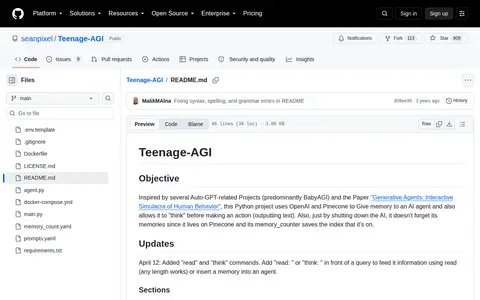
Teenage-AGI is a Python project inspired by Auto-GPT-related projects and the Generative Agents paper. It uses OpenAI and Pinecone to give an AI agent memory and let it think before acting. The agent stores queries and answers in a Pinecone vector database.

Models & Machine Learning 0

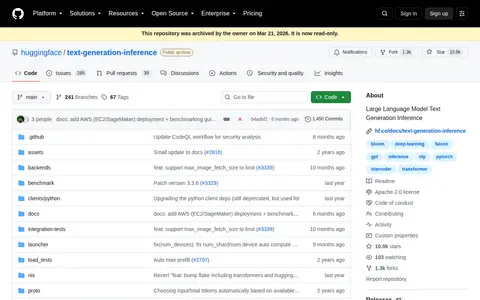
Text Generation Inference is a toolkit for deploying and serving large language models, implemented as a Rust, Python and gRPC server. It supports models including Llama, Falcon, StarCoder, BLOOM and GPT-NeoX, with features such as token streaming, continuous batching and quantization. The repository is archived, read-only, and in maintenance mode, with pull requests limited to minor bug fixes and maintenance.

Models & Machine Learning 0
github.com

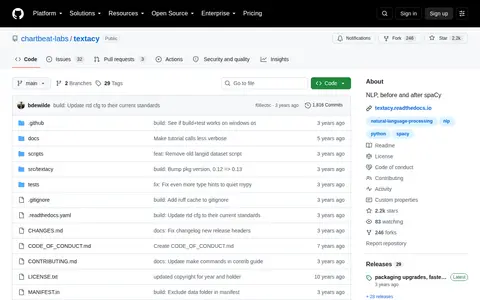
textacy is a Python library for natural language processing tasks built on the spaCy library. It focuses on tasks before and after spaCy processing, with tokenization, part-of-speech tagging and dependency parsing delegated to that library. Features include cleaning and normalizing raw text, extracting n-grams, entities, acronyms and keyterms, similarity metrics, and training topic models.

Models & Machine Learning 0
textblob.readthedocs.io

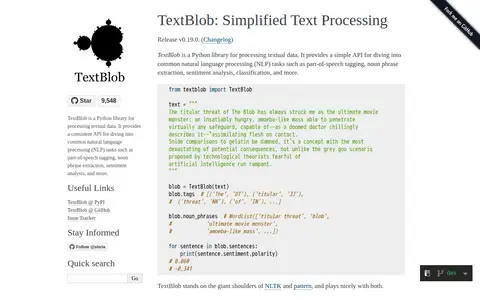
TextBlob is a Python library for processing textual data. It offers a simple API for natural language processing tasks including part-of-speech tagging, noun phrase extraction, sentiment analysis, classification, and tokenization. The documentation lists features such as word and phrase frequencies, parsing n-grams, lemmatization, spelling correction, and WordNet integration. It builds on NLTK and pattern, and new models or languages can be added through extensions.

Models & Machine Learning 0
textrazor.com

TextRazor is a natural language processing API that extracts meaning from text. It performs entity extraction, disambiguation and linking, keyphrase extraction, and automatic topic tagging and classification across 19 languages. It classifies content to the IAB Content and IPTC Media Topic taxonomies and analyzes relations and typed dependencies. Official client SDKs exist in Python, Java and PHP, with a REST API for other languages.

Models & Machine Learning 0
github.com

Python library for automatic extraction of relevant features from time series.

Models & Machine Learning 0
github.com

Some of the python libraries were cut-and-pasted from.

Models & Machine Learning 0
github.com

XGBoost is a scalable, portable and distributed gradient boosting library. It supports multiple programming languages including Python, R, Java, Scala and C, and can run on single machines or distributed frameworks such as Hadoop, Spark, Dask, Flink and DataFlow.

Models & Machine Learning 0