
github.com
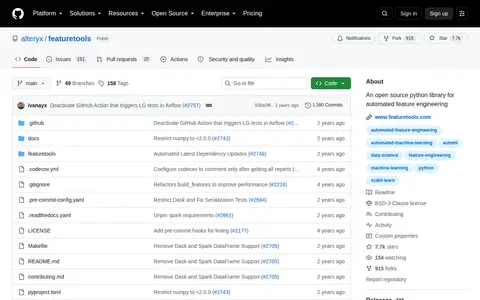
Python library for automated feature engineering.
Directory
Published directory entries matching your search.
Python library for automated feature engineering.

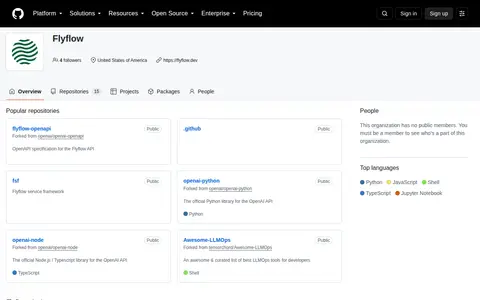
Flyflow is a GitHub organization with public repositories including an OpenAPI specification for the Flyflow API, a service framework, a Python library, and demo applications and notebooks. The organization page lists no public members.

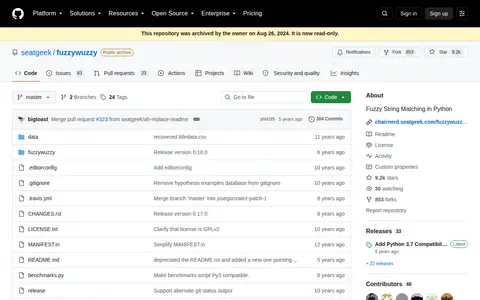
Fuzzy Wuzzy is a Python library for fuzzy string matching. The repository was archived by its owner on Aug 26, 2024, and is now read-only. The project has been renamed and moved to TheFuzz, and pull requests and issues must be resubmitted there.

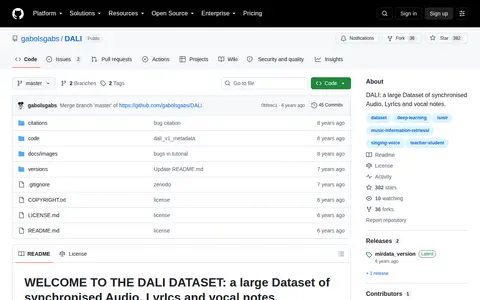
DALI is a dataset of synchronised audio, lyrics and vocal notes, presented as a collection of gz files. A Python package, dali_code, is stored in the repository for reading and working with the data; release versions are installable via pip. The dataset was created automatically using a teacher-student machine learning paradigm, described in an ISMIR 2018 paper.

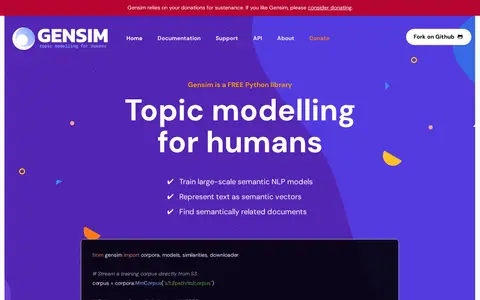
Gensim is a free open-source Python library for topic modelling and semantic NLP. It trains large-scale semantic models, represents text as semantic vectors and finds semantically related documents. The site describes streaming of arbitrarily large corpora, platform independence, and pretrained models and corpora published by the community.

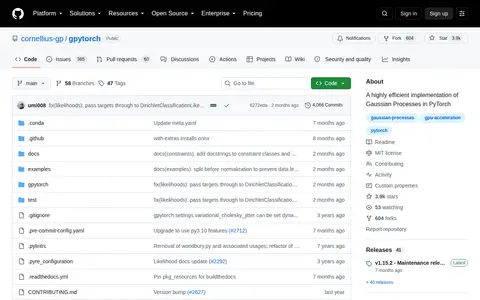
GPyTorch is a Gaussian process library implemented using PyTorch, designed for creating scalable, flexible, and modular Gaussian process models. It performs most inference operations using numerical linear algebra techniques such as preconditioned conjugate gradients, and provides GPU acceleration through matrix-vector-multiplication-based inference. Installation requires Python 3.10 or later, PyTorch 2.4.1 or later, and NumPy 2.0 or later.

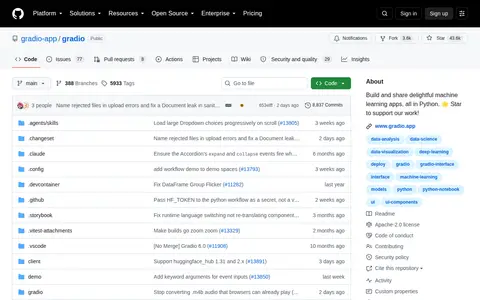
Gradio is an open-source Python library that enables developers to build and share machine learning web applications easily. It provides simple interfaces for creating demos and sharing models, supporting a wide range of ML frameworks.

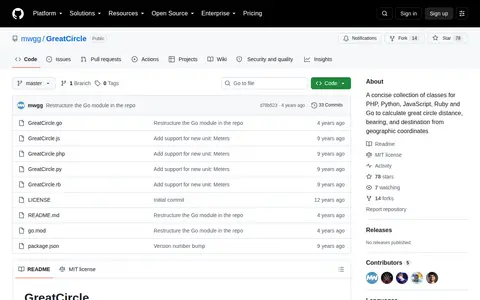
GreatCircle is a concise collection of classes for PHP, Python, JavaScript, Ruby, and Go that calculate great circle distance, bearing, and destination from geographic coordinates, hosted in the mwgg/GreatCircle GitHub repository.
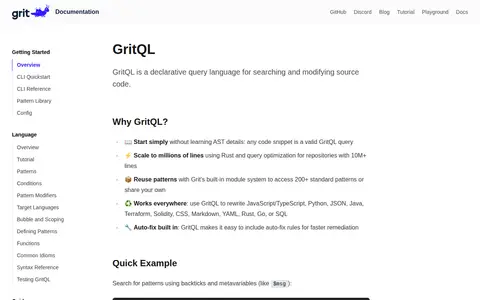
GritQL is a declarative query language from Grit for searching and modifying source code. It lets users search with code snippets and metavariables, define custom lints, and apply auto-fix rules, and it supports rewriting JavaScript/TypeScript, Python, JSON, Java, Terraform, Solidity, CSS, Markdown, YAML, Rust, Go and SQL.

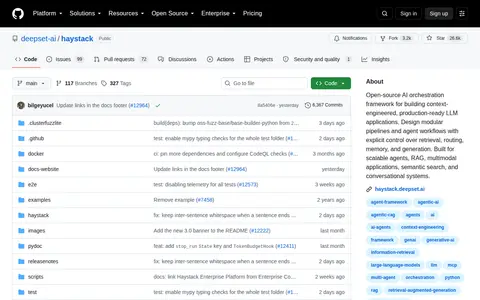
Haystack is an open-source AI orchestration framework for building production-ready LLM applications in Python. It provides modular pipelines and agent workflows with explicit control over retrieval, routing, memory and generation, and is intended for RAG systems, multimodal applications, semantic search, question answering and autonomous agents. Installation is available via pip.

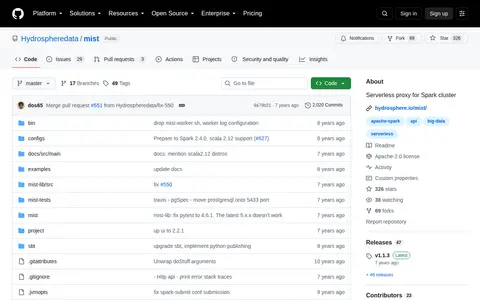
Hydrosphere Mist is a serverless proxy for Spark clusters. It offers a functional programming framework and deployment model for Spark applications, with a REST HTTP and messaging API for Scala and Python Spark jobs. Sessions are managed across EMR, Hortonworks, Cloudera, DC/OS and vanilla Spark clusters.

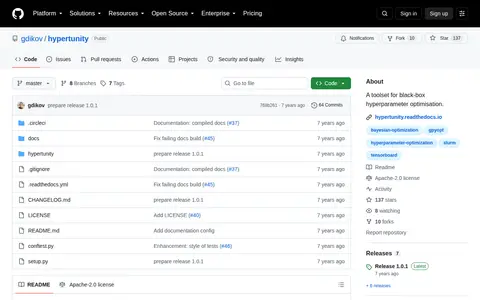
Hypertunity is a lightweight, high-level Python library for black-box hyperparameter optimisation. It supports Bayesian optimisation by wrapping GPyOpt, objective function evaluation through a scheduler that is also compatible with Slurm, and real-time visualisation of results in Tensorboard via the HParams plugin. A Trial wrapper class allows parallel optimisation without manual scheduling, optimiser updates and logging.

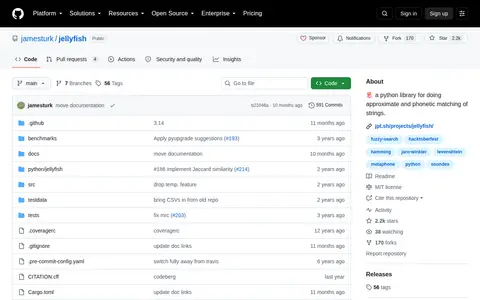
A python library for doing approximate and phonetic matching of strings.

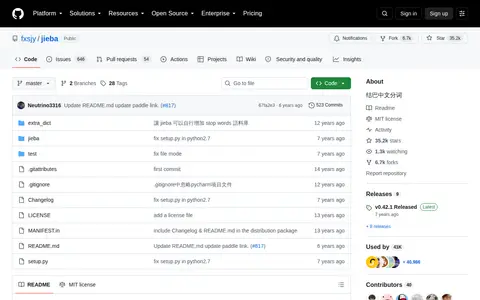
Jieba is a Chinese text segmentation module for Python. It supports four segmentation modes, including precise, full, search-engine and a paddle mode using PaddlePaddle, and offers keyword extraction based on TF-IDF and TextRank.
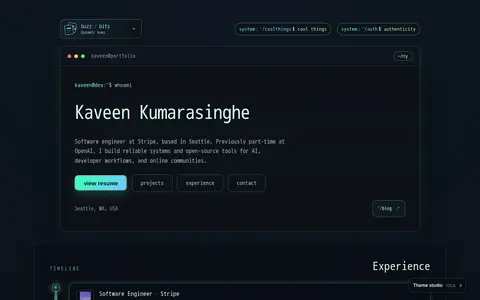
Kaveen Kumarasinghe is a software engineer in Seattle working at Stripe and previously part-time at OpenAI, building open-source tools and AI experiments. The site lists projects including GPTDiscord, an open-source Python integration that brings GPT conversations, image generation and document questions into Discord.

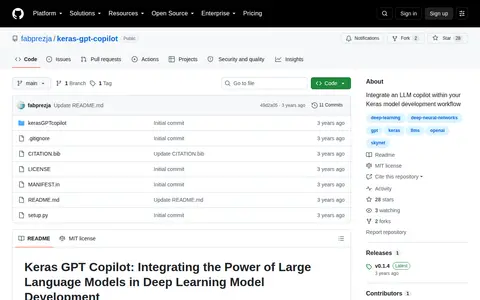
Keras GPT Copilot is a Python package that integrates an LLM copilot within the Keras model development workflow, generating feedback from model configuration, optimizer details and experiment results. It interacts with OpenAI's GPT models and offers a prompt-only mode for compatibility with other large language models.

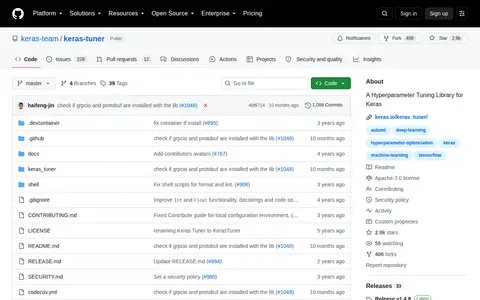
KerasTuner is a hyperparameter optimization framework for Keras. It provides a define-by-run syntax for configuring search spaces and includes Bayesian Optimization, Hyperband and Random Search algorithms. It requires Python 3.8+ and TensorFlow 2.0+.

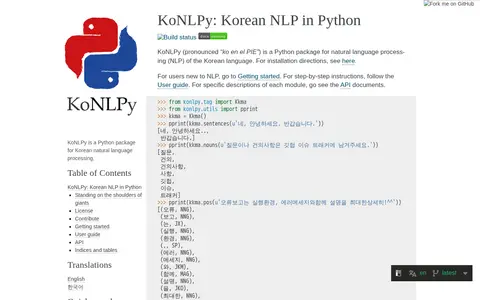
KoNLPy (pronounced "ko en el PIE") is a Python package for natural language processing of the Korean language. It is open source software released under GPL v3 or above, and users are asked to acknowledge its use with a citation.

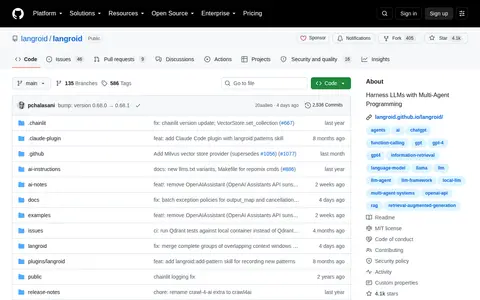
A Python framework for building LLM-powered applications through a multi-agent paradigm. Developers set up agents, equip them with optional components such as LLMs, vector stores and tools, assign tasks, and have them exchange messages to solve problems. It works with practically any LLM and does not use LangChain.
Analyzes structured data and helps produce queries, insights or visualizations.

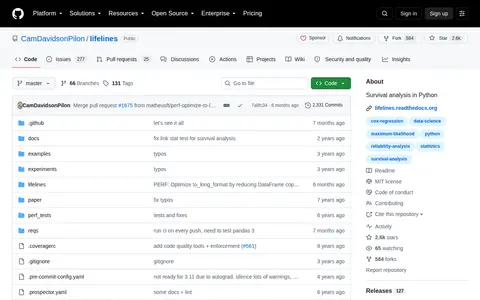
Lifelines is a complete survival analysis library, written in pure Python.
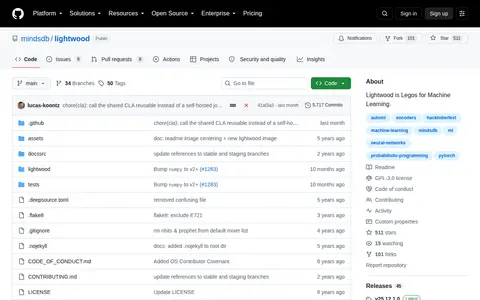
Lightwood is an AutoML framework that generates and customizes machine learning pipelines using a declarative JSON-AI syntax. It handles data types such as numbers, dates, categories, tags, text, arrays and multimedia formats, and includes a time-series mode. Users can override defaults or replace pipeline steps, and the framework generates Python code for the pipeline.

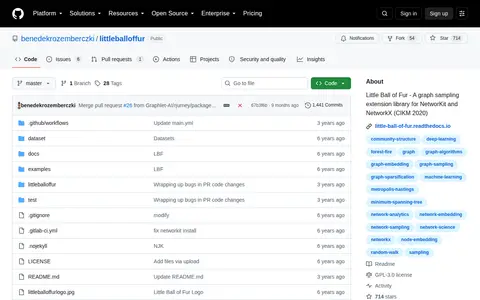
Little Ball of Fur is a graph sampling extension library for Python and a graph sampling extension library for NetworKit and NetworkX. It consists of methods that can sample from graph structured data, covering vertex, edge, and exploration sampling techniques with a unified application public interface.

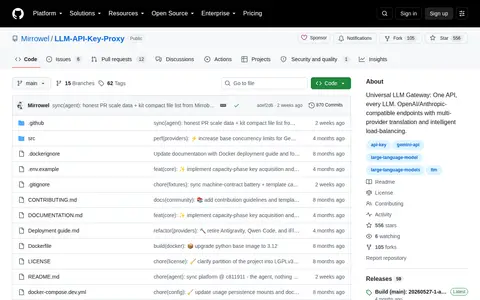
A self-hosted proxy providing OpenAI and Anthropic compatible API endpoints for multiple LLM providers, so existing applications can use any supported provider through a single API key. It includes a FastAPI proxy application and a reusable Python resilience library for API key management, rotation, and failover.