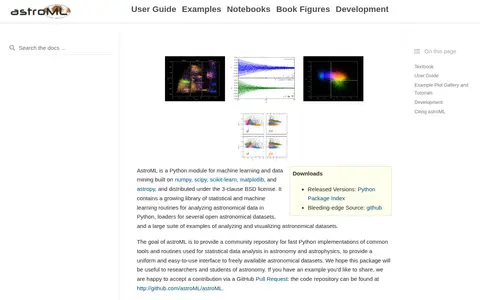
astroML is a Python module for machine learning and data mining built on numpy, scipy, scikit-learn, matplotlib and astropy, distributed under the 3-clause BSD license. It provides statistical and machine learning routines for analyzing astronomical data, loaders for open astronomical datasets, and examples of analyzing and visualizing datasets. The project was started in 2012 to accompany a textbook on statistics, data mining and machine learning in astronomy.
Directory
Search results
Published directory entries matching your search.
autoai is an open-source Python framework for automatic artificial intelligence focused on regression and classification tasks over numerical data. It automates model search, hyper-parameter tuning, and generates high-quality Jupyter Notebook code for resulting models.
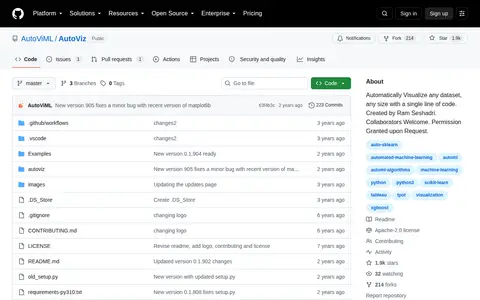
AutoViz is a Python library that automatically visualizes any dataset, any size, with a single line of code. It also offers the FixDQ() function for a quick assessment of dataset quality and fixing data quality issues. The project aims to provide an automated approach to exploratory data analysis through quick and easy data visualization plus data quality, abstracting away the complexities of various plotting libraries and techniques.
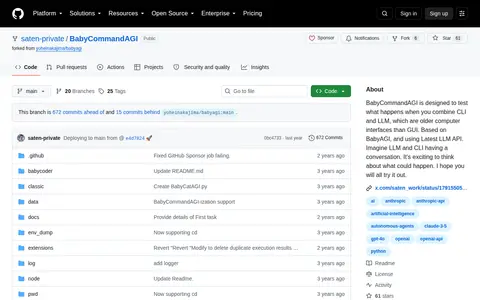
BabyCommandAGI is a Python script system based on BabyAGI that is designed to test combining CLI and LLM interfaces, with the thinking part of BabyAGI greatly simplified to execute commands efficiently. The README warns that it may unintentionally destroy the environment, recommends running it in a virtual environment such as Docker, and recommends Claude 3.7 Sonnet or higher.
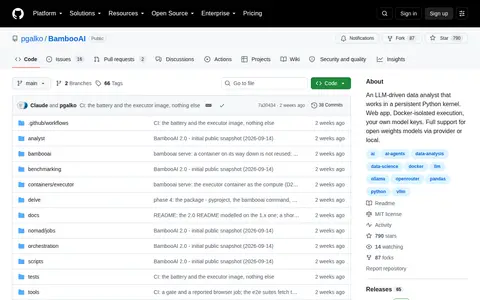
BambooAI is an LLM-driven data analyst tool that operates in a persistent Python kernel. It is available as a web app with Docker-isolated execution, supports user-provided model keys, and is compatible with open weights models via provider or local deployment.
Python bindings for the BLLIP natural language parser.
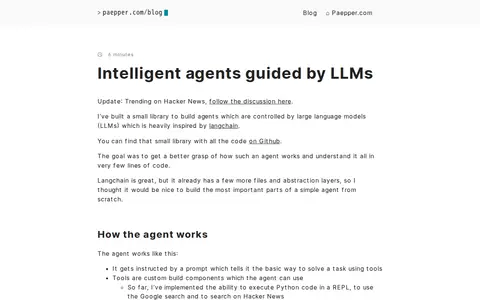
A blog post describing a small library for building agents controlled by large language models, inspired by langchain. The agent is instructed by a prompt and runs in a loop of Thought, Action and Observation. Implemented tools include executing Python code in a REPL, Google search and Hacker News search.
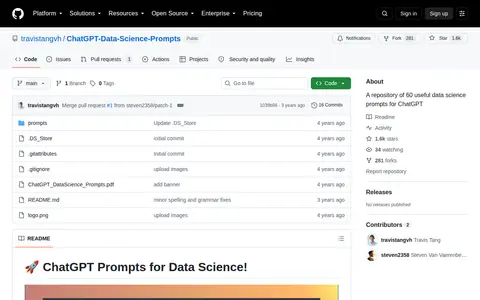
ChatGPT Prompts for Data Science is a GitHub repository containing 60 useful prompts for data science tasks. It includes prompts for writing Python code, automatic machine learning, and other data science workflows.
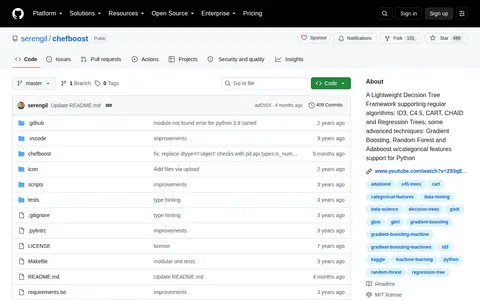
ChefBoost is a lightweight decision tree framework for Python. It supports standard algorithms including ID3, C4.5, CART, CHAID and regression trees, as well as advanced techniques such as gradient boosting, random forest and Adaboost, with support for categorical features.
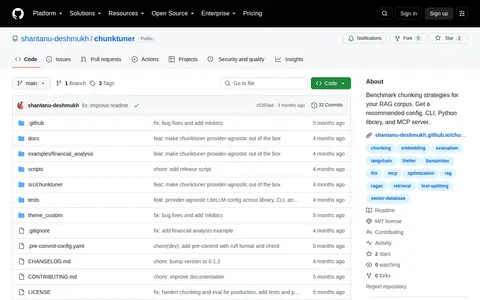
Chunk Tuner is a tool that benchmarks chunking strategies for a RAG corpus and recommends a configuration. It benchmarks strategies such as fixed-token windows, recursive character splitting, semantic splitting and PDF structural chunking, scoring each against retrieval metrics. It is available as a Python library, a CLI and an MCP server.
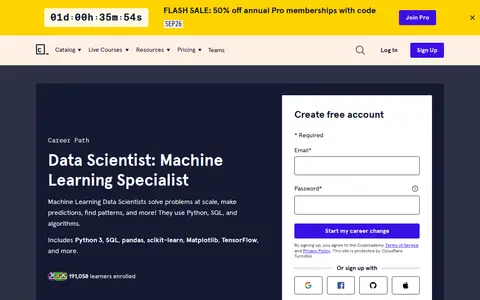
Codecademy's Data Scientist: Machine Learning Specialist Career Path is a beginner-level course covering Python 3, SQL, pandas, scikit-learn, Matplotlib, and TensorFlow. The path is listed as taking 95 hours on average and includes 59 projects with no prerequisites, and is described as teaching analysis of data, drawing predictions with machine learning, and building neural networks.
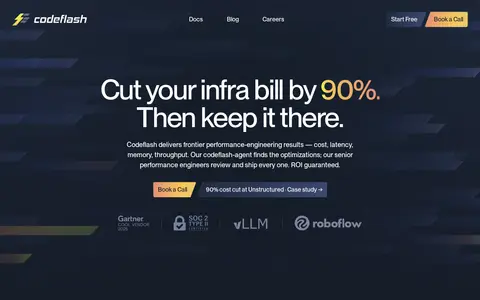
Codeflash uses AI to automatically find the most optimized version of your Python code through benchmarking — while verifying it's correct.
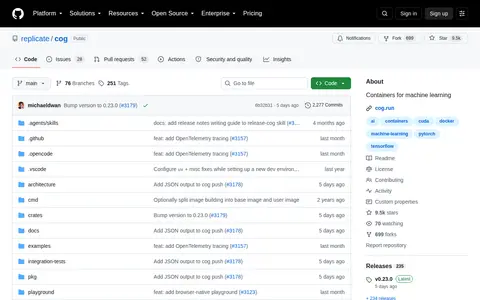
Cog is an open-source tool that packages machine learning models in standard, production-ready containers. Users define the environment in a configuration file, and it generates a Docker image with Nvidia base images and dependency caching. Model inputs and outputs are defined in Python, from which Cog generates an OpenAPI schema and an HTTP inference server. Models can be deployed to own infrastructure or Replicate.
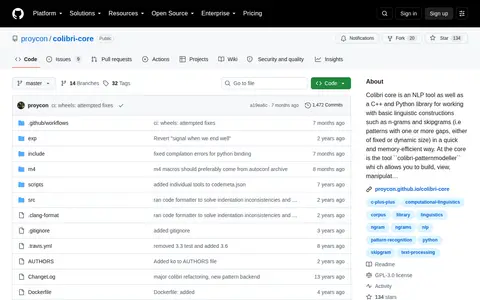
Colibri Core is an NLP tool and a C++ and Python library for working with basic linguistic constructions such as n-grams and skipgrams, i.e. patterns with one or more gaps of fixed or dynamic size. It counts and extracts patterns from large corpus data. The central tool, colibri-patternmodeller, builds, views, manipulates and queries pattern models.
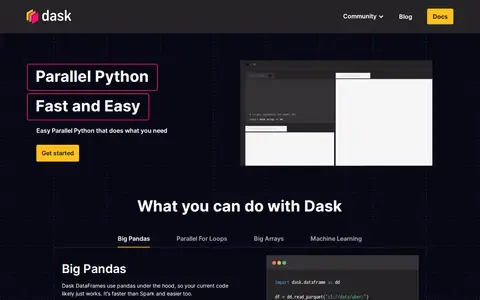
Dask is an open-source Python library for parallel computing maintained by contributors across dozens of companies. The site describes uses including Dask DataFrames for pandas, parallel for loops, large arrays with NumPy and Xarray, and machine learning. It can run on a laptop or be deployed on resource managers such as Kubernetes or cloud.
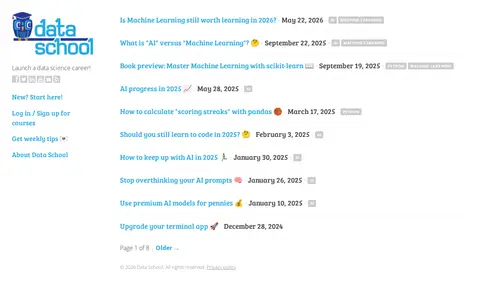
Data School is a blog about data science and machine learning. Its posts cover topics such as the difference between AI and machine learning, learning scikit-learn, AI progress, and using pandas for calculations. Posts are tagged by subject including Python, AI, and machine learning.
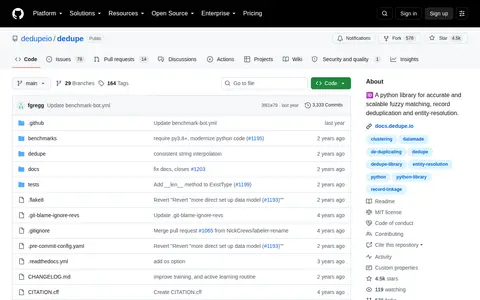
A python library for accurate and scalable fuzzy matching, record deduplication and entity-resolution.
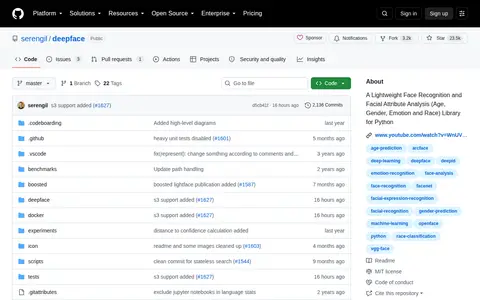
deepface is a lightweight Python library for face recognition and facial attribute analysis. It supports analysis of age, gender, emotion, and race attributes from facial data. The project is hosted as an open source repository on GitHub.
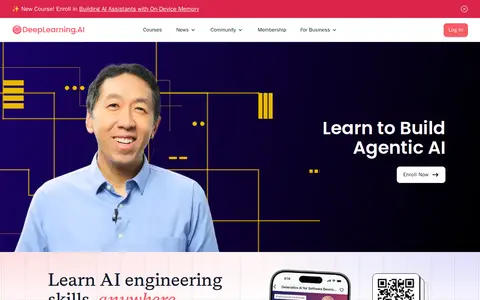
DeepLearning.ai is an educational platform led by Andrew Ng that offers online AI courses, specializations, and certifications for people learning to use and build artificial intelligence. The platform serves over 7 million learners and covers topics including AI Python, prompt engineering, generative AI, and machine learning.
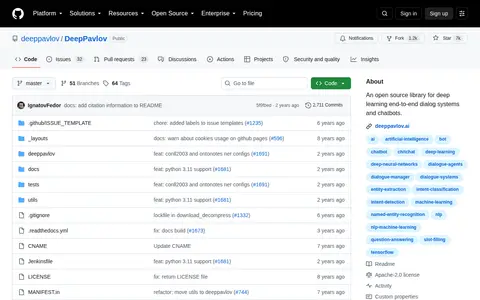
DeepPavlov is an open-source library for deep learning end-to-end dialog systems and chatbots. Version 1.0 is described as an NLP framework built on PyTorch and transformers for modular, configuration-driven development of NLP models, intended for practitioners with limited NLP/ML knowledge. It supports Linux, Windows 10+ through WSL/WSL2, and MacOS Big Sur+ on Python 3.6 to 3.10.
Python library for scalable Bayesian optimisation.
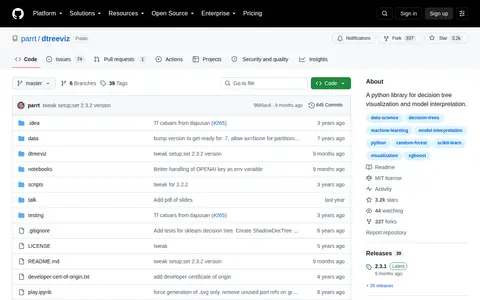
dtreeviz is a Python library for decision tree visualization and model interpretation. It supports scikit-learn, XGBoost, Spark MLlib, LightGBM and TensorFlow, and uses an adaptor object obtained from dtreeviz.model() to extract model information for visualization.
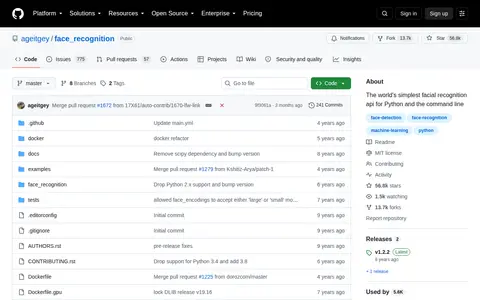
face_recognition is a GitHub repository maintained by ageitgey that provides what is described as the world's simplest facial recognition API for Python and the command line. The repository includes documentation, installation requirements, and online demos for the tool.
FastEdit is a repository intended to help developers inject fresh and customized knowledge into large language models using one command. It supports models including GPT-J, LLaMA, LLaMA-2, BLOOM, Falcon, Baichuan, and InternLM. The implemented algorithm is Rank-One Model Editing (ROME). It requires Python 3.8+ and PyTorch 1.13.1+.