
huggingface.co
Stable Beluga 2 is a text generation model developed by Stability AI. It can be used with libraries such as Transformers, via inference providers, in notebooks, or in local applications.
Directory
Published directory entries matching your search.
Stable Beluga 2 is a text generation model developed by Stability AI. It can be used with libraries such as Transformers, via inference providers, in notebooks, or in local applications.
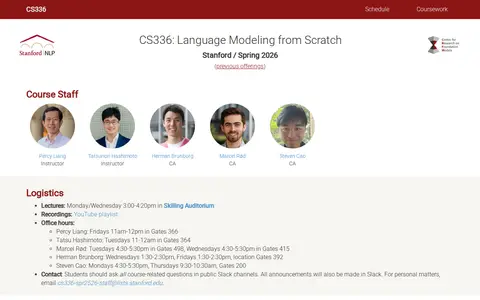
Stanford CS336: Language Modeling from Scratch is the official course website for a Stanford class offered in Spring 2026. The course walks students through the process of developing a language model, including data collection and cleaning for pre-training, transformer model construction, model training, and evaluation before deployment. The site provides logistics, schedule, assignments, and course materials.

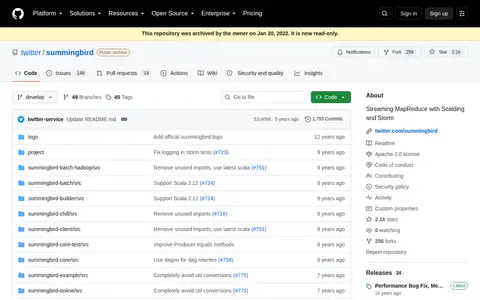
Summingbird is a library for writing MapReduce programs that resemble native Scala or Java collection transformations and running them on distributed MapReduce platforms including Storm and Scalding. Programs can execute in batch mode, realtime mode, or a hybrid mode combining Scalding and Storm. The repository was archived by its owner on Jan 20, 2022 and is read-only.

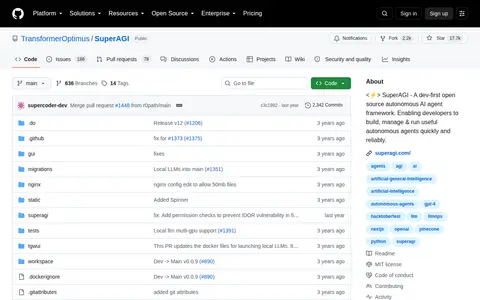
SuperAGI is a dev-first open source autonomous AI agent framework. It enables developers to build, manage, and run useful autonomous agents quickly and reliably. The project is hosted on GitHub under the TransformerOptimus organization.

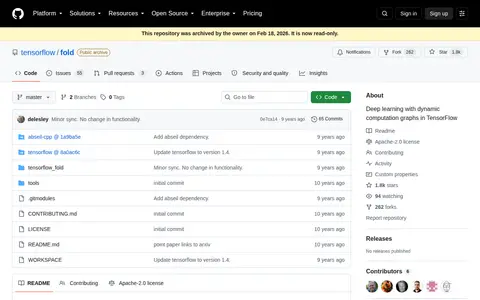
TensorFlow Fold is a library for creating TensorFlow models that consume structured data, where the computation graph depends on the structure of the input data. It implements dynamic batching, transforming batches of arbitrarily shaped computation graphs into a static computation graph. TensorFlow Fold is not an official Google product.

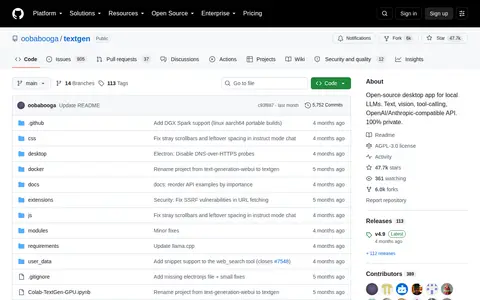
TextGen is an open-source desktop app for local LLMs, with text, vision, tool-calling and web search, plus a UI and API. It supports multiple backends including llama.cpp, Transformers, ExLlamaV3 and TensorRT-LLM, and an OpenAI/Anthropic-compatible API. It also offers LoRA training and image generation. Portable builds are provided for Linux, Windows and macOS.
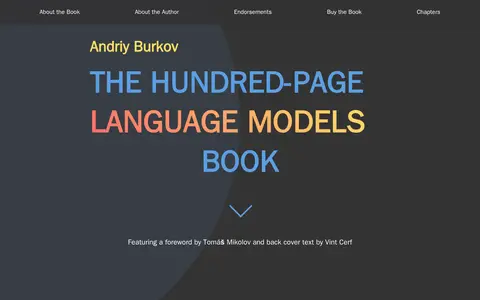
The Hundred-Page Language Models Book by Andriy Burkov is a concise hands-on guide covering machine learning basics through advanced transformer architectures and large language models. It explains AI fundamentals, text representation, count-based models, recurrent neural networks, and transformers, with mathematical foundations and Python code examples. The book targets ML practitioners and engineers building text-based applications.

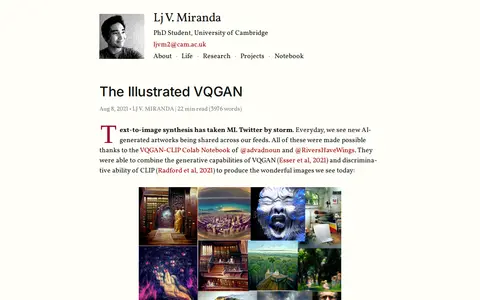
An illustrated explainer article on VQGAN, describing how the model generates images from text at a conceptual level and how VQGAN and CLIP work in tandem. It covers a theory of perception, using transformers to model interactions, expressing images through a codebook, and training the GAN and transformer.

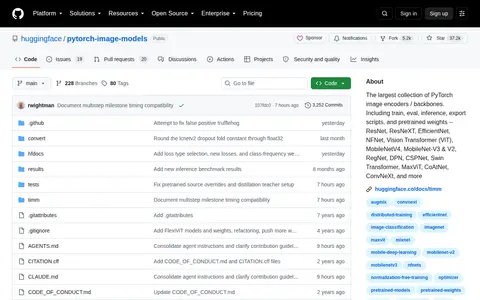
timm is a collection of PyTorch image encoders and backbones, including train, eval, inference and export scripts with pretrained weights. It covers architectures such as ResNet, EfficientNet, Vision Transformer, MobileNet and ConvNeXt.

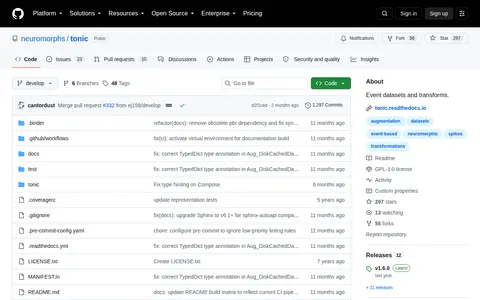
Tonic is a tool for downloading, manipulating and loading event-based or spike-based data, described as similar to PyTorch Vision but for neuromorphic data. It provides event datasets and transformations, and the project states it is looking for a new maintainer.

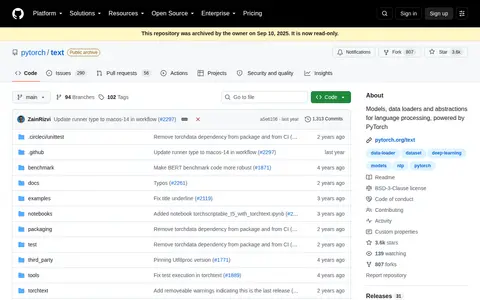
TorchText provides models, data loaders and abstractions for language processing, powered by PyTorch. The library includes dataset iterators, basic NLP building blocks, text-processing transformations, pre-trained models and vocabulary classes. The repository was archived by its owner on Sep 10, 2025, and is now read-only; development is stopped with 0.18 the last stable release.

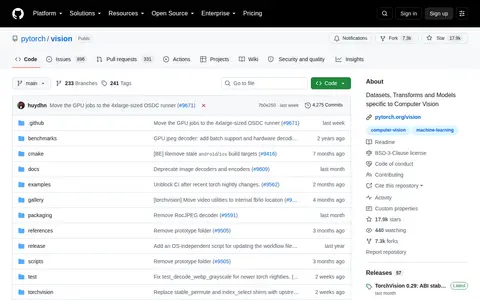
torchvision is a package of popular datasets, model architectures and common image transformations for computer vision. The repository holds documentation, benchmarks, examples, packaging, references and tests alongside the torchvision code. Installation instructions point to official guidance for stable torch and torchvision versions; building from source is covered on the contributing page.

Uses AI agents to complete tasks, coordinate tools or automate multi-step workflows.

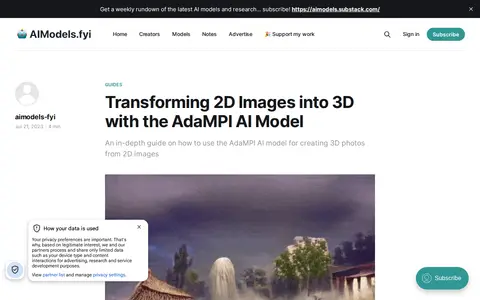
A guide describing the AdaMPI model, which converts single, in-the-wild 2D images into 3D photos. It covers inputs and outputs and a step-by-step usage walkthrough, and notes limitations such as complex scenes with intricate 3D geometry that may not convert perfectly.

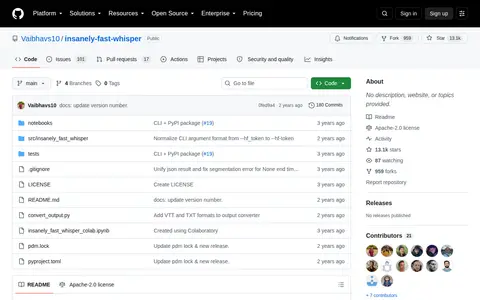
Accelerates transcription with the combination of OpenAI's Whisper Large v2, HF Transformers, Optimum, and flash attention.
Video Gen uses AI to create, edit, transform, or animate video content.

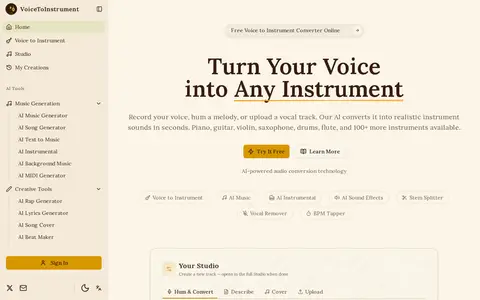
voicetoinstrument.com is an AI audio conversion platform that transforms uploaded voice recordings, hummed melodies, or vocal tracks into realistic instrument sounds. It supports conversion to more than 100 instruments including piano, guitar, violin, saxophone, drums, and flute, and offers a free online converter alongside additional AI audio tools such as stem splitters and vocal removers.

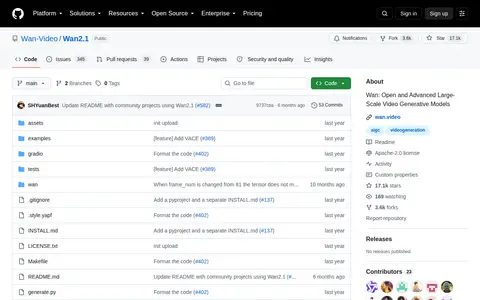
Open-source project that uses AI to create, edit, transform, or animate video content.

A Hackaday article by Matthew Carlson explaining why LLaMa matters. It describes LLaMa as a transformer language model from Facebook/Meta research spanning 7 billion to 65 billion parameters, and notes that llama.cpp runs inference with 4-bit quantization.

A Hugging Face blog post introducing Matryoshka Embedding models. It explains embeddings as numerical representations and describes how Matryoshka models store more important information in earlier dimensions, allowing large embeddings to be truncated while remaining useful. It covers theoretical training and training with Sentence Transformers, with a comparison to a regular embedding model.