
github.com
Open-source project that supports software development with code generation, analysis, debugging, or documentation.
Directory
Published directory entries matching your search.
Open-source project that supports software development with code generation, analysis, debugging, or documentation.

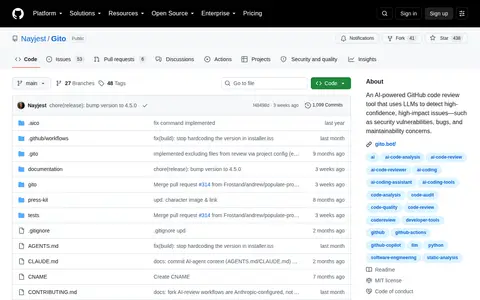
Gito is an open-source AI code reviewer that works with any language model provider. It detects issues in GitHub pull requests or local codebase changes, posts results as PR comments, and reacts to maintainer comments. GitLab support is in beta; Bitbucket support is planned.

Google Antigravity supports software development with code generation, analysis, debugging, or documentation.

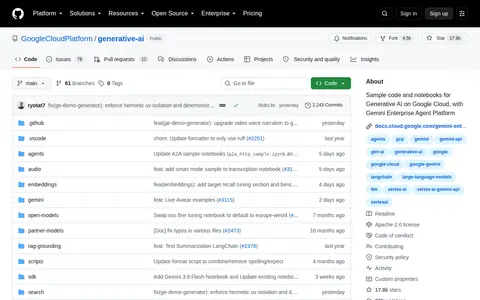
Sample code and notebooks for Generative AI on Google Cloud.
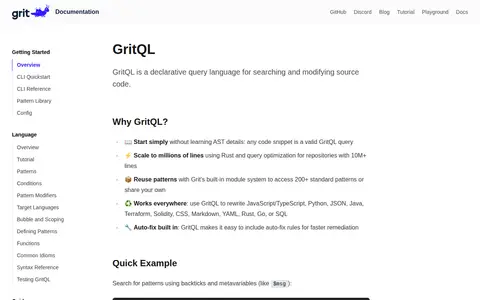
GritQL is a declarative query language from Grit for searching and modifying source code. It lets users search with code snippets and metavariables, define custom lints, and apply auto-fix rules, and it supports rewriting JavaScript/TypeScript, Python, JSON, Java, Terraform, Solidity, CSS, Markdown, YAML, Rust, Go and SQL.

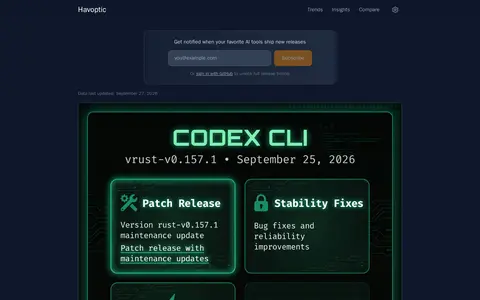
Havoptic tracks releases and changelogs for AI coding tools including Claude Code, Cursor, Codex CLI and Gemini CLI, summarizing each release in plain English with full version history and daily updates. A public API and MCP server documentation provide access to release data, cadence stats and feature comparisons without authentication.

Supports software work with AI-assisted coding, testing or application development.

Intelligent Documentation Generator Agent is a Hugging Face Space that generates detailed documentation for Python code via pasting, uploading, or linking, and allows users to chat with the AI for code explanations and insights.

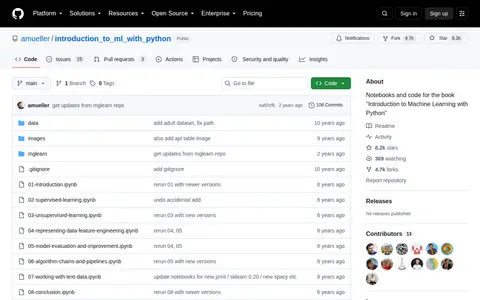
A GitHub repository holding the notebooks and code for the book "Introduction to Machine Learning with Python" by Andreas Mueller and Sarah Guido, together with the mglearn library of helper functions for figures and datasets. The book requires scikit-learn 0.20.0, and the code also needs numpy, scipy, matplotlib, pandas and pillow.

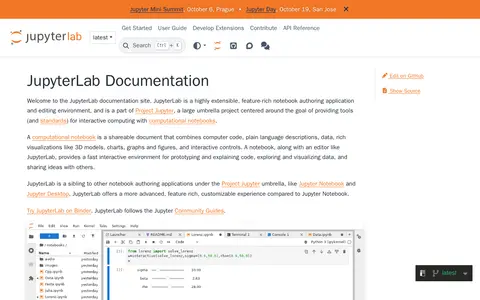
JupyterLab is an extensible notebook authoring application and editing environment within Project Jupyter. A notebook combines code, text descriptions, data and visualizations. JupyterLab provides an environment for prototyping and explaining code, exploring and visualizing data, and sharing ideas. It is a sibling to Jupyter Notebook and Jupyter Desktop and is described as offering a more advanced, customizable experience than Jupyter Notebook.

The Kaggle Merck repository, hosted on GitHub under the user zygmuntz, contains code for the Merck challenge hosted on the Kaggle data science platform. It is an open-source project that accepts contributions via GitHub.

The kaggle-bestbuy big repository, hosted on GitHub under the user zygmuntz, contains code for the Best Buy competition hosted on the Kaggle data science platform. It is an open-source project that accepts contributions from GitHub users.

Kilo is an open source AI coding agent for VS Code, JetBrains, CLI, desktop and cloud. It offers access to 500+ models at zero markup, bring-your-own keys, or local models for privacy. Kilo Gateway provides a unified API to access AI models through a single endpoint.

AI coding assistant offering line-of-code completions and documentation.

Kombai is an AI design engineer that designs websites and product UIs and ships production-ready frontend code. It offers a browser tool for editing rendered UI and sending browser context to prompts, reuse of components, tokens and hooks from repos, npm and Storybook, and a choice of 50+ models.

LangChain is an open agent engineering platform that enables organizations to own, control, govern, and compound their intelligence. Its LangSmith platform offers tools for autonomous agent improvement, observability, performance evaluation, production deployment, safe code execution sandboxes, LLM call control, and no-code agent creation. The platform also provides open source agent frameworks including deepagents, langgraph, and langchain.

Open-source project that supports software development with code generation, analysis, debugging, or documentation.

Lightwood is an AutoML framework that generates and customizes machine learning pipelines using a declarative JSON-AI syntax. It handles data types such as numbers, dates, categories, tags, text, arrays and multimedia formats, and includes a time-series mode. Users can override defaults or replace pipeline steps, and the framework generates Python code for the pipeline.

Llama Coder helps developers write, search, review, test, or manage code and projects.
No-code batch compute platform for LLM evaluation and tuning workloads.

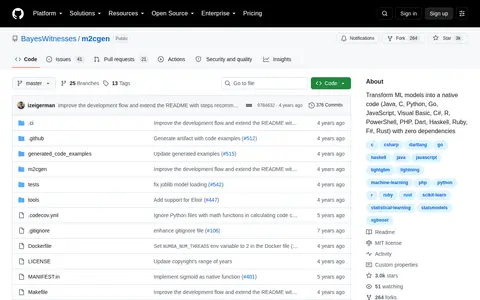
m2cgen is a tool that transforms trained machine learning models into native code across a wide range of programming languages including Java, C, Python, Go, JavaScript, C#, R, PHP, Dart, Haskell, Ruby, F#, and Rust, with zero dependencies. Its codebase is hosted in the BayesWitnesses GitHub repository, which includes navigation for installation, development guidance, supported languages, and supported model types.

Open-source project that supports software development with code generation, analysis, debugging, or documentation.

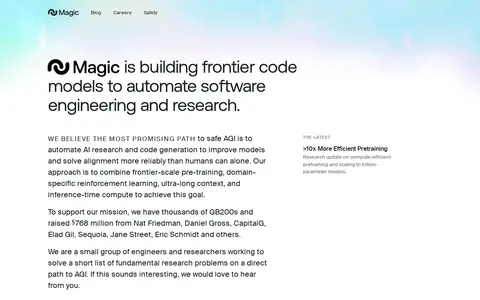
Magic.dev is an artificial intelligence company focused on developing safe artificial general intelligence (AGI) to accelerate progress on high-priority global problems. The company builds frontier code models intended to automate software engineering and AI research workflows. Its technical approach combines large-scale pre-training, domain-specific reinforcement learning, extended context windows, and increased inference-time compute. Magic.dev employs a small team of engineers and researchers working on fundamental AGI-related research problems.

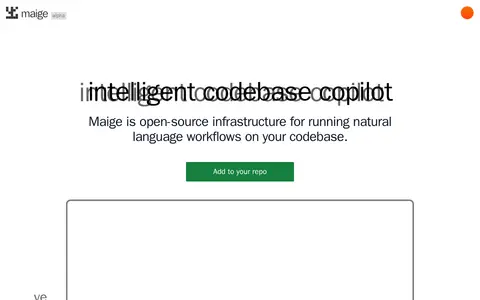
Maige is open-source infrastructure for running natural language workflows on a codebase. After connecting a repository, users write rules describing what should happen when issues and pull requests are opened, and the tool can label, assign, comment, review code, and run simple code snippets. It works with the GitHub API. A standard plan is offered after free use, with usage-based payment.