
Garage is a toolkit for developing and evaluating reinforcement learning algorithms, with an accompanying library of implementations built using it. The toolkit offers modular tools including composable neural network models, replay buffers, high-performance samplers, an experiment definition interface, reproducibility tools, logging including TensorBoard, checkpointing and resuming, and environment interfaces.

Directory
Search results
Published directory entries matching your search.
genei is a research tool that uses an AI algorithm to summarise articles, analyse research and find key information. It offers AI-powered summarisation and keyword extraction for groups of PDFs or webpages, document management with projects and folders, and reference generation. A Chrome extension add-on summarises webpages or saves them for later reading.
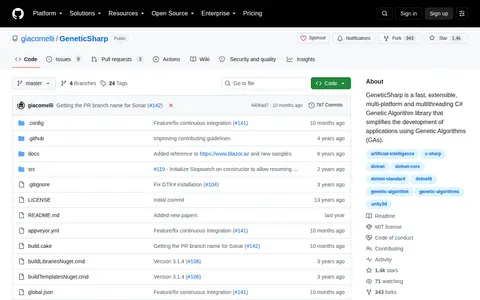
GeneticSharp is a C# genetic algorithm library described as fast, extensible, multi-platform and multithreading, intended to simplify development of applications using genetic algorithms. The source states it can be used in .NET 6, .NET Standard and .NET Framework apps, including ASP.NET MVC, ASP.NET Core, Blazor, Web Forms, UWP, Windows Forms, GTK#, Xamarin, MAUI and Unity3D games.

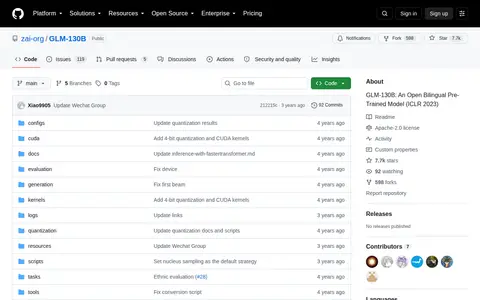
GLM-130B is an open bilingual pre-trained model with 130 billion parameters, pre-trained using the General Language Model algorithm. It was trained on over 400 billion text tokens, half Chinese and half English. With INT4 quantization, hardware requirements can be reduced to a single server with 4 RTX 3090 (24G) GPUs with almost no performance degradation.
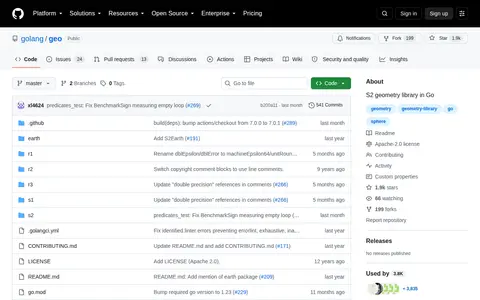
S2 is a Go library for spherical geometry. It provides representations of angles, intervals, latitude-longitude points and unit vectors, geometric shapes over the unit sphere such as caps, rectangles, polylines and polygons, a hierarchical cell decomposition, constructive operations and predicates, in-memory indexing, distance algorithms and snapping and simplification. Planar geometry and conversions to common GIS formats are outside its scope.
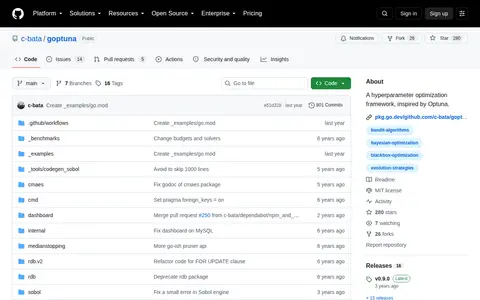
Goptuna is a hyperparameter optimization framework inspired by Optuna, written in pure Go. It provides Bayesian optimization, evolution strategies and multi-armed bandit algorithms, including random search, TPE, CMA-ES variants, ASHA and Sobol sampling. It supports a Define-by-Run style API for dynamically constructing search spaces and offers RDB storage for continuing optimizations and scaling studies across workers.
OCaml-GPR is an OCaml library for Gaussian process regression that includes a command line application and an example application. It implements approximation algorithms for scalable regression with arbitrary covariance functions.

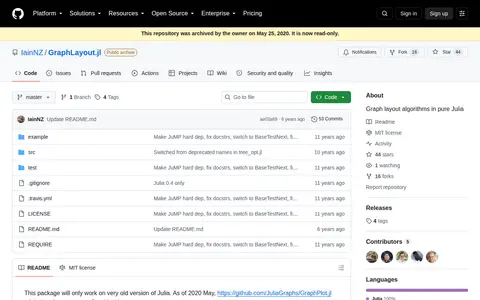
Graph layout algorithms in pure Julia.
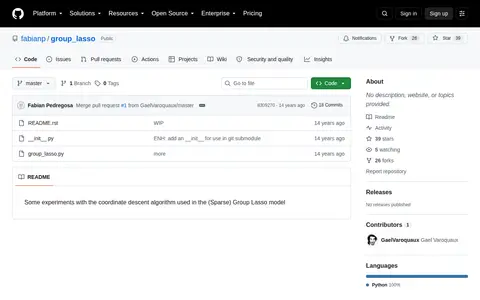
Some experiments with the coordinate descent algorithm used in the (Sparse) Group Lasso model.
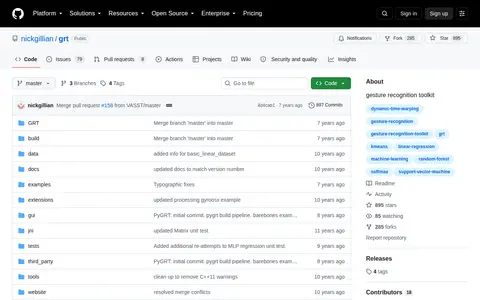
GRT (Gesture Recognition Toolkit) is an open-source project hosted on GitHub. It provides core algorithms, extensions, and related utilities for gesture recognition, with documented architecture and core resources available in the repository.
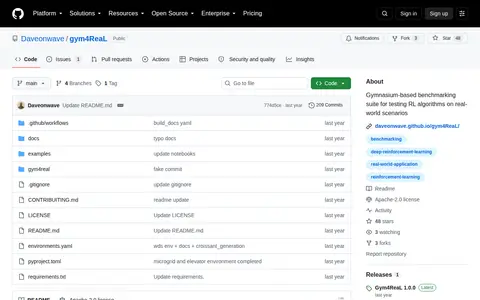
Gym4ReaL is an open-source GitHub repository maintained by Daveonwave. It is a Gymnasium-based benchmarking suite for testing reinforcement learning algorithms on real-world scenarios. The repository includes documentation on supported characteristics, reinforcement learning paradigms, folder structure, contribution guidelines, and licensing terms.
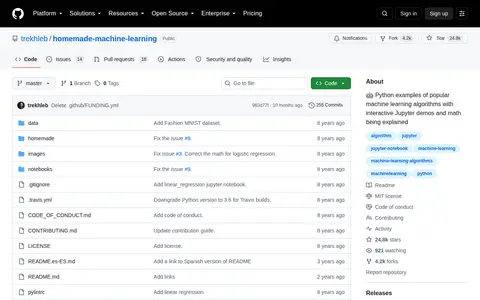
Python examples of popular machine learning algorithms with interactive Jupyter demos and math being explained.
A freeCodeCamp handbook for developers on organizing AI agents for real business cases. It covers prerequisites, large language models, definitions of AI agents, and a decision algorithm for creating optimal agents, including checking budget, starting with one agent, and measuring performance. It uses a Google Research, Google DeepMind, and MIT paper as its primary source and code examples in a Google Colab notebook.
General Machine Learning library using Numenta’s Cortical Learning Algorithm.
Hyperas is a wrapper that combines Keras model definition with Hyperopt hyperparameter optimization. Users define models as usual and wrap parameters in double curly brackets with a chosen distribution. It is installed via pip and runs optimization using algorithms such as TPE with a set number of evaluation runs.
Hypernets is a general AutoML framework for building automatic optimization tools for machine learning frameworks and libraries, including tensorflow, keras, pytorch, sklearn, lightgbm and xgboost. It offers an abstract search space representation covering hyperparameter optimization and neural architecture search, with optimization algorithms such as evolution algorithm and Monte Carlo tree search.
KerasTuner is a hyperparameter optimization framework for Keras. It provides a define-by-run syntax for configuring search spaces and includes Bayesian Optimization, Hyperband and Random Search algorithms. It requires Python 3.8+ and TensorFlow 2.0+.
JavaScript implementation of the k nearest neighbors algorithm for supervised learning.
Just a simple implementation of K-Nearest Neighbors algorithm using with a bunch of similarity measures.
Open-source project that provides machine-learning models, research, training resources, or evaluation tools.
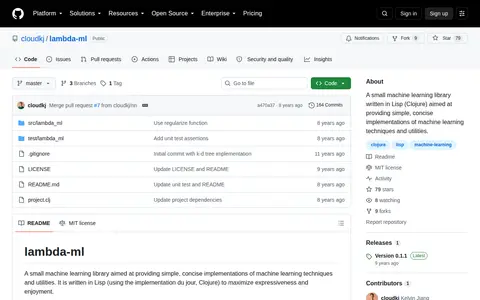
lambda-ml is a small machine learning library written in Lisp, specifically Clojure, aimed at simple, concise implementations of machine learning techniques and utilities. It covers supervised algorithms such as neural networks, decision trees, ensemble methods, k-nearest neighbors, linear and logistic regression, naive Bayes and random forest, plus unsupervised methods including DBSCAN, hierarchical clustering, k-means and non-negative matrix factorization.
An introductory machine learning course taught by Caltech Professor Yaser Abu-Mostafa, recorded from a live broadcast and available as a free online MOOC. It covers basic theory, algorithms and applications across 18 lectures, with homework sets and a final exam. Prerequisites are basic probability, matrices and calculus.
The Libra Toolkit is a collection of algorithms for learning and inference with discrete probabilistic models, including Bayesian networks, Markov networks, dependency networks, sum-product networks and arithmetic circuits. Each algorithm is implemented as a command-line program with consistent options and file formats, and all methods are written in OCaml.
Machine Learning in MatLab/Octave is a collection of MatLab/Octave implementations of popular machine learning algorithms, including code examples and explanations of the associated mathematics. It covers supervised learning tasks such as regression and classification as well as unsupervised learning.