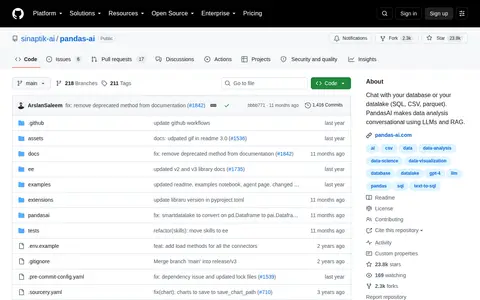

PandasAI is an open-source library that enables conversational data analysis using large language models and retrieval-augmented generation. It allows users to interact with databases or datalakes supporting SQL, CSV, and parquet file formats.
Directory
Search results
Published directory entries matching your search.
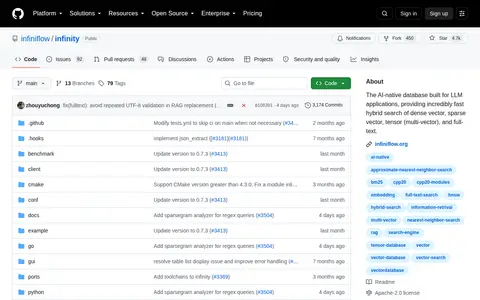
AI-native database built for LLM applications, providing incredibly fast vector and full-text search.
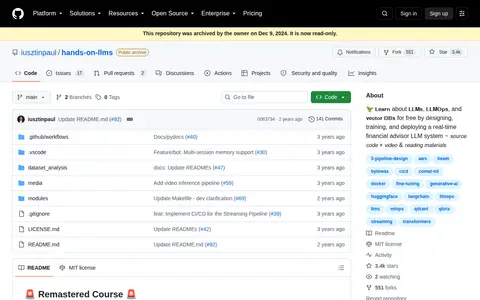
An archived educational course repository for learning about LLMs, LLMOps and vector databases by designing, training and deploying a real-time financial advisor LLM system. It includes source code, video and reading materials, and covers a training pipeline using QLoRA and a streaming pipeline ingesting financial news. The repository was archived by its owner and is read-only.
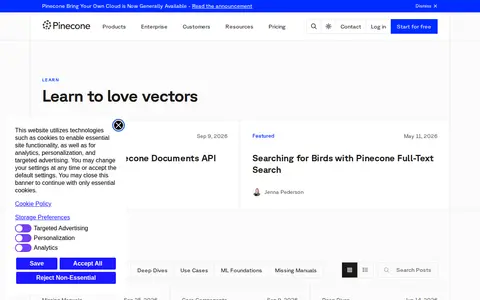
The Pinecone Learning Center is a resource section of the Pinecone website offering educational content related to Pinecone's AI knowledge platform. Available materials include articles, whitepapers, and guides covering topics such as vector database architecture, hybrid search, and retrieval-augmented generation workflows.
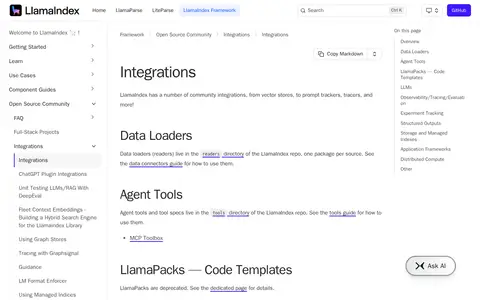
A hub of integrations for LlamaIndex including data loaders, tools, vector databases, LLMs and more.
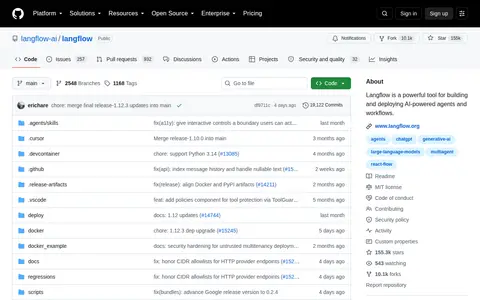
Langflow is a platform for building and deploying AI-powered agents and workflows, with a visual authoring interface and built-in API and MCP servers. It supports major LLMs, vector databases and AI tools, and allows deployment as an API, JSON export or MCP server.
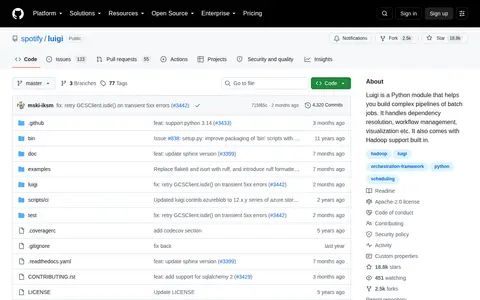
Luigi is a Python package for building complex pipelines of batch jobs. It handles dependency resolution, workflow management, visualization, handling failures and command line integration, and includes Hadoop support. It is intended to stitch together long-running tasks such as Hive, Pig, Hadoop, Spark or database jobs.
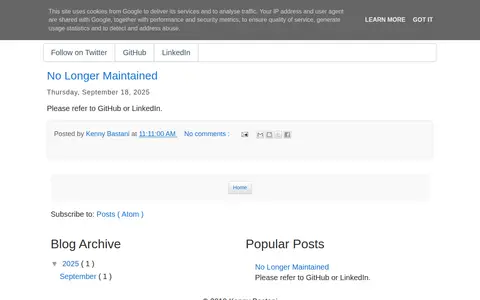
Meaning of is the personal blog of Kenny Bastani, covering open source software, graph databases, cloud native architectures, information theory, artificial intelligence, and machine learning. As of September 18, 2025, the blog is no longer maintained, with readers directed to the author's GitHub or LinkedIn profiles.
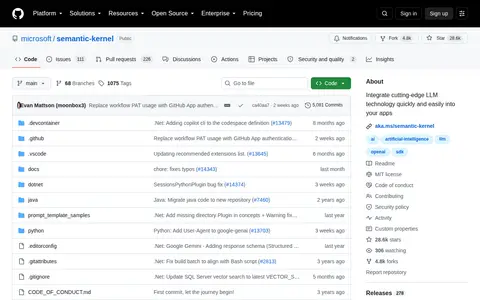
Model-agnostic SDK for building, orchestrating and deploying AI agents and multi-agent systems, with built-in support for OpenAI, Azure OpenAI, Hugging Face and Nvidia. It offers tools/plugins, memory, planning, vector database integrations and a process framework. Microsoft states that Semantic Kernel is now Microsoft Agent Framework.
Milvus is open source vector database for production AI, written in Go and C++, scalable and blazing fast for billions of embedding vectors.
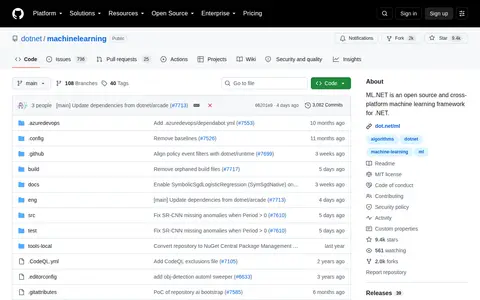
ML.NET is an open source, cross-platform machine learning framework for .NET. It lets developers build, train, deploy and consume custom models in .NET applications, with data loading from files and databases, data transformations and many ML algorithms. Models can be trained for scenarios such as classification, forecasting and anomaly detection, and TensorFlow and ONNX models can be consumed within the framework.
List of models for upscaling images.
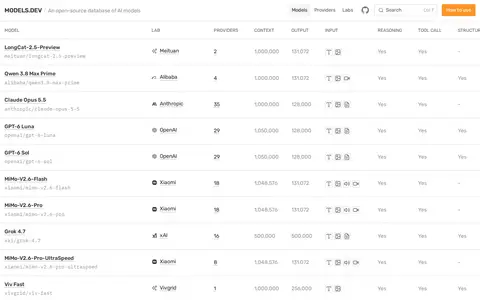
Models.dev is an open-source database that lists AI model specifications, pricing and features. It covers models from multiple providers with details such as context length, modalities and open or closed availability.
MongoDB is a document-oriented operational database that stores data in flexible JSON-like documents. The documentation describes built-in query capabilities including geospatial search, lexical search and vector search, and the platform page lists Atlas use cases such as vector search and stream processing.
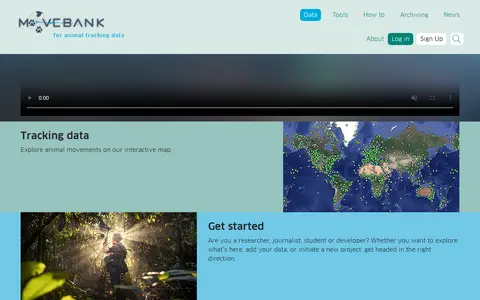
Movebank is a free online database of animal tracking data hosted by the Max Planck Institute of Animal Behavior. It helps animal tracking researchers manage, share, protect, analyze and archive their data, and offers an interactive map for exploring animal movements.

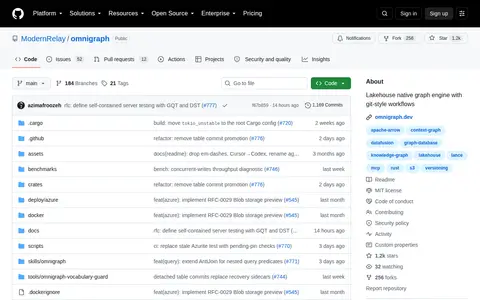
Typed graph database where agents branch and merge like Git. S3-native, Rust, traversal + vector + BM25 in one runtime.
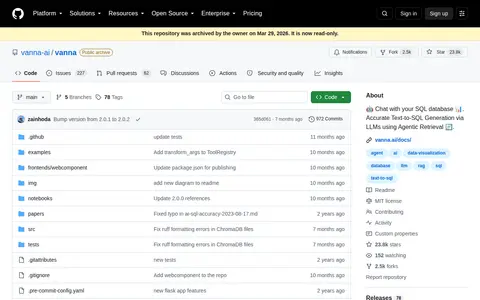
Vanna is an open source tool that enables users to interact with SQL databases via natural language. It uses large language models and agentic retrieval to generate accurate text-to-SQL queries.
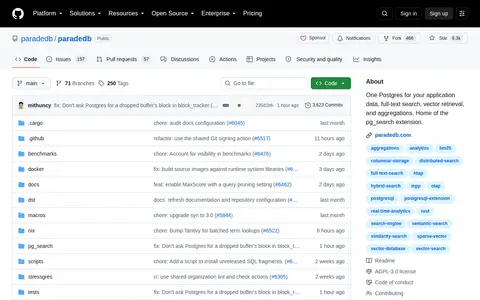
ParadeDB is an open-source PostgreSQL extension hosted on GitHub. It adds functionality for application data management, full-text search, vector retrieval and data aggregations to PostgreSQL databases, and is the home of the pg_search extension. The repository includes links to associated documentation, community resources, a blog and a changelog.
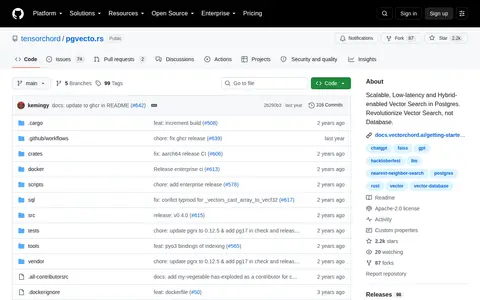
pgvecto.rs is an open-source tool that provides scalable, low-latency, hybrid-enabled vector search for PostgreSQL. It is designed to enhance vector search capabilities without modifying the core database system, per its official GitHub repository.
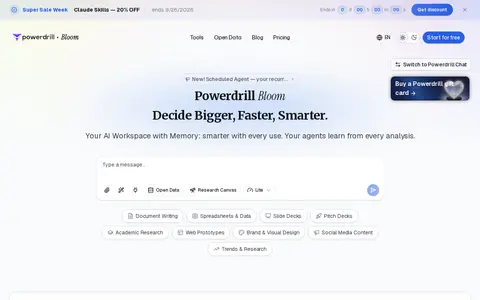
Powerdrill Bloom is an AI data analysis workspace with memory. It lets users ask questions across documents and databases in plain language, returning results with the page, row and figure behind them. It runs on-premise or in a private cloud. The free plan includes 1,000 daily refreshed credits and one scheduled task.
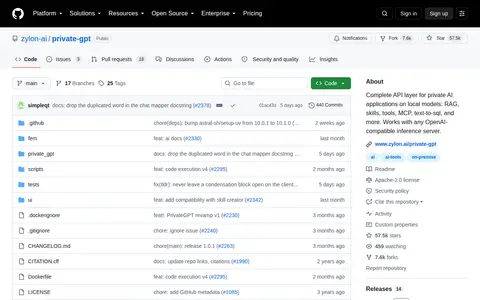
PrivateGPT is an open-source API layer for building private AI applications on local models, following the Claude API model. It provides a messages API, file and artifact ingestion, retrieval with citations and agentic RAG, built-in and custom tools, MCP connectors, structured database and CSV access, and embeddings. It connects to any OpenAI-compatible inference server and does not run models itself.
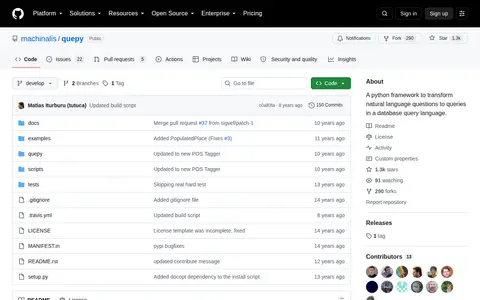
A python framework to transform natural language questions to queries in a database query language.
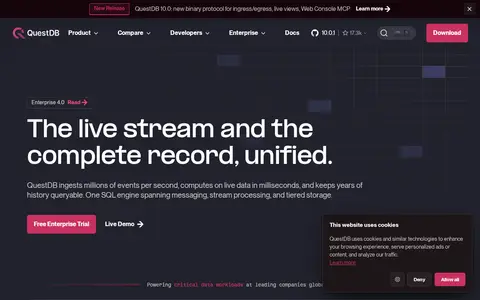
QuestDB is an open-source time-series database engineered for low latency. It uses a column-oriented, time-partitioned storage engine with memory-mapped files and vectorized execution for high-throughput ingestion and millisecond-level analytical queries. SQL is extended with time-series operators such as SAMPLE BY, LATEST ON, ASOF JOIN, WINDOW JOIN and HORIZON JOIN.
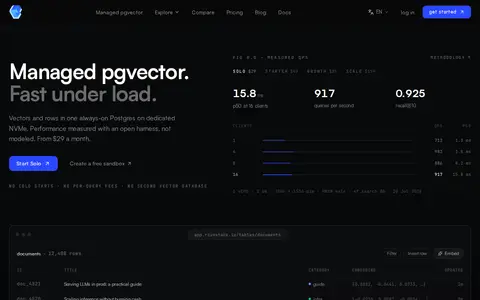
Rivestack offers managed pgvector on dedicated PostgreSQL with local NVMe storage, keeping vectors and application rows in one database. It provides tuned HNSW and StreamingDiskANN indexes, always-on compute with no cold starts, and migration help. Published measurements cover search latency and throughput. New customers get a 7-day free trial, then a plan from $29 per month.