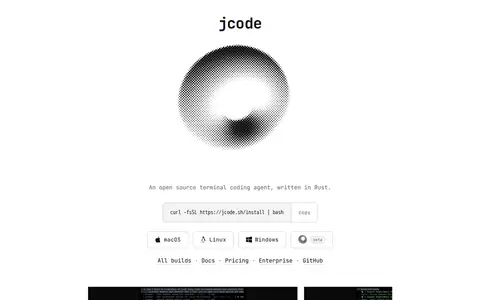

jcode is an open-source terminal coding agent written in Rust. It supports agent swarms, background tasks, and a small RAM footprint, and is installed with one command on macOS, Linux, or Windows. Login flows connect subscription and API model providers, and the agent itself is free while hosted inference plans are available.
Directory
Search results
Published directory entries matching your search.
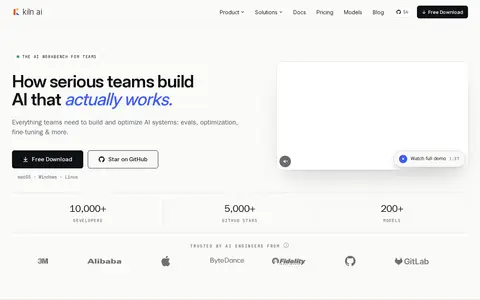
Kiln AI is a platform and open-source library for building, evaluating, and optimizing AI systems. It offers tools for working with retrieval-augmented generation, AI agents, synthetic data, model fine-tuning, and prompt optimization, with a free downloadable application available for macOS, Windows, and Linux.
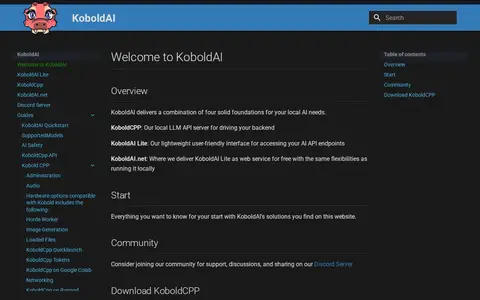
KoboldAI presents tools for local AI use. KoboldCPP is a local LLM API server for driving a backend, and KoboldAI Lite is a lightweight interface for accessing AI API endpoints. KoboldAI.net delivers KoboldAI Lite as a free web service. Downloads for KoboldCPP are offered for Windows, Linux and Mac, and community support is available on Discord.
Loic Tetrel is a blog about computer science and data science topics. Posts cover subjects such as enabling GPU acceleration in Windows 11 Hyper-V virtual machines, using Android TV without a Google account, and Windows/Linux dual-boot.
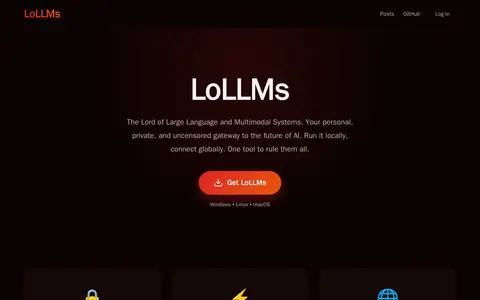
LoLLMs, described as the Lord of Large Language and Multimodal Systems, is a local AI tool for running models. It states full local execution and hardware support for NVIDIA, AMD, Apple Silicon or CPU. It is offered for Windows, Linux and macOS.
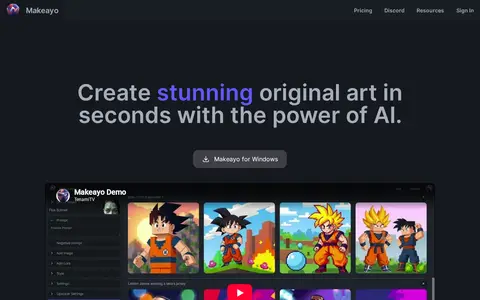
Makeayo is a desktop application for generative art, offering base selection, prompt-based image generation, image transformation, HD upscaling, pose matching and access to many models. It supports Windows 10 and 11, with Mac and Linux versions described as coming soon. The site states a free tier and paid monthly founder, basic, pro and max plans.
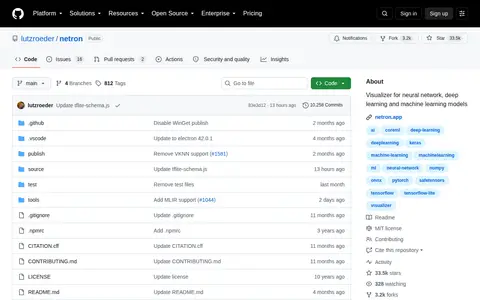
Netron is a viewer for neural network, deep learning and machine learning models. It supports formats including ONNX, TensorFlow Lite, PyTorch, TensorFlow, Core ML, OpenVINO, Keras, Caffe, Darknet, Safetensors and NumPy. It is available as a browser version and installers for macOS, Linux and Windows, plus a Python package. Experimental support exists for MLIR, JAX, GGUF and other formats.
Nixified packages AI executable code as self-contained Nix packages, including dependencies, and builds each project from source. Users can install and run the code with a single nix command on Linux distributions and on Windows through WSL. The project lists textgen and InvokeAI as packaged projects and offers GPU support for NVIDIA and AMD.
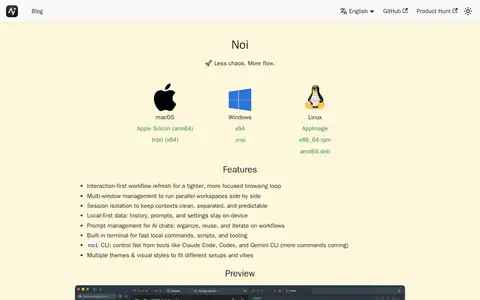
Noi is a desktop application that provides an interaction-focused browsing workflow. It offers multi-window management for parallel workspaces, session isolation, and local-first data storage for history, prompts, and settings. It also includes prompt management for AI chats, a built-in terminal, and a CLI for controlling Noi from tools such as Claude Code and Codex. Builds are listed for macOS, Windows, and Linux.
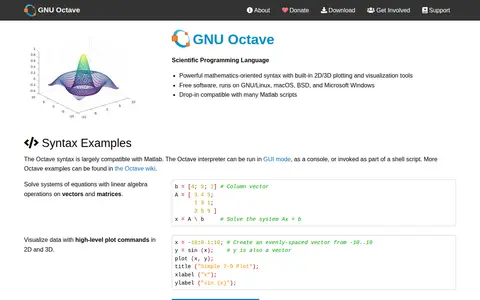
GNU Octave is a programming language for scientific computing with mathematics-oriented syntax and built-in 2D/3D plotting and visualization tools. It is free software licensed under the GNU General Public License and runs on GNU/Linux, macOS, BSD, and Microsoft Windows. Its syntax is largely compatible with Matlab, and it can be extended by packages.
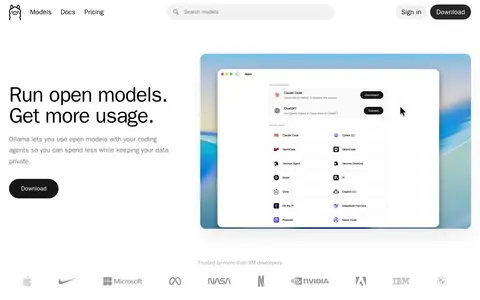
Ollama is a tool for running and building with open AI models locally or in the cloud on macOS, Windows and Linux. Its pricing page lists Free, Pro, Max, Team and Enterprise subscription plans, with paid plans including usage credits and cloud model access. The Free plan includes running models locally and starter usage credits.
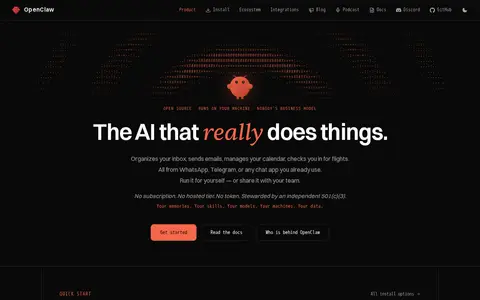
OpenClaw is an open-source AI assistant that runs on the user's machine and works from WhatsApp, Telegram or other chat apps. According to the site, it organizes inboxes, sends emails, manages calendars and checks users in for flights. Desktop apps are listed for macOS, Windows and Linux, and an enterprise platform is in development ahead of a 1.0 release.
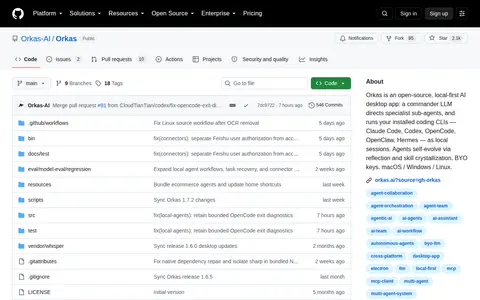
Orkas is an open-source, local-first AI desktop app. A commander LLM directs specialist sub-agents and runs installed coding CLIs including Claude Code, Codex, OpenCode, OpenClaw, and Hermes as local sessions. Its agents self-evolve via reflection and skill crystallization, supports bring-your-own keys, and is compatible with macOS, Windows, and Linux.
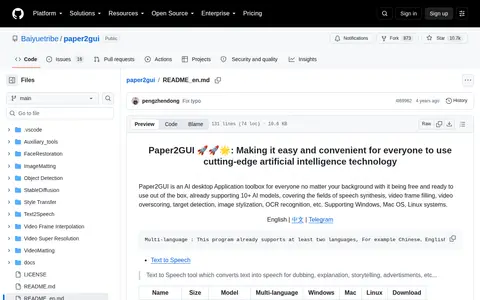
Paper2GUI is an AI desktop application toolbox that is free and ready to use out of the box. It supports more than 10 AI models covering speech synthesis, video frame filling, video overscoring, target detection, image stylization and OCR recognition, on Windows, Mac OS and Linux.
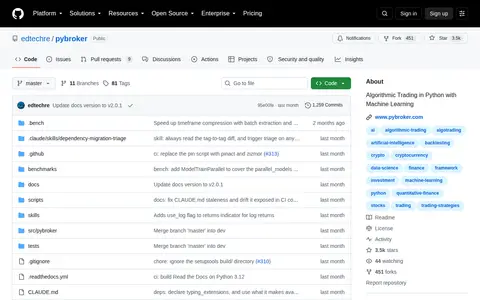
PyBroker is a Python framework for developing algorithmic trading strategies with a focus on machine learning. It provides a backtesting engine built in NumPy and accelerated with Numba, model training and backtesting using Walkforward Analysis, parameter optimization with Optuna, and access to historical data from Alpaca, Yahoo Finance, and AKShare. It supports Python 3.11+ on Windows, Mac, and Linux.
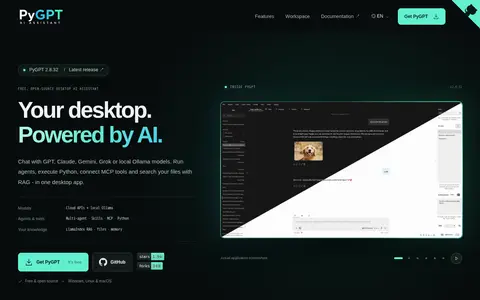
PyGPT is a free, open-source desktop AI assistant compatible with Windows, Linux and macOS operating systems. It supports both cloud-based and local AI models, and offers features including AI chat, multi-agent workflows, RAG-powered knowledge retrieval from user files, skills and plugin support, Python and MCP automation, and voice, vision and content generation capabilities.
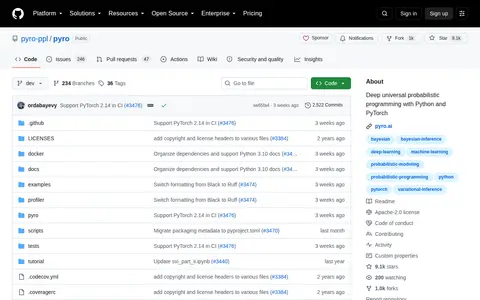
Pyro is a deep probabilistic programming library built on PyTorch, described as universal, scalable, minimal and flexible. It can represent any computable probability distribution and was originally developed at Uber AI, now maintained by community contributors including a team at the Broad Institute. It became a project of the Linux Foundation in 2019. It installs via pip as pyro-ppl.


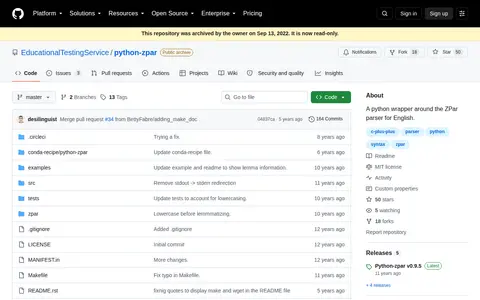
A Python wrapper around the ZPar statistical natural language parser, providing a ctypes-based interface and an XML-RPC ZPar server for batch processing. It works only with English ZPar models and supports 64-bit Linux and OS X. The repository was archived on Sep 13, 2022 and is read-only; the project is no longer under active development.
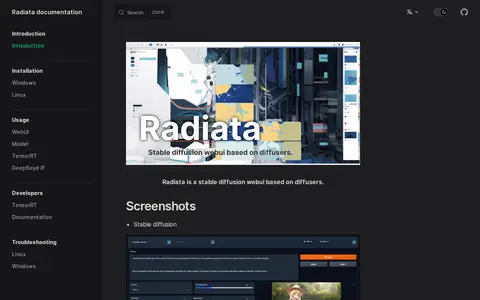
Radiata is a stable diffusion web UI built on the diffusers library that uses TensorRT high-speed inference technology. Its official documentation provides resources for introduction, installation, usage, developer guidance, and troubleshooting for Windows and Linux operating systems. It is categorized under AI & Machine Learning with a focus on AI image generation.
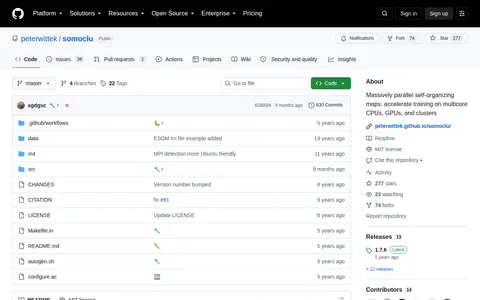
Somoclu is a massively parallel implementation of self-organizing maps, using multicore CPUs, MPI for cluster workload distribution, and CUDA acceleration. It supports OpenMP, MPI, and CUDA, runs on Linux, macOS, and Windows, and offers planar and toroid maps, rectangular and hexagonal grids, and Gaussian and bubble neighborhood functions. Both dense and sparse input data are supported, with interfaces for Python, R, Julia, and MATLAB.
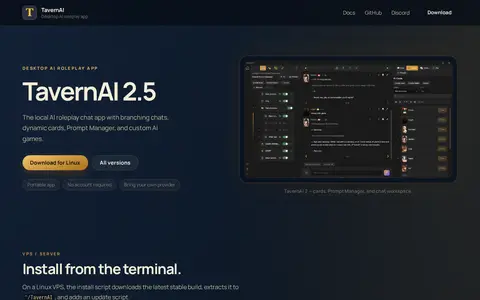
TavernAI 2 is a desktop AI roleplay chat app distributed as a portable app for Windows and Linux, also installable on a VPS. It runs models locally or connects to built-in and custom AI provider integrations, with branching chats, dynamic participants, a Prompt Manager, and custom AI games.
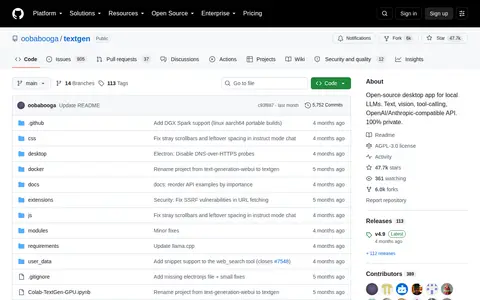
TextGen is an open-source desktop app for local LLMs, with text, vision, tool-calling and web search, plus a UI and API. It supports multiple backends including llama.cpp, Transformers, ExLlamaV3 and TensorRT-LLM, and an OpenAI/Anthropic-compatible API. It also offers LoRA training and image generation. Portable builds are provided for Linux, Windows and macOS.
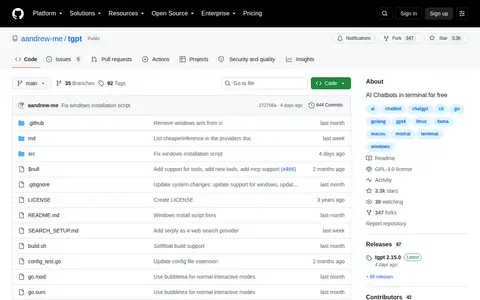
tgpt is a cross-platform command-line interface tool for using AI chatbots in the terminal. It is available for GNU/Linux, macOS, FreeBSD and Windows, and can be installed through scripts, package managers such as Homebrew, Pacman, Scoop, Chocolatey and Go, or from release executables. The project is distributed under the GPL-3.0 license.
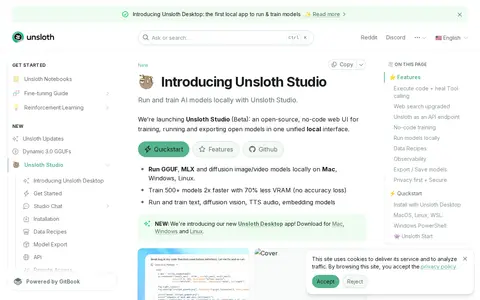
Unsloth Studio is an open-source, no-code web UI for training, running and exporting open models in one local interface. It supports GGUF, MLX and diffusion image/video models on Mac, Windows and Linux, and runs AI models offline without a GPU. A graphical Data Recipes workflow creates synthetic datasets from uploaded files.