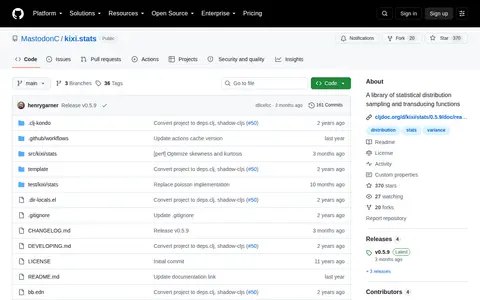

kixistats is a library of statistical distribution sampling and transducing functions. It provides tools for statistical analysis. The project is open-source and available on GitHub, with documentation, installation instructions, and usage examples.
Directory
Search results
Published directory entries matching your search.
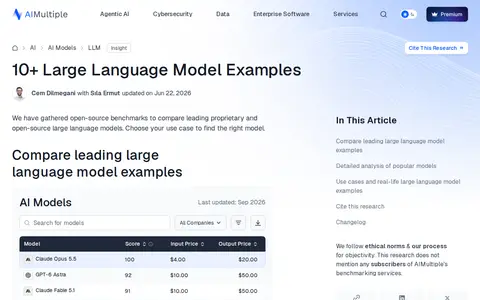
This webpage provides a curated list of large language model examples, alongside insights on business adoption, language model training, and influential models. It includes comparative analysis of leading LLMs such as OpenAI’s GPT-5, Claude 4.6, Gemini, DeepSeek-R1, Qwen, Llama 4, and xAI Grok-4 and Grok-4.1.
LightFM is a Python implementation of recommendation algorithms for implicit and explicit feedback. It allows item and user metadata to be incorporated into matrix factorization algorithms, representing users and items as sums of latent feature representations. Installation is available from PyPI, and a Docker setup is provided for running examples and tests.
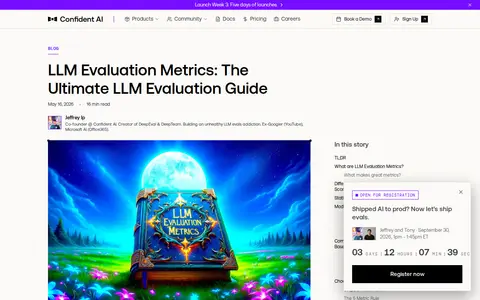
This is a blog post from Confident AI that serves as a guide to LLM evaluation metrics. It covers retrieval-augmented generation (RAG) metrics such as faithfulness and answer relevancy, agent metrics, LLM-as-a-judge approaches, and includes working DeepEval code examples.

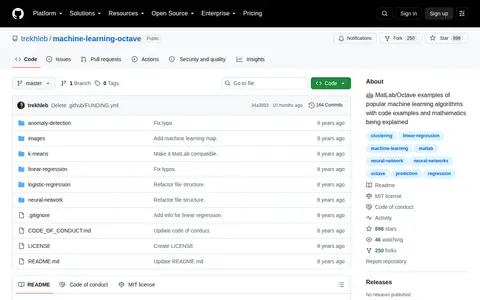
Machine Learning in MatLab/Octave is a collection of MatLab/Octave implementations of popular machine learning algorithms, including code examples and explanations of the associated mathematics. It covers supervised learning tasks such as regression and classification as well as unsupervised learning.
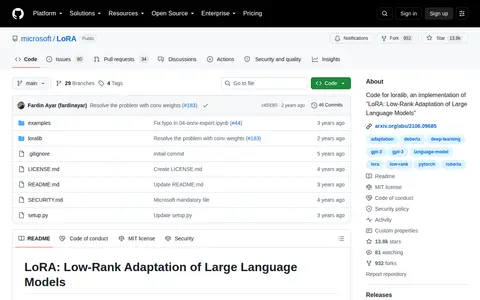
Repository containing the source code of the Python package loralib and examples of integrating it with PyTorch models, such as those in Hugging Face. LoRA learns pairs of rank-decomposition matrices while freezing the original weights, reducing the number of trainable parameters. PyTorch is the only supported framework for now.
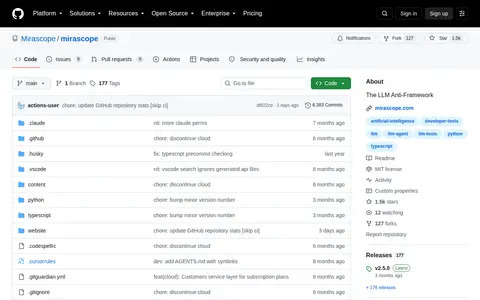
Mirascope is a project labeled the LLM Anti-Framework that provides one unified interface for using frontier LLMs. Its examples show calling LLMs with a decorator, getting structured output via Pydantic models, and building an agent with tools. It is organized as a monorepo with Python and TypeScript implementations plus documentation.
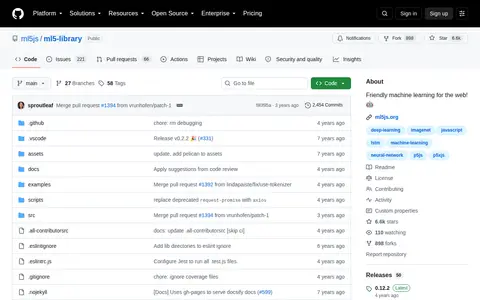
ml5.js is a JavaScript library providing access to machine learning algorithms and models in the browser, building on TensorFlow.js. It aims to make machine learning approachable for artists, creative coders and students, and is supported by code examples, tutorials and sample data sets. The project is described as currently in development.
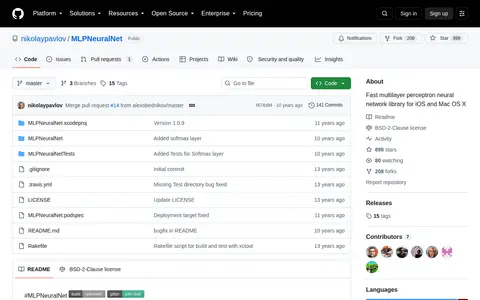
MLPNeuralNet is a multilayer perceptron neural network library for iOS and Mac OS X. It predicts new examples through trained neural networks and is built on Apple's Accelerate Framework using vectored operations and hardware acceleration where available. It is designed to load and run models in forward propagation mode only, and supports classification, multi-class classification, and regression output.
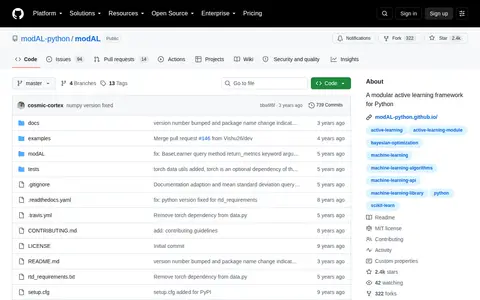
modAL is a modular active learning framework designed for use with the Python programming language. The project includes introductory documentation, overviews of active learning concepts, usage examples, and quickstart guides. It is hosted as an open source repository on GitHub.
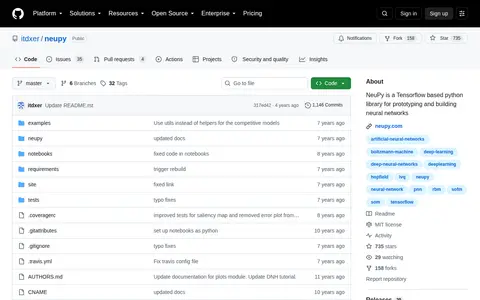
NeuPy is a Python library built on Tensorflow for prototyping and building neural networks. The repository notes that the library is no longer actively maintained. It includes examples and notebooks covering algorithms such as Boltzmann machines and self-organizing maps.
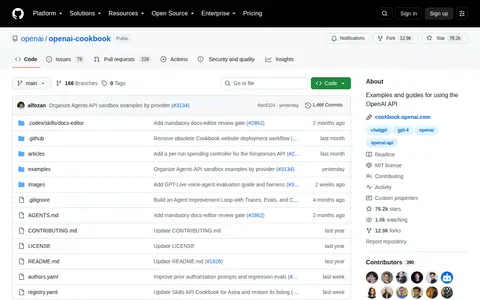
OpenAI Cookbook is a GitHub repository that provides examples and guides for using the OpenAI API. The collection helps developers integrate OpenAI models into their applications. It includes code samples, best practices, and documentation. The project is open source and accepts community contributions.
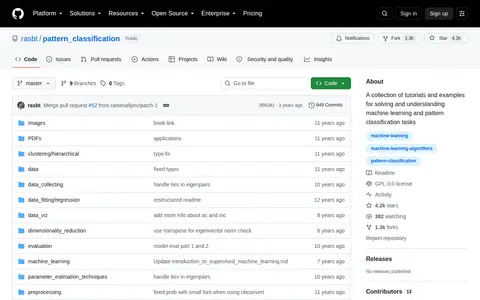
A collection of tutorials and examples for solving and understanding machine learning and pattern classification tasks. Materials are organized into sections covering preprocessing, model evaluation, parameter estimation, algorithms, clustering and data visualization.
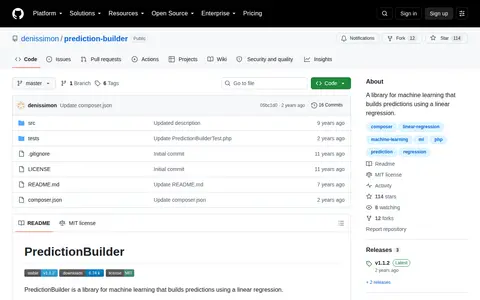
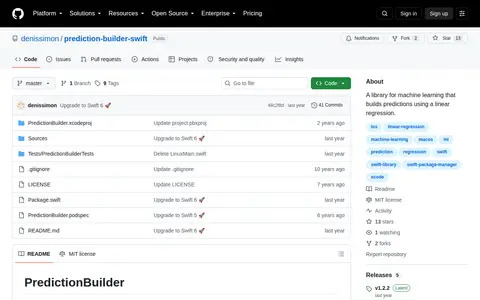
PredictionBuilder is an open-source machine learning library hosted on GitHub, designed to build predictions using linear regression. The repository includes documentation covering library requirements, installation steps, usage examples, and licensing terms.
PredictionBuilder (Swift implementation) is an open-source machine learning library hosted on GitHub, designed to build predictions using linear regression. The repository provides documentation for installation, usage examples, and licensing information.
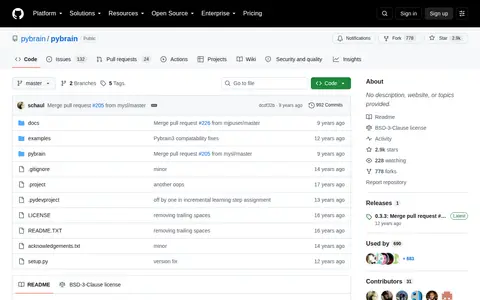
PyBrain is a Python machine learning library distributed under a BSD-3-Clause license. The repository includes documentation, examples, and a setup script; installation requires SciPy and is performed with python setup.py install or by cloning the repository. The project provides a quickstart, tutorials, and an API reference in its documentation.
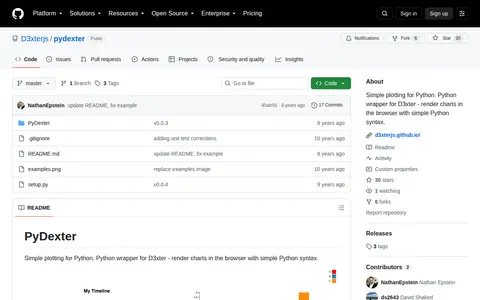
PyDexter is a Python wrapper for D3xter that renders charts in the browser using simple Python syntax. It supports histogram, scatter, plot, pie, timeline and bar chart examples. Installation is done with pip install PyDexter, and charts can be configured with settings such as height, width and title.
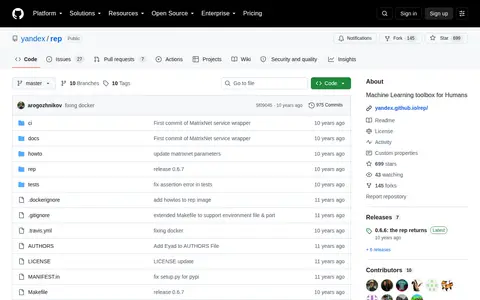
REP is a GitHub-hosted machine learning toolbox developed by Yandex, branded as a Reproducible Experiment Platform. It includes documentation for its main features, usage examples, and installation guidance for both Docker and manual setup.
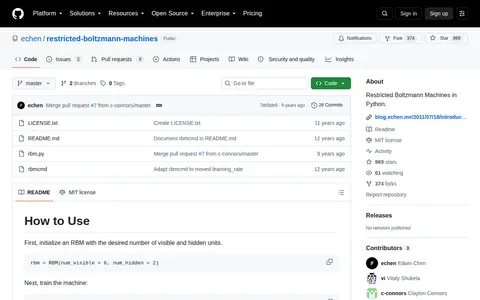
A Python implementation of Restricted Boltzmann Machines. It lets users initialize an RBM with a chosen number of visible and hidden units, train it on a matrix of training examples, run visible or hidden data, and let the network run freely. It is released under an MIT license.
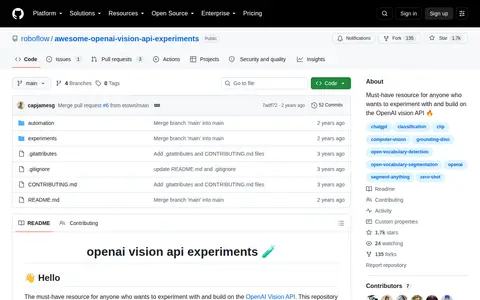
Examples showing how to use the OpenAI vision API to run inference on images, video files and webcam streams.
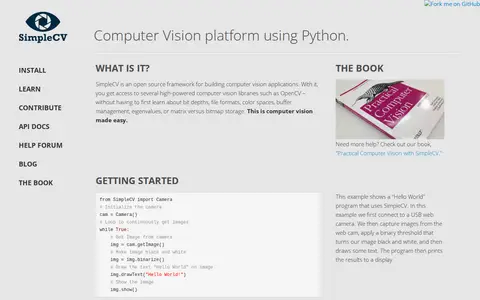
SimpleCV is an open source framework for building computer vision applications, providing access to libraries such as OpenCV without requiring knowledge of bit depths, file formats, color spaces or buffer management. The platform uses Python, and examples include connecting to a camera, binarizing images and drawing text.
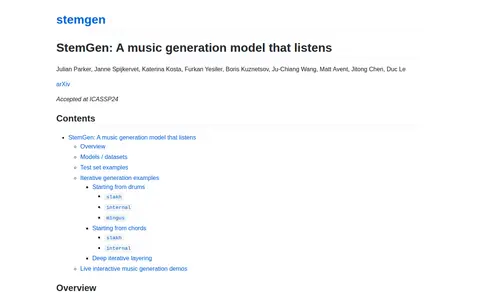
StemGen is an end-to-end music generation model trained to listen to musical context and respond appropriately. It is built on a non-autoregressive language-model type architecture similar to SoundStorm and VampNet, and is presented as examples for an ICASSP2024 paper.
The Hundred-Page Language Models Book by Andriy Burkov is a concise hands-on guide covering machine learning basics through advanced transformer architectures and large language models. It explains AI fundamentals, text representation, count-based models, recurrent neural networks, and transformers, with mathematical foundations and Python code examples. The book targets ML practitioners and engineers building text-based applications.
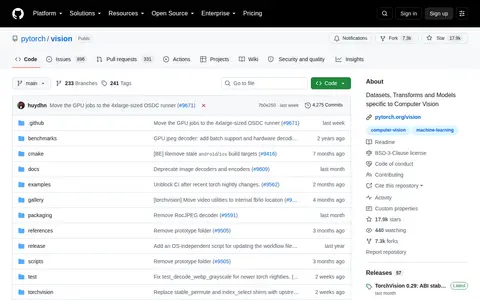
torchvision is a package of popular datasets, model architectures and common image transformations for computer vision. The repository holds documentation, benchmarks, examples, packaging, references and tests alongside the torchvision code. Installation instructions point to official guidance for stable torch and torchvision versions; building from source is covered on the contributing page.