
Multi-Agent Land is a Hugging Face Space developed by build-small-hackathon. It launches the Fishbowl Gradio web interface, loads configuration from a local .env file, operates entirely offline without requiring API keys, and automatically configures relevant settings. The space is currently paused.
Directory
Search results
Published directory entries matching your search.
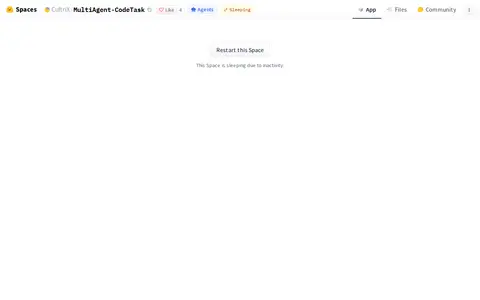
A Hugging Face Space from CultriX for multi-agent code generation. Users enter a programming task description and optionally an OpenAI API key, and the system's AI agents improve the prompt, create a plan, write code, review it and generate tests. The orchestrator collaborates with multiple agents on the code. The Space is sleeping due to inactivity.
AGI, Inc. builds AGI-0, a small action model, and an agent that sees the screen and acts across any app on Android. It runs on the device, learns preferences over time, and works without APIs or integrations. The agent is described as private by design and works offline and on wearables. A platform is offered for building action agents.

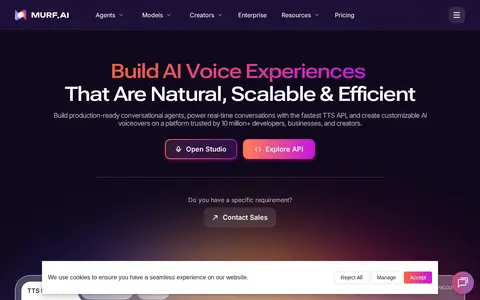
Murf AI is an AI voice and conversational agent platform. It provides tools to generate human-like speech and deploy conversational agents for use by developers, businesses, and creators. The platform offers a text-to-speech API, supports over 200 voices across 35+ languages, includes voice cloning and video translation features, and provides enterprise-grade security. It is described as trusted by over 10 million developers, businesses, and creators.
APIs for messaging, voice, and phone verification.
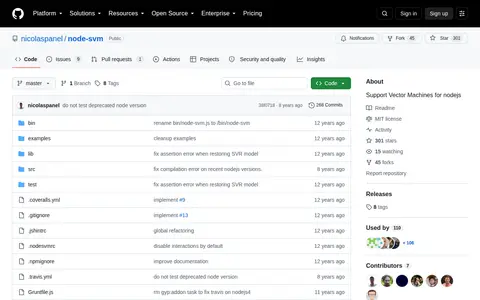
Node-SVM is a GitHub repository that provides support vector machine (SVM) implementations for Node.js. The project enables developers to use SVM algorithms within JavaScript applications. It includes installation instructions, a quick start guide, and an API reference. The repository is open source and contributed to by the community.
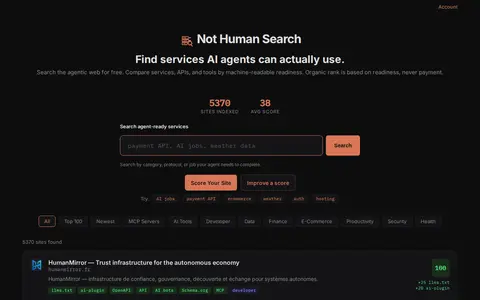
Not Human Search scores websites from 0 to 100 on seven agentic signals, including llms.txt, OpenAPI, MCP and Schema.org. It also indexes agent-ready sites and lets users search for services, APIs and tools by machine-readable readiness. Organic rank is said to be based on readiness rather than payment.
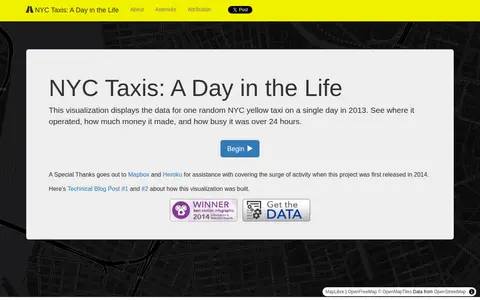
A data visualization by Chris Whong showing the activities of one random NYC yellow taxi on a single day in 2013, including where it operated and how much money it made. It uses taxi trip data provided by the Taxi and Limousine Commission via a FOIL request. Trip routes were produced with Google's Directions API and are not assumed accurate.
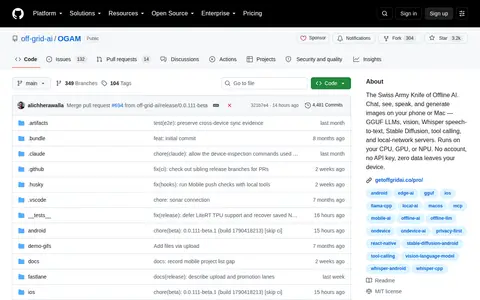
An offline AI application for phones and Macs that supports chat, image generation, vision, Whisper speech-to-text, tool calling and local-network servers. It runs on CPU, GPU or NPU, requires no account or API key, and keeps data on the device. A paid Pro tier adds voice mode, custom personas and draft-and-approve actions.
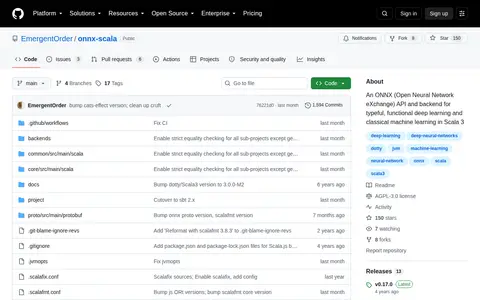
ONNX-Scala is an ONNX (Open Neural Network eXchange) API and backend built for typeful, functional deep learning and classical machine learning use cases in Scala 3. It is hosted as a public repository under the EmergentOrder GitHub organization.
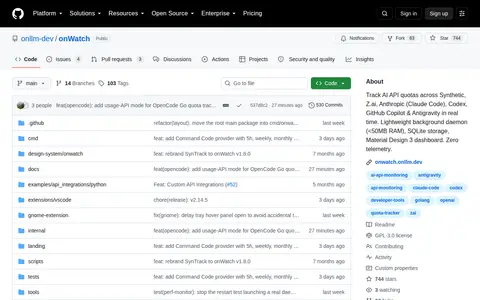
onWatch is an open-source tool developed by onllm-dev that tracks AI API quotas for services including Synthetic, Z.ai, Anthropic Claude Code, Codex, GitHub Copilot and Antigravity in real time. It functions as a lightweight background daemon that uses less than 50MB of RAM, stores data in SQLite, and provides a Material Design 3 dashboard. The tool does not collect telemetry.
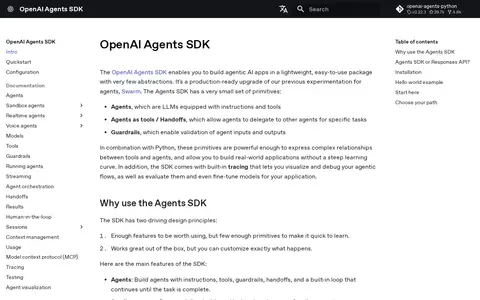
The OpenAI Agents SDK is a lightweight Python package for building agentic AI applications with few abstractions. It provides primitives including agents with instructions and tools, handoffs for delegating tasks between agents, and guardrails for validating inputs and outputs. It includes built-in tracing for visualizing and debugging agentic flows. The SDK uses the Responses API by default for OpenAI models and wraps model calls in a higher-level runtime.
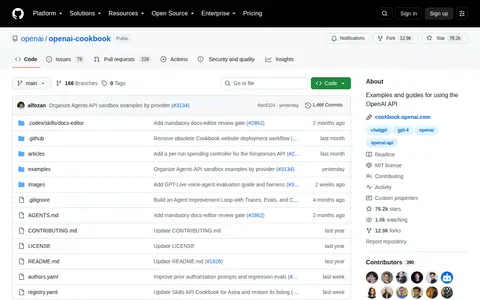
OpenAI Cookbook is a GitHub repository that provides examples and guides for using the OpenAI API. The collection helps developers integrate OpenAI models into their applications. It includes code samples, best practices, and documentation. The project is open source and accepts community contributions.
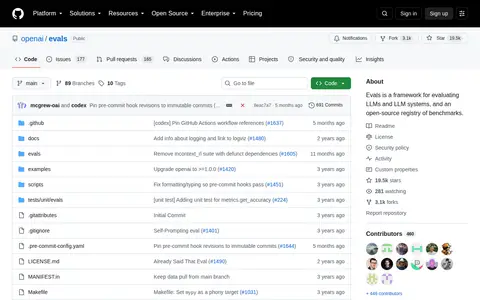
Evals is a framework for evaluating large language models and systems built using LLMs. It offers an existing registry of evals to test different dimensions of OpenAI models and the ability to write custom evals. It is available as an open-source registry of benchmarks. Evals require an OpenAI API key.
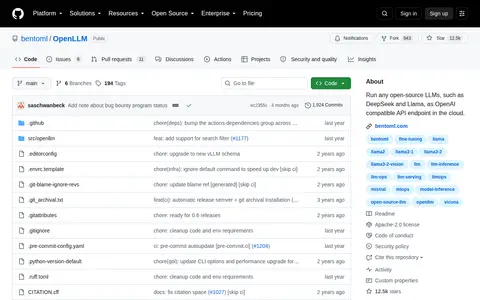
OpenLLM is a project from BentoML for running open-source LLMs or custom models as OpenAI-compatible APIs with a single command. It includes a built-in chat UI, inference backends, and a workflow for cloud deployment with Docker, Kubernetes, and BentoCloud, and it does not store model weights. A Hugging Face token is required for gated models.
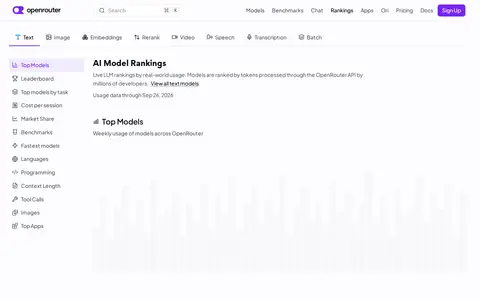
OpenRouter hosts an LLM ranking and AI leaderboard that ranks large language models by real-world usage metrics, specifically the volume of tokens processed through the OpenRouter API. It is intended to show which AI models are most widely used by developers.
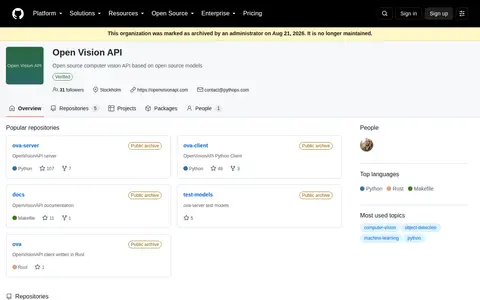
Open source computer vision API based on open source models.
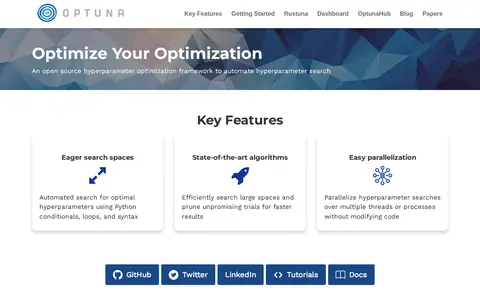
Optuna is an open source automatic hyperparameter optimization software framework designed for machine learning. It provides an imperative, define-by-run style user API with eager search spaces, algorithms that prune unpromising trials, and parallelization of searches over multiple threads or processes without modifying code. It is framework agnostic and can be installed with pip on Python 3.10 or newer.
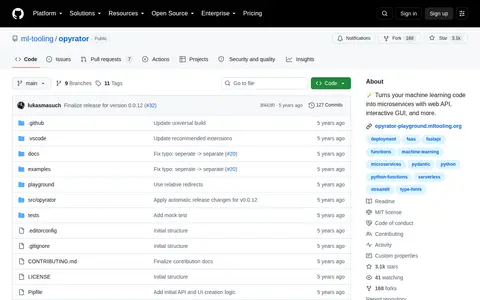
Turns your ML code into microservices with web API, interactive GUI, and more.
Owlbot is an AI chatbot platform for building AI assistants from documents and websites. It supports deployment on a website, mobile app, WhatsApp, Slack or API, and cites sources in replies. The page states that no code is required and lists 12 LLM models and 95 languages.
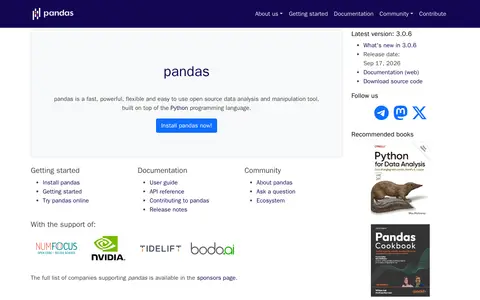
pandas is an open source, BSD-licensed library providing high-performance, easy-to-use data structures and data analysis tools for the Python programming language. It is described as a data analysis and manipulation tool built on top of Python. Documentation, a user guide and an API reference are available.
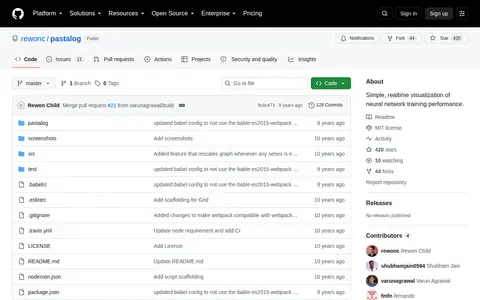
Pastalog is a realtime visualization server for neural network training performance. It works with Lasagne, Keras, Tensorflow, Torch, Theano and other frameworks. Data can be logged through a Python API, a Torch wrapper, or POST requests, and logged metrics update in real time at localhost.
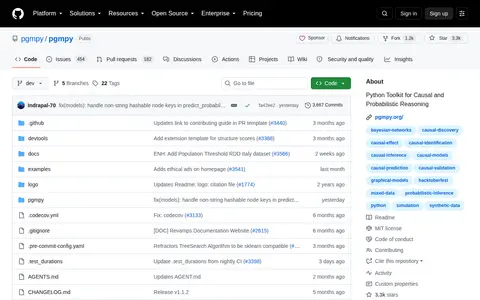
pgmpy is a Python toolkit for causal and probabilistic reasoning using graphical models. It implements data structures for models such as DAGs, PDAGs, MAGs, PAGs, Bayesian Networks, Dynamic Bayesian Networks and Structural Equation Models, with algorithms for tasks including causal discovery, causal identification, inference, model validation, parameter estimation and simulations. Algorithms follow a unified composable API and are scikit-learn compatible when possible. It is available on PyPI and conda.
PhotoRoom is an AI-powered photo editing and listing studio designed for e-commerce businesses and social media creators. It automates visual content creation, formats images for multiple online marketplaces, and provides tools including background removal, AI product photography, virtual try-on, batch processing, and API integration for large-scale workflows.