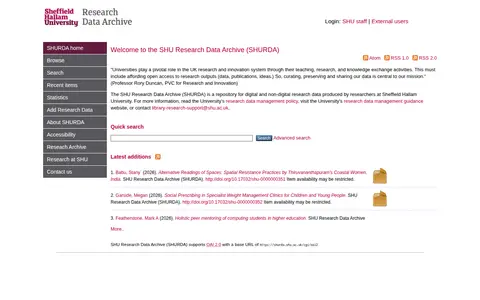
SHURDA is a repository for digital and non-digital research data produced by researchers at Sheffield Hallam University. It offers quick search and lists latest additions, and supports OAI 2.0 with a base URL.
Social Scientific Research Documentation Centre Repository
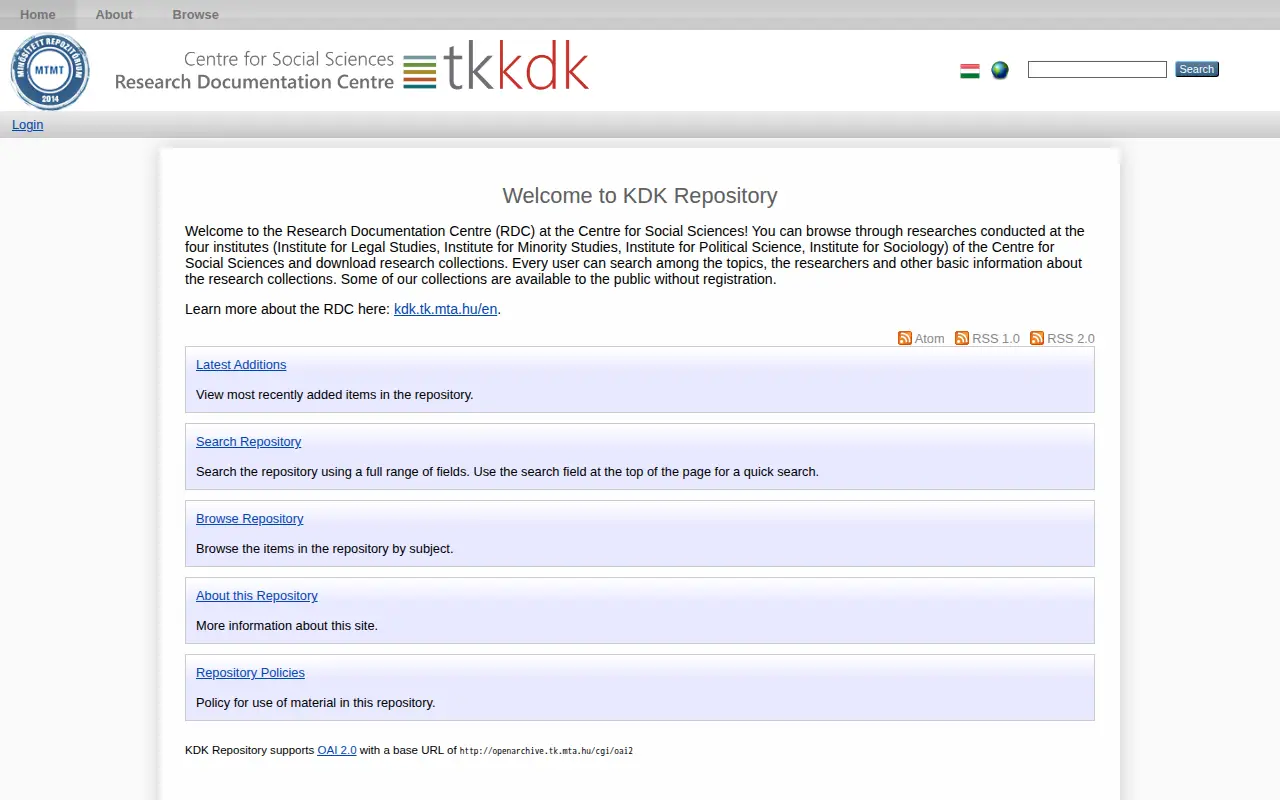
The KDK Repository hosts research collections from the Research Documentation Centre at the Centre for Social Sciences, covering four institutes: Legal Studies, Minority Studies, Political Science, and Sociology. Users can browse and download collections, and search topics and researchers. Some collections are publicly accessible without registration. The repository runs on EPrints 3 and supports OAI 2.0.
Features
- supports OAI 2.0 with base URL Source: openarchive.tk.mta.hu
- Some collections available to public without registration Source: openarchive.tk.mta.hu
Links
Tags
-
0SHURDA is a repository for digital and non-digital research data produced by researchers at Sheffield Hallam University. It offers quick search and lists latest additions, and supports OAI 2.0 with a base URL.
-
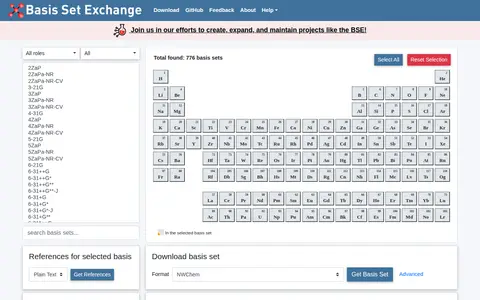
0The Basis Set Exchange (BSE) is a resource for quantum chemistry providing basis sets. The page shows selected basis set details including description, latest version, role, family, and function types, and offers basis set download, related references, and citation guidance.
-
0
Dataset repository covering acoustics, with searchable experimental data.
-
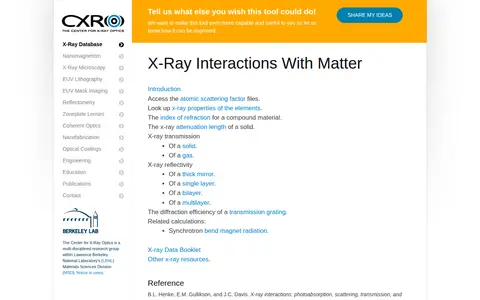
0The X-Ray Database is a reference from the Center for X-Ray Optics at Lawrence Berkeley National Laboratory. It provides access to atomic scattering factor files and lookups of x-ray properties of the elements, plus calculations for index of refraction, attenuation length, transmission, reflectivity and diffraction efficiency. It cites X-ray interaction data covering E=50-30000 eV for Z=1-92.
-
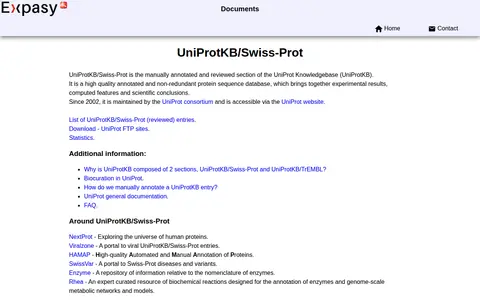
0UniProtKB/Swiss-Prot is the manually annotated and reviewed section of the UniProt Knowledgebase. It is a non-redundant protein sequence database that brings together experimental results, computed features and scientific conclusions. Since 2002 it has been maintained by the UniProt consortium and is accessible via the UniProt website.
-
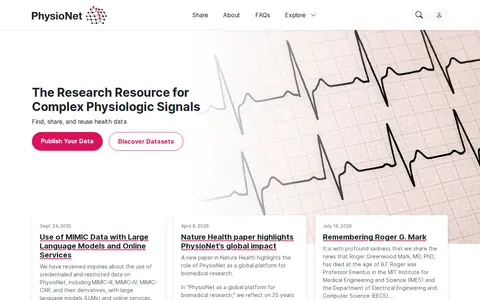
0PhysioNet is a research resource for complex physiologic signals that lets users find, share and reuse health data, including datasets such as MIMIC-IV, MIMIC-CXR and VitalDB. The PhysioNet Credentialed Data Use Agreement prohibits sharing access to credentialed and restricted data with third parties.
Community notes
Reviews and discussion
No reviews yet
Be the first to share how this project worked for you.
Join the discussion
Sign in with a verified account to leave a review or join the discussion.
Sign in to review