
opendata.citywindsor.ca
Find published open datasets through filters, categories and keyword search.

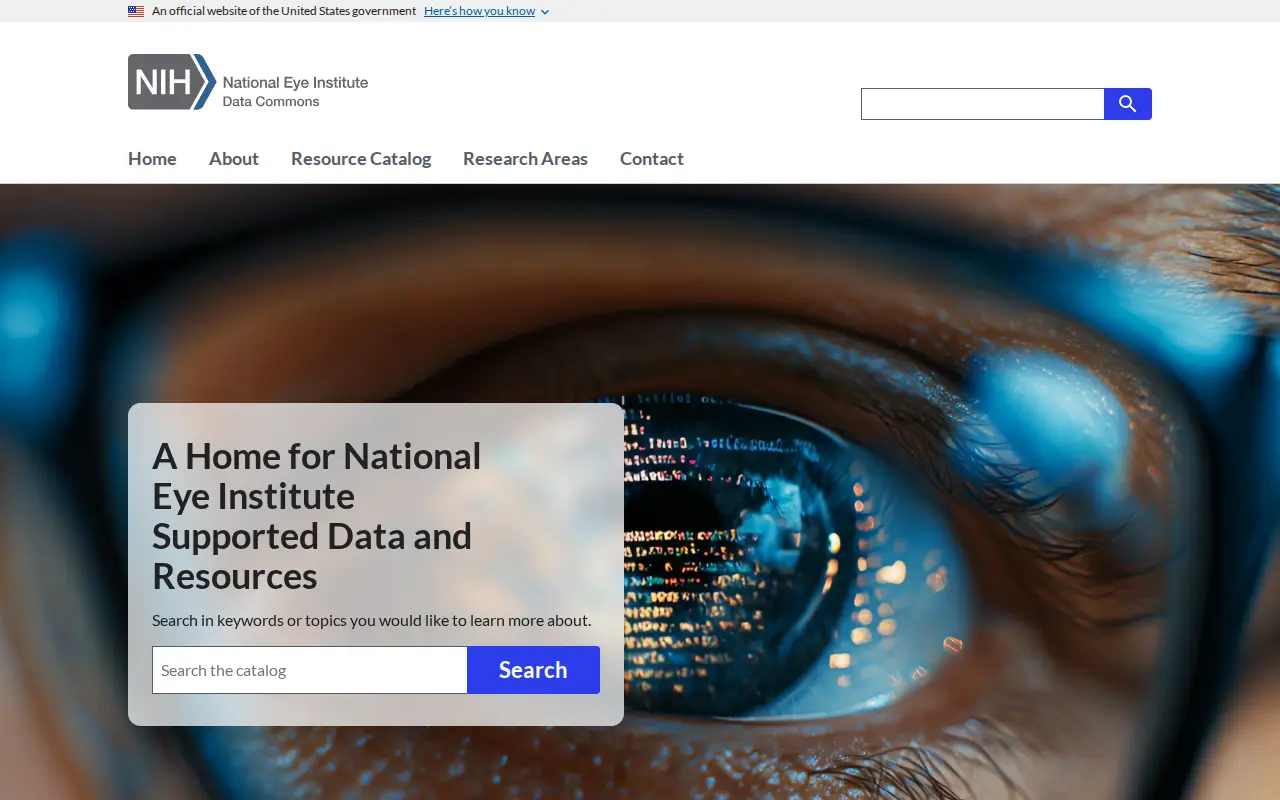
The National Eye Institute Data Commons is an official U.S. government repository for data and resources supported by the National Eye Institute. It hosts materials including next-generation sequencing data and associated tools, eyeGENE datasets and DNA samples for rare inherited eye disease research, the AMD IBI dataset, cone detection data, the Cat-Map resource, the Platform for Analysis of scEiad (PLAE), and materials related to perception, cognition and action research. Users can search the resource catalog.
Find published open datasets through filters, categories and keyword search.

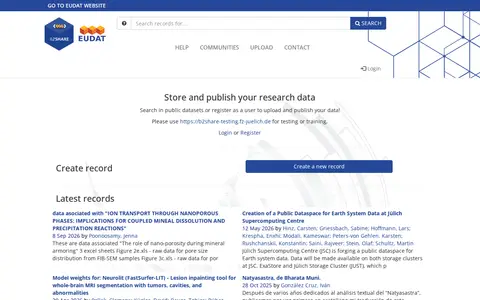
B2SHARE Server Forschungszentrum Jülich is a B2SHARE instance hosted by Forschungszentrum Jülich, operating as part of the EUDAT Collaborative Data Infrastructure. It is co-funded by the EOSC-hub project under Horizon 2020 grant number 777536.

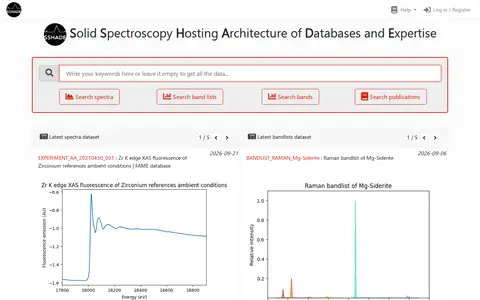
SSHADE is an interoperable solid spectroscopy database infrastructure providing spectral and photometric data from gamma to radio wavelengths. Measured samples include ices, minerals, rocks, organic and carbonaceous materials, and liquids. It contains specialized databases from various research groups, mostly from Europe, and can also be searched through the VESPA virtual observatory.

Browse research datasets and datasets related to biology.

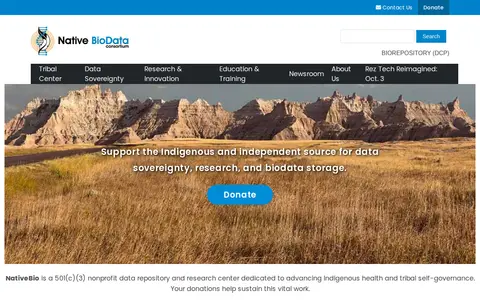
NativeBio is a 501(c)(3) nonprofit data repository and research center described as dedicated to advancing Indigenous health and tribal self-governance. It is presented as an Indigenous and independent source for data sovereignty, research, and biodata storage, and the site points visitors to a Tribal Data Repository (TDR). Its research sections cover microbial genomics and a tribal wastewater project.

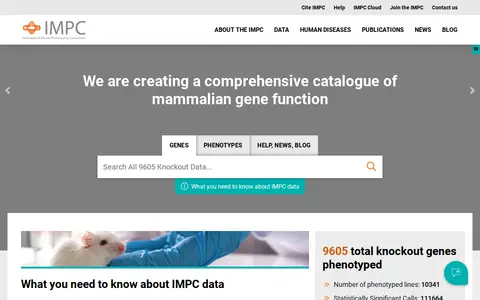
The International Mouse Phenotyping Consortium is an international research infrastructure that creates and phenotypes single-gene mouse knockout lines. Data release 24 reports 9,605 knockout genes phenotyped and over 138 million data points. The consortium states it generates its own data rather than aggregating publications, and targets genes that are yet to be studied.
Community notes
Be the first to share how this project worked for you.
Sign in with a verified account to leave a review or join the discussion.
Sign in to reviewKeep exploring
Find published open datasets through filters, categories and keyword search.
B2SHARE Server Forschungszentrum Jülich is a B2SHARE instance hosted by Forschungszentrum Jülich, operating as part of the EUDAT Collaborative Data Infrastructure. It is co-funded by the EOSC-hub project under Horizon 2020 grant number 777536.
SSHADE is an interoperable solid spectroscopy database infrastructure providing spectral and photometric data from gamma to radio wavelengths. Measured samples include ices, minerals, rocks, organic and carbonaceous materials, and liquids. It contains specialized databases from various research groups, mostly from Europe, and can also be searched through the VESPA virtual observatory.
Browse research datasets and datasets related to biology.
NativeBio is a 501(c)(3) nonprofit data repository and research center described as dedicated to advancing Indigenous health and tribal self-governance. It is presented as an Indigenous and independent source for data sovereignty, research, and biodata storage, and the site points visitors to a Tribal Data Repository (TDR). Its research sections cover microbial genomics and a tribal wastewater project.
The International Mouse Phenotyping Consortium is an international research infrastructure that creates and phenotypes single-gene mouse knockout lines. Data release 24 reports 9,605 knockout genes phenotyped and over 138 million data points. The consortium states it generates its own data rather than aggregating publications, and targets genes that are yet to be studied.