data.gns.cri.nz
Browse research datasets and datasets related to atmospheric.
Recently added
Browse dated community launches and imported or editorial directory additions.
Browse research datasets and datasets related to atmospheric.
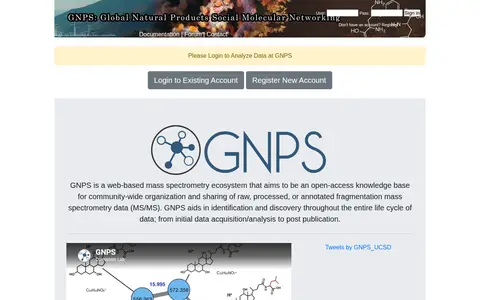
GNPS is a web-based mass spectrometry ecosystem serving as an open-access knowledge base for community-wide organization and sharing of raw, processed or annotated fragmentation mass spectrometry data. It provides tools for molecular networking, library search, MASST search and dataset browsing, supporting identification and discovery across the data life cycle.
Searchable repository for finding agriculture, forestry and veterinary medicine datasets and genomic data.

Find published open datasets through filters, categories and keyword search.

Dataset repository covering basic in biology and medicine, with searchable datasets.
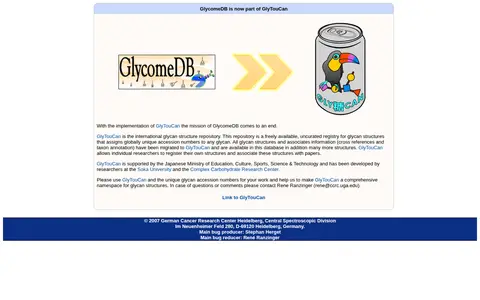
GlycomeDB was a metadatabase of carbohydrate structures that has become part of GlyTouCan. Its glycan structures and related cross-reference and taxon annotation data were migrated to GlyTouCan, the international glycan structure repository. GlyTouCan assigns globally unique accession numbers and allows individual researchers to register their own structures.

Gloucester City Council publishes open data for reuse, including payment performance statistics by year and monthly spending datasets in CSV format. The council asks users to credit Gloucester City Council as the source and states the data is released under the open government licence.

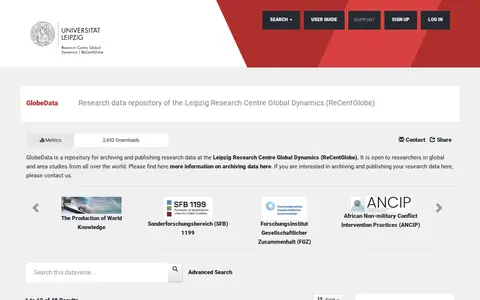
GlobeData is a repository for archiving and publishing research data at the Leipzig Research Centre Global Dynamics (ReCentGlobe). It is open to researchers in global and area studies worldwide. The repository offers support for data archiving, a user guide, and metrics such as downloads. GlobeData is part of the Collaborative Research Centre (SFB) 1199 and the FGZ.

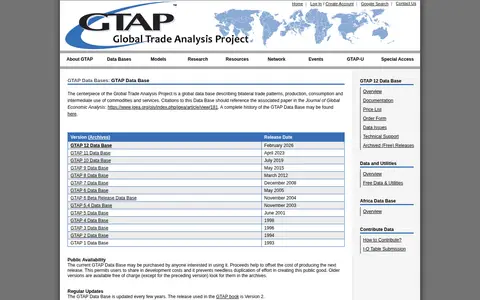
The Global Trade Analysis Project maintains a global database describing bilateral trade patterns, production, consumption and intermediate use of commodities and services. The current database may be purchased; older versions are available free of charge except for the preceding version. It is updated every few years.

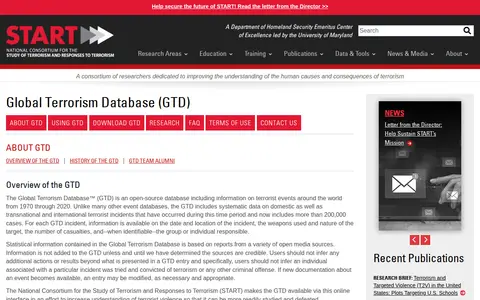
The Global Terrorism Database is an open-source database of terrorist events worldwide from 1970 through 2020, with more than 200,000 cases. Each incident entry covers the date and location, weapons used, target nature, casualties and, when identifiable, the responsible group or individual. Data is drawn from open media sources and added only after source credibility is determined.

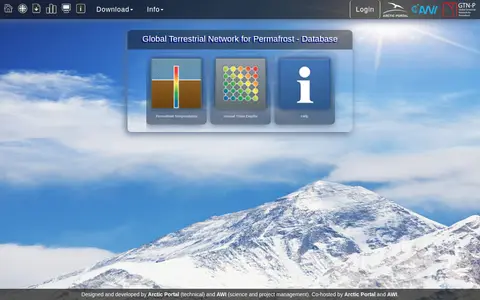
Global Terrestrial Network for Permafrost (GTN-P) Data Management System contains metadata and quality-controlled data on permafrost temperatures and annual thaw depths. The database, currently in beta, offers access to permafrost temperature and active layer data. It is co-hosted by the Arctic Portal and the Alfred Wegener Institute (AWI).
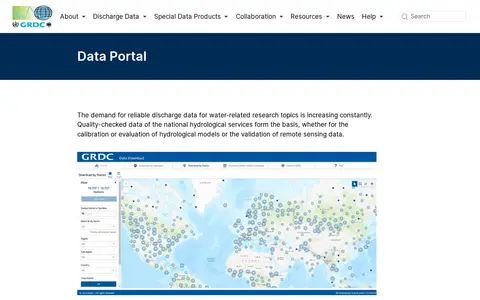
The GRDC Data Portal is a web-based tool for searching and visualising runoff stations and time series data in map and table view. Users select stations, regions, subregions or countries and download data in six formats, with optional subregion or watershed boundaries. Hydrological data are released only for research purposes; commercial use and redistribution are not allowed.

The Global Record of Stocks and Fisheries (GRSF) catalogue is a beta version integrating data from FIRMS, the RAM Legacy Stock Assessment Database, FishSource and the FAO SDG 14.4.1 Questionnaire. It tests logic for generating unique identifiers for stocks and fisheries. Public access is to beta content only, and review of collated stock and fishery data is restricted to selected users.

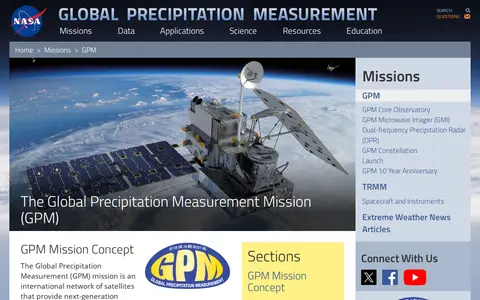
The Global Precipitation Measurement (GPM) mission is an international network of satellites providing global observations of rain and snow. It centers on a Core Observatory satellite with an advanced radar/radiometer system that measures precipitation from space and serves as a reference standard to unify measurements from a constellation of research and operational satellites. The mission was initiated by NASA and JAXA as a successor to TRMM.
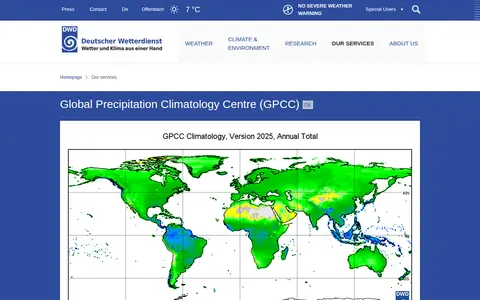
The Global Precipitation Climatology Centre is operated by DWD under the auspices of the World Meteorological Organization. It provides global precipitation analyses for climate monitoring and research, with gridded monthly and daily data sets available through the GPCC Visualizer and Download Gate.
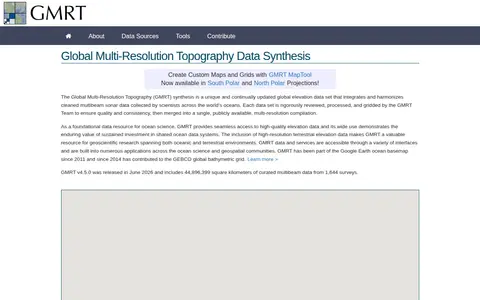
The Global Multi-Resolution Topography (GMRT) synthesis is a continually updated global elevation data set. It integrates cleaned multibeam sonar data collected by scientists across the world's oceans, which the GMRT Team reviews, processes and grids before merging into a single publicly available multi-resolution compilation. It also includes high-resolution terrestrial elevation data.
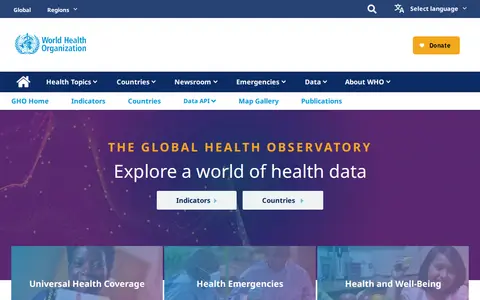
The Global Health Observatory data repository is the World Health Organization's gateway to health-related statistics for its 194 Member States, providing access to over 1000 health topic indicators through indicators, countries, a data API and a map gallery. COVID-19 data is not currently provided by the GHO APIs.

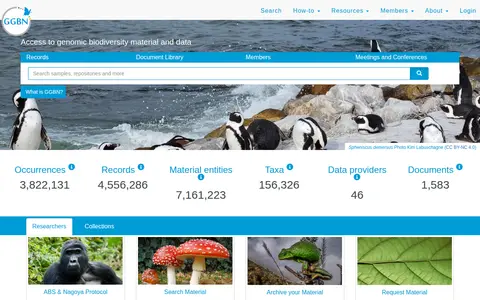
GGBN is a global network of well-managed collections of genomic samples from across the Tree of Life. It provides access to genomic biodiversity material and data, with occurrence, record, material entity and taxon counts. It also offers a document library, ABS and Nagoya Protocol resources, and facilities to search and request material.

Dataset repository covering agriculture, forestry and veterinary medicine, with searchable geospatial data.

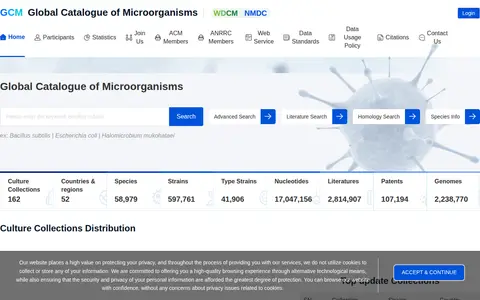
The Global Catalogue of Microorganisms is a system designed to help culture collections manage, disseminate, and share information about their holdings. It also provides a uniform interface for scientific and industrial users to access comprehensive microbial resource information.

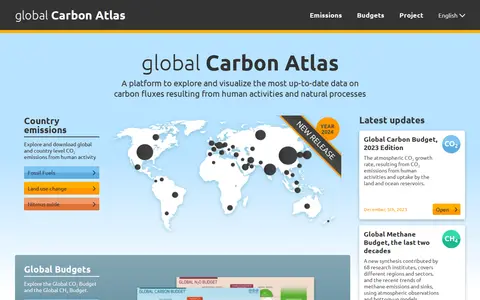
The Global Carbon Atlas is a platform for exploring and visualizing data on carbon fluxes from human activities and natural processes. It offers country-level CO₂ emissions data for fossil fuels and land use change, plus global budgets for carbon, methane and nitrous oxide, and material on city emissions and river carbon transport.
The Glasgow Open Glasgow Data Portal is the Glasgow Open Data Hub. It allows users to create custom initiatives by combining existing applications with a custom site, form teams around specific problems, and invite community participation.

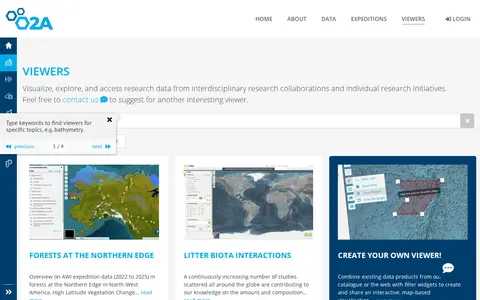
The GIS Maps Portal at AWI is part of the O2A Data Portal, which was developed by scientists for scientists to support FAIR research data management. It enables users to publish, visualize, browse, and access research data from both interdisciplinary research collaborations and individual research initiatives.

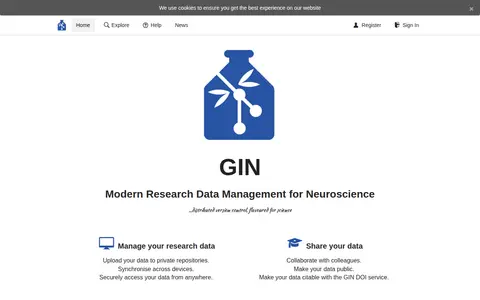
GIN is a free data management system for neuroscientific data, built on open source projects including Git, git-annex, and Gogs. It syncs directories to a dedicated server and tracks changes to files and folders. Data can be shared with collaborators, made citable through a DOI service, and accessed from web and file browsers or a command line interface.