Yahoo vs Qwant
Yahoo vs Qwant: compare free web search, result sources, saved settings, mobile access and advertising. Choose a new default for your everyday searches.
On this page
Qwant is my pick for someone choosing a fresh free search default; Yahoo makes sense if its results and familiar account setup already work for you. The Yahoo vs Qwant choice isn't a price contest. Both offer ordinary web search without a subscription, and neither gives you a wholly separate result source just because you changed the name in the address bar.
The detail to notice first is Qwant's Microsoft partnership. Its own ranking statement describes third-party indexing alongside its own work. Yahoo's transparency report says its general algorithmic results come from Bing. Moving between these services can change the interface without removing every shared dependency behind the results.
Yahoo vs Qwant at a glance
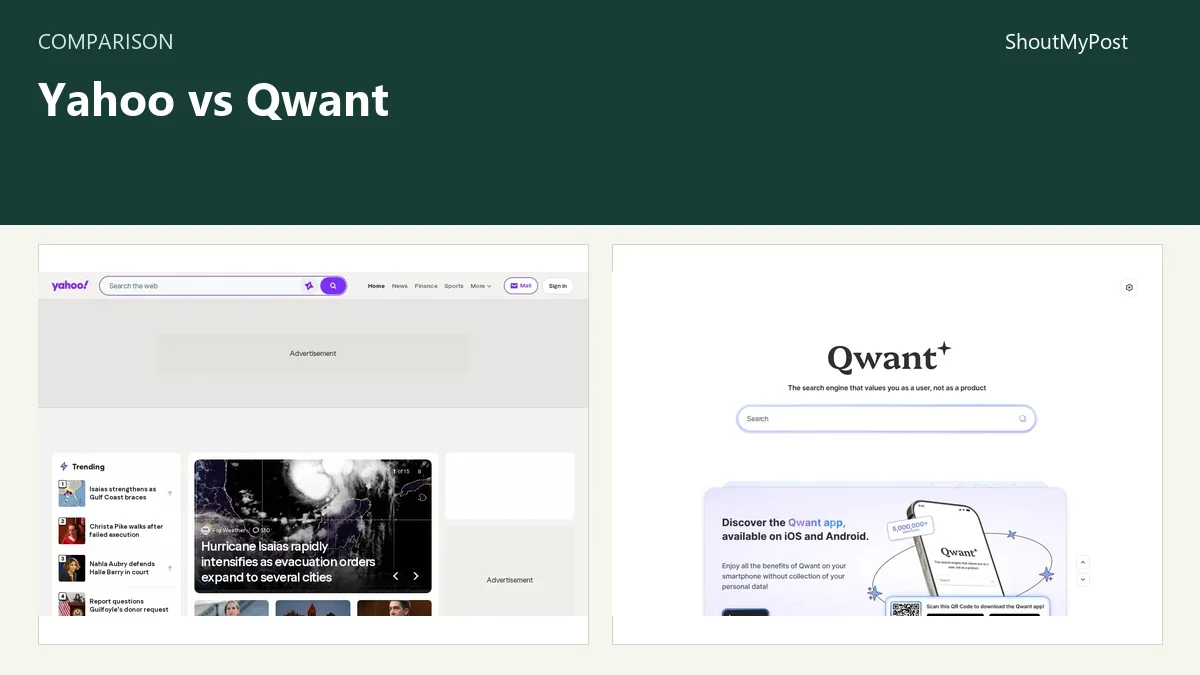
The Yahoo listing and Qwant listing cover the two services. Source names below refer to official pages checked October 9, 2026.
| Factor | Yahoo Search | Qwant | Official source and date checked |
|---|---|---|---|
| Free plan | Ordinary public web search | Ordinary public web search | Yahoo Search; Qwant Search terms; Oct 9, 2026 |
| Paid search price | No ordinary search subscription shown | No ordinary search subscription needed | Yahoo Search; Qwant Search terms; Oct 9, 2026 |
| Search allowance | No prepaid search balance displayed | No prepaid search balance described | Yahoo Search; Qwant Search terms; Oct 9, 2026 |
| Platforms | Desktop and mobile browsers | Web, iOS and Android apps | Yahoo Advanced Search help; Qwant Search product page; Oct 9, 2026 |
| Result sources | General algorithmic results supplied by Bing | Own indexing supplemented by third-party indexing, including Bing | Yahoo DSA Transparency Report; Qwant ranking statement; Oct 9, 2026 |
| Preferences | Saved search preferences; separate advanced form | Region, language, adult-content filter and Flash Answer setting | Yahoo Preferences help; Qwant Search help; Oct 9, 2026 |
| Browser integration | Browser default-engine setup documented | Default-search extension linked by the vendor | Yahoo default-engine help; Qwant settings page; Oct 9, 2026 |
| Open source | Complete service source not published on the search page | Complete production search source not offered on the product page | Yahoo Search; Qwant Search page; Oct 9, 2026 |
| Release information | Continuously operated website, no numbered search release shown | Search help includes July 21, 2026 updates | Yahoo Search; Qwant Search help; Oct 9, 2026 |
| Data and location | Yahoo service with Microsoft-supplied general results | French operator; product page says Europe-hosted; policy describes partner transfers | Yahoo DSA report; Qwant Search page and Privacy Policy; Oct 9, 2026 |
Result sources: a different interface can still share Bing
Yahoo's current transparency report explains that Microsoft supplies general search results using Bing's index and ranking. It also describes why a page removed upstream can disappear from Yahoo after a delay.
Qwant's official classification statement says its own indexing is supplemented by third-party services, including Microsoft Bing. That gives it a different mix, but it isn't a promise that every webpage result came from a crawler operated entirely by Qwant.
This matters when the reason for switching is a missing website. If the old engine doesn't find a page, changing interfaces might find it, or the same upstream gap might remain. A result title, the order of the matches and the query's wording can still differ between services sharing a source.
For that reason, I'd compare a few tasks you actually repeat: a local service, a product's official support page and a niche subject you read about. Check whether the destination answers the question. Counting result cards is less helpful than finding the document you needed.
My choice between these two is Qwant for a new default, mainly because its documented settings make a comfortable starting point. Its weakness is that a European alternative doesn't automatically provide complete independence from Microsoft. Yahoo's weakness is the stronger reliance on Bing for general results.
Winner for a new free default with a differently documented result mix: Qwant. Neither wins a claim to complete index independence.
Settings: Yahoo separates saved preferences from Advanced Search
Yahoo has two workflows. Saved preferences shape ordinary searches, while Advanced Search uses its own form. Its preferences guide also separates signed-in settings from device-local signed-out choices.
That distinction is helpful for someone who regularly runs a constrained query, then returns to broader everyday searches. You can keep the ordinary setup and make a different choice for the one-off search. The weakness is that it can look as though a setting has been ignored if you don't realize the advanced form is separate.
Qwant's Search help covers region, language and adult-content filtering, plus turning Flash Answer off. That last control appeals to readers who want to open webpage results themselves. Turning off an answer feature doesn't also turn off the advertising used to fund search.
A fair comparison starts with the same region and language on both websites. Otherwise, a local query may be comparing different geographic choices. Use the place name in the query when the location matters, especially for a business whose name exists in several cities.
I prefer Qwant's setup for a reader who wants a short list of controls and then a normal results page. Yahoo gets the advantage when the advanced form is part of the job. Neither menu is a substitute for your browser's default-engine setting.
Winner for separate advanced-query controls: Yahoo. Winner for switching the answer feature off in the documented search settings: Qwant.
Advertising and data: free search still has a funding model
Neither service asks you to buy a search allowance for ordinary use. That's the main cost advantage over a paid product such as Kagi Search. It also means the comparison needs to look at advertising and the data described by each service.
Qwant's Privacy Policy describes contextual advertising without advertising consent and additional processing when an account user consents to personalized ads. It also lists technical transfers to Microsoft for supplying results and protecting the partner service, including full-IP transfers for security checks.
Those details are a reason to read the cookie choices rather than treating a short privacy slogan as the whole policy. Qwant's French operation and Europe-hosted product claim don't mean no partner receives technical information.
Yahoo's transparency material describes Microsoft's role in results and advertising. I wouldn't choose it on the assumption that familiar account branding makes the search request private. If the deciding factor is a paid, ad-free search model or a nonprofit operator, the two free services aren't the whole shortlist.
MetaGer's documented prepaid model is another option, and its project page is a place to start. That changes how search is funded. It doesn't turn a browser into a private environment for every website you open afterward.
Between Yahoo and Qwant, my preference is Qwant with its account and consent choices understood. The real weakness is the partner processing in the published policy, so I wouldn't recommend it as a service that sends nothing to third parties.
Winner for this free-search shortlist: Qwant, with the documented partner transfers included in the decision.
Mobile use: compare the search website with the app
Yahoo documents Advanced Search from desktop and mobile browsers. Qwant's product page links to iOS and Android apps. Those are practical access routes, but installing an app is a larger change than switching a browser's search default.
If the existing browser already holds your bookmarks and tabs, start by using the new search website there. You can see whether it finds your usual destinations before moving the rest of your browsing. A search choice shouldn't require rebuilding unrelated browser habits.
The app route matters when you want the vendor's mobile interface. It can also disappoint if an update changes a feature you depended on. Search quality and the navigation around it are separate reasons to stay or leave.
My recommendation is Qwant for someone who wants its named app on either major phone platform. Yahoo remains a browser choice without making the article depend on a particular app edition. Keep the desktop and phone comparison focused on the queries you make on each device; a research laptop and a phone looking for a nearby address aren't doing identical work.
Winner for a clearly documented iOS and Android app choice: Qwant.
What users say
A July 2026 Yahoo discussion includes a reader who finds its results easier to use than Google's and another who likes the news-and-search start page. Other commenters see little reason to use a Bing-backed interface. Familiarity is a real benefit here, while the complaint is about how much the switch actually changes.
An April 2026 Qwant discussion praises everyday searches but describes weaker niche results. A reader also misses visible publication dates on Reddit results. My pick is still Qwant for starting fresh, but these reports make a strong case for including a small-site query in your own comparison.
Choose Yahoo if…
- Its familiar search and account setup already gets you to the pages you need.
- You regularly use the Advanced Search form for a particular query.
- You want to keep a free website-based search habit without moving to another mobile app.
Choose Qwant if…
- You're choosing a new free default and want its region and language controls.
- You want the documented Flash Answer off switch.
- You prefer its iOS or Android app, while accepting the result partners described in its policy.
Other options
Searx Party is the option for selecting upstream engines on a public SearXNG instance. MetaGer adds a nonprofit operator and prepaid search tokens. Both are included in the search engines directory.
More search alternatives
FAQ
Is either service a paid search subscription?
Neither requires a subscription for ordinary public web searches in the offers covered here. You're comparing free search interfaces, rather than a fixed monthly query allowance. A separate Yahoo product or account upgrade isn't automatically a paid Search plan. If you want an ad-free subscription service, compare that model separately from these two websites.
Does changing to Qwant make it my browser's default?
Opening Qwant doesn't by itself replace the address-bar engine. Use your browser's search settings or the vendor's documented integration to select it. A home-screen widget can still use a different service because it starts the request outside the browser. Confirm the destination address when the result doesn't match the engine you selected.
Which should I use for a missing niche website?
Try the same specific query on both, then use a third engine if neither finds the page. Yahoo and Qwant have shared upstream dependencies, so switching between them can't guarantee complete new coverage. A specialist index such as Marginalia is another route for noncommercial pages; the publisher's own navigation is better when you already know its domain.
Sources
Yahoo DSA Transparency Report, Preferences and Advanced Search help; Qwant Search, classification statement, help center and Privacy Policy; the linked reader discussions. Official facts checked October 9, 2026.
Related articles
Current evidence
Verified facts
Each value shows its source and when it was checked.
No shared facts have current source and check-date evidence yet. Facts without that evidence are left out.