Wiby vs Mwmbl
Wiby vs Mwmbl: compare free search, page selection, community editing and privacy. Pick a classic-web discovery tool or help improve a shared index.
On this page
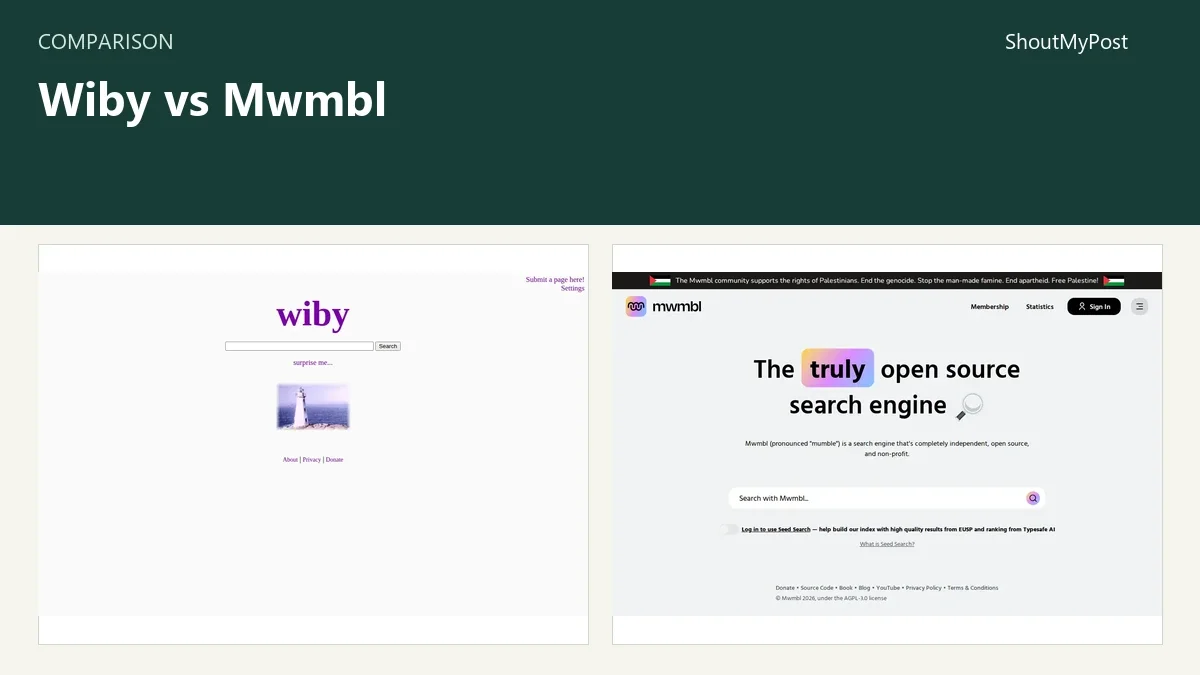
Wiby vs Mwmbl has a clear winner for casual discovery: Wiby. Pick it for simple personal sites and wandering into an unfamiliar subject. Choose Mwmbl if you want a search index you can help improve. Both offer free public searching, but they ask different things of a reader.
Wiby vs Mwmbl: one submitted page isn't a whole website
Wiby's submission page says that, in most cases, only the submitted page gets crawled. Finding one excellent page therefore doesn't mean the rest of its author's site is searchable. That's the detail I would carry into a first visit.
Mwmbl's contribution model operates around queries and approved results. You can improve the answer someone else gets, not just add a site to a private reading list. Its curation documentation describes approving existing entries and adding URLs.
The Wiby listing and Mwmbl listing point to the services. This comparison is about their public search experiences; neither requires installing a crawler to type a query.
At a glance
Official pages checked October 9, 2026. Source names in the last column apply to both tool cells unless that column specifies one tool.
| Factor | Wiby | Mwmbl | Source and date checked |
|---|---|---|---|
| Free plan | Free public search | Free basic search without an account | Wiby homepage; Mwmbl Terms; Oct. 9, 2026 |
| Paid price | No paid public-search tier listed | No paid basic-search tier listed | Wiby homepage; Mwmbl Terms; Oct. 9, 2026 |
| Main limit | Selective index; usually only a submitted page is crawled | Growing index; optional Seed Search has a logged-in quota | Wiby submission guide; Mwmbl Seed Search; Oct. 9, 2026 |
| Platforms | Web browser, including an emphasis on older machines | Web browser | Wiby About; Mwmbl homepage; Oct. 9, 2026 |
| Main features | Classic-web search; surprise-me discovery | Search and community curation | Wiby homepage; Mwmbl Curation Guidelines; Oct. 9, 2026 |
| Integrations | JSON search output | Crawling API with personal keys | Wiby About; Mwmbl Terms; Oct. 9, 2026 |
| Open source | Yes, GPLv2 | Yes, AGPL-3.0; dataset separately licensed | Wiby About; Mwmbl Terms; Oct. 9, 2026 |
| Update signal | Public submission rules and source install guide are available; no dated release supplied there | Privacy policy updated June 3, 2026; GitHub Releases has no published releases | Wiby submission/install guides; Mwmbl Privacy/Releases; Oct. 9, 2026 |
| Privacy | Raw access logs retained up to 48 hours and kept private | Says IPs aren't stored on disk and query logs aren't linked to accounts | Both privacy policies; Oct. 9, 2026 |
| Data location | Privacy page doesn't identify a hosting region | Other personal-data processing in EEA/UK; search providers may process queries elsewhere | Both privacy policies; Oct. 9, 2026 |
Page selection: Wiby has the tighter editorial purpose
Wiby prefers simple HTML and noncommercial sites. Its submission rules also reject intrusive advertising and discourage pages that mainly point visitors toward heavier websites. A page's construction affects whether it belongs in the index.
That creates a recognizable browsing choice. If you enjoy reading a person's long-running project notes or a hand-built reference site, a narrow selection rule can save you from results designed mainly to sell something. The result list doesn't need to cover every publisher to be enjoyable.
The cost is exclusion. A modern page can contain the exact answer you need, and an author may use a complicated layout for reasons unrelated to quality. I wouldn't choose Wiby as the only route to current product instructions or a broad survey of a subject. A focused collection is strongest when you want that focus.
Mwmbl aims at a more general search role through community contributions and its own index. Its selection process isn't built around preserving an earlier web aesthetic. A query can gain a strong result because a contributor recognizes that it answers the question.
That direction is better for someone whose interest is the answer itself, regardless of whether the author wrote a plain HTML page or uses a current publishing system. It also asks more of contributors: a shared result needs to work for people who haven't already learned the subject.
For a weekend of reading, I prefer the narrower invitation. For the ongoing job of finding explanations across different sites, I would keep another engine nearby whichever of these I chose.
Winner for classic-web discovery: Wiby.
Contribution: Mwmbl gives readers a more direct role
Wiby's submission form is a way to nominate a page for its index. You supply a URL, with the submission rules defining what fits. This is especially attractive when you find a small site that a larger search engine rarely surfaces.
Mwmbl lets readers work on results for a particular query. Approving an entry can move it up, and adding a missing URL can fill a specific gap. That connects the contribution to a question, rather than merely placing a page in a general collection.
My pick is Mwmbl if you often find yourself thinking, “This explanation should be easier to find.” You can contribute where that explanation belongs. Another reader searching the same subject then has a chance to benefit without sharing your bookmarks.
The weakness is that contribution isn't always what you want to do. A frustrating result page may arrive while you're trying to solve another problem. The opportunity to help fix search doesn't remove the immediate need to find an answer somewhere else.
Mwmbl's Terms separate basic searching from account-based curation. They also describe a crawling API, with personal API keys and a separate dataset license. Running a crawler is an additional project; it isn't a hidden step in ordinary browsing.
For a group researching one topic, I would still keep the final source URLs in shared notes. Search results can change, and a good contribution isn't a substitute for recording the exact page that supported a decision. This applies even when the engine itself is open source.
Winner for contributing to shared results: Mwmbl.
Query routes and privacy: read the actual policies
Wiby's privacy policy says raw access logs are kept for up to 48 hours, automatically deleted afterward and not shared with third parties. That is a concrete retention statement, with a clear time period.
Mwmbl's June 2026 privacy policy describes outside content sources and the optional Seed Search route. Seed Search sends the query and candidate results to EUSP and TypeSafe AI's Jev ranking service. The policy says account identity isn't forwarded with those requests, but provider processing can happen outside the EEA or UK.
This is the surprising part of comparing two independent projects: “has its own index” doesn't describe every optional search route. If you specifically want to avoid AI reranking, that mode choice matters more than whether the search engine's repository is public.
Neither policy makes the destination website part of the search service. After opening a result, the page you visit has its own requests and account system. Pick the result route you want, then judge the destination separately when a login or private information is involved.
I favor Wiby here for a reader who wants the simpler documented route and a specific raw-log retention period. Mwmbl gives more detail about its newer provider setup, which helps a reader decide how to use it. Its account contribution tools create another choice alongside the search box.
Winner for the simpler documented search path: Wiby.
What users say
An October 2022 Hacker News discussion about Wiby praises finding hobby projects and practical pages that don't rank highly elsewhere. Replies also object to judging content by presentation and raise accessibility objections to treating minimal styling as inherently better.
That tension matters. A reader who misses personal homepages may welcome the selection. A reader who simply needs an accurate answer may see an unnecessary restriction. My recommendation for Wiby follows the first reader's goal.
The September 2023 Mwmbl launch discussion includes enthusiasm for a nonprofit search engine and quick results, as well as complaints about missing pages. Developer Daoud Clarke encouraged contributions and credited Marginalia as an inspiration.
For Mwmbl, I would separate support for the project from reliance on it for every query. Contributing can be worthwhile even if you still reach for a broader engine when a search comes back empty. Neither the mission nor a successful example supplies a reason to promise complete coverage.
Choose Wiby if…
- You want personal and hobby pages with a classic-web feel.
- You like discovering a topic without first writing a precise question.
- You prefer ordinary browsing to editing a shared result set.
- You accept that many current sites fall outside its selection rules.
Choose Mwmbl if…
- You want to improve results for a query you understand.
- You support an open search project through contributions.
- You want general-search ambitions rather than a classic-web collection.
- You're comfortable keeping a second engine for gaps in coverage.
Other options
Marginalia Search is my next choice for text-heavy discovery with personal filtering controls. Kagi Search adds paid daily-search tools. Its existing Kagi versus Qwant comparison explains another paid-versus-free decision.
Searx Party provides hosted metasearch, while MetaGer uses a search-key model. Explore the search engines category for the listings and the existing Presearch alternatives page for another switching shortlist.
FAQ
Are Wiby and Mwmbl free?
Yes, both provide free public web searching. Mwmbl's Terms say basic search doesn't need an account; contributions use one. Wiby displays public search without a paid browsing tier. Optional contributor work or running either project's software on your own server can add tasks and hosting costs beyond using the public search page.
Does Wiby index whole websites after a submission?
Usually it crawls only the submitted page, according to Wiby's submission guide. Use the exact page that contains the material you want searchers to find. Don't assume the homepage submission will make every article discoverable. Wiby also discourages submitting large numbers of pages from one person's site.
Can I transfer my Mwmbl contributions to Wiby?
There is no documented one-click transfer between the two services. A Mwmbl contribution belongs to a query and shared result set; a Wiby submission nominates a page for its selective index. Keep the original source URLs in your bookmarks, then use the other service's own submission process when a page fits.
Sources
Wiby homepage, About, submission guide, privacy policy and source install guide; Mwmbl homepage, Terms, Curation Guidelines, Seed Search, privacy policy and GitHub Releases. Official facts checked October 9, 2026; discussion links appear in the feedback section.
Related articles
Current evidence
Verified facts
Each value shows its source and when it was checked.
No shared facts have current source and check-date evidence yet. Facts without that evidence are left out.