Wiby vs Marginalia
Wiby vs Marginalia: compare personal websites, topic searches, discovery tools and access logs. Choose a free second engine for pages broad search misses.
On this page
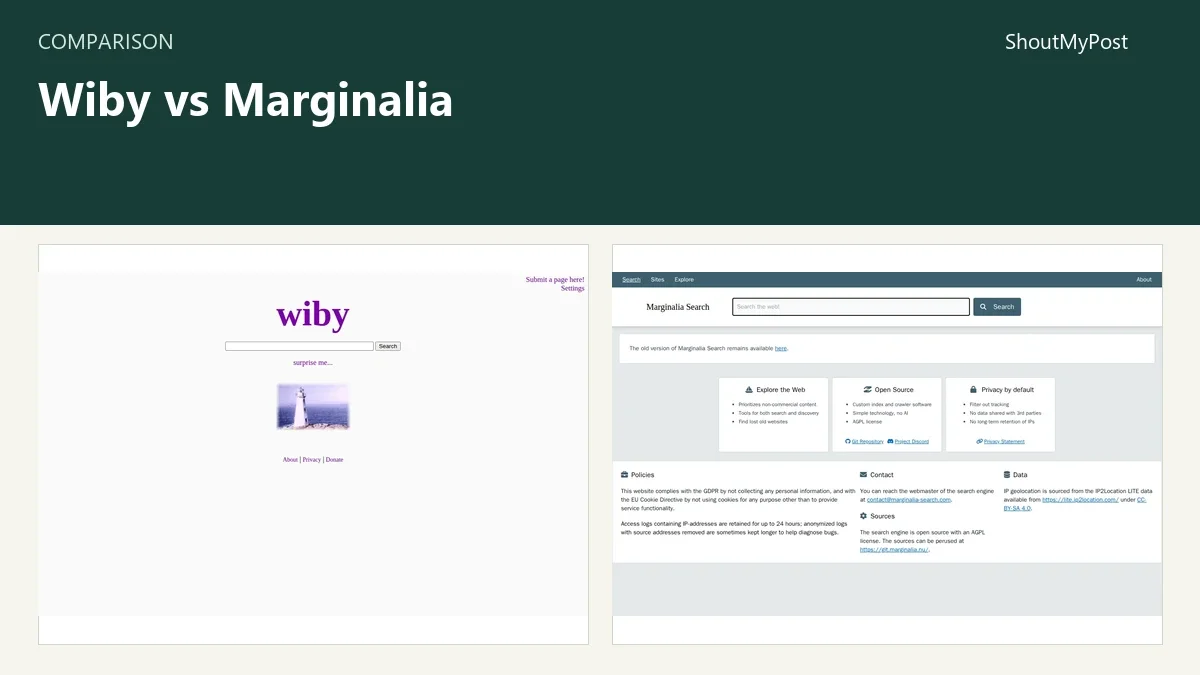
Marginalia is my pick for searching a topic across noncommercial pages; Wiby is the choice for following a tightly focused collection of simple personal websites. Both are free public services. Wiby vs Marginalia is a discovery decision, rather than a contest to replace every local, news and shopping query in your browser.
One small but concrete difference is access-log retention. Wiby's policy says raw logs stay for up to 48 hours; Marginalia says IP-containing access logs stay for up to 24 hours. A minimal page and an open-source license don't automatically mean the hosted service keeps no logs at all.
Wiby vs Marginalia at a glance
The Wiby listing and Marginalia Search listing cover the projects. Official sources below were checked October 9, 2026.
| Factor | Wiby | Marginalia Search | Official source and date checked |
|---|---|---|---|
| Free plan | Free public search | Free public search | Wiby homepage; Marginalia homepage; Oct 9, 2026 |
| Paid search price | No public search subscription shown; donations accepted | No public search subscription shown; donations and other funding described | Wiby Donate; Marginalia About; Oct 9, 2026 |
| Search allowance | No prepaid search balance displayed | No prepaid search balance displayed | Both public homepages; Oct 9, 2026 |
| Platforms | Browser, with a focus on simple pages and vintage-browser access | Browser; an old interface is offered for text-based browsers | Wiby About; Marginalia homepage; Oct 9, 2026 |
| Indexed material | Simple personal and hobby pages; human-seeded index | Noncommercial, content-rich material; own crawler and index | Wiby Submit and operator guide; Marginalia homepage; Oct 9, 2026 |
| Discovery controls | Query search and random surprise redirect | Search, Sites and Explore interfaces | Both homepages; Oct 9, 2026 |
| Developer access | JSON output documented | API linked from official About page | Wiby About; Marginalia About; Oct 9, 2026 |
| Open source | GPLv2 | AGPL | Wiby About; Marginalia homepage; Oct 9, 2026 |
| Dated documentation | Operator guide gives July 8, 2022 source-release date | About page dated January 1, 2025 | Wiby operator guide; Marginalia About; Oct 9, 2026 |
| Hosted release number | No numbered hosted-service release displayed | No numbered hosted-service release displayed | Both public homepages; Oct 9, 2026 |
| Privacy and location | Raw access logs up to 48 hours; not shared with third parties | IP logs up to 24 hours; anonymized logs may remain longer; operated from Sweden | Wiby Privacy Policy; Marginalia About and homepage; Oct 9, 2026 |
Topic searches: Marginalia is the better starting point
Marginalia's homepage describes a custom crawler and index that prioritizes noncommercial content. Its About page describes the project as a complement to broad engines. That makes the intended job clear: find pages that an ordinary search might bury.
Wiby's About page centers simple sites made around personal interests. Its submission rules prefer simple HTML and little decorative scripting. The operator guide describes seeding the index through submissions, which gives the collection a narrower admission path.
My recommendation is Marginalia when you have a subject and want several kinds of independent explanation. Wiby is attractive when the style and personal character of the indexed pages are part of the goal. Neither site's purpose supports a promise that it will find a particular author's page first.
The weakness of Marginalia is coverage for known mainstream targets. Its focus on discovery can be frustrating when all you wanted was the official page of a familiar service. Wiby's weakness is the smaller, curated scope: a closely matching page can fall outside the collection.
Use a short recognizable topic on either engine, then assess the destination. A technical article should identify the technology and context it discusses. A page about a place should give you enough detail to tell it apart from another place with the same name.
Winner for starting a topic search: Marginalia. Wiby wins when simple personal-web pages are the target itself.
Discovery: Wiby gives you a random doorway
Wiby's surprise link redirects to a selected random website. This is a distinct browsing habit: arrive without a precise question, look at the new page and decide whether to follow the author. The how-to in this cluster explains the exact route and how to save the destination.
Marginalia exposes Search, Sites and Explore. That gives a reader more ways to move around the indexed web from the interface. My pick is Marginalia if you want to alternate between a query and a browseable discovery view.
For Wiby, the upside is how little preparation the random route needs. The weakness is that the destination can be unrelated to your current interest. It works well as a spare-moment discovery bookmark and poorly as a promise to complete a particular research task.
For Marginalia, the extra views help when you want to keep a topic in mind while exploring. They add decisions about where to begin, so someone who only wants one random doorway may find Wiby's route more appealing.
I would keep the actual destinations as bookmarks, whichever engine led to them. The result page isn't the valuable item after you find an author you want to read. A few saved sites make the session something you can return to instead of a set of pages that vanish when the tabs close.
Winner for an immediate random starting point: Wiby. Winner for several discovery interfaces: Marginalia.
Data handling: short logs are still logs
Wiby's Privacy Policy says raw access logs are kept for up to 48 hours and automatically deleted afterward. It also says logs within that window are private and aren't shared with third parties.
Marginalia's official policy says logs containing IP addresses stay for up to 24 hours. Anonymized logs can remain longer for diagnosing problems. Its homepage says no data is shared with third parties, and its About page identifies operation from Sweden.
Between the two stated IP-log windows, Marginalia has the shorter one. That is a specific comparison a reader can make without claiming either service makes every browsing session anonymous. The policies describe the hosted engines, not every website in their results.
Open source answers another question: whether the software's code is available under the stated license. It doesn't by itself tell you what logs a hosted operator keeps. A self-hosted copy is a separate service whose settings and operation belong to the person running it.
My verdict is Marginalia if this exact retention window is the deciding factor. Wiby's two-day limit is still short, but it is twice the published one-day IP-log window. I wouldn't expand that narrow fact into a ranking of every aspect of security or data protection.
Winner for the published IP-containing log window: Marginalia.
Setup and maintenance: use the hosted sites unless building is the task
You can use both public websites without building a crawler. Wiby links a source download and operator installation guide; Marginalia links its repository and developer information. Those are valuable for contributors, but they don't make installation the first step for a reader.
The hosted route is the least work for finding personal pages. The weakness is dependence on the operator's coverage, uptime and index choices. Running the software yourself changes that responsibility and adds maintenance, hosting and crawling work.
Wiby's documented JSON output is available for developers wanting to request result data. Marginalia also links an API. The public search interface and the API are different access routes, so the existence of free browser search isn't a promise of unlimited automated use.
I recommend choosing the website first and the codebase only when there is a specific building project. A smaller index operated at home won't become a full replacement for broad search merely because it is under your control.
The documentation dates in the table are dates of particular statements, not evidence that either live website stopped development then. Inspect the current repository and developer updates when planning to operate the software. For browsing, the hosted page and returned destinations are the relevant starting point.
Winner for ordinary readers: the hosted route on either service. Marginalia remains my topic-search choice; Wiby remains the personal-page discovery bookmark.
What users say
An October 2022 Wiby discussion praises the surprise feature for finding personal collections, including a computer archive. Other readers object to the limited results and questionable material. The operator explains why large familiar sites can overwhelm the collection. The practical weakness is that curation around a page style isn't a guarantee of factual quality.
A December 2023 Marginalia discussion includes readers who like keyword searching and one who couldn't reach expected Wikipedia or IMDb pages. Developer Viktor Lofgren describes the search as hit or miss and explains the aim of finding less familiar material. Those reports fit my recommendation to use it alongside a broad engine.
Choose Wiby if…
- You specifically want simple personal websites and hobby pages.
- A random destination is part of the fun of browsing.
- You're collecting authors and projects rather than expecting one answer to every query.
Choose Marginalia if…
- You have a topic and want noncommercial reading material.
- Search, Sites and Explore suit the way you discover pages.
- Its published one-day IP-log window matters to your choice of hosted service.
Other options
Mwmbl is another independent search project. Searx Party lets you choose available upstream engines. Kagi Search adds personal domain controls through a paid service. All sit in the search tools category.
More search alternatives
FAQ
Can either engine be my only search engine?
You can make either a default if your browser supports the setup, but their specialist scope can leave everyday tasks uncovered. Keep another route for local businesses, current news or a known commercial website. These tools earn their place by finding different reading material. They don't need to handle every query to be worth using regularly.
Are Wiby and Marginalia free to browse?
Yes, their public search websites are free in the offers covered here. Wiby accepts donations, and Marginalia describes donations, grants and commercial API deals in its funding model. Those models don't turn a destination publisher's paid article into free content. Hosting your own copy also adds operating costs separate from the public browsing route.
Will a simple-looking result be trustworthy?
No, visual simplicity doesn't prove a page's claims are correct. Inspect its author, date, references and the context around the claim you need. A personal site can be excellent for a hobby project or historical account while its old software instructions need updating. Use current official documentation when the next step depends on exact settings or compatibility.
Sources
Wiby About, Submit, operator guide, Donate and Privacy Policy; Marginalia homepage and About page; the two linked Hacker News discussions. Official facts checked October 9, 2026.
Related articles
Current evidence
Verified facts
Each value shows its source and when it was checked.
No shared facts have current source and check-date evidence yet. Facts without that evidence are left out.