Cambridge Core vs Project MUSE
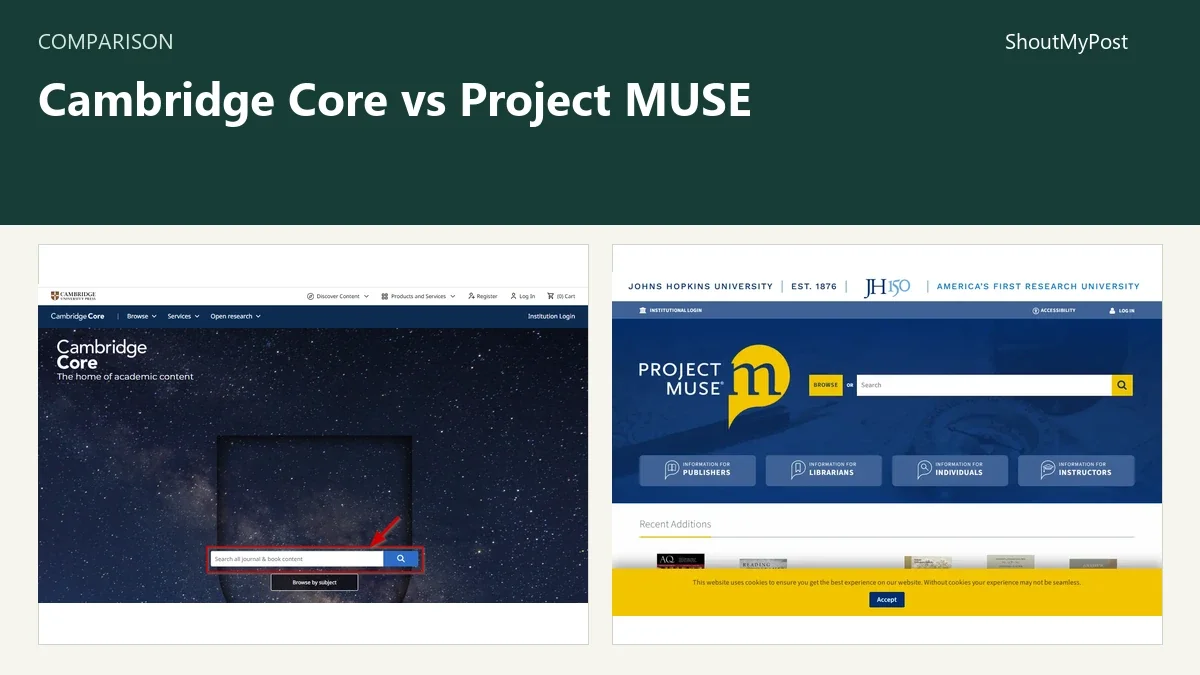
Cambridge Core vs Project MUSE: compare subjects, library access, open books and reading formats, then find the right route to your next scholarly text.
On this page
Project MUSE is my first stop for humanities and social-science reading across university presses. Choose Cambridge Core when the book, journal or Cambridge Elements title you need is published there. Cambridge Core vs Project MUSE is a choice about coverage and access: neither account gives you every text for free.
One detail can prevent a wasted search: Project MUSE's default results favor material available through your institution or open access. You can expand the search to all content. A short result list can reflect that access setting as well as the topic.
On October 9, 2026, Cambridge Core displayed a temporary-disruption notice saying some systems and services were suspended. Its login page carries the current notice. It gives no recovery date.
Find the directory pages for Cambridge Core and Project MUSE.
Cambridge Core vs Project MUSE at a glance
Official facts checked October 9, 2026. Prices depend on the content and access route; there is no single reader subscription amount to compare.
| Factor | Cambridge Core | Project MUSE | Source and date |
|---|---|---|---|
| Main reading range | Cambridge books, journals and Elements across subjects | Humanities and social sciences from scholarly publishers | Cambridge Core subject menu; MUSE About, Oct. 9, 2026 |
| Free reading | Open-access titles and articles | Open-access books, journals and digital humanities works | Official open-access pages, Oct. 9, 2026 |
| Paid price | Varies by title and subscription | Selected individual articles/issues have publisher-set prices; library books use acquisition models | Cambridge access page; MUSE Purchasing Content and Books Program, Oct. 9, 2026 |
| Access limit | Your subscription, membership or institution's holdings | Your institution's holdings, purchases and open content | Official access guidance, Oct. 9, 2026 |
| Platform | Web browser; responsive reading | Web browser, including mobile | Cambridge reader benefits; MUSE FAQ, Oct. 9, 2026 |
| Personal tools | Saved searches, bookmarks, citation export and alerts | Personal library, citations, saved searches and alerts | Cambridge My Core guidance; MyMUSE account page, Oct. 9, 2026 |
| Library connections | Institutional access and catalogue metadata | Institutional access, discovery partners and catalogue metadata | Cambridge librarian resources; MUSE Discovery Partners, Oct. 9, 2026 |
| Open source | No open-source reader product advertised | No open-source reader product advertised | Official product descriptions, Oct. 9, 2026 |
| Release model | Hosted service; current disruption notice | Hosted service; no desktop release number | Official sites, Oct. 9, 2026 |
| Privacy/data location | Cambridge privacy policy covers international transfers | MUSE privacy policy covers personal data; no single storage country promised here | Official privacy policies, Oct. 9, 2026 |
Coverage: the title matters more than the platform name
A known reading-list item makes the choice straightforward. Search its exact title, author and year. A platform that contains the right edition is more valuable for that job than one with a larger-sounding catalogue. Neither service should be treated as a search of all scholarship.
Cambridge Core brings Cambridge's scholarly publishing together. Its subject menu spans fields from chemistry and engineering to history and literature. Books, journal articles and Elements can play different roles in a reading plan: a chapter may introduce a topic while a journal article addresses one narrow question.
Project MUSE's strength is humanities and social sciences across university presses and scholarly societies. For a literature or history topic, my preference is to start there, then follow references into other collections. Its publisher range gives you a reason to search beyond one press's list.
Consider two concrete jobs. If a lecturer assigns a named Cambridge chapter, start on Core and match the edition. If your question is how historians interpret a period, begin with subject terms on MUSE and compare the arguments in several titles. These are search strategies, not claims about which results rank first.
For interdisciplinary research, use both. A topic about environmental policy can need scientific context and political analysis. Keep those strands in separate search notes so the final bibliography doesn't become a pile of documents selected only because one query found them together.
Winner for a humanities reading shortlist: Project MUSE. A known Cambridge title decides the choice in Core's favor.
Access and cost: start from your library's link
The price decision begins with what you can already open. Follow your library's database link or the access route supplied by your scholarly society. Logging into a personal account and being recognized as an institutional reader are separate steps.
Cambridge's access guidance describes institutional and society routes. A society's member link can redirect to its journal; other membership access uses an activation process. Use the route your organization supplies instead of trying an unrelated account login repeatedly.
MUSE's individual purchase guidance says selected journals sell online articles and issues, with fees set by the publisher. It also warns readers to check institutional access before paying. Look at the page range: an item labeled as a review might be a short book review rather than the full research article you intended to obtain.
A librarian choosing a MUSE ebook collection faces another decision. Its Books Program describes custom collections, current-year collections and individual title routes. Those are acquisition choices for a library; they aren't a flat monthly plan a student can buy to open the entire service.
For an independent reader, I would make a short list of exact titles before buying anything. Put an open-access version, existing library entitlement or legitimate library request beside each title where available. Then a purchase decision is about the missing item, not a vague promise of access to a whole subject.
Winner for cost: the service your library already covers. Compare item-level offers only after that.
Reading formats: download choices affect the next step
Cambridge's reader benefits describe Core Reader, its HTML reading view with figures, tables and supplementary material. That can fit a reading session where you want to follow the text and inspect its supporting material in the same browser.
MUSE lists HTML, PDF and EPUB formats. Its FAQ says EPUB files need a compatible reader after download; MUSE doesn't provide an in-browser EPUB reader. If the available file is EPUB, the next task is choosing that reader, not waiting for a missing browser preview to appear.
The format you want depends on the work. PDF is a sensible choice when page references are part of a seminar discussion. A reflowable ebook can be more comfortable for a long reading session on a small screen. The available formats still depend on the particular content.
My approach to annotations would be to keep the original download separate from a marked-up copy. Name the file after the work, and keep its publication details beside the notes. That lets you return to the unmarked text when checking a quotation or sharing a citation.
A reading platform also isn't your research notebook. Write a sentence about why a source belongs in the project before moving to the next result. For example: “This chapter explains the method; this article challenges the assumption.” That makes the saved list easier to use when drafting.
Winner for a browser reading session: Cambridge's Core Reader is the clearer documented route. MUSE offers more file-format choices in its guidance.
Saved research: organize a question, then save its evidence
Cambridge's reader and access guide describes My Core bookmarks, saved searches, citation exports and content alerts. MUSE's official MyMUSE account page describes a personal library, searches within saved items, citation generation and alerts.
The most interesting MyMUSE detail is that an email address isn't mandatory for creating a personal account. The account page says support may be limited without a valid address and an inactive account can be deactivated after a year. That's a different setup from assuming every scholarly reading account is a permanent email-based library.
For a small assignment, a title list and notes may be enough. For a longer project, separate the material by the question it answers. A search alert can help you revisit a developing subject, but it shouldn't turn every new matching title into another item you feel obliged to read.
Keep a citation record outside either service for the sources you actually use. That is especially helpful when your institution's subscription changes or your own project moves between subjects. The record can retain the author, year, title, edition and stable content link without making one platform the only map to your research.
Winner for a saved reading library: MyMUSE has the more detailed documented personal-library tools.
What readers say
In a September 2026 Penn State discussion, a reader looking for an article is directed through the university library to MUSE. The practical recommendation is to begin with the library's route when a normal web visit asks for payment.
An August 2026 Cambridge prereadings discussion includes difficulty opening assigned material and replies about library discovery and institutional access. The friction is reaching the reading through the right access path. Neither conversation supplies a reason to assume a personal login buys the text.
Choose Cambridge Core if…
- Your reading list names a Cambridge book, journal or Elements title.
- You want to follow that publisher's content across several subjects.
- Core Reader and Cambridge alerts fit the way you plan to read.
Choose Project MUSE if…
- Your project is centered on humanities or social sciences.
- You want university-press reading across publishers.
- A saved personal library matters to an ongoing research project.
Other options
Directory of Open Access Books is the better starting point for freely available scholarly books. EconBiz helps discover economics and business literature. EconStor focuses on open economics publications, while NASA Technical Reports Server serves a technical research collection.
FAQ
Should I search both services for a literature review?
Yes, if both cover part of your question. Start with the database closest to the subject, then use the second to fill a named gap, such as a publisher or discipline. Record your terms and shortlisted titles separately so that overlapping results don't become duplicate entries in the final reading list.
What should I send a librarian when a text won't open?
Send the title, author, year and content link, plus the access message you see. Include the library route you followed. That gives the librarian a specific item and failure to investigate; a message saying only that “the database doesn't work” leaves out the details needed to check holdings and access.
Can one platform replace my citation manager?
I would use its saved items as a reading aid and keep the working bibliography separately. A bibliography needs the exact edition or article you used, plus your own notes about its role in the project. Organizing those details outside a platform also makes research across several databases easier to follow.
Sources
Cambridge Core access guidance, subject menu, open-access pages, search help and Cambridge privacy policy; Project MUSE About, FAQ, MyMUSE account benefits, Purchasing Content, Books Program and privacy policy. Official pages checked October 9, 2026. The two linked university discussions supplied reader feedback.
Related articles
Current evidence
Verified facts
Each value shows its source and when it was checked.
No shared facts have current source and check-date evidence yet. Facts without that evidence are left out.