
AllGPTs is a GPT directory that hosts a list of over 30,000 GPTs sorted by popularity to help users find relevant tools quickly. Up to 100 new GPTs are added to the directory daily, and the platform was acquired by Chipp.ai to support creators in building, measuring and selling GPT-based products.
Directory
AI & Machine Learning
AI and Machine Learning covers the tools, models, and services built around machine learning. Models and machine learning holds model hubs, playgrounds, and training resources. AI image generation collects text-to-image tools, editors, and prompt libraries, while audio and speech covers transcription, voice, and music generation. AI coding and development lists assistants, code review tools, and developer utilities, and AI agents and automation brings together workflow builders and task tools. AI data and analytics holds platforms for labelling, monitoring, and evaluating models. Many listings are open source projects rather than hosted services, so check what you get and what it costs before you depend on one. We do not independently test each tool, and a Shout shows member support rather than a quality score. Imported listings do not start with an assigned owner or price.
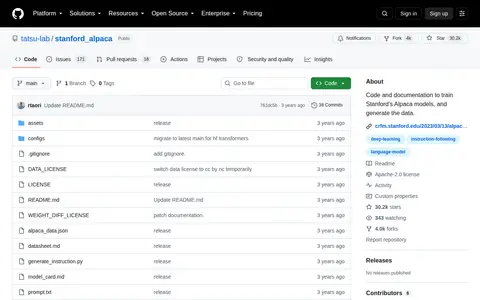
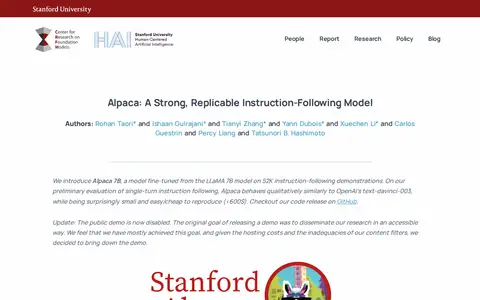
Alpaca 7B is a model fine-tuned from the LLaMA 7B model on 52K instruction-following demonstrations. In a preliminary evaluation of single-turn instruction following, it behaved qualitatively similarly to OpenAI's text-davinci-003 while being small and cheap to reproduce.
Alpaca creates or edits images with generative AI and text-based controls.
Alpaca is a project that provides code and documentation to train Stanford's Alpaca instruction-following LLaMA models and generate associated training data. It includes details on the data release, data generation process, and fine-tuning procedures.
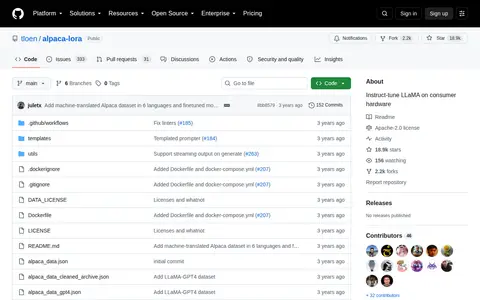
alpaca-lora is a repository with code for reproducing the Stanford Alpaca results using low-rank adaptation (LoRA). It provides an Instruct model and training code that can be easily extended to the 13b, 30b and 65b models, along with a script for downloading and inference.
Open-source project that provides conversational AI for questions, tasks, and general assistance.
Open-source project that applies AI to data analysis, extraction, visualization, or business intelligence.
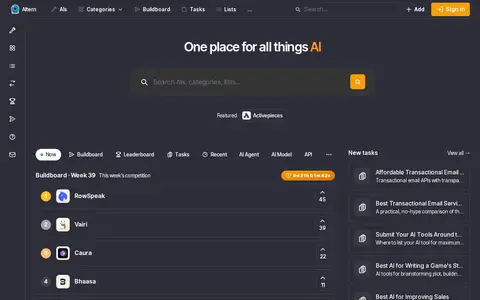
Altern is a directory for finding AI tools, curated lists and categories, with a searchable index of AIs, a weekly leaderboard, tasks and alternatives. Its help center covers user accounts, saving tools, and suggesting alternatives.
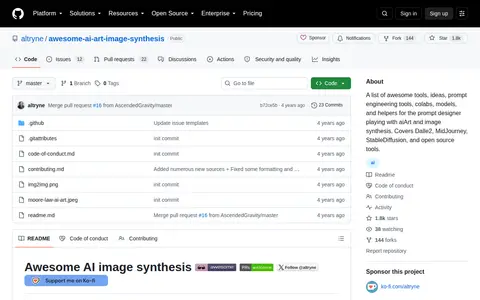
A GitHub repository compiling tools, ideas, prompt engineering resources, Colabs, models and helpers for prompt designers working with AI art and image synthesis. The list covers Dalle2, MidJourney, StableDiffusion and open source tools, and includes sections on commercial and free hosted tools, prompt engineering, post-processing and communities.
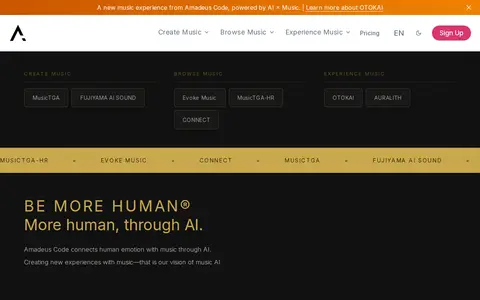
Amadeus Code provides music AI infrastructure spanning rights-cleared training data, audio supply and royalty management. Its products include MusicTGA for MIDI songwriting ideas, FUJIYAMA AI SOUND for music and sound materials, and Evoke Music, a royalty-free library. CONNECT is a royalty management platform for copyrights and master rights in Japan.
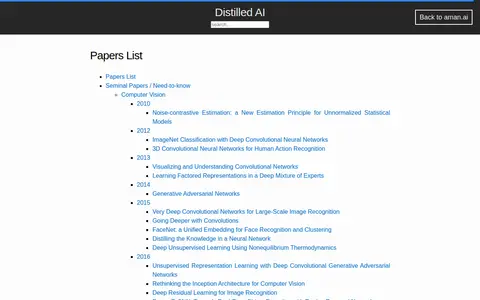
Aman's AI Journal papers list compiles seminal and need-to-know computer vision papers, organized by publication year from 2010 onward. Entries include titles such as ImageNet Classification with Deep Convolutional Neural Networks, Generative Adversarial Networks, and Deep Residual Learning for Image Recognition. The site also offers course notes and learning material for Artificial Intelligence and Deep Learning Stanford classes.
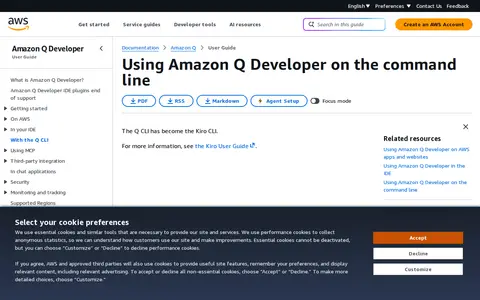
Amazon Q Developer for the command line adds AI-powered features to the terminal, including command autocompletion, natural language chat and code generation for popular CLIs. The source states that the Q CLI has become the Kiro CLI.
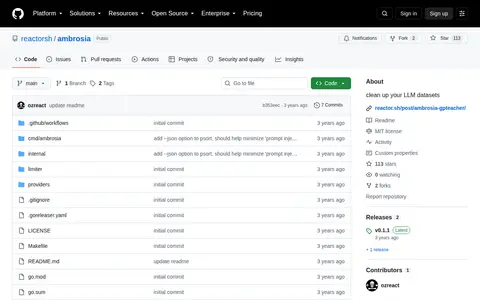
Ambrosia is a cross-platform command line tool written in Go for improving text datasets used in machine learning. It offers fast deduplication, filtering, length checking and whitespace trimming, plus an LLM-based filtering option called psort. It ships as a single binary with no dependencies and is pre-1.0 software.
amCharts is a TypeScript library for JavaScript charts, offering 60+ chart types plus maps, stock charts, and Gantt charts. The site states the library is free to use and React-ready. Documentation lists React, Angular, Vue.js, Next.js, and other integrations.
A Java Toolbox for Scalable Probabilistic Machine Learning.
Amundsen applies AI to data analysis, extraction, visualization, or business intelligence.
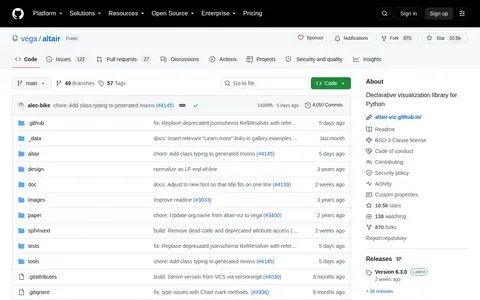
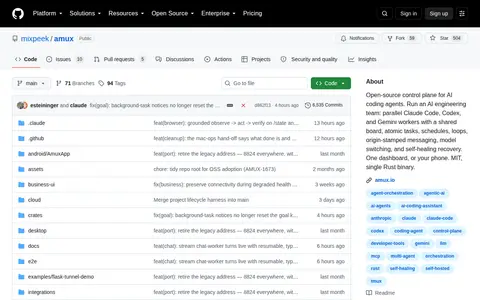
amux is an open-source control plane for AI coding agents, hosted on GitHub by mixpeek. It enables management of parallel AI coding workers including Claude Code, Codex, and Gemini, with features such as a shared task board, atomic task assignment, scheduling, origin-stamped messaging, model switching, self-healing recovery, and access via a dashboard or mobile interface. It is MIT licensed and distributed as a single Rust binary.
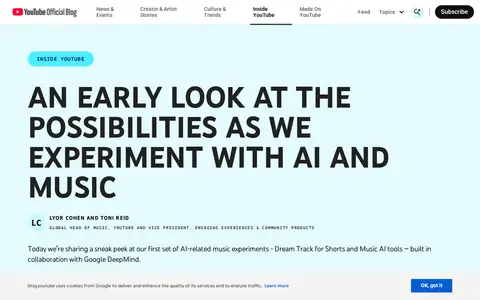
A YouTube Blog post announcing an early look at the company's first AI-related music experiments: Dream Track for Shorts and Music AI tools, built in collaboration with Google DeepMind. Dream Track is powered by the Lyria music generation model and initially lets a small group of select US creators create soundtracks of up to 30 seconds for Shorts.
Anaconda is a platform for Python, data science, and AI development. Its core is conda, an open-source package and environment manager that installs software, resolves dependencies, and isolates projects. Two installers are offered: Anaconda Distribution, which bundles conda, Python, Anaconda Navigator, and hundreds of packages, and Miniconda, a minimal base environment. Anaconda Notebooks is a cloud-based JupyterLab environment.

Analyzes structured data and helps produce queries, insights or visualizations.

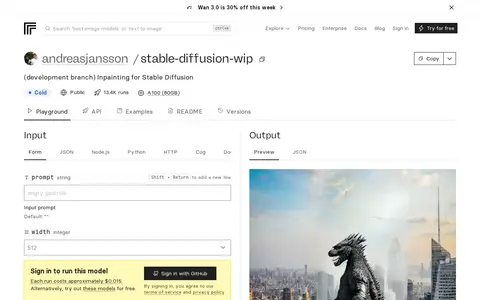
A work-in-progress inpainting branch of Stable Diffusion, published as a public Replicate model. The model runs on Nvidia A100 (80GB) GPU hardware and predictions typically complete within 11 seconds. It costs approximately $0.015 to run on Replicate, or 66 runs per $1. It is open source and can be run on a computer with Docker.
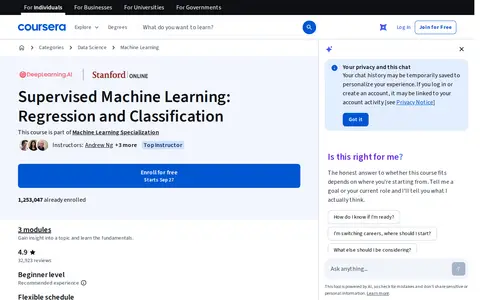
Andrew Ng’s Machine Learning at Stanford University is a Coursera course titled 'Supervised Machine Learning: Regression and Classification'. It is the first course of the Machine Learning Specialization. The course teaches how to build machine learning models in Python using NumPy and scikit-learn, covering regression and classification. It is aimed at beginners, requires flexible scheduling over three weeks at ten hours per week, and offers a shareable certificate.
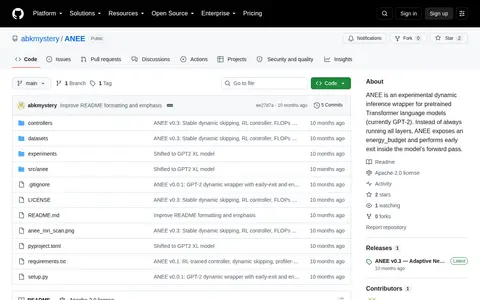
ANEE is an experimental dynamic inference wrapper for pretrained Transformer language models, currently GPT-2. It exposes an energy_budget and performs early exit inside the model's forward pass rather than always running all layers. It adds per-token adaptive computation using a profiler and learned controller to skip redundant layers while keeping the KV-cache aligned.
German book about applied data science.