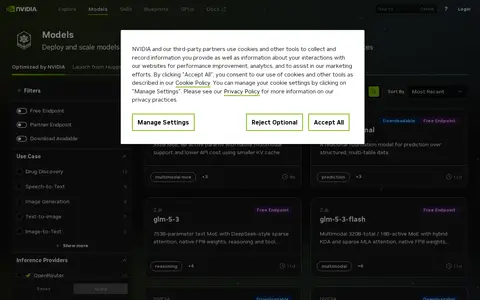
NVIDIA NIM is a catalog of models offered as inference microservices for deployment on the user's GPU infrastructure. The listings include downloadable models and free or partner endpoints, organized by use cases such as image generation, speech-to-text and drug discovery.

Directory
Models & Machine Learning
Models and machine learning covers model hubs, research papers, training guides and evaluation tools. The topic mixes practical resources with reference material, so you will find repositories that host downloadable models next to sites that explain how a technique works. Some entries are collections of papers or benchmarks, and others are tutorials that walk through fine-tuning or deployment. It pays to compare the model licence, the training data, the hardware needed and the date of the last update. The field moves quickly, so verify version notes on the source before you build on anything listed here.
Woozlit provides conversational AI for questions, tasks, and general assistance.
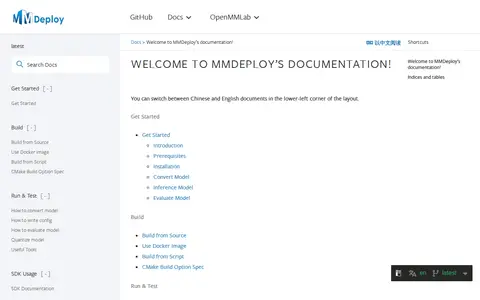
MMDeploy is documented at version 1.3.1 and covers getting started, converting, running, evaluating and quantizing models, building from source or Docker image, and SDK usage. Its backend support pages describe ncnn, ONNX Runtime, OpenVINO, PPLNN, SNPE, TensorRT, TorchScript, RKNN, TVM and Core ML, and its codebase support covers several OpenMMLab projects.
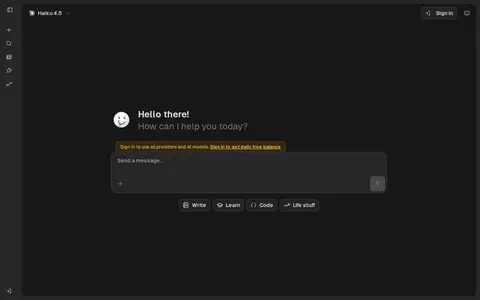
AI Assistant is a chat interface that offers conversation with more than 30 AI models at no cost. The listed models include Ministral, Mixtral, Mistral, Pixtral, Codestral, Llama, DeepSeek, GLM, Qwen, GPT OSS, Phi, Kimi and Minimax variants. The page also refers to generating images.
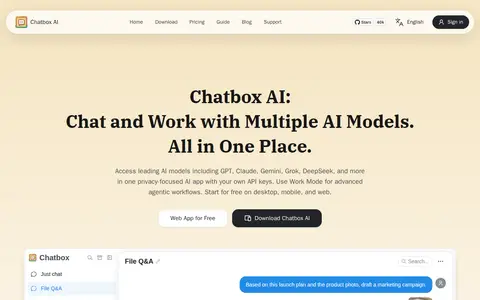
Chatbox provides conversational AI for questions, tasks, and general assistance.
AI chat platform for asking questions, coding, reasoning, and working with DeepSeek models.
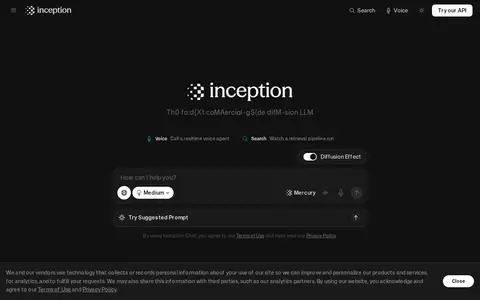
Inception provides conversational AI for questions, tasks, and general assistance.
ISH provides conversational AI for questions, tasks, and general assistance.
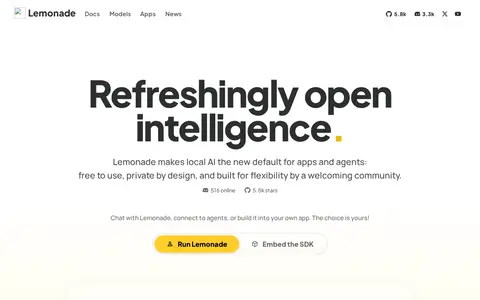
Lemonade Server is a lightweight, open-source local LLM server for running and managing multiple AI applications on a local machine. It provides a simple CLI for managing applications and supports various LLMs, and offers endpoints compatible with OpenAI, Ollama, Anthropic and others, plus a local-first API and MCP gateway.
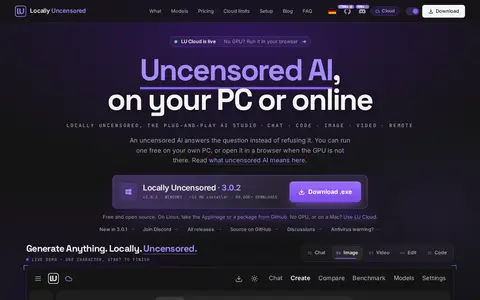
Locally Uncensored provides machine-learning models, research, training resources, or evaluation tools.
MiMo Studio helps build, test, automate, or manage AI agents, prompts, models, and API workflows.
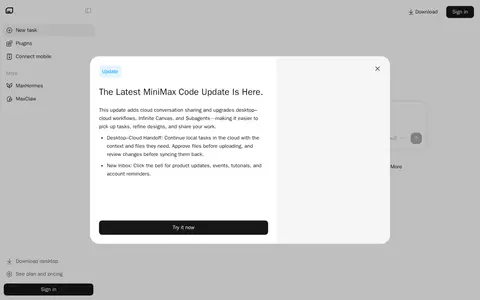
MiniMax AI helps build, test, automate, or manage AI agents, prompts, models, and API workflows.
Mistral provides conversational AI for questions, tasks, and general assistance.
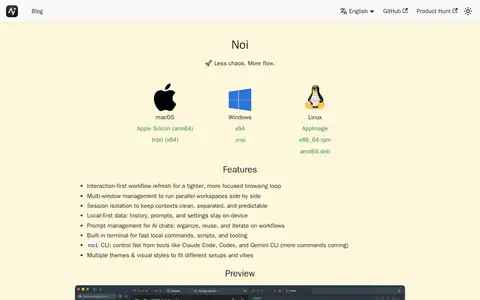
Noi is a desktop application that provides an interaction-focused browsing workflow. It offers multi-window management for parallel workspaces, session isolation, and local-first data storage for history, prompts, and settings. It also includes prompt management for AI chats, a built-in terminal, and a CLI for controlling Noi from tools such as Claude Code and Codex. Builds are listed for macOS, Windows, and Linux.
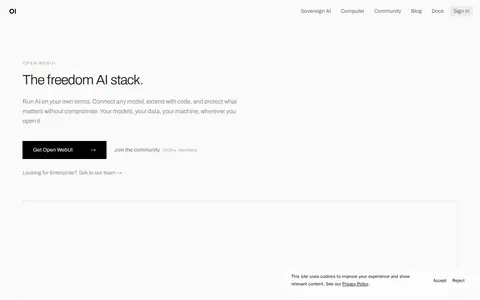
Open WebUI is a self-hosted AI interface for running AI on the user's own hardware. It connects to local or cloud models including Ollama, OpenAI, Anthropic, or compatible services, and can be extended with Python. The project offers community-shared prompts, models, tools, and functions, and lists deployment options including on-premises or air-gapped setups. Installation can be done with a pip command.
Poolside AI provides machine-learning models, research, training resources, or evaluation tools.
Qwen Studio is the official platform from Qwen that provides unified access to the company's series of open-source and proprietary AI models. It offers functionality including chatbots, image and video understanding, image generation and editing, document processing, tool utilization, voice and video chat, and artifacts, and has a dedicated mobile application.
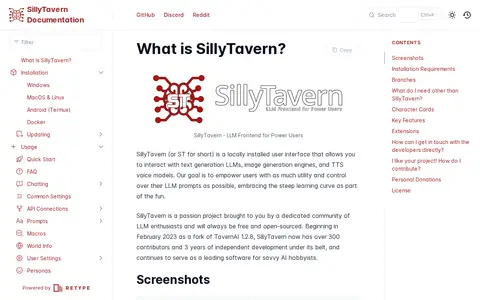
SillyTavern is a locally installed user interface for interacting with text generation LLMs, image generation engines and TTS voice models. It began in February 2023 as a fork of TavernAI 1.2.8 and is built around character cards, collections of prompts that set the behavior of the LLM. It is free and open-sourced.
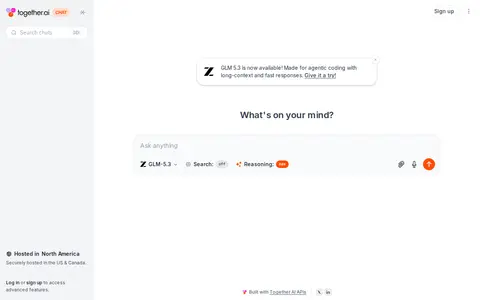
Together.ai provides conversational AI for questions, tasks, and general assistance.
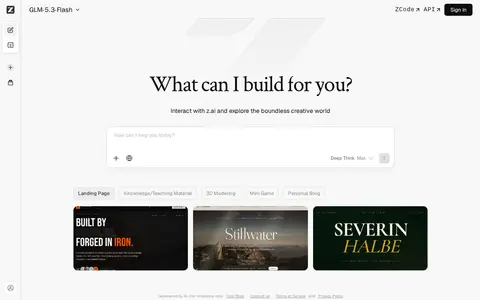
Z.ai is an advanced AI chatbot and agent powered by the GLM-5.3-Flash model. It is capable of tasks including building websites, writing code, handling long-horizon tasks, and providing instant answers to user queries.
ArceeAI provides conversational AI for questions, tasks, and general assistance.
Arena.ai is an X account describing itself as a place where AI meets the real world. It states that it measures and advances the frontier of AI through community-driven evaluation.
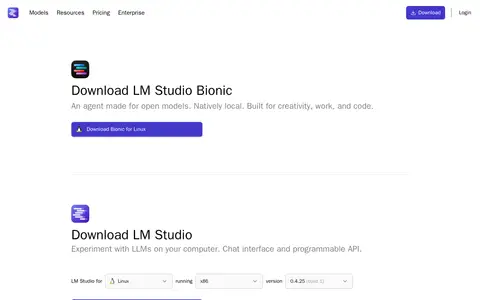
LM Studio helps build, test, automate, or manage AI agents, prompts, models, and API workflows.
LobeHub provides conversational AI for questions, tasks, and general assistance.