
github.com
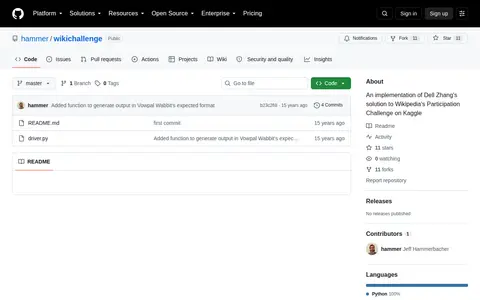
An implementation of Dell Zhang's solution to Wikipedia's Participation Challenge on Kaggle.
Directory
Models and machine learning covers model hubs, research papers, training guides and evaluation tools. The topic mixes practical resources with reference material, so you will find repositories that host downloadable models next to sites that explain how a technique works. Some entries are collections of papers or benchmarks, and others are tutorials that walk through fine-tuning or deployment. It pays to compare the model licence, the training data, the hardware needed and the date of the last update. The field moves quickly, so verify version notes on the source before you build on anything listed here.
An implementation of Dell Zhang's solution to Wikipedia's Participation Challenge on Kaggle.

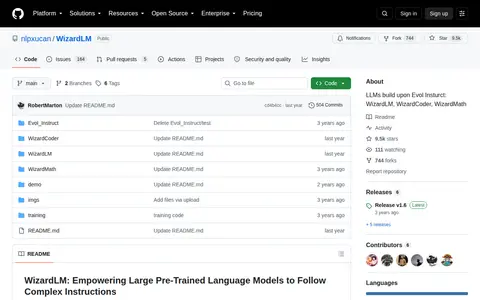
WizardLM is a repository of large language models including WizardLM, WizardCoder and WizardMath, described as LLMs built upon Evol Instruct. The page lists model checkpoints and benchmark results, with WizardCoder-33B-V1.1 reported at 79.9 pass@1 on HumanEval and WizardMath-7B-V1.1 reported at 83.2 pass@1 on GSM8k.

Woopicx is a platform offering AI-generated stock photos, 3D icons, and mockups. It provides a library of over 60,000 assets that can be browsed and downloaded for free, with AI tools to edit images, animate visuals to video, or generate new content. Downloaded assets include a commercial license.

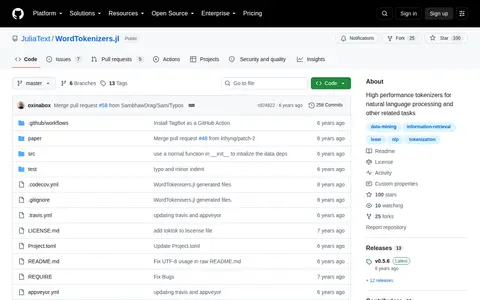
Tokenizers for Natural Language Processing in Julia.

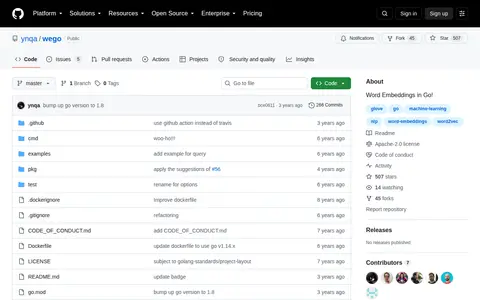
Word Embeddings: the full implementation of word2vec, GloVe in Go.

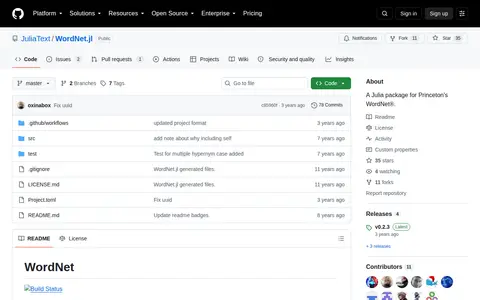
WordNet.jl is a Julia package for using Princeton's WordNet, described as heavily inspired by Doches' rwordnet. It provides functions for loading a database, retrieving synsets, antonyms, expanded hypernyms and sense keys, with example use shown for the words glad, dog and cat.

Open-source project that provides machine-learning models, research, training resources, or evaluation tools.

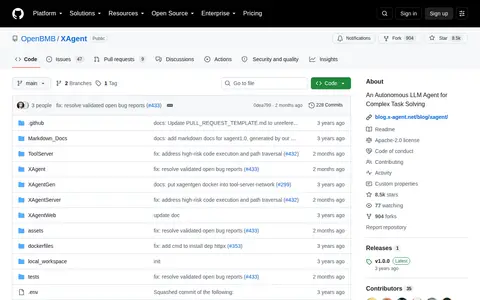
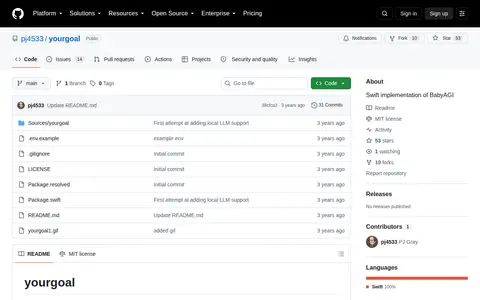
An Autonomous LLM Agent for Complex Task Solving.

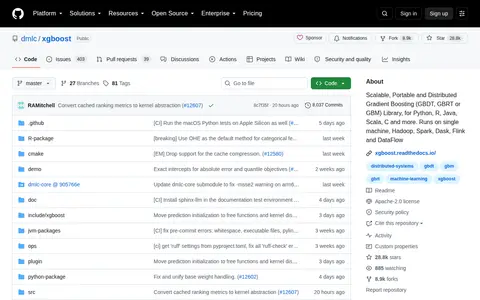
XGBoost is a scalable, portable and distributed gradient boosting library. It supports multiple programming languages including Python, R, Java, Scala and C, and can run on single machines or distributed frameworks such as Hadoop, Spark, Dask, Flink and DataFlow.

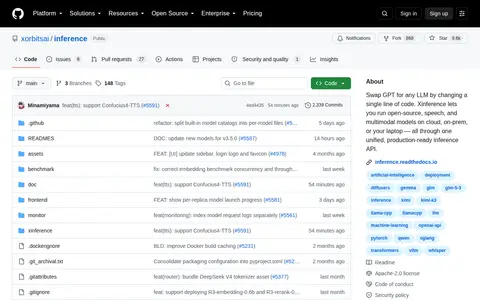
Xinference is a model serving tool that provides a unified production-ready inference API. It allows users to run open-source, speech and multimodal models on cloud infrastructure, on-premises systems or personal laptops by modifying a single line of code.

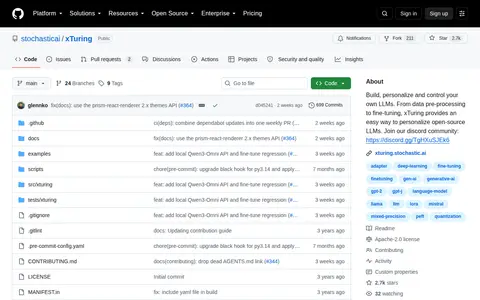
xTuring is an open-source project for building, personalizing, and controlling LLMs, covering data pre-processing through fine-tuning. It includes a simple API for data prep, training, and inference, LoRA and low-precision (INT8/INT4) support, and built-in evaluation metrics such as perplexity. Models can run locally or in a private VPC and scale from CPU to multi-GPU.

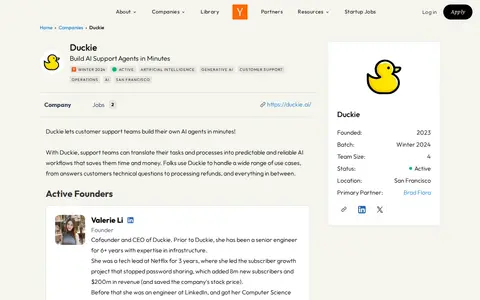
Duckie is a Y Combinator-backed company that lets customer support teams build their own AI agents quickly. According to the listing, teams translate tasks and processes into AI workflows, with use cases including answering technical questions and processing refunds. The company was founded in 2023 by Valerie Li and Joel Ritossa and is based in San Francisco.

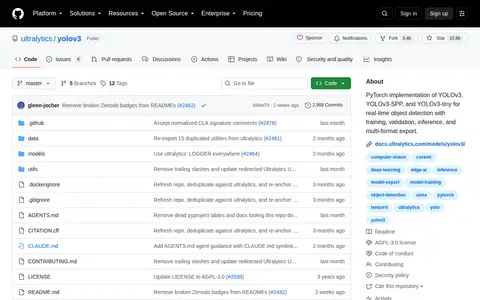
PyTorch implementation of YOLOv3, YOLOv3-SPP, and YOLOv3-tiny for real-time object detection. The repository includes training, validation, inference, and multi-format export tooling, and reuses shared utilities from the ultralytics package. Detection is framed as a single regression problem predicting bounding boxes and class probabilities from full images in one forward pass.

Open-source project that provides machine-learning models, research, training resources, or evaluation tools.

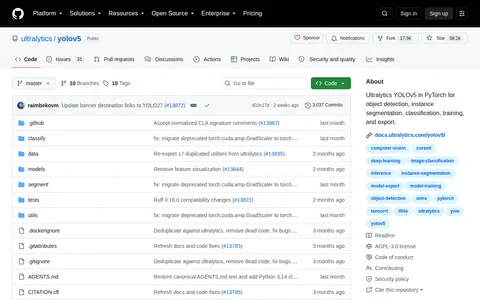
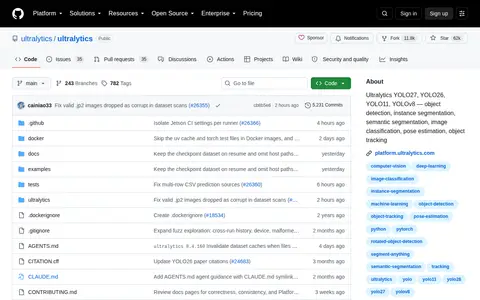
Repository of Ultralytics YOLO models, including YOLO27, YOLO26, YOLO11, and YOLOv8, covering object detection, instance segmentation, semantic segmentation, image classification, pose estimation, and object tracking. Models can be installed as the ultralytics package, used through a CLI yolo command or Python, and exported to formats such as ONNX.

Open-source project that provides machine-learning models, research, training resources, or evaluation tools.

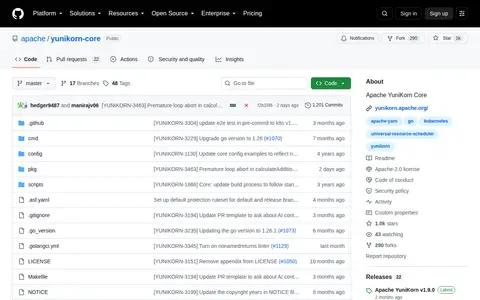
Light-weight, universal resource scheduler for container orchestrator systems.

Yuval Noah Harari argues that AI has hacked the operating system of human civilisation provides machine-learning models, research, training…

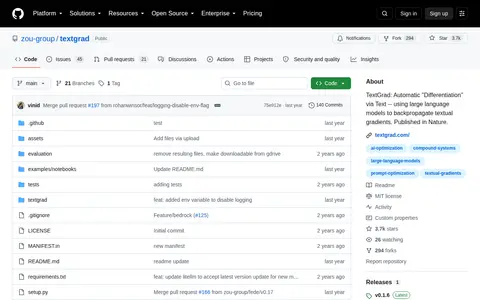
Automatic "Differentiation" via Text, using large language models to backpropagate textual gradients.

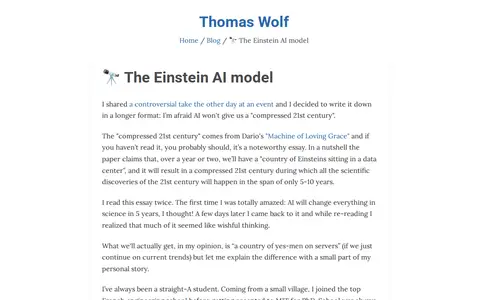
A blog post by Thomas Wolf arguing against the idea that AI will produce a compressed 21st century, suggesting current trends would instead yield a country of yes-men on servers. It draws on the author's personal experience as a researcher.

Google tool for building, testing, and experimenting with Gemini prompts, models, and API workflows.

Limits provides machine-learning models, research, training resources, or evaluation tools.

Open-source project that provides machine-learning models, research, training resources, or evaluation tools.

ML Resources supports machine learning models, deployment, inspection, datasets, or AI development workflows.