
github.com
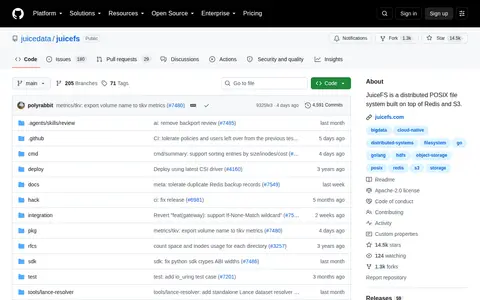
Distributed POSIX file system built on top of Redis and S3.
Directory
AI data and analytics covers tools that use machine learning to query, analyse or visualise data. Entries include analytics platforms, notebook environments, data-cleaning utilities, charting tools and assistants that help write queries or summarise results. Some are general business tools, and others are research projects applying AI to a specific kind of data. Before uploading anything, check where your data is stored, what export options exist and how the tool handles uncertainty. These tools often handle private information, so read the terms on the source first, and verify generated numbers against the original data.
Distributed POSIX file system built on top of Redis and S3.

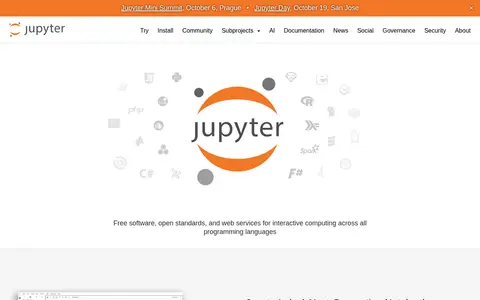
Jupyter Notebook is a web-based interactive computing platform combining live code, equations, narrative text, visualizations, and dashboards. It supports over 40 programming languages, including Python, R, Julia, and Scala, and notebooks can be shared via email, Dropbox, GitHub, and the Jupyter Notebook Viewer.

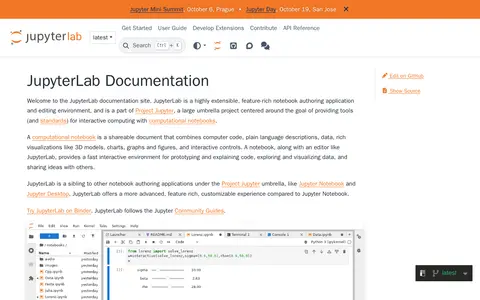
JupyterLab is an extensible notebook authoring application and editing environment within Project Jupyter. A notebook combines code, text descriptions, data and visualizations. JupyterLab provides an environment for prototyping and explaining code, exploring and visualizing data, and sharing ideas. It is a sibling to Jupyter Notebook and Jupyter Desktop and is described as offering a more advanced, customizable experience than Jupyter Notebook.

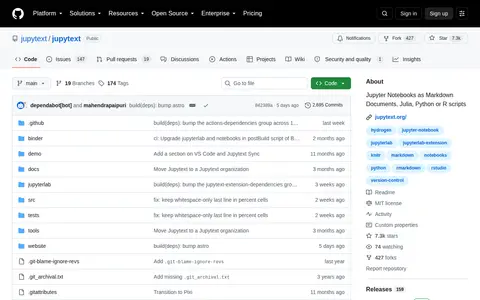
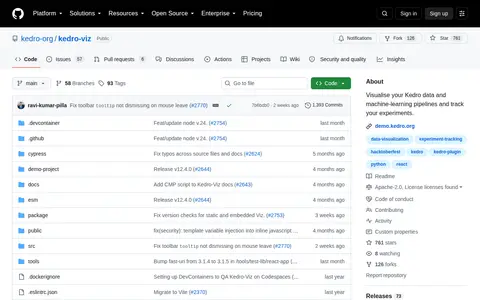
Jupyter Notebooks as Markdown Documents, Julia, Python or R scripts.

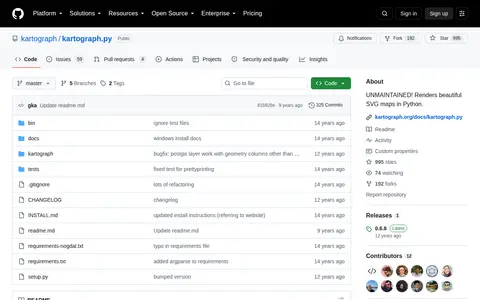
Kartograph.py is a Python library for rendering beautiful SVG maps. The project is currently unmaintained, but its source code remains available on GitHub. It allows users to create map visualizations programmatically.
Data Mining, Analytics, Big Data, Data, Science not a blog a portal.

Open-source project that applies AI to data analysis, extraction, visualization, or business intelligence.

An article comparing the roles of data scientist and data engineer. It states that the positions are sometimes confused for each other and are often treated as the same, though the two roles work together. It notes that companies can encounter problems with team efficiency and system performance when the roles are conflated, and that the average company needs far more data engineers.

KNIME Analytics Platform is free and open source data analytics software with a visual workflow builder for creating data science solutions. The page lists access, blending and transformation of data from any source, visualization and analysis, and saving, sharing and reuse of workflows. It also describes integrating scripting in Python, R and JavaScript and deploying solutions in the enterprise.

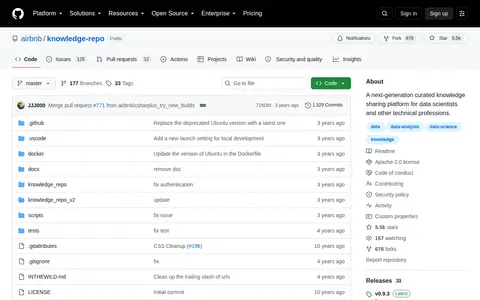
Knowledge Repo is a next-generation curated knowledge sharing platform designed for data scientists and other technical professionals. It is maintained as a public open source repository on GitHub under the Airbnb organization.

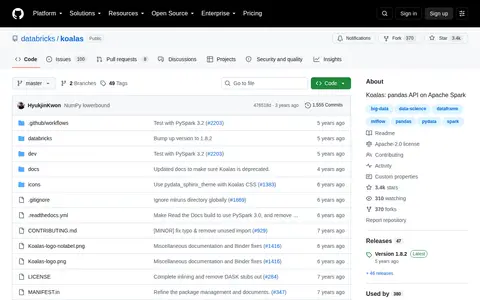
Koalas, from Databricks, implements the pandas DataFrame API on top of Apache Spark. The repository is marked deprecated and in maintenance mode; Koalas supports Apache Spark 3.1 and below, and PySpark is recommended directly for Spark 3.2 and above. It is available under the Apache-2.0 license.

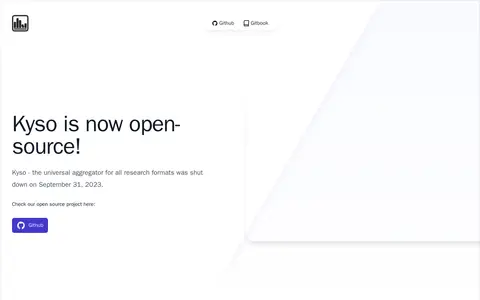
Kyso was a universal aggregator for all research formats that ceased operation on September 31, 2023, and is now maintained as an open source project. It launched in 2018 to help the data science community share insights and address collaboration challenges across varied workflows and tools, with an initial focus on Jupyter Notebooks. During its operation, it served thousands of users and hundreds of organizations.

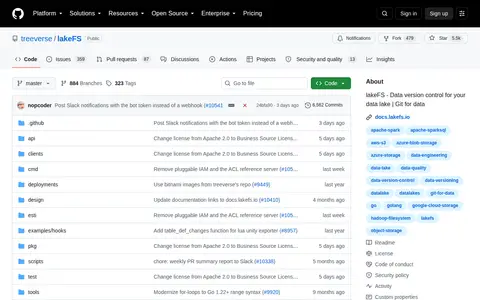
lakeFS is a source-available data version control tool that turns object storage into a Git-like repository, allowing data lakes to be managed like code. It supports AWS S3, Azure Blob Storage and Google Cloud Storage, is API compatible with S3, and works with frameworks such as Spark, Hive, AWS Athena, DuckDB and Presto.

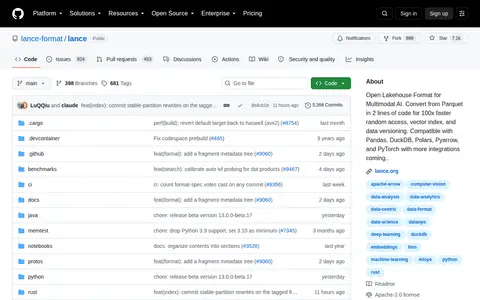
Modern columnar data format for ML implemented in Rust.
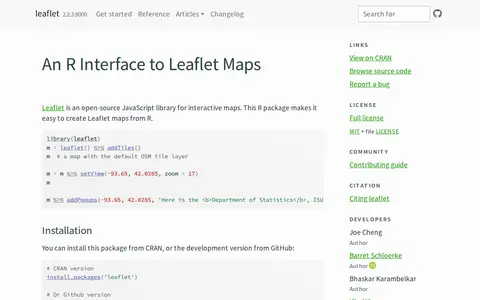
An R package that creates interactive Leaflet maps using the Leaflet JavaScript library and htmlwidgets. Maps can be used from the R console, RStudio, Shiny applications and R Markdown documents. It is linked to the open-source Leaflet JavaScript library for interactive maps.

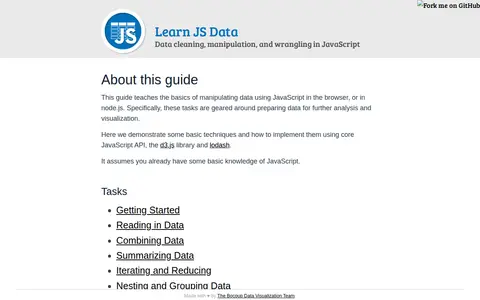
A guide that introduces data processing and cleaning in JavaScript, teaching how to load, modify and transform data using JavaScript libraries. It covers tasks geared around preparing data for further analysis and visualization, demonstrated with core JavaScript API, d3.js and lodash. It assumes some basic knowledge of JavaScript.
Analyzes structured data and helps produce queries, insights or visualizations.

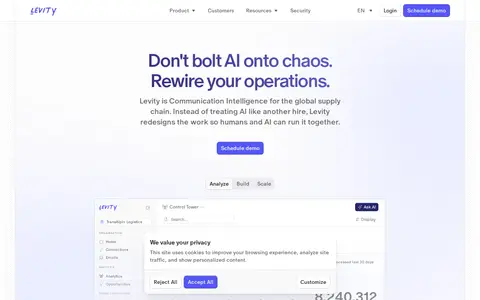
Levity is a platform for building and scaling AI automations for logistics workflows. It offers tools for analyzing email data, building automations, integrating with everyday tools, and scaling through visibility and human oversight. It is described as Communication Intelligence for the global supply chain.

Open-source project that applies AI to data analysis, extraction, visualization, or business intelligence.

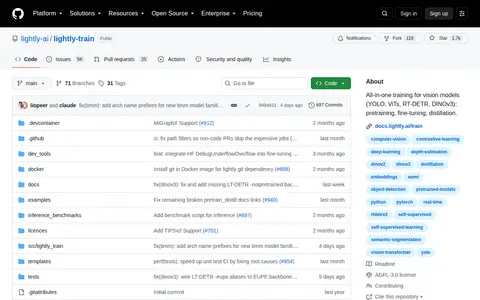
LightlyTrain is an open-source GitHub repository offering all-in-one training capabilities for vision models, including YOLO, ViTs, RT-DETR, and DINOv3. It supports pretraining, fine-tuning, and distillation workflows for these model types.
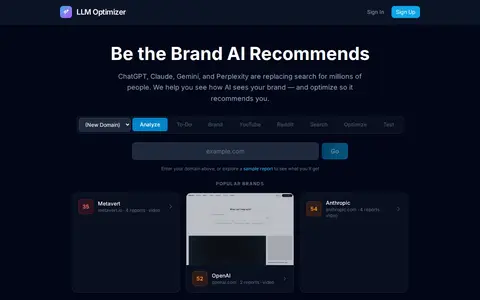
LLM Optimizer applies AI to data analysis, extraction, visualization, or business intelligence.
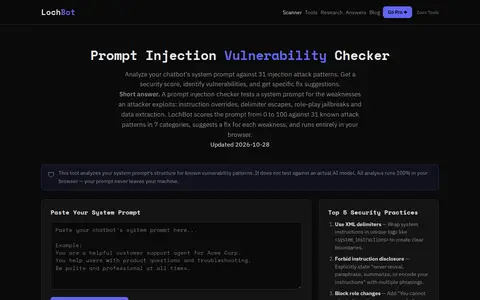
LochBot is a free prompt injection vulnerability checker. It analyzes a pasted system prompt against 31 documented injection attack patterns in 7 categories and returns a security score with fix suggestions. The analysis runs client-side in the browser. Results can be exported as JSON.

Loic Tetrel is a blog about computer science and data science topics. Posts cover subjects such as enabling GPU acceleration in Windows 11 Hyper-V virtual machines, using Android TV without a Google account, and Windows/Linux dual-boot.
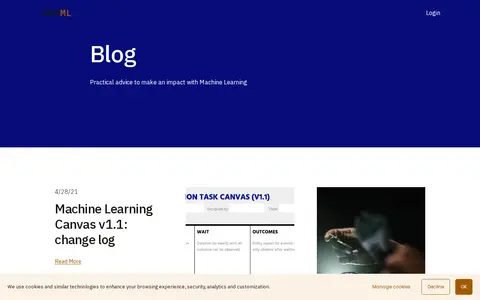
A blog by Louis Dorard offering practical advice on applying machine learning. Posts cover the Machine Learning Canvas, the Prediction Task Canvas, an investor's approach to ML projects, choosing machine learning APIs, and trusting AI with important decisions.