
huggingface.co
Supports software work with AI-assisted coding, testing or application development.
Directory
AI coding and development covers assistants, code review tools, and machine learning projects aimed at developers. The topic mixes code completion services, agent frameworks, prompt and context templates, dataset tools, and research notebooks. They sit at different points in the workflow, so compare where each one fits: writing code, reviewing a change, or setting up a model to run yourself. Check the language and editor support, how the tool handles your code and where it sends it, and the licence attached to any generated output. Some entries are production products and others are experiments that may not run without setup.
Supports software work with AI-assisted coding, testing or application development.

Interview Solver is a technical interview preparation platform and AI copilot for software engineering candidates. Its native desktop application for macOS and Windows provides real-time, screen-sharing-invisible assistance during live coding interviews, including LeetCode-style problem solutions, system design diagrams, voice transcription, and answers tailored to a user's resume or job description.

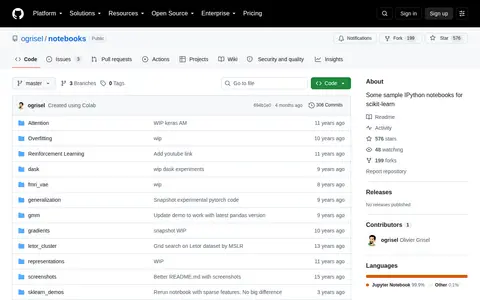
The ipython-notebooks repository, hosted on GitHub under the user ogrisel, contains sample IPython notebooks for use with the scikit-learn machine learning library. It is an open-source project that accepts contributions from GitHub users.

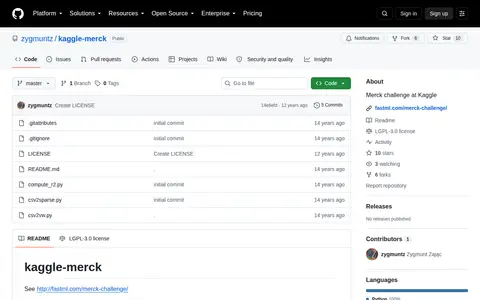
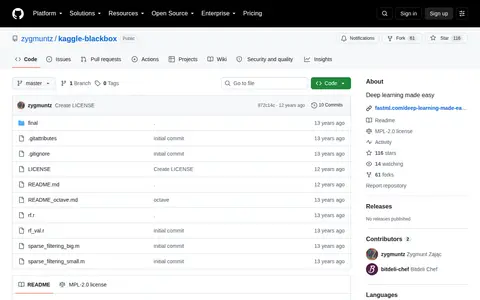
The Kaggle Merck repository, hosted on GitHub under the user zygmuntz, contains code for the Merck challenge hosted on the Kaggle data science platform. It is an open-source project that accepts contributions via GitHub.

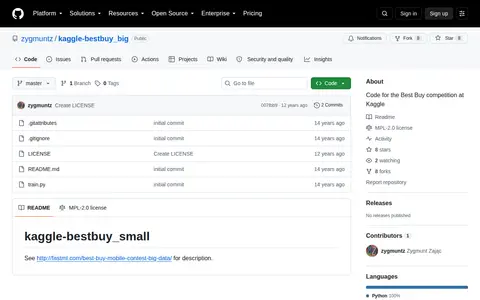
The kaggle-bestbuy big repository, hosted on GitHub under the user zygmuntz, contains code for the Best Buy competition hosted on the Kaggle data science platform. It is an open-source project that accepts contributions from GitHub users.

Supports software work with AI-assisted coding, testing or application development.

Supports software work with AI-assisted coding, testing or application development.
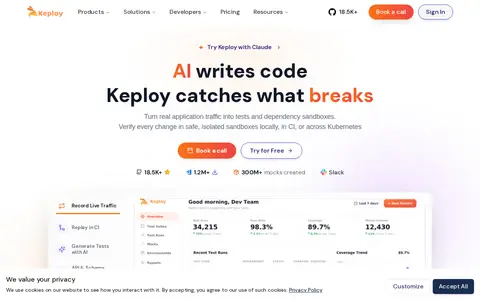
Keploy is an open-source AI-powered API and unit testing tool for developers. It builds a digital twin of production behavior using real API traffic, mocks, and dependencies to verify AI- or human-written code changes in continuous integration pipelines before deployment, and requires no code changes to implement.

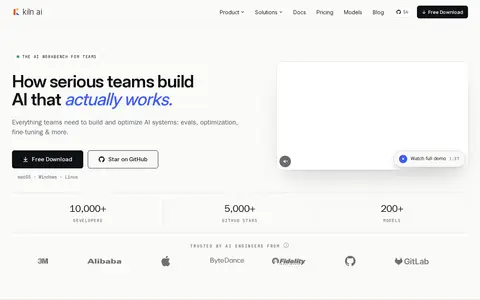
Kiln AI is a platform and open-source library for building, evaluating, and optimizing AI systems. It offers tools for working with retrieval-augmented generation, AI agents, synthetic data, model fine-tuning, and prompt optimization, with a free downloadable application available for macOS, Windows, and Linux.

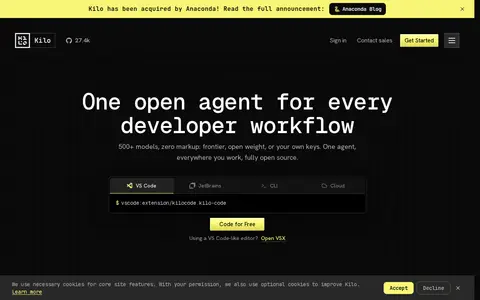
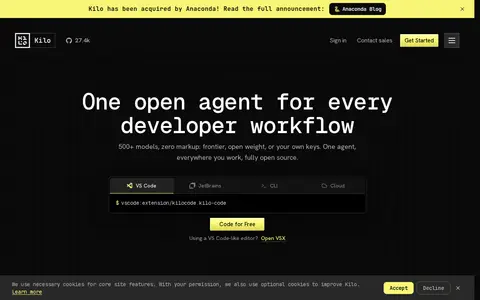
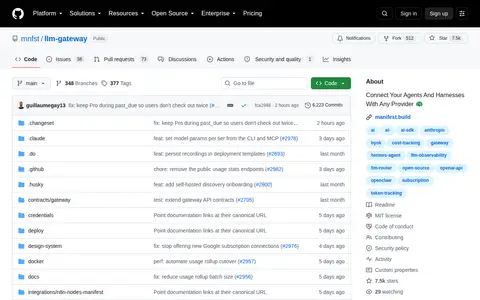
Kilo is an open source AI coding agent for VS Code, JetBrains, CLI, desktop and cloud. It offers access to 500+ models at zero markup, bring-your-own keys, or local models for privacy. Kilo Gateway provides a unified API to access AI models through a single endpoint.

Kilo Code supports software development with code generation, analysis, debugging, or documentation.

AI coding assistant offering line-of-code completions and documentation.

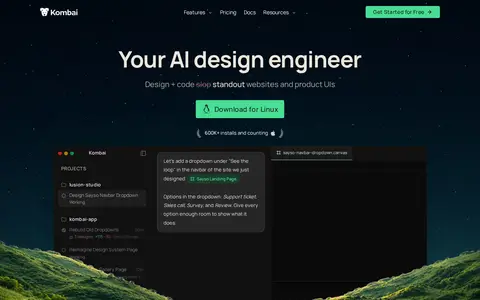
Kombai is an AI design engineer that designs websites and product UIs and ships production-ready frontend code. It offers a browser tool for editing rendered UI and sending browser context to prompts, reuse of components, tokens and hooks from repos, npm and Storybook, and a choice of 50+ models.

Open-source project that supports software development with code generation, analysis, debugging, or documentation.
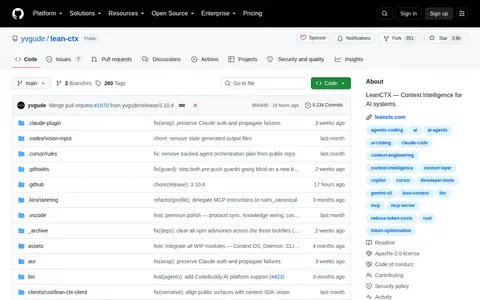
LeanCTX is an open-source context gateway that sits between AI tools and the information they read. It selects task-relevant context, applies supported access and content controls, and records observable context operations and evidence. The engine can run locally through CLI, MCP, hooks and proxy paths, and an SDK embeds supported engine capabilities in applications.

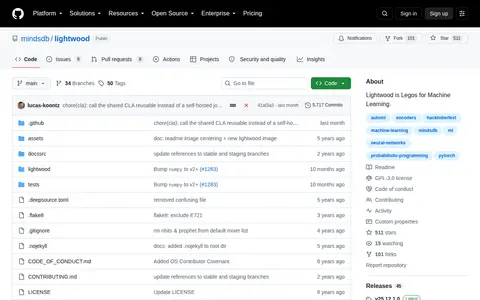
Lightwood is an AutoML framework that generates and customizes machine learning pipelines using a declarative JSON-AI syntax. It handles data types such as numbers, dates, categories, tags, text, arrays and multimedia formats, and includes a time-series mode. Users can override defaults or replace pipeline steps, and the framework generates Python code for the pipeline.

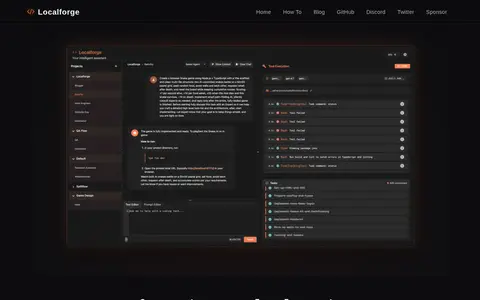
Localforge is a free, open-source desktop GUI for Codex AI, Claude and other LLMs. It runs locally and lets autonomous agent loops edit files, run tests and work on large multi-file codebase tasks. It supports swapping providers and storing prompt templates, and is distributed under the MIT license.

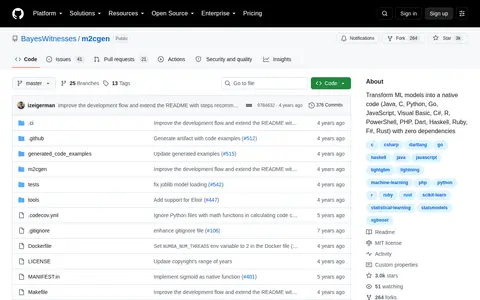
m2cgen is a tool that transforms trained machine learning models into native code across a wide range of programming languages including Java, C, Python, Go, JavaScript, C#, R, PHP, Dart, Haskell, Ruby, F#, and Rust, with zero dependencies. Its codebase is hosted in the BayesWitnesses GitHub repository, which includes navigation for installation, development guidance, supported languages, and supported model types.

Open-source project that supports software development with code generation, analysis, debugging, or documentation.

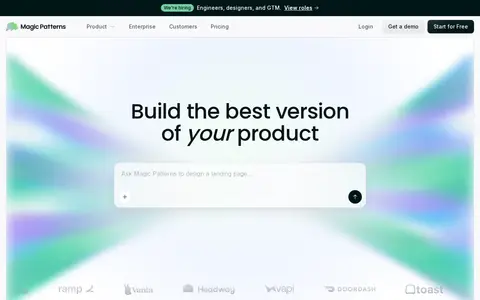
Magic Patterns is an AI design tool for product teams that turns prompts into production-ready UI. It can use existing components and design rules to generate prototypes, and offers an infinite canvas with collaboration. A changelog describes PDF uploads and export options.

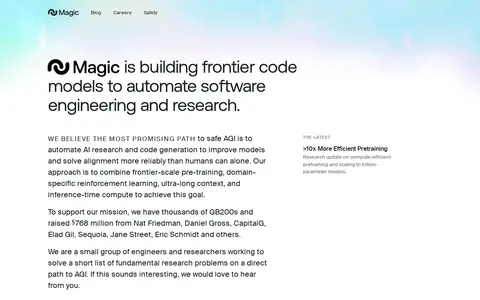
Magic.dev is an artificial intelligence company focused on developing safe artificial general intelligence (AGI) to accelerate progress on high-priority global problems. The company builds frontier code models intended to automate software engineering and AI research workflows. Its technical approach combines large-scale pre-training, domain-specific reinforcement learning, extended context windows, and increased inference-time compute. Magic.dev employs a small team of engineers and researchers working on fundamental AGI-related research problems.

An alternative to Supabase for AI Code editors and Vibe Coding tools.
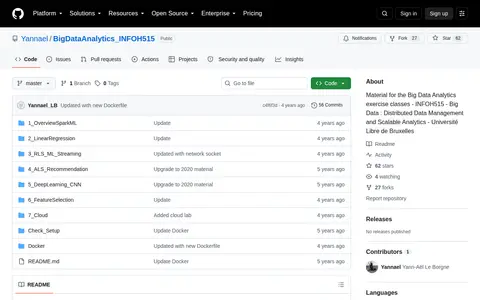
A repository of material for the exercise classes of a Big Data Analytics master course. Hands-on sessions cover Spark and its machine learning library, Map/Reduce implementations of linear regression and alternating least squares, streaming analytics with Recursive Least Squares, and image classification with convolutional neural networks. Material is provided as Jupyter notebooks.
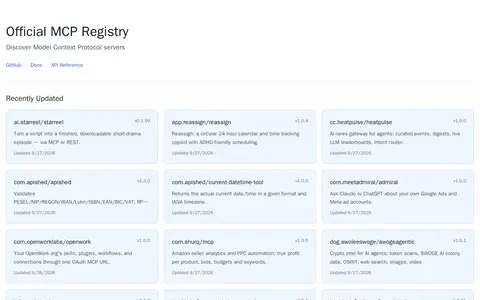
A registry for discovering Model Context Protocol servers, with links to GitHub and API reference documentation. The site lists recently updated servers and provides a base URL for API access.